

In the demanding world of industrial wastewater treatment, energy efficiency isn’t just a buzzword—it is the difference between a profitable operation and a financial drain. For facility managers and engineers dealing with high-salinity effluents, mvc evaporator heat exchangers represent the critical intersection of thermodynamics and operational reliability. Unlike traditional evaporation methods that rely heavily on external steam sources, Mechanical Vapor Compression (MVC) systems utilize the latent heat of the vapor itself, drastically reducing operating costs.
Whether you are tackling zero liquid discharge (ZLD) requirements or managing complex chemical streams, the performance of your MVC system hinges almost entirely on the design and integrity of its heat exchanger. If the heat transfer surface fouls, corrodes, or fails to maintain the necessary temperature delta, the entire treatment process grinds to a halt. This guide draws upon decades of field experience to explore how optimizing these components can transform your wastewater strategy.
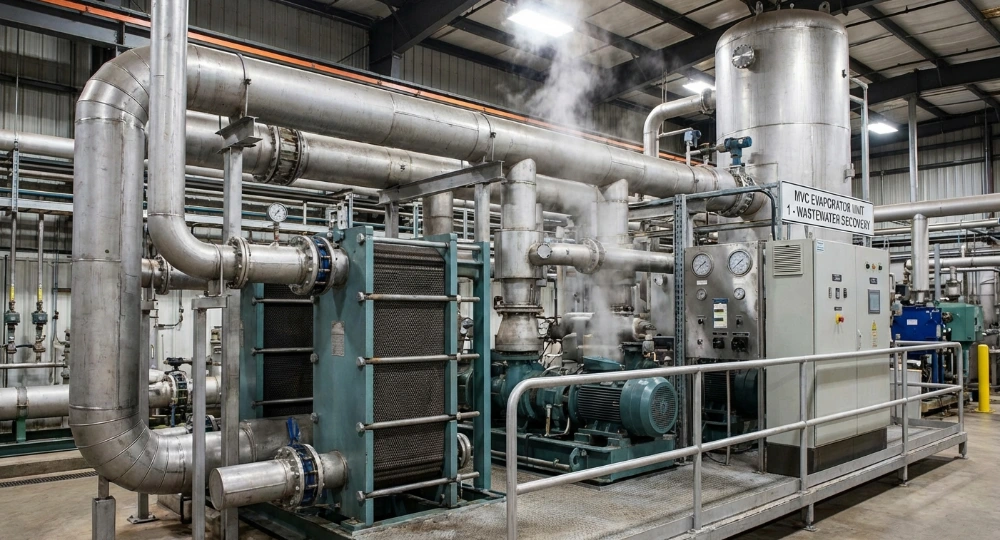
The Thermodynamics Behind MVC Evaporator Heat Exchangers
To understand why mvc evaporator heat exchangers are superior for specific applications, we must look at the energy balance. In a standard setup, the compressor (often a Roots blower or centrifugal fan) increases the pressure and temperature of the vapor generated inside the vessel. This upgraded vapor is then forced into the shell side of the heat exchanger.
Here, the vapor condenses on the outside of the tubes (or plates), transferring its latent heat to the wastewater flowing inside. This continuous cycle means the system acts as its own heat source. The efficiency of this process is measured by the specific energy consumption, which is significantly lower than steam-driven counterparts.
Heat Transfer Coefficient Considerations
The “heartbeat” of the system is the Overall Heat Transfer Coefficient (U-value). In wastewater applications, maintaining a high U-value is challenging due to the viscosity and solid content of the fluid. Falling Film designs are predominantly used here because they provide:
- High Heat Transfer Rates: A thin film of liquid flows down the tubes, maximizing surface contact.
- Low Residence Time: Minimizes thermal degradation of heat-sensitive components in the wastewater.
- Reduced Power Consumption: Lower temperature differences ($\Delta T$) are required to drive evaporation.
Battling Fouling and Scaling in High-TDS Streams
Experience in the field teaches us that the theoretical design often clashes with the harsh reality of industrial effluent. The primary enemy of any mvc evaporator heat exchanger is fouling. As water evaporates, the concentration of dissolved salts (TDS) rises, inevitably pushing calcium, magnesium, and silicates beyond their solubility limits.
When scale forms on the heat exchange surface, it acts as an insulator. A layer of scale as thin as 0.8mm can reduce heat transfer efficiency by over 12%, forcing the compressor to work harder and spiking electricity usage.
Strategies for Scale Mitigation
Effective management involves a multi-layered approach. We typically recommend the following protocols for robust operation:
- Seeding Technique: Introducing gypsum or specific crystal seeds into the feed provides a preferential surface for crystallization, keeping the heat exchanger tubes clean.
- Proper Wetting Rates: Ensuring the falling film completely coats the tube surface prevents “dry spots” where baked-on scale forms rapidly.
- Automated CIP (Cleaning In Place): Modern systems must include automated acid/caustic wash cycles based on pressure differential monitoring.
Comparative Analysis: MVC vs. Multi-Effect Systems
A common dilemma for plant operators is choosing between Mechanical Vapor Compression (MVC) and Multi-Effect Evaporators (MEE). While MEE systems, such as triple-effect evaporators, have their place (especially where waste steam is available), MVC offers distinct advantages for electrical-based operations.
The following comparison highlights the operational differences:
| Feature | MVC System | MEE (3-Effect) |
|---|---|---|
| Primary Energy Source | Electricity | Steam |
| Energy Equivalent (per ton water) | ~15-20 kWh | ~0.35 tons steam |
| Footprint | Compact | Large |
| Cooling Water Need | Minimal / None | High (Condenser) |
| Startup Time | Fast | Slow |
For facilities lacking a boiler, the MVC evaporator solutions are almost always the more economical choice due to the removal of steam generation infrastructure.
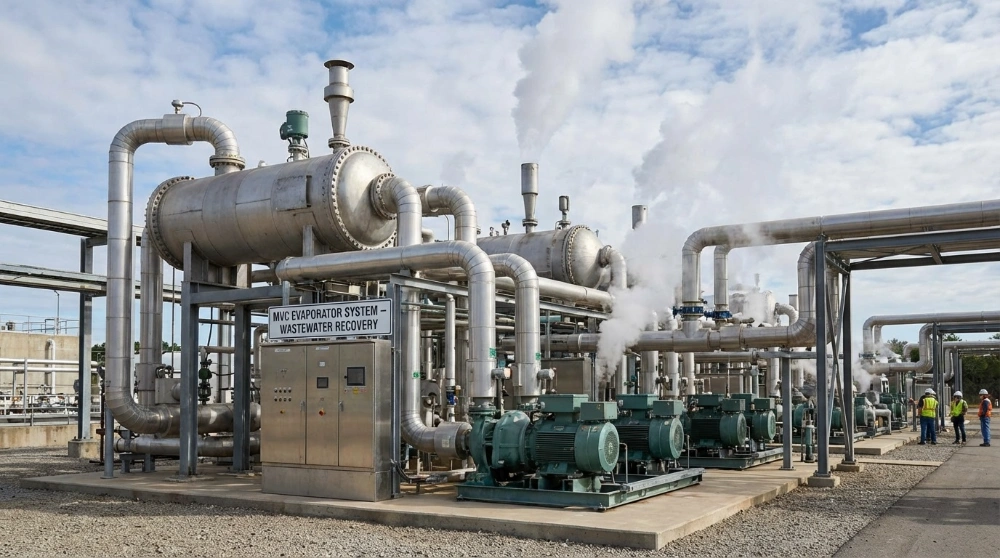
Metallurgy Matters: Preventing Corrosion
Wastewater is rarely neutral. In applications involving electroplating wastewater treatment, the fluid may contain high levels of chlorides, fluorides, and heavy metals. The longevity of mvc evaporator heat exchangers depends on selecting the correct alloy.
Standard Stainless Steel 304 is rarely sufficient for industrial wastewater. We typically engineer systems using:
- Duplex Stainless Steel (2205): Excellent resistance to stress corrosion cracking and pitting. Ideal for moderate chloride levels.
- Titanium (Gr. 1 or Gr. 2): The gold standard for high-chloride environments (like seawater or brine concentration). While the initial material cost is higher, the lifecycle cost is lower due to zero replacement needs.
- Nickel Alloys (Hastelloy): Required for extremely aggressive, acidic streams often found in chemical processing.
According to data from the National Association of Corrosion Engineers (NACE), improper material selection accounts for nearly 30% of premature evaporator failures in the chemical sector. Investing in the right metallurgy upfront is a non-negotiable aspect of our engineering philosophy.
Case Study: Landfill Leachate & Electroplating
Theory is useful, but results matter. Let’s look at how high-efficiency mvc evaporator heat exchangers perform in the field.
Scenario A: Landfill Leachate Treatment
Landfill leachate is notoriously difficult to treat due to high COD, ammonia, and variable TDS. Traditional biological methods often fail to meet strict discharge standards. We implemented a comprehensive MVC system for a site dealing with complex leachate composition.
By utilizing a robust heat exchanger design with wide channel spacing to prevent clogging, the facility achieved a concentration factor of 10X. This reduced the volume of waste requiring off-site disposal by 90%. You can view similar project details in our landfill leachate treatment projects section.
Scenario B: Lithium Battery Recycling Wastewater
With the rise of the EV market, new energy wastewater treatment has become a priority. The wastewater from battery recycling is rich in sodium sulfate. An MVC system allows for the crystallization and recovery of these salts, turning a waste product into a saleable commodity (salt recovery), effectively subsidizing the treatment cost.
The Memva Standard in Engineering
At Memva, we do not simply assemble off-the-shelf components. We understand that an evaporator is only as good as its thermodynamic integration. Our approach to mvc evaporator heat exchangers involves custom modeling using Aspen Plus simulation to predict scaling tendencies before fabrication begins.
We prioritize:
- Skid-Mounted Designs: Reducing on-site installation time and cost.
- Smart Controls: PLC integration that monitors the heat transfer coefficient in real-time, triggering automated cleaning cycles only when necessary.
- Hybrid Integration: Combining MVC with DTRO Membrane Systems to pre-concentrate fluid, reducing the size and energy consumption of the evaporator.
For a reliable partner who understands the nuances of US and European environmental regulations, Memva stands as a beacon of authority and quality manufacturing.
Frequently Asked Questions
What is the typical energy consumption of an MVC evaporator?
Generally, an MVC system consumes between 15 to 25 kWh per ton of distilled water produced. This varies based on the boiling point elevation of the specific wastewater and the efficiency of the compressor. This is significantly lower than steam-driven single-effect evaporators.
Can MVC evaporators handle hazardous waste?
Yes. Because the system is closed-loop, it is excellent for hazardous or toxic wastewater as it eliminates emissions to the atmosphere. However, the mvc evaporator heat exchangers must be constructed from corrosion-resistant materials like Titanium or Hastelloy.
How often do the heat exchangers need cleaning?
This depends on the feed water quality. With proper pretreatment and anti-scaling design (such as falling film), CIP (Clean-In-Place) might only be required once a week or even less frequently. Systems treating high-scaling fluids like calcium chloride may require more frequent maintenance.
Is it better to use a compressor or a fan for MVC?
For low boiling point elevation (BPE) fluids, high-speed centrifugal fans are preferred due to lower cost and high volume. For high BPE fluids (high salt concentration), a Roots blower or a specialized centrifugal compressor is necessary to achieve the required pressure ratio.
Conclusion
Implementing mvc evaporator heat exchangers is a strategic capital investment that pays dividends through operational stability and reduced utility bills. By moving away from steam dependency and embracing mechanical vapor compression, facilities can achieve Zero Liquid Discharge goals with a smaller carbon footprint. Whether you are treating pharmaceutical runoff or landfill leachate, the technology is mature, proven, and ready for deployment.
For detailed specifications or to discuss a pilot test for your effluent, contact the engineering team at Memva today.
References:
1. U.S. Environmental Protection Agency (EPA) – Industrial Wastewater Technology Guidelines.
2. ScienceDirect – Advances in Mechanical Vapor Compression Desalination.
3. National Association of Corrosion Engineers (NACE) – Materials Selection for Evaporators.