

In the high-stakes world of industrial manufacturing, water purity is not a variable you can afford to gamble on. Whether you are running a semiconductor fabrication plant, a pharmaceutical line, or a high-pressure boiler system, the quality of your process water dictates the quality of your final product. For decades, facility managers have relied on a fragmented supply chain, purchasing critical equipment through distributors, integrators, and catalog houses. But the market has shifted. Today, the smartest capital expenditure strategy is to buy industrial DI water system direct from factory floors.
Why the shift? It comes down to three critical factors: accountability, customization, and cost-efficiency. When you cut out the middleman, you aren’t just saving 30% on the sticker price; you are gaining a direct line to the engineers who design the hydraulics and program the logic controllers. This guide draws on years of field experience to walk you through the technical and commercial realities of sourcing a DI water system industrial unit directly from a manufacturer like Memva. We will bypass the sales fluff and dive straight into the engineering specifications, integration with wastewater technologies, and the operational realities you need to know.
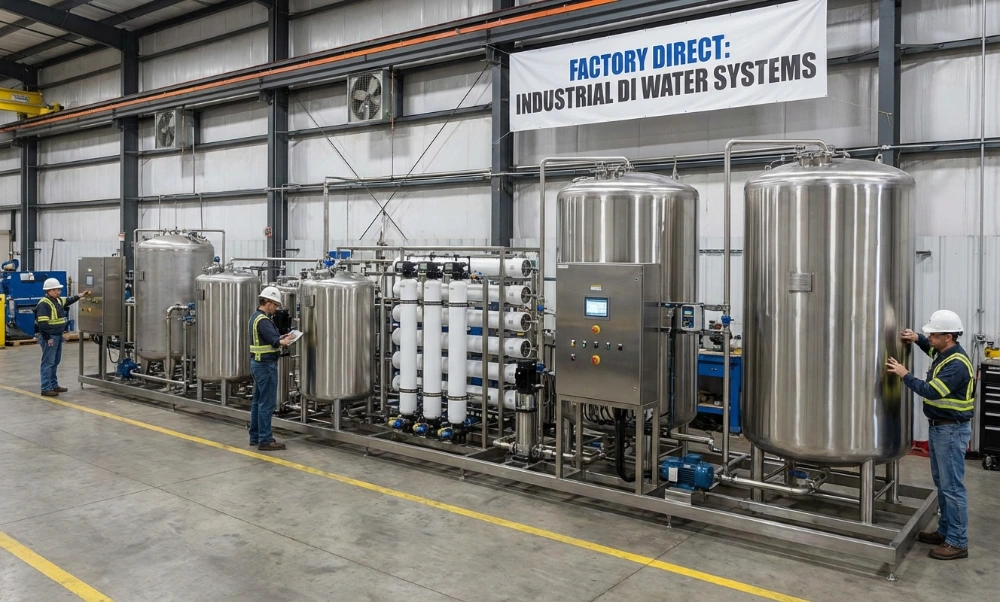
The Hidden Costs of the Middleman Model
To understand the value of going factory-direct, we first need to dissect the traditional buying process. Typically, a local distributor buys a standard skid from a white-label manufacturer, adds their margin, and sells it to you. The problem isn’t just the markup; it’s the disconnection of technical knowledge.
When you encounter a specific water chemistry issue—say, a sudden spike in silica in your feed water—a distributor will often look up a generic chart. A manufacturer, however, understands the molecular interaction within the resin beads. They know that your specific fluctuating feed requires a double-pass Reverse Osmosis (RO) pre-treatment rather than a standard single-pass. This level of expertise is what prevents catastrophic downtime.
Customization is Not a Luxury, It’s a Requirement
No two water sources are identical. Municipal water in Detroit differs vastly from well water in Texas or recycled effluent in Germany. A “catalog” system assumes a perfect world that doesn’t exist. By working with a factory, we can tailor the system’s pre-treatment train to handle specific contaminants, such as high Total Organic Carbon (TOC) or heavy metals, ensuring the longevity of your expensive deionization (DI) components.
Deconstructing the Technology: RO, EDI, and Polishing
When you set out to procure a system, you need to speak the language of the shop floor. A modern industrial high-purity water system is rarely a standalone unit; it is an integrated train. Here is how the best-in-class systems are architected.
1. The Workhorse: Reverse Osmosis (RO)
Before water ever touches a deionization resin, it must be stripped of the bulk of its dissolved solids. RO is the industry standard here. It removes 95% to 99% of contaminants. Without a robust RO stage, your DI resin will exhaust in hours, leading to skyrocketing operational costs (OPEX). For facilities dealing with difficult feed water, specifically those recycling wastewater, we often implement DTRO membrane systems (Disc Tube RO) which are far more resistant to fouling than standard spiral-wound elements.
2. The Polisher: Electrodeionization (EDI) vs. Mixed Bed
This is the most critical decision you will make.
- Mixed Bed Deionizers (MB): These traditional tanks use chemical regeneration (acid and caustic). They deliver ultra-high purity but require handling hazardous chemicals and experiencing downtime during regeneration.
- Electrodeionization (EDI): This is the modern standard for DI water system industrial applications. It uses electricity to continuously regenerate the resin. There are no chemicals, no downtime, and a consistent product water quality.
At Memva, we strongly advocate for EDI in continuous process applications. The ROI on eliminating chemical handling usually pays off within 18-24 months.
Synergy with Wastewater Treatment: The ZLD Approach
Here is where the expertise of a comprehensive manufacturer shines. Modern factories are under immense pressure to reduce water footprint. You cannot view your DI water intake in isolation from your wastewater discharge. The most efficient plants are now adopting Zero Liquid Discharge (ZLD) principles, treating their wastewater and feeding it back into the front end of their pure water system.
However, you cannot just pump raw wastewater into a high-purity system. It requires thermal separation first. This is where MVC evaporator technology becomes vital. Mechanical Vapor Compression (MVC) evaporators distill the wastewater, removing salts, oils, and heavy metals. The resulting distillate is incredibly pure, often cleaner than city water, making it the perfect feed for your DI system.
Case in Point: Pharmaceutical Effluent
Consider a pharmaceutical plant. Their wastewater is laden with complex organics. By running this stream through a pharmaceutical wastewater treatment system utilizing evaporation, they recover 90% of the water. This recovered water is then polished by the Memva DI system, closing the loop. This level of integration is impossible if you are buying piecemeal components from a catalog.
Sizing and Specifications: An Engineer’s Checklist
Undersizing is the most common failure mode I see in the field. Managers often size for average flow, forgetting that peak demand can be 3x higher. When you contact the factory, have the following data ready to ensure accurate engineering:
| Parameter | Why It Matters | Typical Range |
|---|---|---|
| Feed Water Conductivity | Determines the load on the RO and EDI. Higher conductivity requires more robust pre-treatment. | 50 – 1000 µS/cm |
| TOC Levels | Total Organic Carbon fouls anion resin. High TOC demands UV oxidizers. | < 500 ppb |
| Peak Flow Rate | Ensures pumps and piping can handle maximum demand without pressure drops. | Varies (e.g., 10 – 500 GPM) |
| Silica Content | Silica is difficult to remove and can glaze over electrodes. Requires specific pH adjustments. | < 10 ppm |
If your facility deals with challenging waste streams, such as those from energy production, reviewing our projects on new energy wastewater treatment can provide insight into how we handle heavy contaminant loads prior to polishing.
Installation and Site Preparedness
Buying direct means you take on a bit more responsibility for site readiness, but the payoff is control. A factory-built system from Memva typically arrives skid-mounted, pre-piped, and pre-wired. However, “Plug and Play” is a relative term in heavy industry. Here is what you need to prepare:
- Loop Design: Ensure your distribution loop (the piping going out to your factory and back) is built from PVDF or 316L Stainless Steel with sanitary welds. A great system feeding into a dirty pipe is a waste of money.
- Velocity: Maintain a return velocity of at least 3-5 feet per second to prevent biofilm formation. Static water is the enemy of purity.
- Temperature Control: DI systems are sensitive to heat. If you are using condensate from a wastewater evaporation system, ensure it is cooled to below 40°C (104°F) before it hits the resin.
The Memva Advantage: Authority and Trust
In an industry crowded with “box movers,” Memva stands out by focusing on the total lifecycle of water. We don’t just sell you a machine; we engineer a solution that fits your unique hydraulic profile. Our expertise spans from the dirty end of the pipe—handling complex landfill leachate treatment—to the ultra-pure polishing required for microelectronics.
This holistic view is crucial. A vendor who only understands “clean water” will fail when the feed water quality fluctuates due to upstream process changes. Because we build the evaporators, the membrane systems, and the DI units, we understand the entire ecosystem of your factory’s fluids.
Expert Tips for Long-Term Reliability
As someone who has commissioned hundreds of systems, I can tell you that 90% of long-term issues stem from neglecting the basics.
1. Monitor Trends, Not Just Alarms: Don’t wait for the “High Conductivity” alarm. Watch the trend. If your EDI voltage is creeping up month over month, you have scaling issues starting.
2. Sanitize Regularly: Even in a closed loop, biology finds a way. Schedule regular hot water or ozone sanitization cycles.
3. Pre-treatment is Key: Protect the expensive parts. Changing a $20 carbon filter cartridge is cheaper than replacing a $5,000 EDI stack.
Frequently Asked Questions (FAQ)
What is the typical lead time when I buy an industrial DI water system direct from the factory?
Because these systems are engineered to order, typical lead times range from 8 to 12 weeks. This includes engineering design, fabrication, and Factory Acceptance Testing (FAT). While off-the-shelf units exist, they rarely offer the longevity needed for heavy industrial use.
Can I use evaporated wastewater as feed for the DI system?
Yes, and it is a best practice for sustainability. Distillate from a MVC evaporator is extremely low in TDS, making it excellent feed water. It may require minor polishing to remove volatile organics, but it significantly reduces fresh water consumption.
What is the difference between Single-Pass and Double-Pass RO for DI feed?
Single-pass RO runs the water through membranes once. Double-pass sends the product water through a second set of membranes. For a DI water system industrial setup, double-pass is often preferred if the feed water has high CO2 or Silica, as it reduces the ionic load on the final polishing stage.
Does Memva provide installation support?
Absolutely. While we ship global, we provide remote or onsite commissioning support. We also provide detailed P&IDs and electrical schematics so your local contractors can prepare the site accurately before the equipment arrives.
How do I determine if I need Type I or Type II water?
Type II water (>1 MΩ-cm) is suitable for general laboratory rinsing, boiler feed, and standard chemical mixing. Type I (18.2 MΩ-cm) is required for critical applications like semiconductor manufacturing, HPLC, and cell culture. Over-specifying your water quality leads to unnecessary OPEX.
Final Thoughts: Making the Right Investment
Deciding to buy industrial DI water system direct from factory is a strategic move. It places the responsibility for water quality where it belongs: with the experts who built the machine. It allows for tighter integration with advanced wastewater technologies, turning a cost center into a sustainable loop.
At Memva, we are committed to engineering excellence. Whether you need a simple skid or a complex ZLD integrated plant, we have the experience to deliver. Don’t settle for catalog solutions in a custom world. Reach out to our engineering team today, and let’s build a water system that drives your business forward.
References: