

When industrial facilities face tightening environmental regulations, the conversation inevitably turns to water management. Achieving Zero Liquid Discharge (ZLD) is no longer just a regulatory hoop to jump through; it is a strategic necessity for cost control and sustainability. At the heart of the most efficient ZLD systems lies a technology that has revolutionized thermal separation: mechanical vapor recompression. If you are running a plant, you don’t just need “equipment”; you need a solution that stops your operating costs from bleeding out through steam boilers. MVR technology fundamentally shifts the economics of wastewater treatment by recycling energy rather than constantly generating new heat.
In this comprehensive guide, we are going to tear down the complexities of MVR technology. We will explore why it is the preferred engine for ZLD, how it compares to traditional evaporation, and what you need to look for when selecting a partner. Whether you are dealing with high-salinity leachate or pharmaceutical effluent, understanding the physics and financials of this system is the key to turning a compliance burden into an operational asset.
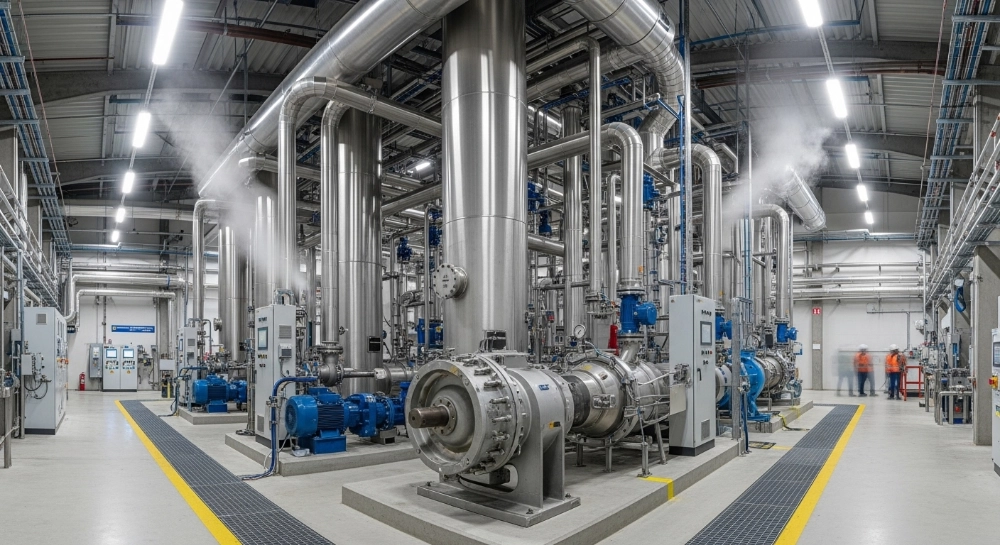
The Thermodynamics of Savings: How Mechanical Vapor Recompression Works
To understand why mechanical vapor recompression (MVR) is superior to steam-driven systems, we have to look at the energy balance. In a traditional evaporator, you burn gas or coal to create steam, that steam heats your wastewater, and the vapor generated from the wastewater is often condensed and wasted. You are essentially paying for energy once and throwing it away.
MVR changes this equation. It functions on the principle of a heat pump. The vapor generated from the boiling wastewater is not condensed immediately. Instead, it is fed into a compressor (driven by electrical energy). This compressor increases the pressure and temperature of the vapor. This “upgraded” vapor is then piped back into the heat exchanger to heat the very wastewater it came from.
The magic happens here: the system uses the latent heat of vaporization over and over again. Once the system is running, you don’t need an external steam source. The only energy input is the electricity to run the compressor. This creates a closed-loop thermal cycle that is incredibly efficient.
Key Components of the System
- The Evaporator Vessel: Where the boiling and separation occur.
- The Compressor: The heart of the system (Roots, Centrifugal, or Turbo fans).
- Heat Exchanger: Transfers energy from compressed vapor to the influent.
- Mist Eliminator: Protects the compressor from water droplets.
Why MVR is the Backbone of Zero Liquid Discharge Systems
Zero Liquid Discharge systems are typically composed of three stages: Pre-treatment, Concentration (Evaporation), and Crystallization. The concentration phase is where the heavy lifting happens, removing 80% to 90% of the water volume. If you use older technologies like single-effect evaporation here, your energy bills will destroy your profit margins.
We utilize mechanical vapor recompression in this stage because of its ability to handle high volumes with low specific energy consumption. In a ZLD setup, the MVR unit concentrates the wastewater up to near-saturation points. For example, if you are treating electroplating wastewater, the MVR can take the Total Dissolved Solids (TDS) from 30,000 ppm up to 200,000 ppm or more.
Once the MVR has done this bulk reduction, the remaining thick brine is sent to a crystallizer or a centrifuge for the final solid-liquid separation. Without the MVR doing the bulk work efficiently, the crystallizer—which is energy-intensive—would have to be massive, making the project unfeasible.
The Memva Approach to ZLD Integration
At Memva, we design our systems to seamlessly hand off this concentrated brine. We have found that balancing the concentration ratio in the MVR unit is critical. Push it too hard, and you risk scaling; don’t push it enough, and you overload your crystallizer. It is a delicate balance that requires deep engineering experience.
Operational Cost Showdown: MVR vs. Multi-Effect Evaporation (MEE)
This is usually the deciding factor for our clients. While the capital expenditure (CAPEX) for an MVR system can be higher than a simple 3-effect evaporator, the operational expenditure (OPEX) tells a different story. Let’s look at the numbers based on real-world data from industrial applications.
| Parameter | 3-Effect Evaporator (Steam) | Mechanical Vapor Recompression (Electric) |
|---|---|---|
| Energy Source | Steam (Natural Gas/Coal) | Electricity |
| Energy Consumption per ton of water | ~0.4 tons of steam | ~20 – 45 kWh |
| Cooling Water Required | High volume required | Minimal / None |
| Startup Time | Fast (30 mins) | Slower (45-60 mins) |
| COP (Coefficient of Performance) | ~2.5 – 3.0 | ~10 – 20 |
| Estimated Cost per m³ treated* | $8.00 – $12.00 | $2.50 – $4.50 |
*Note: Costs vary based on local electricity vs. gas prices. Data reflects 2024 industrial averages.
As you can see, the specific energy consumption of mechanical vapor recompression is drastically lower. In regions where steam generation is expensive or regulated, MVR is the clear winner. Furthermore, MVR systems do not require large cooling towers to condense the final vapor, saving massive amounts of space and civil engineering costs.
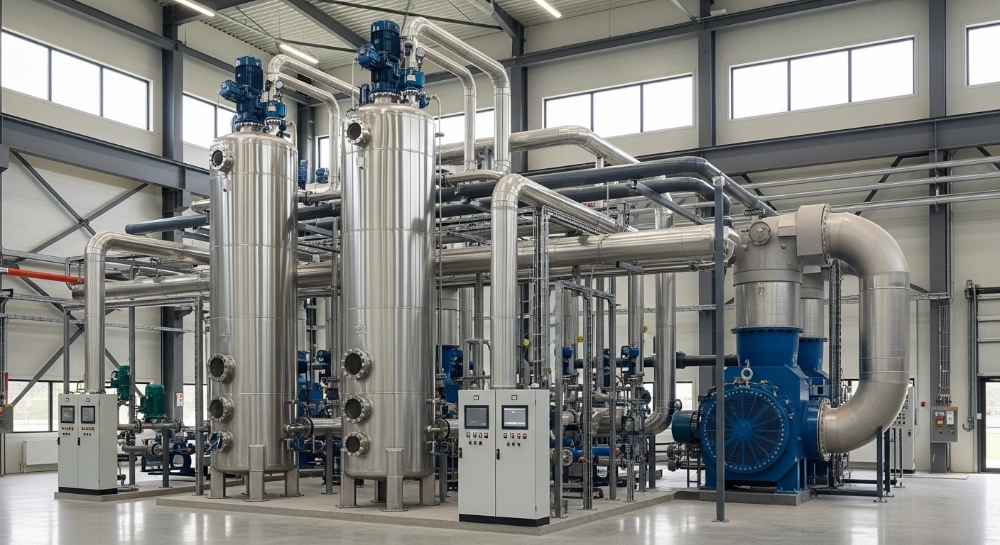
Deep Dive: The Compressor—The Heart of the Beast
The reliability of an MVR system is 90% dependent on the compressor. This is not a standard air compressor; it is handling hot, potentially corrosive steam. We generally categorize them into three types based on the flow rate and temperature rise required.
1. Centrifugal Fans (Turbo Fans)
These are used for high flow rates but lower compression ratios. They are excellent for applications where the boiling point elevation (BPE) is low. They run at high speeds and are generally very efficient.
2. Roots Blowers (Positive Displacement)
Roots blowers are rugged and can handle higher pressure differences. We often utilize these in smaller capacity plants or where the fluid properties fluctuate. They are louder but incredibly robust.
3. Single-Stage Centrifugal Compressors
For large-scale Zero Liquid Discharge systems, these are the gold standard. They offer the highest efficiency and can handle significant vapor volumes. Memva’s high-end units often deploy these with advanced impeller designs using Titanium or Duplex Stainless Steel to resist corrosion.
Choosing the right compressor involves analyzing the Boiling Point Elevation of your specific wastewater. If your supplier gets this wrong, the system will surge (vibrate violently) or fail to evaporate.
Metallurgy Matters: Fighting Corrosion in Wastewater
When you boil wastewater, you are essentially creating a corrosive acid or base bath. Chlorides, in particular, become extremely aggressive at high temperatures. A standard 304 stainless steel vessel might last a few months before stress corrosion cracking sets in.
Reliable mechanical vapor recompression evaporators must be built with the right materials.
- 316L Stainless Steel: Good for low chloride, neutral pH applications.
- Duplex 2205: The industry workhorse. Twice the strength of 316L and excellent resistance to pitting.
- Titanium (Gr.1 / Gr.2): Essential for high salinity, aggressive leachate, or seawater desalination applications.
- Hastelloy: Reserved for extreme acidic environments with high fluoride or chloride content.
At Memva, we conduct a thorough water quality analysis before welding a single sheet of metal. We have seen too many generic systems fail because the manufacturer tried to save money on materials. In ZLD, cheap materials are the most expensive mistake you can make.
Solving the Scaling and Fouling Nightmare
The enemy of heat transfer is scaling. Calcium carbonate, calcium sulfate, and silica love to coat heat exchanger tubes, acting as insulation. As scale builds up, your compressor has to work harder to maintain the same evaporation rate, driving up energy consumption.
To mitigate this in an MVR setup, we employ several strategies:
- Forced Circulation: By pumping the liquid through the heat exchanger at high velocity, we create turbulence that scours the tube walls, preventing crystals from settling.
- Falling Film Design: For lower viscosity fluids, falling film evaporators offer high heat transfer coefficients. However, uniform distribution is key.
- Seed Crystal Technique: In ZLD, we sometimes intentionally introduce crystals into the brine. New precipitates prefer to grow on existing crystals rather than on the metal heat exchanger walls.
Real World Applications: From Pharma to Landfills
Theory is fine, but how does this perform in the field? Let’s look at two distinct scenarios where MVR proved critical.
Scenario A: Landfill Leachate Treatment
Landfill leachate is notoriously difficult to treat due to high COD (Chemical Oxygen Demand) and ammonia. A client approached us with a site generating 200 tons of leachate per day. Biological treatment wasn’t enough to meet discharge standards.
The Solution: We implemented a Memva MVR system with a titanium heat exchanger. The system concentrated the leachate, reducing the volume by 85%. The distillate was clean enough for reuse, and the concentrate was solidified. You can read more about similar projects in our leachate treatment case studies.
Scenario B: Lithium Battery Recycling Wastewater
The new energy sector generates wastewater rich in sodium sulfate. The goal here isn’t just disposal; it’s recovery.
The Solution: An MVR crystallizer was installed. The system recovers high-purity sodium sulfate crystals which can be sold, offsetting the operational costs. The mechanical vapor recompression unit maintains a precise temperature curve to ensure crystal size uniformity.
Expert Troubleshooting: Common MVR Issues
Even the best systems encounter hiccups. Here is what we typically see in the field and how to fix it.
Problem: Compressor Surging
Symptoms: Loud vibration, fluctuating amperage.
Cause: Usually insufficient vapor flow or excessive pressure difference.
Fix: Check for fouling in the heat exchanger (which reduces vapor generation) or air leaks in the system.
Problem: Distillate Conductivity Rising
Symptoms: The “clean” water isn’t clean.
Cause: Foam carryover.
Fix: Check the defoamer dosage or inspect the mist eliminator (demister pad) for damage. In some MVC evaporator designs, the vapor velocity might be too high.
The Future of MVR: IoT and Hybrid Systems
The future of wastewater treatment is smart. We are seeing a shift towards MVR systems integrated with IoT sensors. These systems monitor vibration analysis on the compressor bearings in real-time, predicting failures weeks before they happen.
Additionally, hybrid systems are gaining traction. For instance, combining Reverse Osmosis (RO) with MVR. We use DTRO membrane systems to pre-concentrate the water as much as possible electrically (which is cheaper per gallon than evaporation) before sending the retentate to the MVR. This hybrid approach optimizes the OPEX to the absolute mathematical minimum.
How to Vet Your MVR Manufacturer
Choosing a supplier for a piece of equipment that costs hundreds of thousands of dollars is a high-stakes decision. Do not just look at the price tag. Here is your checklist:
- Reference Projects: Do they have running systems in your specific industry? Treating oily wastewater is totally different from treating salty brine.
- In-House Manufacturing: Does the company manufacture their own core components, or are they just an assembler? Memva takes pride in overseeing the fabrication of our core heat exchangers to ensure quality.
- Service Response: If the compressor goes down, how fast can they get a technician to your site?
- Pilot Testing: Will they take a sample of your water and run a pilot test? Never buy a ZLD system without a pilot test. The chemistry of wastewater is unpredictable.
Frequently Asked Questions
Is Mechanical Vapor Recompression suitable for all types of wastewater?
Not all. MVR is best suited for wastewater with high Total Dissolved Solids (TDS) where biological treatment fails. However, if the boiling point elevation is extremely high (e.g., highly concentrated caustic soda), the compressor might not be able to bridge the temperature gap, and a steam-driven system might be better.
What is the typical ROI period for an MVR system?
While MVR systems have a higher upfront cost compared to multi-effect evaporators, the energy savings are massive. Depending on local energy prices, the Return on Investment (ROI) is typically between 18 to 36 months.
How often does the compressor need maintenance?
High-speed centrifugal compressors generally require bearing inspections annually and a major overhaul every 3-5 years. Roots blowers may require more frequent oil changes but are mechanically simpler.
Can MVR achieve Zero Liquid Discharge on its own?
MVR is an evaporation technology. To achieve true ZLD (dry solids), it is usually paired with a crystallizer or a centrifuge and dryer at the tail end to handle the final slurry.
Final Thoughts
Implementing a mechanical vapor recompression system is a significant engineering undertaking, but it is the most thermally efficient path to Zero Liquid Discharge available today. It transforms wastewater treatment from a pure cost center into a manageable, predictable utility. By recycling latent heat, you are insulating your facility against fluctuating fuel costs and strict environmental penalties.
If you are looking for a system that balances robust engineering with cutting-edge efficiency, or if you need advice on a difficult wastewater stream, the engineering team at Memva is ready to help. We believe in data-driven solutions that work in the real world, not just on paper.
References & Further Reading
- U.S. Department of Energy, Office of Energy Efficiency & Renewable Energy. “Industrial Heat Pumps for Steam and Fuel Savings.”
- Water Research Foundation. “Zero Liquid Discharge Systems: Technology and Cost Assessment.”