

Lorem ipsum dolor sit amet, consectetur adipiscing elit. Ut elit tellus, luctus nec ullamcorper mattis, pulvinar dapibus leo.
Memva designs and manufactures disc tube reverse osmosis (DTRO) systems for wastewater streams where salinity, fouling potential or feed variability make conventional spiral-wound RO difficult to operate. System pressure, staging, recovery target and pretreatment are selected from your actual water analysis rather than a one-size-fits-all specification.
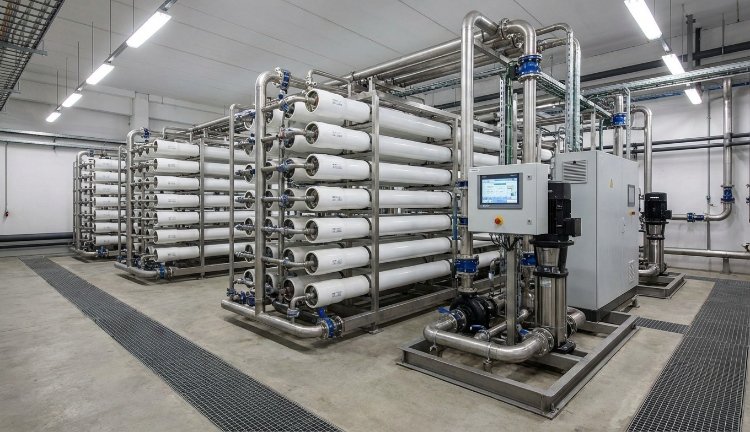
DTRO is normally evaluated when the wastewater is too saline, variable or fouling-prone for a conventional RO layout, or when membrane pre-concentration can reduce the load on downstream evaporation.
The open disc-tube flow path is designed for difficult wastewater and can be more tolerant of suspended solids, organics and scaling risk than tightly spaced spiral-wound modules.
High-pressure DTRO configurations can be considered when the feed salinity requires more operating pressure than a conventional wastewater RO system can practically provide.
DTRO can be used in landfill leachate treatment trains, but the correct position of the membrane stage depends on COD, ammonia, suspended solids, salinity and the required discharge or reuse quality.
For suitable wastewater, DTRO can recover part of the water and reduce the hydraulic volume sent to an MVC/MVR evaporator or other downstream concentration step.
DTRO uses reverse osmosis membranes in a disc-tube module with an open flow channel. Pressure drives water through the membrane while salts and other rejected constituents remain in the concentrate stream.
Wastewater is equalized and conditioned as required. The pretreatment scope is selected from suspended solids, hardness, silica, organics, pH and other scaling or fouling indicators.
A high-pressure pump supplies the pressure required to overcome osmotic pressure and drive permeation through the RO membrane.
Flow through the disc-tube geometry creates crossflow and turbulence intended to reduce concentration polarization and pollutant deposition on the membrane surface.
Permeate is routed to reuse, polishing or discharge as required. Concentrate can be recirculated, further concentrated, evaporated or otherwise managed according to the project and local regulations.
Both technologies use reverse osmosis membranes. The key difference is the module and flow-channel configuration, which changes how each system handles difficult feedwater and high-pressure operation.
| Selection Factor | DTRO | Conventional Spiral-Wound RO |
|---|---|---|
| Flow channel | Open disc-tube channel designed for difficult wastewater | Tighter feed-spacer channel with higher sensitivity to suspended solids and fouling |
| Typical feed challenge | High TDS, variable wastewater, leachate, RO concentrate, high fouling potential | Cleaner or more consistently pretreated feedwater |
| Pressure capability | High-pressure configurations are available; final rating depends on the selected module and system design | Depends on membrane type and pressure-vessel design; often lower for industrial wastewater RO |
| Pretreatment | Can be less restrictive in selected applications, but pretreatment is still project-specific | Usually requires tighter control of suspended solids and fouling potential |
| Best use case | Difficult feed where robustness and concentration capability justify the system cost | Feedwater that can be economically conditioned for standard RO operation |
A DTRO system should not be selected from pressure, TDS or recovery rate alone. Full ionic composition, scaling potential, target permeate quality and concentrate strategy all affect the final design.
| Parameter | How Memva Approaches It |
|---|---|
| System capacity | Configured from hourly/daily flow, operating hours, peak load and redundancy requirements. |
| Operating pressure | Selected from feed osmotic pressure, target recovery and membrane limits. High-pressure configurations up to 120 bar can be evaluated where the selected components are rated for it. |
| Feed TDS | Evaluated together with ionic composition and scaling risk rather than treated as one universal maximum value. |
| Salt rejection / permeate quality | Depends on membrane selection, temperature, feed chemistry, pressure and staging. Proposal guarantees should be based on defined design conditions. |
| Recovery rate | Project-specific. It is set by osmotic pressure, concentration factor, scaling potential, stage design and concentrate disposal or evaporation strategy. |
| pH and cleaning range | Defined by the selected membrane element, cleaning chemistry and materials of construction. |
| Automation | PLC-based control can be configured for pressure, flow, conductivity, tank level, alarms, flushing and cleaning sequences. |
Note: Published values should match your actual membrane datasheet and guaranteed design conditions. Do not present a universal recovery or maximum TDS as a guaranteed value for every wastewater.
A useful quotation starts with wastewater data. Sending only “capacity” or “TDS” is usually not enough to select a reliable membrane configuration.
Industrial wastewater varies from plant to plant. The equipment configuration should therefore follow the actual process conditions instead of a fixed catalogue template.
Module quantity, number of stages, circulation strategy and redundancy can be adapted to the required flow and recovery objective.
Pressure rating and membrane type are selected around salinity, permeate target and the allowable operating envelope.
Filtration, pH conditioning, antiscalant, softening or biological treatment can be integrated where the feedwater requires it.
Wetted materials, pumps, piping and valves can be selected for chloride level, pH, corrosion risk and site requirements.
Flushing and CIP logic should be designed around fouling indicators, permeability decline and the selected membrane supplier's limits.
PLC logic, conductivity monitoring, flow and pressure instruments, alarms and remote-support functions can be configured for the operating team.
The technology is most relevant where the feed presents a combination of salinity, fouling risk and discharge or water-recovery pressure.
Variable leachate containing salts, refractory organics, ammonia and suspended matter may require a multi-barrier treatment train. DTRO can be evaluated as part of that train based on actual feed quality.
Chemical, pharmaceutical, metal-processing and other industrial streams can require high-pressure membrane concentration when dissolved salts make conventional treatment difficult.
DTRO may be used to recover additional water from suitable RO concentrate before the remaining brine moves to a thermal or disposal step.
In a ZLD process, DTRO can serve as a membrane concentration stage before evaporation, helping reduce the volume that requires thermal treatment.
The most economical route depends on feed chemistry and the final treatment target. A typical concept may combine pretreatment, membrane recovery and thermal concentration rather than asking one machine to perform every treatment step.
Memva's public company information describes an integrated capability covering wastewater treatment design, equipment manufacturing, factory testing, installation guidance and after-sales technical support.
Equipment selection is based on wastewater characteristics, capacity, treatment target and site conditions.
System checks before shipment help confirm the agreed equipment configuration and basic operating functions.
Technical documentation and installation support can be coordinated with the customer's site team.
Remote assistance, operating guidance and spare-parts support can be included according to the project scope.
Buyers comparing DTRO usually also need to understand pretreatment, concentrate handling, evaporation and relevant project experience.
See how leachate treatment can require pretreatment, biological treatment and membrane polishing rather than one standalone unit.
View application → Downstream ConcentrationCompare membrane pre-concentration with thermal evaporation when a project targets brine reduction or ZLD.
Explore MVC → ExperienceReview Memva's published industrial wastewater applications and project pages.
Browse projects →These answers are written to help engineering and procurement teams decide what information is needed before requesting a system proposal.
To receive a technically useful proposal, include your daily flow, water analysis and target treatment result. If you already have a laboratory report, mention the main values in the message and tell us what you need the treated water or concentrate to achieve.