

For industrial plant managers and environmental engineers, wastewater disposal is no longer just an operational line item—it is a massive financial bleed. With stricter environmental regulations tightening globally and haulage costs skyrocketing, the old “treat and release” model is failing. This is where the evaporator for wastewater treatment shifts from being an option to a necessity.
Implementing a Zero Liquid Discharge (ZLD) strategy isn’t just about environmental compliance; it is about survival and efficiency. By recovering up to 95% of your water for reuse and reducing waste volume to a solid slurry, you regain control over your operational costs. Whether you are managing high-salinity effluent from pharmaceutical manufacturing or dealing with complex chemical streams, understanding evaporation technology is your first step toward sustainability.
In this comprehensive guide, we strip away the marketing fluff. We will examine the physics behind the technology, compare Mechanical Vapor Compression (MVC) against Multi-Effect Evaporators (MEE), and analyze real-world data to help you select the right system for your facility.
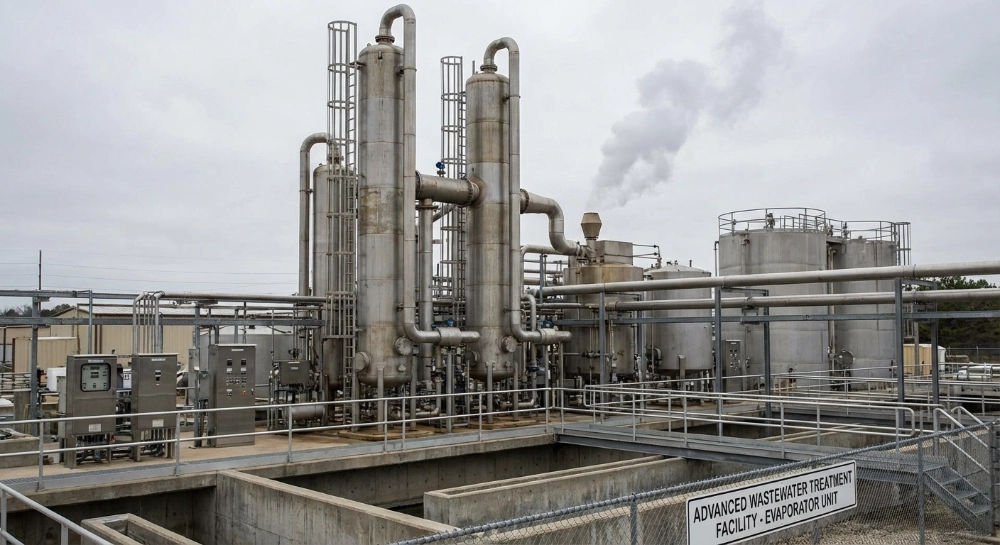
Why Zero Liquid Discharge (ZLD) Matters Now
The concept of ZLD is straightforward: you process liquid waste until there is no liquid left to discharge into the environment. However, achieving this requires robust thermal separation technology. An industrial evaporator for wastewater treatment functions as the heart of this system.
Traditional chemical precipitation or biological treatments often fail when Total Dissolved Solids (TDS) exceed 40,000 mg/L. Evaporators, specifically designed for industrial applications, thrive in these high-concentration environments. They boil the water, separating pure distilled water from the contaminants, which are concentrated into a brine or solid crystal.
Expert Insight: “Many facility managers mistake filtration for concentration. Reverse Osmosis (RO) is great, but it hits a limit at high osmotic pressures. To truly bridge the gap to ZLD, you need thermal evaporation to handle the brine that RO cannot touch.”
Core Technologies in Industrial Evaporation
Not all evaporators are built the same. The choice between technologies usually comes down to your energy source (steam vs. electricity) and the specific boiling point elevation of your wastewater.
1. Mechanical Vapor Compression (MVC)
Mechanical Vapor Compression is widely regarded as the most energy-efficient thermal process for wastewater capacity under 50 tons per hour. In an MVC evaporator, the vapor generated from the boiling product is compressed by a mechanical fan or compressor. This compression raises the pressure and temperature of the vapor, allowing it to be reused as the heating medium for the same boiling process.
The beauty of MVC lies in its low operating cost. It does not require a steam boiler. It runs strictly on electricity, making it ideal for facilities where steam is unavailable or expensive to generate. For industries like new energy battery production, where electrical infrastructure is robust, MVC is the gold standard.
2. Multi-Effect Evaporators (MEE)
If your facility has an abundance of waste steam or low-cost steam, a Multi-Effect Evaporator is a strong contender. The principle is cascading energy: the vapor from the first effect heats the second effect, and so on.
- Single Effect: High steam consumption, low capex. Used for small batches.
- Triple Effect: Balanced efficiency. Uses roughly 0.4 kg of steam to evaporate 1 kg of water.
- Multi-Effect: High efficiency but higher capital complexity.
3. Heat Pump Evaporators
For smaller volumes (under 5 tons per day), vacuum heat pump evaporators operate at lower temperatures. They are excellent for corrosive fluids or heat-sensitive compounds but lack the throughput capacity of large MVC systems provided by manufacturers like Memva.
Comparative Analysis: MVC vs. MEE vs. Heat Pump
Selecting the correct evaporator for wastewater treatment depends heavily on your OPEX (Operating Expenses) calculations. Below is a comparison based on industry standard performance metrics.
| Feature | Mechanical Vapor Compression (MVC) | Multi-Effect Evaporator (3-Effect) | Heat Pump Evaporator |
|---|---|---|---|
| Primary Energy Source | Electricity | Steam | Electricity |
| Energy Consumption (per ton of water) | ~20-30 kWh | ~0.35 tons of steam + Cooling Water | ~150-200 kWh |
| Operating Temperature | Low/Medium (Vacuum) | High | Low (Vacuum) |
| Footprint | Compact | Large (Requires boiler & cooling tower) | Very Compact |
| Best Application | High volume, steady flow, limited steam access | Cheap steam available, high boiling point elevation | Small batches, highly corrosive |
Overcoming Common Evaporation Challenges
Installing the hardware is step one. Running it efficiently for ten years is the real challenge. Here is how experienced operators handle common issues.
Handling Scaling and Fouling
Wastewater is rarely just water and salt. It contains calcium, magnesium, silica, and organics. When you concentrate these, they form scale on heat transfer surfaces, destroying efficiency.
To mitigate this, advanced systems use forced circulation. By pumping the fluid at high velocity through the heat exchanger, we prevent crystals from settling on the tubes. Additionally, integrating DTRO Membrane Systems as a pre-concentration step can reduce the load on the evaporator, removing potential scaling agents before they hit the thermal unit.
Corrosion Management
High chloride concentrations at high temperatures are a recipe for pitting corrosion. Standard 304 or 316 stainless steel often fails in these conditions. An authoritative supplier will insist on high-grade materials like Duplex 2205, Titanium, or specialized alloys for the heat exchanger tubes. Never compromise on metallurgy to save upfront capital; you will pay for it in downtime later.
Foaming Control
In industries like electroplating or landfill leachate treatment, the presence of surfactants causes massive foaming inside the vessel. This foam causes “carryover,” where dirty water is sucked into the clean distillate, ruining your water quality. Modern evaporators utilize cyclonic separation and built-in defoaming systems to mechanically break the foam without heavy chemical reliance.
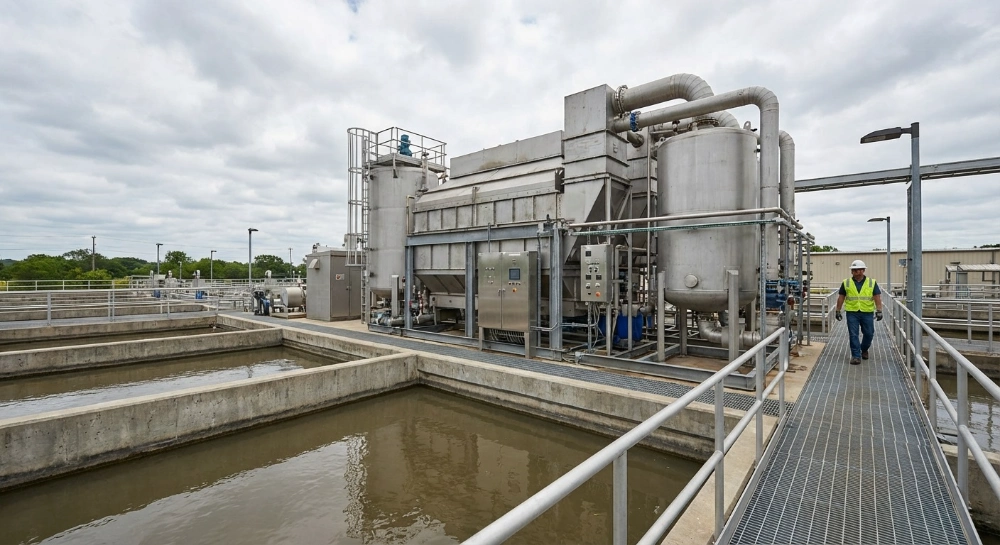
Case Studies: Efficiency in Action
Theory is useful, but data drives decisions. Here are two scenarios where Memva technology solved critical wastewater issues.
Scenario A: Landfill Leachate Treatment
The Problem: A municipal landfill site was generating leachate with COD values over 5,000 mg/L and high ammonia nitrogen. Using standard biological treatment was ineffective due to toxicity. Hauling the leachate cost the municipality over $350,000 annually.
The Solution: The facility installed a Memva Leachate MVC System. The unit concentrated the leachate to 20% of its original volume.
The Result:
- Disposal volume reduced by 80%.
- Distillate water quality met discharge standards.
- ROI achieved in 14 months.
Scenario B: Oily Wastewater from Compressor Manufacturing
The Problem: An automotive parts manufacturer had wastewater laden with emulsified oils and coolants. Filtration membranes clogged within hours.
The Solution: They deployed a vacuum evaporator designed for oily wastewater applications. The system utilized a scraper mechanism to keep the heat transfer surface clean despite the sticky nature of the oil.
The Result: The plant achieved ZLD, recycling the distilled water back into their cooling processes, effectively closing the water loop.
Criteria for Choosing a Manufacturer
When you are ready to procure an evaporator for wastewater treatment, the vendor landscape can be confusing. It is vital to distinguish between equipment resellers and true engineering firms.
A reliable partner, such as Memva, distinguishes itself through:
- Lab Testing Capabilities: They should never sell a unit without first testing a sample of your actual wastewater. Theoretical calculations do not account for your specific chemical matrix.
- Customization: Avoid “off-the-shelf” standard units for complex streams. Your evaporator should be sized for your specific boil-up curve.
- Holistic Design: Look for suppliers who understand the upstream and downstream implications. Do they offer heat exchangers and crystallizers? Can they integrate with your existing PLC?
For detailed specifications on system setups, you can review the technical parameters at Memva’s official portal. Their approach prioritizes long-term operational stability over the lowest initial bid, aligning with the needs of serious industrial players.
Frequently Asked Questions (FAQ)
1. How much energy does an MVC evaporator consume?
Generally, a well-designed MVC system consumes between 20 to 30 kWh per ton of distilled water produced. This is significantly more efficient than atmospheric boiling, which requires massive amounts of thermal energy.
2. Can I achieve ZLD with just an evaporator?
Usually, an evaporator takes you to 90-95% recovery. To get to true Zero Liquid Discharge (solids only), you typically need to pair the evaporator with a Crystallizer or a filter press to dewater the final concentrated brine slurry.
3. How often does the system need cleaning?
This depends on the chemistry. However, modern systems with automated Clean-In-Place (CIP) cycles typically require a chemical wash once every 2 to 4 weeks, requiring minimal operator intervention.
4. Is evaporation suitable for volatile organic compounds (VOCs)?
Standard evaporation will boil off VOCs along with the water, meaning they end up in your distillate. If you have high VOCs, you need a pre-treatment stripping column or post-treatment carbon filter to ensure the distilled water is clean.
Final Thoughts: Invest in Reliability
The transition to Zero Liquid Discharge is challenging, but the technology is mature and proven. An evaporator for wastewater treatment is an asset that pays dividends in regulatory peace of mind and reduced disposal fees.
Whether you require a double-effect system for moderate steam availability or a high-efficiency compressor unit, the key is matching the physics of the machine to the chemistry of your waste. By partnering with experienced manufacturers like Memva, you ensure that your investment delivers consistent results for decades.
Don’t let wastewater management be the bottleneck of your production. Evaluate your streams, calculate your disposal costs, and make the engineering choice that secures your facility’s future.