

If you manage an industrial facility, you know that wastewater treatment is often the largest line item on your utility bill. You are likely looking for a way to cut those costs while meeting increasingly strict discharge regulations. MVR technology (Mechanical Vapor Recompression) is an evaporation method that recycles its own steam energy to treat wastewater, reducing energy consumption by up to 60% compared to traditional evaporators.
Instead of constantly burning fresh steam from a boiler, an MVR system uses a compressor to increase the pressure and temperature of the vapor generated during evaporation. This “recompressed” vapor is then sent back into the system to heat the incoming wastewater. It is essentially a heat pump for industrial liquids. For plant managers and engineers, this translates to massive operational savings and a viable path to Zero Liquid Discharge (ZLD).
In this guide, we will break down exactly how this works, why it is replacing older multi-effect systems, and how to choose the right equipment partner, such as the industry specialists at Memva.
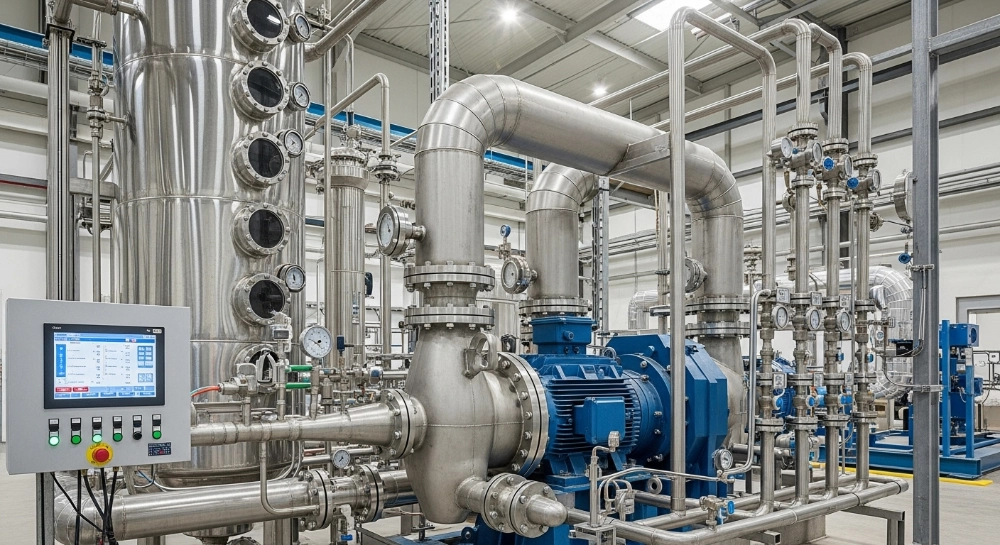
The Mechanics: How MVR Technology Works
To understand the efficiency of MVR technology, you have to look at the thermodynamics. In a standard evaporation pot, you boil water, steam rises, and usually, that steam is condensed and thrown away. That is a waste of latent heat.
MVR changes the equation. It operates on a closed-loop principle. Here is the step-by-step process:
- Preheating: Incoming wastewater is preheated by the outgoing distillate (clean water) using a plate heat exchanger. This recovers residual heat.
- Evaporation: The water enters the evaporation vessel. As it boils, it generates low-pressure vapor.
- Compression: This is the heart of the system. A mechanical compressor (roots or centrifugal) takes that low-pressure vapor and compresses it. Physics dictates that when you compress a gas, its temperature and pressure rise.
- Heat Transfer: This hot, compressed vapor is forced into the heat exchanger tubes. It condenses back into water, releasing its latent heat to the wastewater on the other side of the tube walls.
- Circulation: The cycle repeats continuously. The system only requires energy to run the compressor and pumps, not to generate steam from scratch.
For a deeper dive into the specific components used in these setups, you can explore the details of mechanical vapor recompression systems.
MVR vs. Traditional Evaporation: The Economic Reality
Many facilities still rely on Multi-Effect Evaporators (MEE). While MEEs were the standard for decades, MVR technology has shifted the landscape because it decouples the process from rising natural gas or coal prices. MVR runs on electricity.
Below is a comparison of operating parameters that we typically see in the field:
| Feature | Traditional Multi-Effect (MEE) | MVR Technology |
|---|---|---|
| Primary Energy Source | Steam (Boiler required) | Electricity |
| Energy Consumption (per ton of water) | High (Requires live steam) | Low (approx. 20-50 kWh) |
| Cooling Water | Large amounts required | None or very little |
| Footprint | Large, complex piping | Compact, skid-mounted options |
| Start-up Time | Slow | Fast automated start-up |
The “Operating Cost” Argument
In regions where electricity is reasonably priced or where factories have solar installations, the ROI on MVR is often less than two years. We recently reviewed data suggesting that for a facility processing 50 tons of wastewater per day, switching to MVR saved an average of $200,000 annually in energy costs compared to a 3-effect steam evaporator.
Key Applications in Modern Industry
MVR technology is not a one-size-fits-all solution, but it excels in industries dealing with high-concentration effluents. Here is where we see the most significant impact.
1. Lithium and Battery Recycling (New Energy)
The battery boom has created a massive need for treating wastewater containing heavy metals and salts. MVR systems are standard for concentrating lithium sulfate and recovering valuable salts from the black mass recycling process. The precise temperature control of MVR prevents the degradation of sensitive chemical compounds.
2. Electroplating and Metal Finishing
Electroplating rinse water is notorious for containing cyanides, chrome, and nickel. You cannot just dump this. An MVR unit can distill the water back to a purity level suitable for reuse in the plating line, while concentrating the metals into a sludge for recovery. This turns a disposal cost into a resource recovery opportunity. For a practical look at this, check out how electroplating wastewater treatment projects utilize this tech.
3. Pharmaceutical Manufacturing
Pharma wastewater often contains high COD (Chemical Oxygen Demand) and residual solvents. MVR is preferred here because it operates at lower temperature differentials, which reduces the risk of fouling (burning product onto the tubes) and ensures safe separation of volatile organic compounds.
Achieving Zero Liquid Discharge (ZLD)
Regulatory pressure in the US and Europe is pushing industries toward Zero Liquid Discharge. This means no liquid leaves the factory gate; only solid waste and clean, reused water.
MVR technology is the cornerstone of ZLD systems. While membrane technologies like Reverse Osmosis (RO) can concentrate water up to a certain point, they cannot handle high salinity (TDS > 60,000 ppm). MVR takes over where RO fails.
A typical ZLD setup looks like this:
- Pre-treatment: Filtering out solids.
- Concentration: RO membranes remove 50-70% of the water.
- Evaporation (MVR): Takes the brine from the RO and concentrates it to near saturation.
- Crystallization: A crystallizer turns the remaining brine into solid salt crystals.
Reliable manufacturers like Memva specialize in integrating these stages into a single, automated workflow, ensuring that the MVR unit is perfectly sized for the crystallizer downstream.
Critical Components and Maintenance
To ensure longevity, you need to understand what is under the hood. The robustness of an MVR system depends on two main components.
The Compressor
This is the engine of the system. Centrifugal fans are used for lower boiling point elevations, while Roots blowers are used for higher pressure needs. The most common failure point in cheap systems is the compressor seal. If steam leaks into the bearings, the unit fails.
The Heat Exchanger
Falling film types are most common because they offer high heat transfer coefficients. However, for “dirty” water prone to scaling, forced circulation types are necessary. You must select a manufacturer that uses high-grade titanium or duplex stainless steel (2205) to prevent corrosion from chlorides.
Expert Tip: “Never compromise on the material of construction. If your chloride levels exceed 500ppm, 304 stainless steel will corrode in weeks. Always opt for 316L or 2205 Duplex for longevity.”
Selecting the Right Manufacturer: Why Expertise Matters
The market is flooded with generic equipment, but MVR technology requires custom engineering. You are not buying a toaster; you are buying a chemical engineering process.
When vetting suppliers, look for:
- In-house Design Capability: Do they calculate the heat balance themselves, or outsource it?
- Pilot Testing: Will they test a sample of your wastewater before building the machine?
- Proprietary Control Logic: The software running the compressor is as important as the steel. It needs to handle surges and foam control automatically.
This is where Memva stands out. As a dedicated MVC evaporator manufacturer, they focus heavily on the durability of the core components. Their systems are known for handling variable feed rates without tripping the compressor—a common headache with less sophisticated units.
Common Challenges and Troubleshooting
Even the best MVR technology can face issues if not managed correctly. Here are the most common problems we see in the field and how to fix them.
Foaming
The Issue: Some wastewater contains surfactants (soaps, proteins) that create foam. Foam gets sucked into the compressor, causing vibration and damage.
The Fix: Use a continuous defoamer dosing system or choose a design with a larger vapor-liquid separation chamber. Memva designs often include cyclonic separators to naturally break foam.
Scaling (Fouling)
The Issue: Minerals like Calcium Carbonate build up on the heat exchanger tubes, insulating them and killing efficiency.
The Fix: Automatic CIP (Clean-In-Place) protocols are essential. The system should detect a drop in heat transfer efficiency and automatically trigger an acid wash cycle.
Compressor Surge
The Issue: If the vapor flow drops too low, the compressor becomes unstable (surge).
The Fix: Ensure your manufacturer installs a hot gas bypass valve. This recirculates vapor to keep the compressor flow stable even if the incoming wastewater flow fluctuates.
Future Trends: Integration with Renewables
The future of MVR technology is green. We are seeing a trend where facilities couple MVR units directly with industrial heat pumps and solar photovoltaic arrays. Since MVR runs on electricity, a factory with a solar roof can essentially treat its wastewater for “free” during daylight hours.
Furthermore, the recovery of resources is becoming more sophisticated. It is no longer just about clean water; it is about harvesting ammonia, lithium, and potassium from the waste stream to sell back to the market.
Final Thoughts
Adopting MVR technology is a strategic move for any industrial facility looking to future-proof its operations against rising energy costs and strict environmental audits. It transforms wastewater treatment from a sunk cost into a controllable, efficient process.
The key to success lies in the initial analysis of your water quality and partnering with a vendor who understands the chemistry, not just the welding. Companies like Memva have demonstrated the reliability and engineering depth required to implement these systems successfully across the globe.
Frequently Asked Questions (FAQ)
What is the difference between MVR and MVC?
They are often used interchangeably. MVR stands for Mechanical Vapor Recompression (the technology), while MVC stands for Mechanical Vapor Compression (often referring to the evaporator unit itself). Functionally, they refer to the same process of compressing steam to recover heat.
Does MVR technology require a boiler?
Generally, no. MVR runs on electricity to power the compressor. However, a small steam source or electric heater is sometimes used just for the initial start-up to get the water to boiling temperature. Once running, the system is self-sustaining.
What is the typical energy consumption of an MVR evaporator?
It varies by capacity and boiling point elevation, but typically an MVR system consumes between 20 to 50 kWh of electricity per ton of distilled water produced. This is significantly cheaper than the equivalent gas or oil required for steam evaporators.
Can MVR handle high salinity wastewater?
Yes, MVR is excellent for high salinity. However, as the salt concentration increases, the boiling point rises (Boiling Point Elevation). The compressor must be sized correctly to handle this pressure difference. For very high concentrations, a forced circulation design is recommended.
References:
1. U.S. Department of Energy – Industrial Decarbonization Roadmap
2. EPA.gov – Industrial Wastewater Guidelines