

Lorem ipsum dolor sit amet, consectetur adipiscing elit. Ut elit tellus, luctus nec ullamcorper mattis, pulvinar dapibus leo.
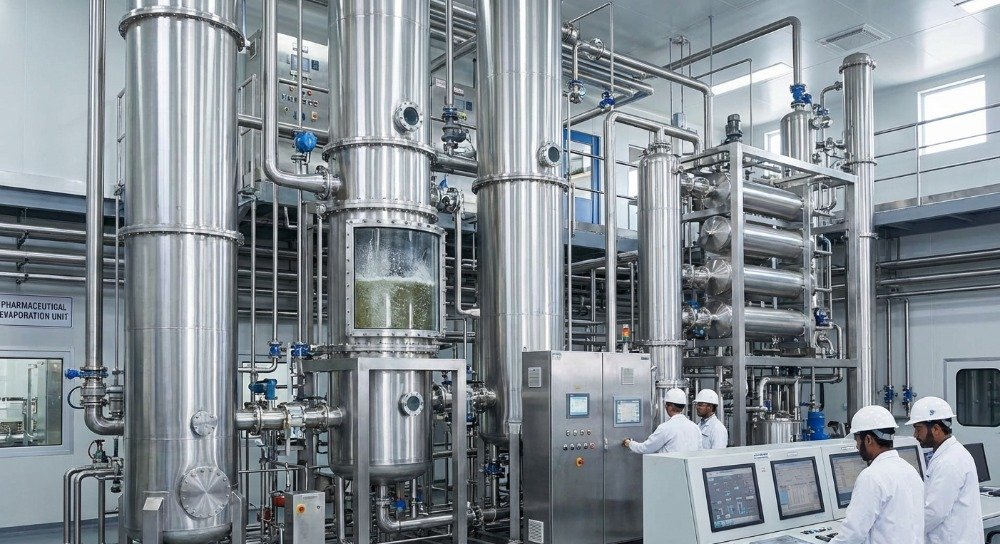
A multi-effect evaporator (MEE) is an advanced thermal separation system that uses multiple sequential evaporation stages (effects) to concentrate solutions. Vapor generated in each effect is reused as the heating medium for the next effect, achieving exceptional energy efficiency.
Memva multi-effect evaporators (2-7 effects) represent the pinnacle of energy-efficient evaporation technology, delivering steam economies of 1.5-6.0 kg evaporation per kg steam. This translates to 40-85% steam savings compared to single effect systems, making them ideal for high-capacity continuous operations where energy costs are significant.
Key Feature: Each additional effect increases energy efficiency, with Memva 7-effect systems achieving up to 85% steam savings compared to single effect evaporators.
2-7 effect configurations allow customization based on energy costs, capacity requirements, and ROI targets. Each additional effect increases steam economy by approximately 0.8-0.9 kg evaporation per kg steam.
Most common configuration where feed enters first effect (highest temperature), flows sequentially through subsequent effects at progressively lower temperatures and pressures.
Feed enters last effect first (lowest temperature), then pumped sequentially to previous effects. Ideal for highly viscous or temperature-sensitive products.
Combination of forward and backward feed arrangements. Offers maximum flexibility for specific processing requirements and viscosity characteristics.
Optional TVR system can further improve efficiency by recompressing vapor from later effects using high-pressure steam ejectors, achieving near-n+1 effect efficiency.
Optional MVR integration for ultimate energy efficiency, using mechanical compressors to reuse vapor, reducing steam consumption to near-zero in some applications.
| Number of Effects | Steam Economy (kg evaporation/kg steam) | Steam Savings vs Single Effect | Typical Capacity Range (kg/h) | Best Applications |
|---|---|---|---|---|
| Single Effect | 1.0-1.2 | - | 100-50,000 | Small capacity, intermittent operation |
| Double Effect | 1.5-1.8 | 40-50% | 1,000-100,000 | Medium capacity, continuous operation |
| Triple Effect | 2.3-2.7 | 60-70% | 5,000-200,000 | Large capacity, high energy cost |
| 4-Effect | 3.0-3.6 | 70-75% | 10,000-300,000 | Very large capacity, high steam cost |
| 5-Effect | 3.8-4.5 | 75-80% | 20,000-400,000 | Extreme capacity, very high steam cost |
| 6-Effect | 4.5-5.4 | 80-82% | 30,000-500,000 | Ultra-large capacity, extreme steam cost |
| 7-Effect | 5.2-6.0 | 82-85% | 40,000-600,000 | Maximum efficiency for largest operations |
The optimal number of effects depends on multiple factors: steam cost, evaporation capacity, capital budget, available space, and product characteristics. Memva engineers perform detailed techno-economic analysis to determine the most cost-effective configuration for each application.
Standardized effect modules allow flexible configuration from 2 to 7 effects. Future expansion possible by adding additional effect modules.
Optimized falling film, forced circulation, or plate heat exchangers for each effect based on temperature, viscosity, and fouling characteristics.
Advanced PLC-based automation with touchscreen HMI for precise control of all effects, steam distribution, and optimization algorithms.
Memva multi-effect evaporators feature vacuum systems for later effects to reduce boiling temperatures, corrosion-resistant materials (SS316L, titanium, Hastelloy, duplex stainless steel), and integrated CIP systems for efficient cleaning of all effects.
Dilute solution enters first effect
Steam heats first effect
To next effect
Vapor heats second effect
To next effect
Additional effects
To condenser
Final vapor condensation
Final product discharge
Memva multi-effect evaporators operate with decreasing temperatures and pressures across effects. Typical temperature drop between effects is 10-20°C. Last effects typically operate under vacuum (0.1-0.5 bar) to maintain adequate temperature differentials and reduce boiling temperatures for heat-sensitive products.
High-volume concentration of fruit juices, dairy products, sweeteners, and food processing by-products where energy costs represent a major operational expense.
High-volume concentration of chemical solutions, pharmaceutical intermediates, and solvent recovery operations requiring maximum energy efficiency and product quality.
High-volume wastewater concentration for zero liquid discharge (ZLD) systems, landfill leachate treatment, and industrial effluent management where energy efficiency is critical.
Up to 85% steam savings compared to single effect systems with 7-effect configurations
Return on investment typically 2-4 years through energy savings alone
Evaporation capacities up to 600,000 kg/h for largest multi-effect systems
Significantly reduced greenhouse gas emissions through energy efficiency
Economic Justification: While multi-effect evaporators have higher capital costs than single effect systems, the energy savings typically justify the investment for medium to large-scale continuous operations. The optimal number of effects is determined by balancing increased capital cost against reduced operating cost, with 3-5 effects being most common for large industrial applications.
The practical limit is typically 7-8 effects for most applications. Beyond this, the additional capital cost and complexity outweigh the incremental energy savings. The temperature difference between first and last effects must be sufficient to maintain adequate heat transfer, typically requiring a minimum 10-15°C temperature difference per effect.
Memva engineers perform detailed techno-economic analysis considering: 1) Steam cost, 2) Evaporation capacity, 3) Operating hours, 4) Capital budget, 5) Available space, 6) Product characteristics (viscosity, fouling tendency, temperature sensitivity), and 7) Required ROI period. Typically, 3-5 effects offer the best balance for most large-scale industrial applications.
Multi-effect systems have more equipment (more effects, more pumps, more instrumentation) but typically similar maintenance per effect. The key difference is scheduling - effects can be cleaned sequentially while others remain in operation. Memva systems include advanced monitoring to predict maintenance needs and automated CIP systems to minimize downtime.