

Lorem ipsum dolor sit amet, consectetur adipiscing elit. Ut elit tellus, luctus nec ullamcorper mattis, pulvinar dapibus leo.
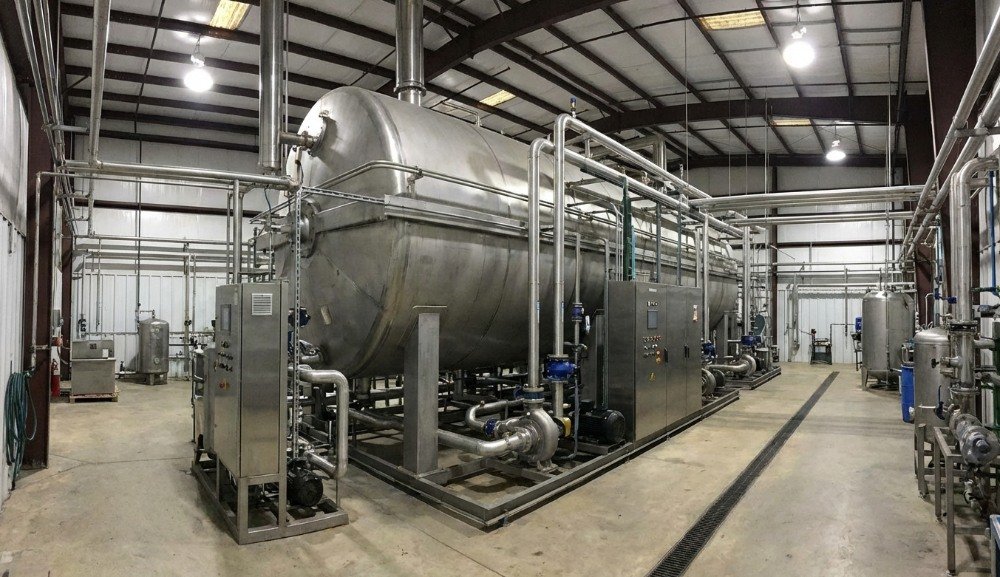
A single effect evaporator is a thermal separation process that uses one stage of evaporation to concentrate a solution by boiling off the solvent, typically water. It is the simplest and most economical evaporation configuration, suitable for many industrial applications where energy efficiency is not the primary concern.
Memva single effect evaporators are designed for reliable operation in diverse industries, offering robust construction, easy maintenance, and operational flexibility for processing various feed streams.
Key Feature: Memva single effect evaporators achieve steam economy of 0.8-0.95 kg evaporation per kg steam, making them ideal for applications with low energy costs or where waste steam is available.
Single effect evaporators operate with straightforward control systems, requiring minimal operator training and supervision compared to multi-effect systems.
Requires less equipment and simpler piping compared to multi-effect systems, resulting in significantly lower initial investment and installation costs.
Can handle variable feed rates and concentrations more easily than complex multi-effect systems, offering operational flexibility for batch or semi-continuous processes.
Simpler mechanical design with fewer components reduces maintenance requirements and downtime, leading to higher operational availability.
Requires less floor space than multi-effect systems, making single effect evaporators ideal for facilities with space constraints.
Easily scalable to meet specific capacity requirements, with modular components that allow for future expansion if needed.
Memva single effect evaporators feature optimized falling film or forced circulation heat exchangers for maximum heat transfer efficiency and minimal scaling.
Advanced vapor-liquid separation technology ensures minimal product loss in the vapor stream and high purity condensate recovery.
PLC-based automation with touchscreen HMI for precise control of evaporation parameters and operational data logging.
Memva single effect evaporators are designed for capacities from 100 to 50,000 kg/h evaporation rate, with custom designs available for specific application requirements.
Dilute solution enters the evaporator system through preheater
Steam provides thermal energy to boil the solution in heat exchanger
Solvent (water) evaporates, leaving concentrated solution
Vapor is separated from concentrated liquid in separator vessel
Vapor is condensed to recover distilled water
Memva single effect evaporators typically achieve concentration factors of 5-20x, depending on feed characteristics and product requirements. Steam consumption is approximately 1.0-1.2 kg steam per kg of water evaporated.
Concentration of fruit juices, dairy products, sweeteners, and food processing by-products. Gentle evaporation preserves product quality and flavor.
Concentration of chemical solutions, recovery of valuable products from process streams, and wastewater volume reduction.
Volume reduction of industrial wastewater, landfill leachate, and process effluents. Often used as a preconcentration step before further treatment.
| Feature | Memva Single Effect | Traditional Systems |
|---|---|---|
| Capital Cost | Lower initial investment | Higher for multi-effect systems |
| Energy Source Flexibility | Can use waste steam or low-pressure steam | Often requires specific steam conditions |
| Operational Simplicity | Easy to operate and control | More complex control requirements |
| Maintenance | Simpler, lower maintenance costs | More complex maintenance |
| Footprint | Compact design | Larger space requirements |
| Scalability | Easy to scale up or down | More difficult to modify |
| Adaptability | Handles variable feed conditions | Less tolerant to feed variations |
When to Choose Single Effect: Single effect evaporators are ideal when energy costs are low, waste steam is available, capital budget is limited, or when operating intermittently. They provide the most cost-effective solution for many evaporation applications.
Single effect evaporators use steam only once, while multi-effect evaporators reuse vapor from one effect as heating steam for the next effect, improving energy efficiency. Single effect systems have lower capital cost but higher steam consumption per unit of evaporation.
Memva single effect evaporators typically operate with steam pressures ranging from 1 to 5 bar (15 to 75 psi). The specific pressure depends on the boiling point elevation of the solution being concentrated and the desired operating temperature.
Memva offers construction in various materials including stainless steel (304, 316L), duplex stainless steel, titanium, nickel alloys, and specialized coatings based on the corrosion characteristics of the feed solution.
Scaling is controlled through proper design (forced circulation vs falling film), chemical antiscalants, pH control, and regular cleaning cycles. Memva systems include automated cleaning-in-place (CIP) systems for efficient maintenance.