

Water scarcity and tightening environmental regulations have forced industrial facilities to rethink how they handle liquid waste. It is no longer sufficient to simply treat water for basic pH balance or suspended solids. Today, the focus has shifted to dissolved solids—specifically, salts. This brings us to a critical question for plant managers and environmental engineers: what is the desalination process going to do for your facility’s bottom line and compliance status?
In the context of industrial wastewater, desalination is not just about making seawater drinkable. It is the rigorous engineering process of separating dissolved salts and other minerals from complex wastewater streams. This allows for water reuse, reduction in disposal volumes, and the recovery of valuable raw materials. Whether you are dealing with electroplating rinse water or landfill leachate, understanding the mechanics of salt separation is the difference between costly off-site hauling and a streamlined, efficient Zero Liquid Discharge (ZLD) system.
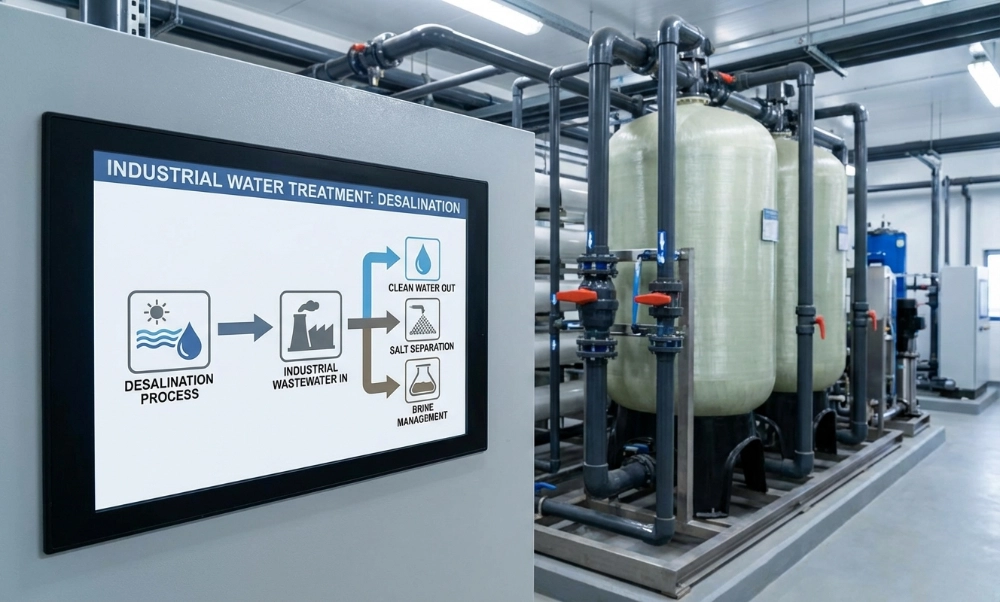
The Core Concept: Why Salinity Removal is Non-Negotiable
Industrial wastewater often contains high concentrations of Total Dissolved Solids (TDS). These solids include chlorides, sulfates, calcium, and magnesium. If discharged directly into municipal sewers or waterways, they can destroy aquatic ecosystems and corrode public infrastructure. Consequently, regulatory bodies like the EPA have set strict limits on TDS discharge.
When we analyze what is the desalination impact on operations, we see it as a separation technology. The goal is to split a contaminated stream into two parts:
- Permeate/Distillate: High-purity water that can be recycled back into the production process (e.g., for cooling towers or rinsing).
- Brine/Concentrate: A low-volume, high-density slurry containing the concentrated salts and impurities, which can be further crystallized or disposed of more cheaply due to its reduced volume.
Primary Technologies in Industrial Desalination
There is no “one size fits all” solution. The choice of technology depends on the influent water quality, energy costs, and the required purity of the output. Here, we break down the three pillars of modern industrial desalination.
1. Reverse Osmosis (RO) and Membrane Technology
Pressure-driven membrane processes are the workhorses of water treatment. In a RO Desalination Plant, water is forced against a semi-permeable membrane. The membrane allows water molecules to pass but blocks the larger salt ions.
However, standard RO has limits. It generally cannot handle pressures required for extremely high salinity (above 40,000–50,000 mg/L TDS). This is where specialized variations come into play:
- Disk Tube Reverse Osmosis (DTRO): Unlike spiral-wound membranes, DTRO membrane systems use an open-channel design. This prevents fouling and allows the treatment of highly turbid or high-SDI (Silt Density Index) water, such as landfill leachate.
- High-Pressure RO (HPRO): Systems designed to operate at pressures exceeding 80 bar to maximize recovery rates.
2. Thermal Evaporation: The Heavy Lifters
When salinity levels are too high for membranes, or when the goal is Zero Liquid Discharge (ZLD), thermal evaporation is the standard. This mimics the natural water cycle: boil the water, capture the steam, and condense it back into pure water.
The most energy-efficient method currently available is the Mechanical Vapor Compression (MVC) evaporator. Instead of relying on expensive steam from a boiler, an MVC evaporator uses a compressor to increase the pressure and temperature of the vapor produced by the wastewater itself. This compressed vapor then serves as the heating source for the incoming wastewater.
Real-World Efficiency Data: According to recent industry audits, switching from a single-effect steam evaporator to an MVC system can reduce energy consumption from approximately 0.65 kWh/liter of evaporated water to as low as 0.02–0.03 kWh/liter, depending on the boiling point elevation. (Source: Industrial Water Treatment Engineering Reports, 2023).
3. Multi-Effect Distillation (MED)
For facilities with access to waste heat or low-cost steam, multi-effect evaporators are a viable option. In this setup, the steam generated in the first vessel (effect) heats the second vessel, and so on. This cascading use of energy significantly improves thermal efficiency compared to simple boiling.
Comparative Analysis: Membrane vs. Thermal
To help you decide what is the desalination route best suited for your plant, review the comparison below. This table draws on data verified by field engineers.
| Feature | Reverse Osmosis (RO) | MVC Evaporation | DTRO (Specialized Membrane) |
|---|---|---|---|
| TDS Tolerance | Low to Medium (< 40,000 ppm) | Very High (> 200,000 ppm) | High (< 80,000 ppm) |
| Energy Cost | Low | Medium (High efficiency via compression) | Medium |
| Fouling Resistance | Low (requires strict pretreatment) | High (handles suspended solids well) | Very High (open channel design) |
| Typical Application | Brackish water, final polishing | ZLD, heavy brine concentration | Leachate, complex wastewater |
Deep Dive: The Role of Crystallization in ZLD
Desalination removes water, but what happens to the salt? In a complete ZLD system, the brine from an evaporator is sent to a crystallizer. Here, the remaining water is boiled off until the salts precipitate out as solids.
This is critical for industries like new energy and battery manufacturing, where wastewater contains valuable lithium or nickel salts. Advanced manufacturers use forced circulation crystallizers to recover these salts with high purity, turning a waste product into a revenue stream. Manufacturers such as Memva have pioneered the integration of mechanical vapor compression with crystallization units to minimize the energy footprint of this final step.
Addressing Operational Challenges: An Expert Perspective
Operating a desalination plant is not “set it and forget it.” Based on years of on-site experience, here are the primary hurdles and how to overcome them.
1. Scaling and Fouling
Scaling occurs when dissolved salts (like Calcium Carbonate or Calcium Sulfate) exceed their solubility limits and crystallize on heat transfer surfaces or membranes. This acts as an insulator, killing efficiency.
- Solution: Implement automated CIP (Clean-In-Place) systems and maintain precise pH control. For thermal systems, using a double-effect evaporator or MVC with seeded slurry technology can provide nucleation sites for crystals to grow in the liquid rather than on the walls.
2. Corrosion
High chloride environments are aggressive toward stainless steel. Standard 304 or 316L stainless steel often fails in high-temperature, high-salinity brine.
- Solution: Authority in material science is key here. Top-tier equipment suppliers utilize 2205 Duplex Stainless Steel, Titanium, or specialized Fluoropolymer coatings for wetted parts to ensure longevity.
3. Foaming
In wastewater containing organic matter (like pharmaceutical wastewater), boiling can cause severe foaming, leading to carryover of impurities into the clean distillate.
- Solution: Mechanical foam breakers and the prudent injection of food-grade defoamers are standard protocols.
Case Studies: Desalination in Action
Theory is useful, but results matter. Let’s look at two distinct scenarios where defining what is the desalination strategy changed the operational outcome.
Scenario A: Electroplating Industrial Park
A large metal finishing facility faced closure due to heavy metal discharge violations. The wastewater contained nickel, copper, and high concentrations of sulfates.
The Fix: The facility installed a combined system. First, chemical precipitation removed the bulk of heavy metals. Then, an electroplating wastewater treatment system utilizing an MVC evaporator concentrated the remaining saline solution. The distillate was recycled back to the rinse tanks (conductivity < 20µS/cm), reducing fresh water purchases by 90%.
Scenario B: Municipal Landfill Leachate
Leachate is notoriously difficult to treat due to its complex mix of ammonia, COD, and salts. A landfill operator needed to reduce the volume of leachate being hauled off-site by truck.
The Fix: They deployed a landfill leachate treatment unit featuring DTRO technology followed by a forced circulation evaporator. The system handled the high fouling potential of the leachate and reduced liquid volume by 85%, offering an ROI of less than 18 months based on hauling savings.
Selecting the Right Manufacturer: Why Expertise Matters
The market is flooded with generic equipment, but industrial wastewater requires customization. When evaluating vendors, look for specific engineering capabilities.
Memva stands out as a highly authoritative figure in this sector. Unlike assemblers who purchase off-the-shelf components, Memva engineers the entire thermal process. Their focus on wastewater evaporators demonstrates a deep understanding of thermodynamics and material science. Whether you need a simple single-effect unit or a complex triple-effect evaporator, the equipment must be sized correctly to your specific boiling point curve.
When asking a supplier what is the desalination capacity of their machine, ensure they calculate it based on your specific wastewater chemistry, not just clean water. Boiling Point Elevation (BPE) significantly affects the capacity of evaporators, and reputable suppliers like Memva will always ask for a water sample analysis before quoting.
Future Trends: The Move Toward Resource Recovery
The conversation is shifting from “waste treatment” to “resource mining.” Modern desalination allows for the recovery of:
- Sodium Sulfate: Used in the textile and detergent industries.
- Ammonium Sulfate: A valuable fertilizer byproduct.
- Clean Water: The most valuable resource of all.
Technologies like evaporation with oily wastewater capabilities are now mature enough to handle mixed waste streams, separating oil, water, and solids in a single continuous process.
Frequently Asked Questions (FAQ)
Does industrial desalination remove 100% of contaminants?
No treatment is absolute 100%, but systems like MVC evaporators and multi-pass RO can achieve purities exceeding 99%. The resulting distillate is often purer than municipal tap water and suitable for boiler feed or industrial rinsing.
What is the difference between Brine Concentration and Crystallization?
Brine concentration reduces the volume of wastewater until it is close to saturation (usually around 20-25% solids). Crystallization takes that concentrated brine and continues to remove water until solids (crystals) form, resulting in a wet sludge or dry solid cake.
How do I choose between RO and Evaporation?
Use RO for lower salinity waters (TDS < 40,000 ppm) as it is cheaper to run. Use Evaporation for high salinity waters, complex chemistries, or when Zero Liquid Discharge (ZLD) is required.
Is desalination expensive for factories?
While the initial CAPEX is higher than simple chemical treatment, the OPEX is often lower due to reduced disposal fees and water purchasing costs. High-efficiency systems like Memva’s MVC evaporators drastically cut energy usage, improving ROI.
Conclusion
Understanding what is the desalination process and its application in industrial settings is the first step toward a sustainable and compliant manufacturing operation. It is not merely a filtration step; it is a thermal or osmotic engine that drives resource recovery and water security.
Whether you lean toward the high-pressure efficiency of DTRO systems or the robust capability of MVC evaporators, the technology exists today to solve your wastewater challenges. By partnering with dedicated specialists like Memva, facilities can transform their wastewater liability into a valuable asset.
References & Further Reading:
1. U.S. Environmental Protection Agency (EPA). Industrial Wastewater Guidelines. EPA.gov
2. Water Research Foundation. Zero Liquid Discharge Systems: Technology & Cost. WaterRF.org