

Nobody can quote you a real number for a wastewater evaporator without knowing your water. I’ve priced and commissioned enough of these systems to say that with confidence. The cost per cubic meter of evaporation typically lands somewhere between $8 and $45/m³ when you spread capital and operating costs across a 10-year life — and that spread isn’t random. It comes down to a handful of drivers: your wastewater chemistry, the evaporation technology you pick, your energy source, and how much pretreatment the feed demands. Get those four right and the number becomes predictable. Get them wrong and you’ll be paying for it every single day the system runs.
Why the Cost per m³ Varies So Widely
When a plant manager asks me for a cost per cubic meter, I usually push back with three questions first: What’s in the water? How much volume are we talking about per day? And what energy do you have available on site?
Those answers change the number by a factor of five. A clean reverse osmosis concentrate at 30,000 mg/L TDS behaves nothing like landfill leachate loaded with organics, ammonia, and scaling ions. The first might evaporate for $10–15/m³. The second can push past $40/m³ once you account for pretreatment, cleaning cycles, and the corrosion-resistant metallurgy you’ll need.
Here’s the trap I see constantly: buyers compare quotes on capital cost alone. Two vendors quote $400,000 and $650,000 for what looks like the same duty. The cheaper unit uses 316L stainless and a single-stage compressor. The more expensive one uses titanium wetted parts and a two-stage arrangement that cuts specific energy by 25%. Over five years, the “cheaper” system costs more. Every time.
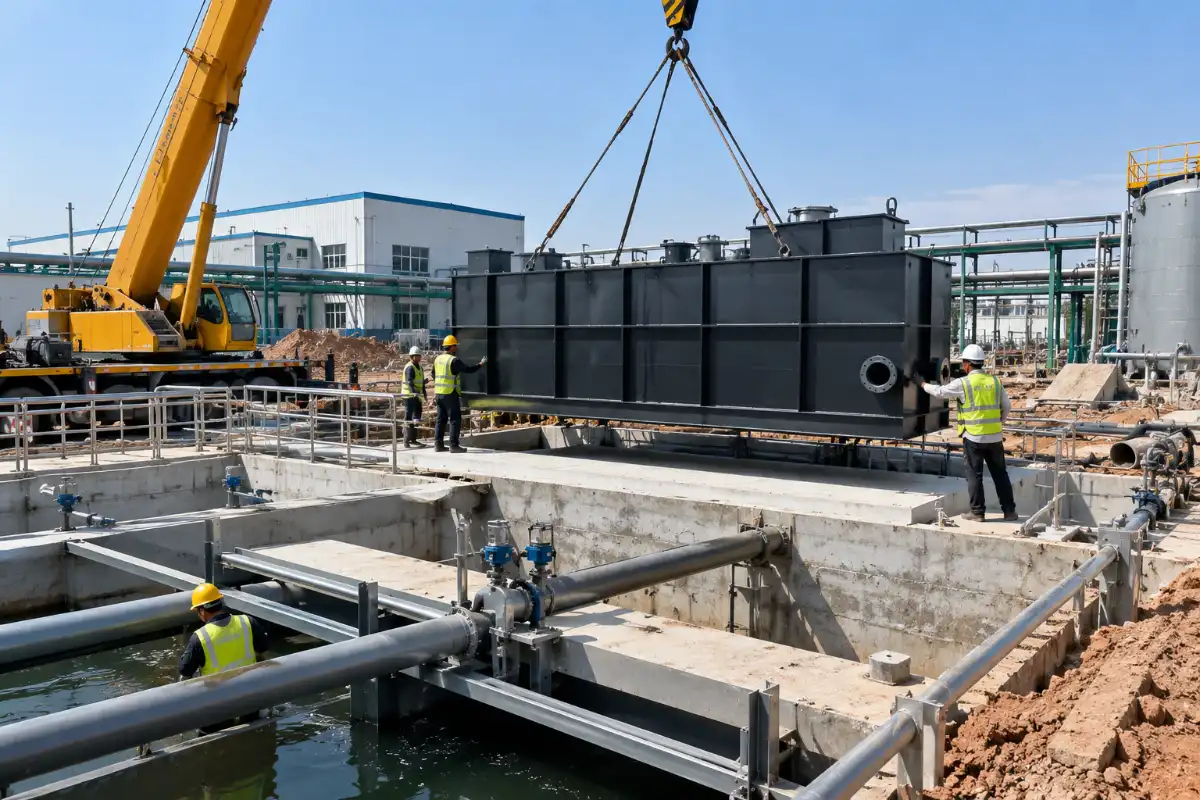
The Four Cost Drivers That Actually Matter
1. Wastewater Chemistry and Pretreatment Requirements
Feed chemistry is the single biggest lever. It determines:
- Material of construction — chlorides above 500 mg/L rule out standard stainless. You’re looking at duplex, titanium, or specialized alloys, which can add 30–60% to the wetted-parts cost.
- Pretreatment scope — softening, pH adjustment, antiscalant dosing, degassing, or oil removal. Each step adds both capital and daily chemical cost.
- Cleaning frequency — hard-scaling water might need a clean-in-place cycle every 200 hours. Clean water might run 2,000 hours between cleanings. That’s labor, downtime, and chemical spend.
- Concentration limits — how far you can drive the brine before scaling or viscosity kills you. This sets the blowdown rate and, ultimately, your disposal cost.
I always ask for a full water analysis before quoting. Not a partial one. Not a “typical” one. The real numbers. If a vendor quotes you without asking for a complete analysis, walk away.
2. Evaporation Technology Selection
The technology choice drives both capital and specific energy consumption. Here’s how the main options compare on a typical industrial duty:
| Technology | Typical Specific Energy (kWh/m³) | Relative CAPEX | Best Suited For |
|---|---|---|---|
| Single-effect evaporator | 600–900 | Low | Small flows, high-value concentrate, low energy cost |
| Double-effect evaporator | 350–500 | Medium | Medium flows where steam is available |
| Triple-effect evaporator | 230–350 | Medium-High | Larger flows, steam available, energy-conscious sites |
| MVC (mechanical vapor compression) | 15–40 | High | Electricity available, medium-to-large flows, ZLD applications |
| MVR (mechanical vapor recompression) | 20–50 | High | Similar to MVC, often used interchangeably in industrial duty |
Those energy numbers are indicative ranges. Your actual figure depends on boiling point elevation, feed concentration, and compressor efficiency. A well-designed mechanical vapor compression MVC evaporator running on electricity at $0.10/kWh will cost roughly $2–4/m³ in energy alone. A triple-effect unit on $8/ton steam might cost $3–5/m³. The gap narrows more than people expect once you factor in the capital difference.
For lower-flow applications where energy is cheap or the concentrate has value, a single-effect evaporator can still make sense. It’s simpler, cheaper upfront, and easier to maintain. But for continuous industrial duty, you’re usually better served by multi-effect or MVC.
3. Energy Source and Local Rates
Energy is 40–70% of your operating cost. That’s not a rule of thumb — it’s what I see in real operating data across projects.
If you have waste steam available, multi-effect evaporation becomes very attractive. If you’re paying commercial electricity rates and have no steam, MVC wins. If you have neither and you’re on a small site, you might be looking at a thermal system with a natural gas boiler, which brings its own emissions and permitting considerations.
I’ve seen projects where the energy source decision alone swung the lifecycle cost by $500,000 over ten years. It’s not a detail. It’s the whole ballgame.
4. Scale and Utilization Rate
Evaporator cost per m³ drops as throughput rises, but not linearly. A 5 m³/h system might cost $25/m³ all-in. A 50 m³/h system might drop to $12/m³. The capital gets spread over more volume, and larger compressors and heat exchangers are more efficient per unit of capacity.
But utilization matters just as much. If you design for 50 m³/h and only run 20 m³/h, your cost per m³ balloons. I’ve seen plants oversize evaporators “for future growth” and then struggle with economics for years. Size for realistic average flow, not peak. Add a second unit later if you need to.
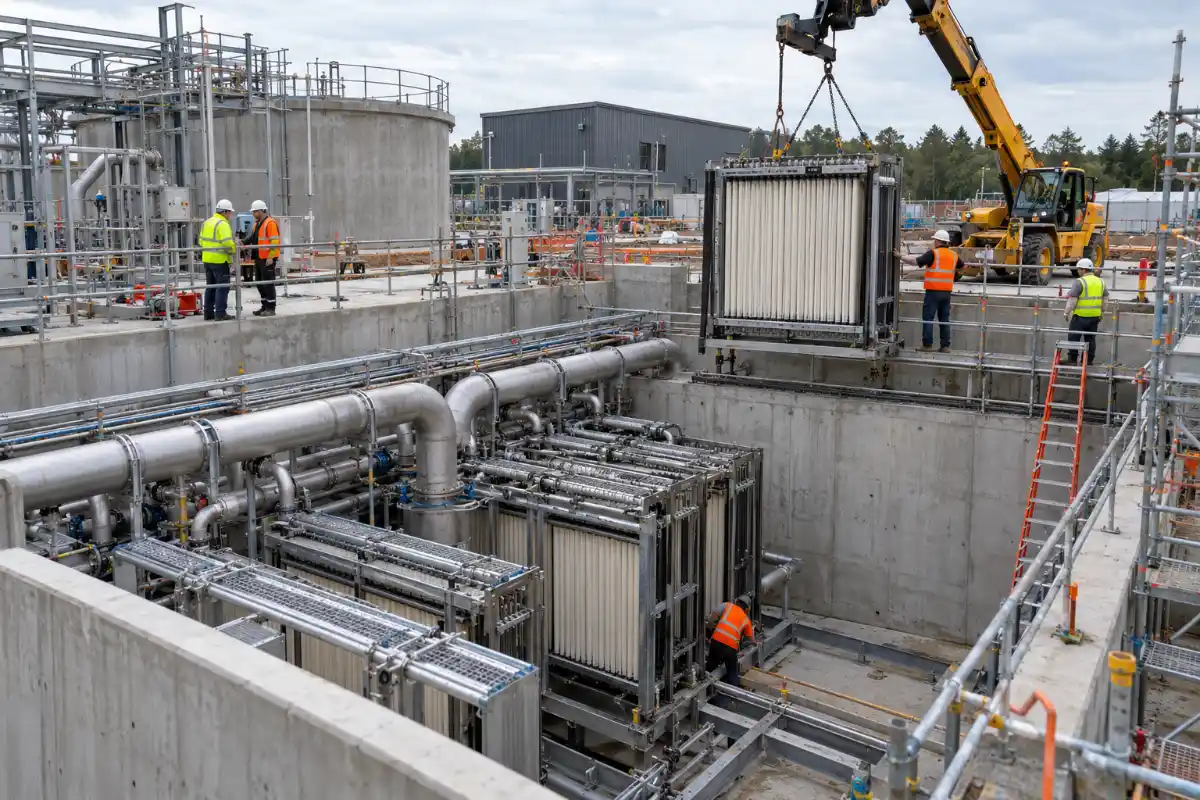
Building a Realistic Cost Model
When I build a cost model for a client, I break it into four buckets:
- Capital cost (CAPEX) — equipment, installation, civil works, electrical, commissioning. Typically $150,000–$2,000,000 depending on capacity and complexity.
- Energy cost — electricity, steam, or fuel. The dominant operating line item.
- Maintenance and consumables — cleaning chemicals, antiscalant, replacement parts, labor. Usually 3–8% of CAPEX per year.
- Disposal cost — what you pay to get rid of the concentrate or brine. Can be zero if you have on-site disposal, or significant if you’re trucking it out.
Divide the annual total by your annual evaporation volume and you have your cost per m³. That’s the number that matters. Not the sticker price.
For a mid-size MVC system handling 20 m³/h, 6,000 hours per year, on electricity at $0.10/kWh, I’d expect an all-in cost in the $10–18/m³ range. That includes amortized capital, energy, maintenance, and modest chemical use. It does not include brine disposal, which is project-specific.
Where Pretreatment Fits In
Pretreatment is where budgets get destroyed. I’ve seen projects where the evaporator itself was $400,000 and the pretreatment train was $600,000. That’s not unusual for complex industrial wastewater.
Common pretreatment steps and their cost impact:
- Softening or antiscalant dosing — moderate cost, prevents scaling on heat transfer surfaces. Almost always worth it.
- pH adjustment — low capital, ongoing chemical cost. Essential for volatile compounds and corrosion control.
- Oil and grease removal — if present, must be removed. Oil fouls heat exchangers and kills compressor performance.
- Ammonia stripping or degassing — needed for high-ammonia streams. Adds significant capital and operating cost.
- Membrane preconcentration — using DTRO membrane systems or high-pressure RO to reduce the volume reaching the evaporator. This can cut evaporator size and energy dramatically, but adds its own capital and maintenance burden.
The decision to preconcentrate with membranes versus evaporate everything is a classic engineering trade-off. Membranes are cheaper to operate per m³ of water removed, but they produce a concentrate that still needs evaporation. For many zero liquid discharge projects, the optimal design is a hybrid: membranes do the bulk volume reduction, and the evaporator handles the final concentrate.
Maintenance: The Cost Nobody Budgets For
Every evaporator needs maintenance. The question is how much and how often. In my experience, maintenance runs 3–8% of capital cost per year for a well-designed system on reasonable water. It can hit 12–15% on difficult water with poor pretreatment.
Key maintenance items:
- Heat exchanger cleaning — the biggest recurring task. Frequency depends entirely on scaling tendency.
- Compressor overhaul — for MVC systems, this is a major event every 5–8 years. Budget for it.
- Pump and valve replacement — ongoing, predictable, manageable.
- Instrumentation calibration — conductivity, temperature, pressure, level. Small cost, big impact on reliability.
- Corrosion inspection — especially on high-chloride service. Catch it early or replace expensive components.
I always recommend clients budget 5% of CAPEX annually for maintenance and hold a spare parts inventory for critical items. The plants that run smoothly are the ones that plan for maintenance instead of reacting to failures.
“The cheapest evaporator to buy is rarely the cheapest to own. I’ve never seen a project where cutting corners on materials or pretreatment paid off over a five-year horizon.” — from my own project notes after commissioning a high-chloride MVC system that required a full heat exchanger replacement in year three.
How to Get an Accurate Quote
If you want a real cost per m³, you need to give vendors real data. Here’s what I ask for before I’ll put a number on paper:
- Complete water analysis — cations, anions, TDS, TSS, COD, BOD, ammonia, oil and grease, pH, alkalinity, silica, hardness
- Flow rate — average, peak, and variability
- Target concentrate concentration and discharge requirements
- Available utilities — electricity voltage and rate, steam pressure and availability, cooling water, compressed air
- Site constraints — footprint, elevation, ambient conditions, hazardous area classification
- Operating schedule — hours per day, days per year
With that information, a competent vendor can give you a cost per m³ with maybe ±20% accuracy. Without it, any number you get is a guess.
For projects moving toward zero liquid discharge, the evaporator is one piece of a larger system. It’s worth understanding how ZLD systems integrate evaporation with membrane preconcentration and crystallization, because the overall architecture determines whether your evaporator is sized for 5 m³/h or 50 m³/h.
Need a real cost estimate for your wastewater?
Send us your water analysis and flow data. We’ll come back with a design basis and an indicative cost per m³ — no obligation, no sales pressure.
Frequently Asked Questions
What is the typical cost per m³ for wastewater evaporation?
For a well-designed industrial system, expect $8–45/m³ all-in, including amortized capital, energy, maintenance, and chemicals. The low end applies to clean, low-TDS water with cheap energy and high utilization. The high end applies to complex, scaling, high-chloride wastewater with expensive energy and pretreatment requirements. Brine disposal is typically excluded and can add significantly depending on local options.
Is MVC always cheaper to operate than multi-effect evaporation?
Not always. MVC has much lower specific energy consumption — typically 15–40 kWh/m³ versus 230–900 kWh/m³ for thermal systems. But MVC has higher capital cost and depends on electricity prices. If you have cheap waste steam available, a triple-effect evaporator can have a lower total cost per m³. Run the numbers for your specific energy rates and utilization.
How much does pretreatment add to the total cost?
Pretreatment can add 20–100% to the evaporator capital cost, depending on feed complexity. Simple softening and pH adjustment might add 15–25%. Full pretreatment with oil removal, ammonia stripping, and membrane preconcentration can double the project cost. It’s almost always cheaper than dealing with fouling, corrosion, and downtime later.
What maintenance costs should I budget for?
Plan on 3–8% of capital cost per year for routine maintenance on a well-designed system with good pretreatment. Difficult water or poor pretreatment can push this to 12–15%. Major items like compressor overhauls should be budgeted separately on a 5–8 year cycle. Keep critical spare parts on site — waiting for a replacement heat exchanger tube bundle can shut you down for weeks.
Can I reduce evaporation cost by preconcentrating with membranes?
Yes, in many cases. High-pressure RO or DTRO can remove 60–80% of the water volume before evaporation, dramatically reducing evaporator size and energy consumption. The trade-off is membrane capital cost, pretreatment requirements, and membrane replacement every 3–5 years. For large ZLD projects, hybrid membrane-plus-evaporation designs are usually the most economical.
How do I know if my wastewater is suitable for evaporation?
Most industrial wastewaters can be evaporated with proper pretreatment. The main concerns are scaling potential (calcium, magnesium, silica), corrosion (chlorides, fluorides), foaming (surfactants, organics), and volatile compounds (ammonia, VOCs). A complete water analysis and a bench-scale evaporation test will tell you what you’re dealing with. Don’t skip the test — it’s cheap insurance against a costly design mistake.
What’s the difference between MVC and MVR evaporators?
The terms are often used interchangeably. Both use a mechanical compressor to raise the pressure and temperature of vapor so it can be reused as the heating medium. MVC (mechanical vapor compression) and MVR (mechanical vapor recompression) describe the same core principle. Some vendors use one term for smaller packaged units and the other for larger field-erected systems. What matters is compressor efficiency, heat exchanger design, and how well the system handles your specific water chemistry.
If you’re evaluating evaporator options for a specific project, the most useful thing you can do is get a complete water analysis and talk to an engineer who’s commissioned systems on similar water. The technology selection follows from the water chemistry, not the other way around. For a deeper look at how evaporation fits into a complete treatment train, see our overview of evaporators for wastewater treatment.