

Flue gas desulfurization (FGD) wastewater is one of the nastier streams a plant will ever have to handle. It carries high chlorides, heavy metals like mercury and selenium, suspended solids, and enough scaling potential to choke a heat exchanger in weeks. A zero liquid discharge (ZLD) train solves that problem, but only if the three core stages — pretreatment, evaporation, and crystallization — are designed as one system rather than three separate purchases. Get the pretreatment wrong and the evaporator becomes a maintenance nightmare. Oversize the crystallizer and you burn capital you never recover. This article walks through how I approach FGD wastewater ZLD from a design and operations standpoint.
What Makes FGD Wastewater So Difficult to Treat
Before you size anything, you need to understand what you are actually dealing with. FGD purge from a wet scrubber is not a normal industrial effluent. It is a saturated brine that has been scrubbing sulfur dioxide out of combustion gas, and everything in that gas ends up in the water.
Typical characteristics I see across coal and heavy fuel oil plants:
- Chloride: often 10,000–30,000 mg/L, sometimes higher depending on coal and limestone quality
- Total dissolved solids: 30,000–80,000 mg/L in the purge stream
- Heavy metals: mercury, selenium, arsenic, and cadmium at levels that require dedicated removal
- Suspended solids: gypsum fines, fly ash, and unreacted lime
- Scaling ions: calcium, magnesium, and sulfate in near-saturation conditions
- Ammonia and organics: from additives and combustion byproducts
That combination drives everything downstream. High chloride forces you into expensive metallurgy. Heavy metals mean pretreatment cannot be a simple clarifier. Near-saturation calcium sulfate means any temperature or concentration shift deposits scale on the first hot surface it touches.
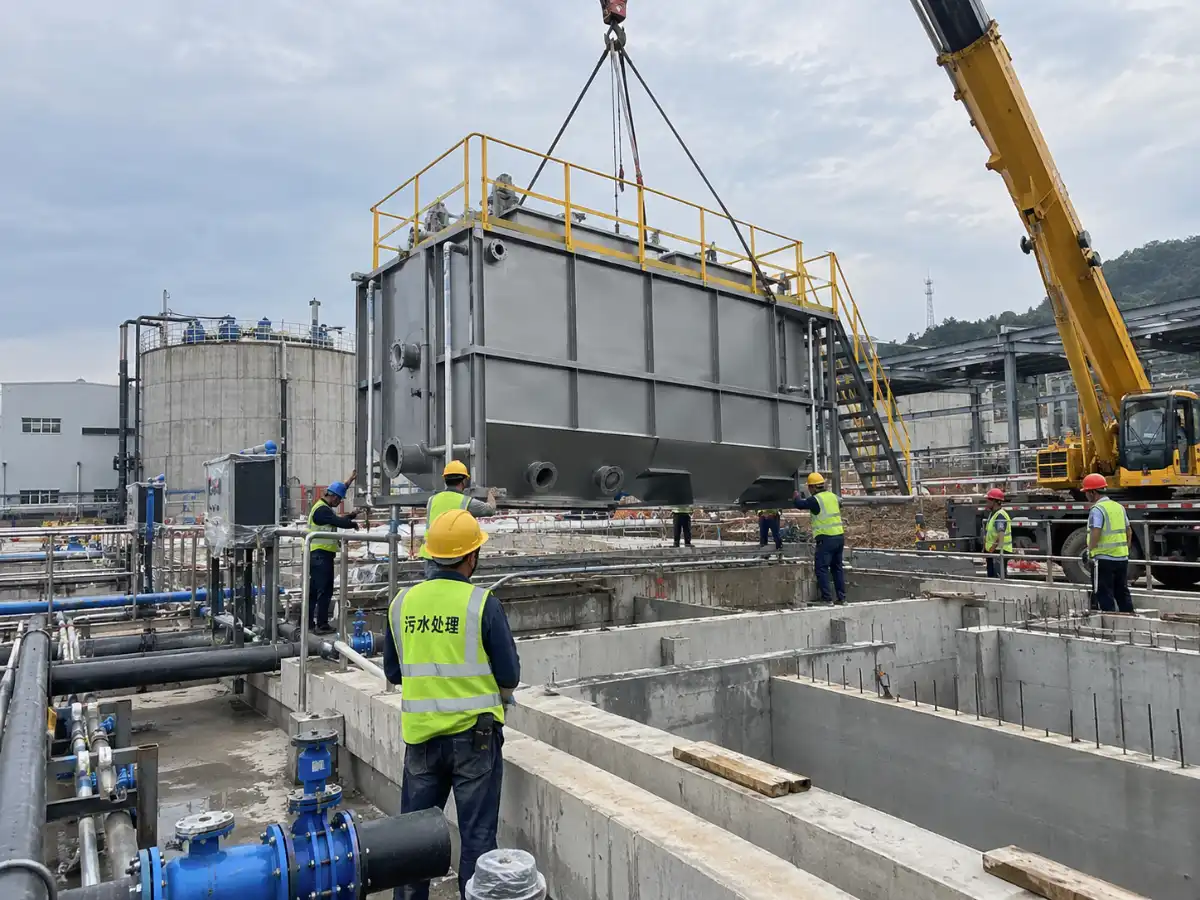
Pretreatment: The Stage That Decides Whether Your ZLD Plant Survives
I have seen more ZLD failures traced back to weak pretreatment than to any evaporator design flaw. The evaporator is a heat and mass balance problem. Pretreatment is a chemistry problem, and chemistry is where operators get surprised.
Primary Solids Removal
The first job is knocking down suspended solids before they reach any membrane or heat exchanger. A typical sequence starts with equalization, then coagulation and flocculation, then clarification or dissolved air flotation. Where gypsum loading is heavy, a softening step with lime or soda ash brings calcium and magnesium down before the water moves on.
For the sludge that comes out of this stage, a screw press sludge dewatering unit is often the most practical choice. It handles the fine, gelatinous solids from FGD chemistry better than a belt press, runs continuously, and needs less operator attention. Cake dryness in the 20–30% range is realistic depending on the feed, and that directly cuts your hauling cost.
Heavy Metal and Selenium Removal
Mercury and selenium are the two that keep compliance managers awake. Standard hydroxide precipitation handles most metals, but selenium is trickier because selenate does not precipitate easily. Options I have used include:
- Iron or aluminum co-precipitation for selenite
- Biological reduction for selenate, where the plant has the space and the operators to run it
- Zero-valent iron or specialized adsorbents for polishing
Mercury usually comes out with sulfide precipitation followed by co-precipitation on iron or organic matter. The key point is that whatever you do not remove here ends up in your brine and eventually in your mixed salt. If that salt has to be landfilled, the disposal cost is set by what pretreatment left behind.
Softening and Scale Control
This is where the evaporator’s life is decided. Calcium sulfate, calcium carbonate, and silica all become far less soluble as temperature rises. Feed a hard, sulfate-rich stream to an evaporator and you will be descaling within a month.
What works in practice:
- Lime or soda ash softening to drop hardness below the level that keeps the brine stable at the evaporator’s operating temperature
- Silica removal by magnesium addition or by seeding, depending on the level
- Antiscalant dosing as a backup, not a substitute for real softening
A useful rule of thumb: design the pretreatment to deliver a brine that stays below saturation for calcium sulfate at the highest temperature and highest concentration the evaporator will see. If you cannot get there chemically, you need to reconsider the evaporator type or add a seeding circuit.
Membrane Pre-Concentration Where It Fits
If the pretreated water is clean enough, a membrane stage before evaporation cuts the volume the evaporator has to handle, and that is where the real money is saved. Disc-tube reverse osmosis handles high-fouling, high-salinity streams that would destroy a spiral-wound element. You can review the range of DTRO membrane systems to see where this fits in a ZLD train.
But be honest about the limits. Membrane pre-concentration only works if pretreatment has already removed the scaling precursors and the organics that foul membranes. Skip that and you have just moved the problem upstream.
Evaporation: Choosing Between MVC, MVR, and Multi-Effect
Once the water is clean enough, evaporation does the heavy lifting. The choice between mechanical vapor recompression, multi-effect, and hybrid configurations is a capital-versus-energy trade-off, and it depends heavily on your power cost and steam availability.
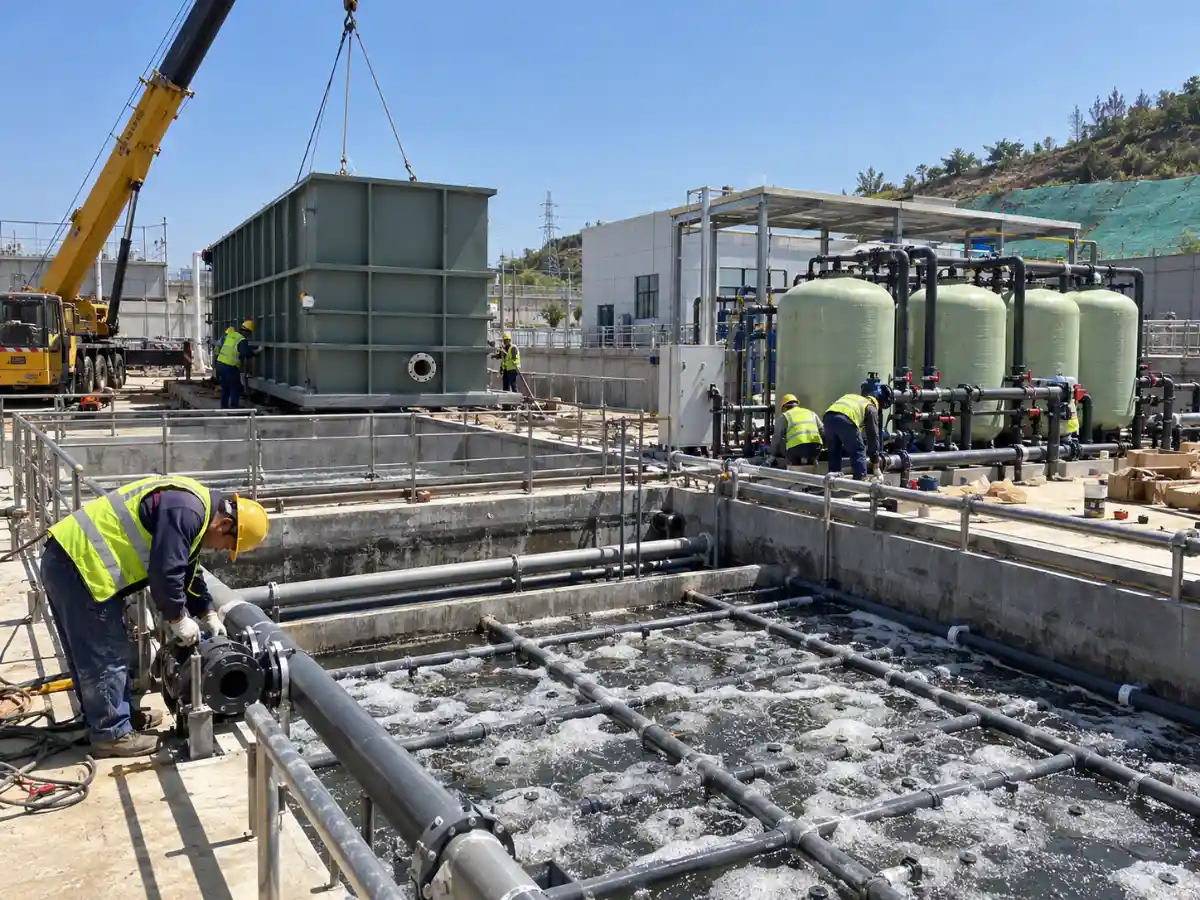
How the Main Options Compare
| Configuration | Typical Energy Use | Best Fit | Main Drawback |
|---|---|---|---|
| Single-effect evaporator | High, roughly 1 kg steam per kg water evaporated | Small flows, low duty, simple operation | Poor energy efficiency at scale |
| Multi-effect (2–4 effects) | Moderate, drops with each added effect | Plants with cheap or available steam | Larger footprint, more complexity |
| MVC / MVR | Low, driven by compressor power | High electricity availability, no steam | High compressor capex, power quality sensitive |
| MVR + multi-effect hybrid | Lowest overall | Large ZLD plants with both steam and power | Highest capital, needs strong controls |
For most FGD ZLD projects I work on, a mechanical vapor compression MVC evaporator is the default starting point. It runs on electricity, needs no steam header, and the compressor does the work of several effects. The trade-off is that compressor reliability and power cost dominate the operating budget.
Where steam is cheap — for example, a plant with an existing turbine bleed — a multi-effect evaporator can be more economical over a 15-year life. The number of effects matters: a triple-effect unit uses roughly a third of the steam a single-effect unit would, but adds vessels, pumps, and interstage complexity.
Heat Exchanger Design and Fouling
The heat exchanger is where the evaporator either works or does not. FGD brine scales aggressively, and the exchanger surface is the hottest point in the system. Falling-film designs with good wetting and generous recirculation rates are generally more forgiving than forced-circulation designs for this service. Material selection matters too — duplex stainless or titanium for chloride-rich brine, with the choice driven by chloride level, temperature, and pH.
If you want to go deeper on this specific piece of the design, the MVC evaporator heat exchanger selection logic is worth reviewing before you lock in a vendor.
Concentration Limits and Vapor Quality
You cannot evaporate to dryness in the evaporator. The practical limit is where the brine becomes too viscous, too scaling, or too corrosive to handle. In FGD service, the evaporator typically concentrates to 20–30% total dissolved solids and hands off a thick slurry to the crystallizer. Pushing past that usually trades a small energy saving for a large maintenance bill.
Vapor quality matters for two reasons: the condensate has to meet discharge or reuse standards, and any entrainment carries salts into the condensate. Demister design and proper vapor velocity are the controls here. If the condensate is going to a cooling tower or a boiler, you need to verify ammonia and volatile organics are handled, not just salts.
Crystallization: Turning Brine into a Handleable Solid
The crystallizer takes the concentrated brine and forces the dissolved salts out as solid crystals. This is the stage that actually achieves zero liquid discharge, and it is also the stage with the highest maintenance intensity.
Forced Circulation vs. Falling Film Crystallizers
For FGD brine with mixed salts, a forced-circulation crystallizer with an external heat exchanger is the most common choice. The high recirculation rate keeps crystals suspended and reduces scaling on the heat transfer surface. Falling-film crystallizers can work for cleaner, more predictable brines but are less forgiving when the salt composition shifts.
Salt Quality and Disposal
What comes out of the crystallizer is a mixed salt — mostly sodium chloride, sodium sulfate, and calcium sulfate, plus whatever heavy metals pretreatment missed. In most cases this salt is not saleable and goes to landfill. That is a cost you have to plan for from day one.
Some plants separate the salt into a cleaner sodium chloride stream and a mixed residue, which can reduce disposal volume or open a reuse path. This adds equipment and complexity, and the economics only work when disposal cost is high or a local buyer exists. Be skeptical of claims that FGD mixed salt is easily saleable — it usually is not.
Where the facility has a use for the concentrated brine or a nearby industrial user, that can change the picture. Otherwise, plan for landfill and design the salt handling accordingly.
Energy, Cost, and Lifecycle Reality
ZLD is capital-intensive and energy-intensive. Anyone who tells you otherwise is selling something. Here is how the cost picture usually breaks down.
Capital Cost Drivers
- Pretreatment complexity, driven by heavy metal and selenium levels
- Evaporator type and capacity — MVC compressor cost is a major line item
- Metallurgy — chloride-resistant alloys are expensive and non-negotiable
- Crystallizer size and salt handling
- Civil works, especially where footprint is constrained
Operating Cost Drivers
- Electricity for the compressor or steam for multi-effect operation
- Chemical consumption — lime, soda ash, antiscalant, and coagulants
- Membrane and heat exchanger replacement
- Landfill tipping fees for the mixed salt
- Labor and maintenance, which is higher than most plants expect
Energy is usually the single largest operating cost in an MVC-based train. If power is expensive, that pushes the design toward multi-effect or hybrid configurations. If steam is unavailable, MVC wins by default. The MVR evaporator cost breakdown is a useful reference for framing the capital and operating trade-offs before you go to bid.
Where Projects Usually Go Over Budget
Three patterns I see repeatedly:
- Underestimated pretreatment. Heavy metal and selenium removal is treated as a small add-on and turns into a major subsystem.
- Optimistic scaling assumptions. Designers assume antiscalant will handle calcium sulfate, then discover it will not at the operating temperature.
- Salt disposal surprises. The mixed salt volume and its classification are not confirmed with the disposal authority before design is frozen.
Getting these three right up front is worth more than any equipment optimization.
Operations and Maintenance: What Actually Breaks
ZLD plants fail in predictable ways. Knowing them in advance lets you design for serviceability instead of reacting.
Common Failure Modes
- Heat exchanger scaling: the number one issue. Usually caused by pretreatment excursions or antiscalant underdosing.
- Compressor vibration and seal failure: often from entrained droplets or fouling in the vapor path.
- Demister fouling: drives condensate quality down and can force a shutdown.
- Crystallizer circulation pump wear: abrasive salt crystals eat impellers.
- Instrument drift: density and conductivity meters in brine service need frequent calibration.
Design Choices That Reduce Maintenance
- Provide clean-in-place circuits for heat exchangers and allow for offline cleaning without full shutdown
- Use redundant circulation pumps on the crystallizer
- Install enough density and temperature instrumentation to catch scaling early
- Design for easy demister access — you will be cleaning it
- Keep a spares strategy for compressor seals and heat exchanger tubes
If you want to see how these principles play out in real project configurations, the electroplating wastewater treatment and landfill leachate treatment project references show similar high-salinity, high-scaling challenges handled with the same three-stage logic.
Discuss Your FGD ZLD Project With Our Engineers
Design Sequence I Recommend
When I am asked to review an FGD ZLD design, I work through it in this order:
- Characterize the wastewater properly. Full ion balance, heavy metals, selenium speciation, organics, and temperature range. Do not rely on a single grab sample.
- Set the discharge or reuse target. Condensate quality, salt disposal route, and any local limits drive the whole design.
- Design pretreatment to protect the evaporator. Softening, metals removal, and solids removal are not optional extras.
- Select the evaporator based on energy reality. Power cost, steam availability, and load profile decide MVC versus multi-effect.
- Size the crystallizer for the actual salt composition. Mixed salt behavior is not the same as pure sodium chloride.
- Plan for maintenance from the start. Cleaning access, redundancy, and spares strategy are design decisions, not afterthoughts.
This sequence is not glamorous, but it is what keeps a ZLD plant running past its first year. The projects that struggle are almost always the ones where one of these steps was skipped in the interest of schedule or capital.
Frequently Asked Questions
What is the biggest cause of FGD ZLD plant failure?
Pretreatment that does not remove enough hardness and scaling precursors. When calcium sulfate and silica enter the evaporator above their saturation limits, heat exchangers scale rapidly, and the plant spends more time cleaning than evaporating. Getting softening and metals removal right is the single highest-value investment in the train.
Should I choose MVC or multi-effect evaporation for FGD wastewater?
It comes down to energy. If you have no steam and reliable electricity, MVC is usually the better fit because the compressor replaces the steam demand. If you have cheap steam available — for example, from an existing turbine — a multi-effect or hybrid configuration can have a lower lifecycle cost. Run the numbers with your actual power and steam prices before committing.
How much does an FGD ZLD system cost?
It varies widely with flow rate, pretreatment complexity, and salt disposal route. Capital cost is dominated by pretreatment scope, evaporator type, and metallurgy. Operating cost is dominated by energy and landfill fees for the mixed salt. Any budget figure should be built from a specific water analysis and a confirmed disposal path, not from a generic per-cubic-meter rule.
Can the salt from FGD crystallization be sold or reused?
In most cases, no. The mixed salt from FGD brine contains chlorides, sulfates, and residual heavy metals, which makes it unsuitable for most commercial uses. It typically goes to landfill. Some plants separate a cleaner sodium chloride stream, but this adds equipment and only makes sense when disposal cost is high or a specific buyer exists.
How often does the evaporator heat exchanger need cleaning?
With well-controlled pretreatment, cleaning intervals of several months are achievable. With pretreatment excursions or scaling events, it can drop to weeks. The design should include clean-in-place capability and enough instrumentation to detect fouling early, so cleaning is planned rather than reactive.
What maintenance items drive the most downtime?
Heat exchanger scaling, compressor seal and vibration issues, demister fouling, and crystallizer circulation pump wear. Redundant pumps, accessible demisters, and a spares strategy for compressor components are the design choices that reduce unplanned downtime most effectively.
Is membrane pre-concentration worth adding before the evaporator?
It can be, if pretreatment is good enough to protect the membranes. Disc-tube reverse osmosis handles high-fouling, high-salinity streams better than spiral-wound elements, and reducing the volume sent to the evaporator cuts both capital and operating cost. But if pretreatment is weak, membranes just become another fouling problem. Evaluate it as part of the whole train, not as a standalone upgrade.