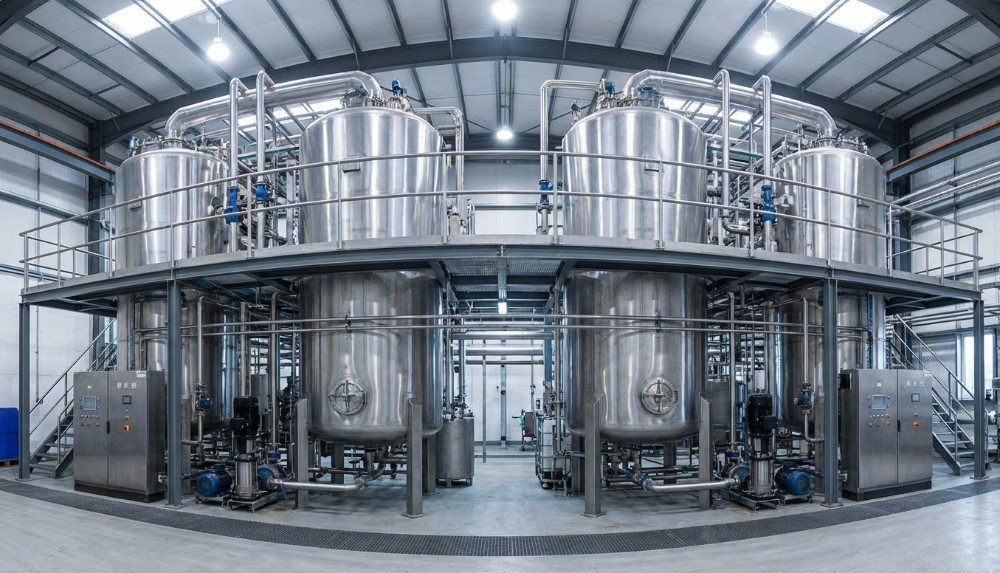
What is the main advantage of a double effect evaporator?
The first-effect vapor is reused as heat for the second effect. This can reduce live-steam
consumption compared with a single-effect system, although the actual saving depends on the
temperature profile, boiling-point elevation, heat losses and operating conditions.
What is the typical steam economy of a double effect evaporator?
A project may target approximately 1.5–1.8 kg of water evaporation per kg of live steam under
suitable conditions. This should be treated as a design reference, not a universal guarantee. Final
performance needs a heat-and-mass balance for the actual feed.
When should forced circulation be used?
Forced circulation is commonly evaluated for feeds with higher solids, viscosity, scaling or
crystallization tendency, because circulation velocity and boiling location can be controlled more
deliberately than in some film arrangements.
Can a double effect evaporator be used for high-salinity wastewater?
Yes, for suitable high-salinity streams. The design must account for salt composition, saturation
limits, scaling, corrosion, foaming, suspended solids and the required final concentration.
Pretreatment or a different evaporator configuration may be needed for difficult feeds.
How do I choose between double effect and MVC/MVR evaporation?
Compare the feed characteristics, evaporation load, operating hours, steam price, electricity price,
maintenance strategy and site utilities. MVC/MVR can reduce dependence on live steam, while double
effect systems can be attractive where steam is readily available and a simpler thermal
configuration is preferred.
What information is required for a quotation?
Provide feed flow, composition or water analysis, TDS/solids, inlet temperature, target
concentration, operating hours, available steam pressure, cooling-water conditions, electrical
supply and any known scaling, corrosion or foaming issues.