

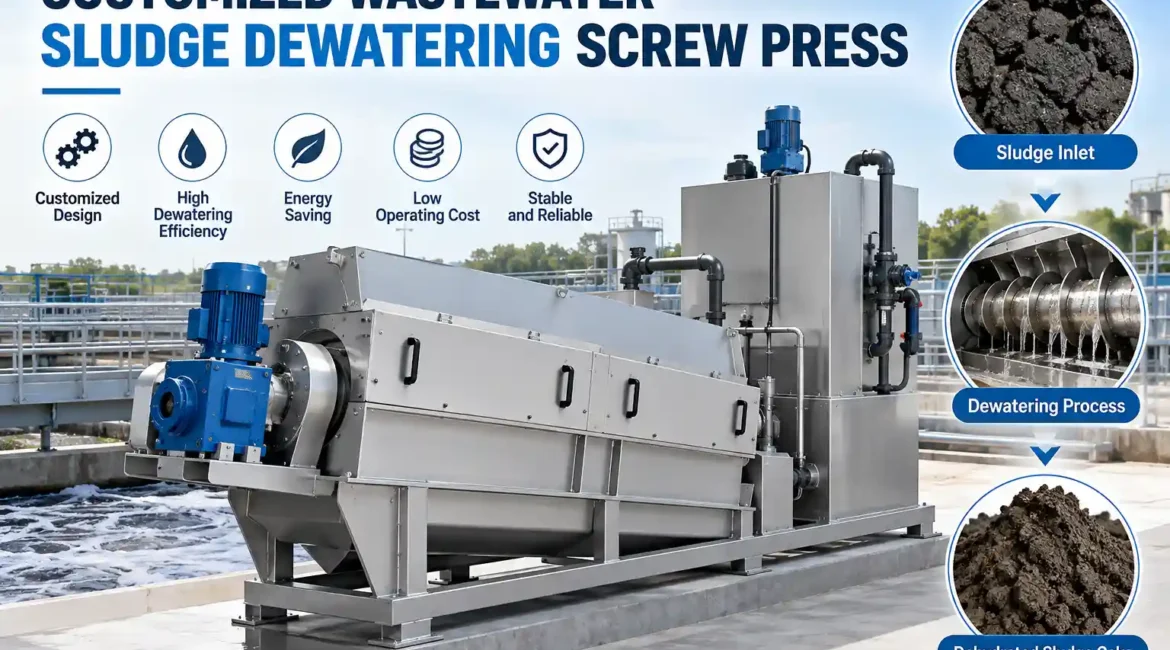
A customized wastewater sludge dewatering screw press should be selected from sludge behavior and dry-solids loading, not from wastewater flow alone. The equipment has a straightforward purpose: condition sludge, drain free water, apply gradually increasing compression, and discharge a cake that is easier and less expensive to handle. The difficult part is deciding how the screw geometry, filtration section, polymer system, materials, back pressure, controls, wash system, and downstream handling should be configured for a specific sludge. I’d treat customization as an engineering exercise rather than an option sheet. A correctly specified screw press can simplify sludge handling and reduce wet residual volume, but poor feed data or unrealistic cake-solids assumptions can make even a well-built machine disappointing. The sections below explain how I would evaluate the equipment before approving a purchase.
What “Customized” Should Actually Mean for a Sludge Dewatering Screw Press
The word “customized” is used very loosely in wastewater equipment quotations. Changing the paint, motor voltage, control-panel language, or discharge chute dimensions is customization in a manufacturing sense, but none of those changes solves a difficult dewatering problem.
For this comparison, I’m prioritizing process customization: changes that affect how efficiently the equipment separates water from solids and how reliably it operates under the expected sludge conditions.
A serious configuration should begin with sludge data and then work outward to mechanical design. The machine supplier should be able to explain why the proposed screw diameter, number of dewatering sections, filtration-gap profile, polymer system, shaft speed, back-pressure arrangement, motor, wash system, and materials fit the stated sludge.
I’d normally expect meaningful customization to address at least the following:
- Average and peak sludge flow
- Feed total solids or dry-solids concentration
- Dry-solids mass loading
- Sludge source and treatment history
- Organic versus inorganic solids content
- Particle size and floc behavior
- Oil, grease, fibers, grit, or abrasive material
- pH, chloride, and corrosive constituents
- Polymer type, concentration, preparation, and dosing method
- Required operating hours and redundancy
- Desired cake condition
- Filtrate quality expectations
- Wash-water availability and quality
- Cake discharge method
- PLC, instrumentation, and plant-control interfaces
- Installation footprint and maintenance clearances
A capacity stated only as cubic meters per hour is therefore incomplete. Two sludges entering at exactly the same volumetric flow can place very different solids loads on the screw press.
The number I look at first is dry-solids loading
For preliminary sizing, the relationship is simple:
Dry-solids load = sludge flow × solids concentration
For example, a feed of 10 m³/h at approximately 1.2% solids contains roughly 120 kg of dry solids per hour, assuming the sludge density is close enough to water for preliminary estimation.
The same 10 m³/h at 2.0% solids is roughly 200 kgDS/h. Hydraulic flow did not change, but the solids load increased by about 67%. That difference can change the required screw size, number of shafts, polymer demand, operating speed, and expected cake performance.
| Information Needed | What I Would Ask the Supplier to Confirm | Why It Changes the Design |
|---|---|---|
| Average sludge flow | Normal m³/h or equivalent flow basis | Sets the basic hydraulic duty |
| Peak sludge flow | Duration and frequency of peaks | Determines whether equalization or additional press capacity is required |
| Feed solids | Normal, minimum, and maximum %TS | Directly changes dry-solids loading |
| Sludge type | Biological, primary, DAF, chemical, mixed, digested, oily, or other | Changes drainage, compressibility, and polymer response |
| Grit and fibers | Concentration and maximum particle size | Affects wear, blockage risk, and upstream screening |
| pH and corrosive constituents | Normal and upset ranges | Influences wetted-material selection |
| Operating schedule | Hours/day and days/week | Changes required hourly capacity and redundancy |
| Final cake handling | Bin, conveyor, pump, bag, dryer, or disposal container | Determines discharge arrangement and acceptable cake consistency |
In my view, receiving this information before model selection is one of the clearest differences between process engineering and catalog selling.
How a Screw Press Dewaters Wastewater Sludge
A sludge screw press separates water progressively rather than attempting to squeeze all of it out in one step. Polymer-conditioned sludge normally enters a flocculation or conditioning section first. The formed flocs then enter the press, where free water drains through openings in the filtration structure.
As the screw rotates, sludge moves toward the discharge end. The available volume becomes smaller because of screw geometry, reduced pitch, increasing shaft diameter, discharge restriction, or a combination of these features. Pressure therefore increases gradually. Water leaves through the filtration openings while retained solids continue toward the cake outlet.
Several modern sludge dewatering machines use alternating fixed and moving rings instead of a conventional stationary wedge-wire basket. Movement between the rings helps disturb deposited solids and can reduce the tendency for the filtration gaps to blind. Other screw press designs use screens, wedge wire, brushes, spray cleaning, or different self-cleaning arrangements.
The mechanical principle is easy to understand. The process chemistry is less forgiving.
Flocculation is part of the dewatering process
Untreated biological sludge contains small particles and water that is difficult to release mechanically. Polymer conditioning encourages fine particles to form larger flocs with drainage characteristics that the press can use.
If the flocs are weak, they can shear apart before or inside the press. If the polymer dose is too low, filtrate may contain excessive suspended solids and the cake may remain wet. Excess polymer can also cause trouble: higher chemical cost, sticky material, undesirable filtrate characteristics, or a narrow operating window.
I’d therefore evaluate the polymer preparation unit, mixing method, maturation time, dilution water, injection location, and sludge residence time as part of the screw press package. A high-quality press with poor conditioning is still a poor dewatering system.
Published cake-solids numbers need context
A historical Environmental Protection Agency technology summary described an inclined screw press receiving primary and secondary sludge at approximately 1.5–2% solids and producing cake at approximately 20–25% solids. The same document described a roughly 20-degree inclined screw, a 200-micron wedge-wire screen, progressive pressure, and periodic external wash water. The document also cautions that some technology information available at that time originated from equipment suppliers, so I would treat those numbers as a documented historical case rather than a universal specification.
“Provide cost-effective dewatering with simplified operations and lower polymer usage.”
Source: Environmental Protection Agency, Emerging Technologies for Biosolids Management, 2006.
A much more recent peer-reviewed study published in 2024 also illustrates why universal cake-solids guarantees are risky. Researchers evaluating a compact screw press reported significant effects from back-pressure setting, substrate type, particle characteristics, and feed dry-solids content. The study was not a universal wastewater screw-press performance test, but its result supports a practical point I consider fundamental: mechanical settings cannot be separated from feed properties.
That is why I’d ask for a sludge test whenever the residual is unusual, highly variable, difficult to flocculate, or expensive to dispose of.
Capacity Should Be Specified in Both Flow and Dry Solids
One of the easiest ways to compare two quotations incorrectly is to look at nominal flow alone.
A supplier might list a unit as 5 m³/h, 10 m³/h, or 20 m³/h. Those values become useful only after the corresponding feed-solids condition is stated. The more defensible specification includes both hydraulic throughput and dry-solids throughput.
I’d want a data sheet written approximately like this:
Design sludge flow: X–Y m³/h
Design feed solids: A–B% TS
Maximum dry-solids load: Z kgDS/h
Sludge description: defined process source
Conditioning basis: specified polymer and test condition
Operating schedule: defined hours per day
This gives both buyer and manufacturer a common performance boundary.
Do not size the press from average flow if sludge wasting is intermittent
A wastewater plant may generate sludge continuously but operate the dewatering equipment only part of the day. In that case, daily sludge production must be compressed into a shorter operating window.
Suppose a process generates 1,200 kgDS/day and the screw press will operate for eight effective dewatering hours per day.
Required average press solids loading = 1,200 ÷ 8 = 150 kgDS/h.
If cleaning, startup, shutdown, operator checks, or upstream sludge availability reduce actual productive operation to seven hours, the required average rises to about 171 kgDS/h.
I’d add reasonable process margin, but I would not blindly double the machine size. Oversizing has its own disadvantages. A screw press operating far below its intended loading can have unstable feed distribution, unnecessarily long residence time, poor polymer control, or less predictable cake formation.
| Sizing Question | Weak Specification | Specification I Would Prefer |
|---|---|---|
| Вместимость | “10 m³/h” | Hydraulic range plus kgDS/h at a defined feed-solids range |
| Feed concentration | “About 1%” | Minimum, normal, and maximum %TS |
| Время работы | “Continuous” | Expected productive operating hours plus cleaning and downtime assumptions |
| Cake performance | “Up to 25% solids” | Performance range tied to tested sludge and conditioning conditions |
| Polymer | “Low consumption” | Type, active basis, dose range, preparation concentration, and test method |
| Filtrate | “Clear” | Defined suspended-solids or capture-performance test where required |
The Customization Options That Actually Affect Performance
A useful custom design is usually a combination of process, mechanical, materials, controls, and installation decisions. I would rank those decisions by the consequence of getting them wrong rather than by how impressive they look on a quotation.
Screw diameter and number of dewatering channels
Diameter affects available filtration area, solids inventory, torque, residence time, and overall capacity. For larger loads, suppliers may use multiple dewatering channels rather than a single large screw.
Parallel channels can provide useful turndown. One channel can sometimes be stopped at low load while the remaining channel operates closer to an efficient range. The exact control strategy depends on the equipment design.
Screw pitch and compression profile
The screw should not simply transport sludge. Its geometry determines how quickly the available volume decreases and how pressure develops.
Aggressive compression may appear attractive because buyers associate pressure with drier cake. In practice, pressure that develops too quickly can squeeze weak flocs, push solids into the filtrate, increase torque, or create unstable discharge behavior.
I’d choose a progressive pressure profile supported by testing rather than assuming maximum compression is automatically desirable.
Filtration-gap arrangement
Gap size and progression influence drainage and solids capture. Wider gaps can improve early drainage but may permit excessive solids passage if flocculation is weak. Smaller gaps can retain finer solids but increase fouling sensitivity.
For a multi-disc screw press, ring dimensions, spacing, moving-ring motion, and screw-to-ring interaction are not minor manufacturing details. They are part of the separation mechanism.
Discharge back pressure
The outlet restriction controls resistance at the discharge end and helps create the final compression zone. Depending on the machine, this may involve an adjustable plate, cone, pneumatic arrangement, mechanical spring, or another restriction device.
More back pressure can improve cake dryness under some conditions, but it can also raise torque and reduce throughput. I’d want the supplier to provide an operating procedure that explains how cake appearance, filtrate, motor load, and throughput should be balanced during adjustment.
Variable-speed drive
Variable screw speed gives the operator another way to respond to sludge loading and drainage behavior. A slower speed increases residence time but also changes solids inventory inside the machine. Faster operation may increase throughput while reducing compression time.
The useful setting should come from sludge behavior, not from a fixed assumption that slower always means drier.
Строительные материалы
“Stainless steel” is not enough information for a chemical or industrial sludge application.
I’d ask for the actual grade of the screw, rings or screen, tank, wetted piping, fasteners where relevant, and polymer-system components. Chloride concentration, pH, cleaning chemicals, temperature, abrasion, and oxidation conditions should influence alloy selection.
Common austenitic stainless steels may be suitable for many duties, but more aggressive service can justify another alloy or protection strategy. Material upgrades should be based on chemistry rather than purchased as an automatic premium.
Which Sludge Types Are Good Candidates for Screw Press Dewatering?
Screw presses are widely considered for biological sludge and many industrial residuals, but the application should be screened by sludge behavior rather than by industry name.
Отходы активного ила
Waste activated sludge contains a high proportion of biological material and bound water. Polymer conditioning is normally central to successful mechanical dewatering. Feed solids can vary significantly with upstream thickening.
I’d want representative samples across the normal operating range instead of one unusually concentrated sample collected specifically for a test.
Primary and mixed sludge
Primary sludge often contains particles with different drainage characteristics from biological solids. Mixed primary and biological sludge can therefore perform differently from either component alone.
The mixing ratio belongs in the design basis. A test performed on a 50:50 mixture does not automatically represent a plant that changes from 30:70 to 70:30 over its operating cycle.
DAF sludge
Dissolved-air-flotation residuals can contain fats, oils, proteins, chemical precipitates, or other process-specific material. Some DAF sludge dewaters reasonably well after appropriate conditioning; other residuals remain sticky and difficult to release.
I would pay particular attention to oil and grease, surfactants, temperature, coagulant history, and polymer compatibility.
Chemically precipitated sludge
Metal hydroxides, lime precipitates, phosphate sludge, and other chemical solids can behave very differently from biological sludge. Some drain readily; some create fine particles that are difficult to retain.
A supplier should know the precipitation chemistry because upstream chemical treatment influences both solids quantity and physical structure.
Food and fermentation residuals
Organic sludge may contain fibrous material, proteins, starch, fat, or suspended food particles. Those components can change floc strength and cake compressibility. Temperature variation can also affect viscosity and polymer response.
Oily sludge
The word “oily” covers too many conditions to support a generic selection. Free oil, emulsified oil, surfactant-stabilized material, and oil attached to solids behave differently.
I’d request a bench or pilot trial before accepting an aggressive cake-solids guarantee for an unfamiliar oily residual.
Sludge containing grit or hard abrasive solids
This is where I become more cautious. A screw press is a slow-speed machine, but abrasive material can still accelerate wear at close-clearance components. Large debris can also interfere with feed pumps, polymer mixing, and the filtration section.
Screening, grit removal, or another upstream separation step may be justified. I would not use the dewatering press as a substitute for coarse-solids protection.
Polymer Selection Can Matter More Than Another Percentage Point of Motor Efficiency
Polymer is one of the recurring costs that deserves more attention during procurement.
A polymer system normally includes storage or powder handling, solution preparation, aging or maturation where required, dosing pumps, dilution, flow control, and the mixing arrangement between polymer and sludge.
The phrase “polymer consumption” is also surprisingly easy to misunderstand. A quotation should identify whether dosage is expressed as neat liquid product, prepared solution, emulsion product, dry polymer, or active polymer per unit of dry sludge.
I’d normalize supplier comparisons to an active-polymer basis wherever possible.
A practical polymer trial should optimize more than cake dryness
The best dose is not necessarily the dose that creates the visually driest cake during a short test.
I would watch at least four responses together:
- Floc size and mechanical strength
- Filtrate solids
- Cake solids or cake consistency
- Polymer dose per unit of dry solids processed
A fifth variable matters commercially: throughput. A setting that gains a small amount of cake dryness but sharply reduces solids throughput may increase equipment operating hours and erase the expected savings.
The 2024 peer-reviewed screw-press study referenced earlier found that substrate properties, back-pressure setting, and feed dry matter materially affected the dewatering result. That is consistent with how I would approach polymer optimization: change one controlled variable at a time and record the result rather than selecting settings by visual impression alone.
Screw Press vs. Belt Press, Centrifuge, and Filter Press
No dewatering technology should be selected from a generic winner-and-loser chart. The correct comparison depends on cake target, feed stability, operator skill, footprint, energy, polymer, wash water, maintenance capability, and what happens to the cake afterward.
For this comparison, I’m prioritizing variables that affect an actual equipment purchase.
| Фактор принятия решения | Screw Press | Belt Filter Press | Decanter Centrifuge | Chamber Filter Press |
|---|---|---|---|---|
| Operating principle | Slow progressive screw compression and drainage | Gravity drainage followed by pressure between belts | High-speed centrifugal separation | Batch pressure filtration through cloth |
| Operation mode | Continuous | Continuous | Continuous | Batch |
| Typical mechanical speed | Низкий | Moderate belt movement | High rotational speed | No high-speed separation rotor |
| Polymer dependence | Usually significant | Usually significant | Often significant | Depends strongly on sludge and conditioning |
| Wash-water requirement | Usually intermittent or design-dependent | Continuous belt washing is common | Cleaning requirement depends on duty | Cloth washing and cleaning required |
| Operator attention | Can be highly automated | Requires belt tracking and wash-system attention | Automation is high but mechanical condition is important | Batch sequencing and cake release must be managed |
| Vibration sensitivity | Generally limited by low-speed operation | Умеренный | Important because of high-speed rotating equipment | Usually not a high-speed vibration issue |
| Cake-solids potential | Sludge-specific | Sludge-specific | Sludge-specific | Can reach higher cake solids for suitable sludge but cycle time matters |
| Best comparison metric | kgDS/h, cake, capture, polymer, wash water | kgDS/h, cake, capture, polymer, wash water | kgDS/h, cake, capture, polymer, energy | kgDS/cycle, cake, cycle time, cloth performance |
If I were choosing for a facility with moderate solids loading, limited operator attention, a preference for continuous operation, and no requirement for exceptionally high cake solids, I would put a screw press on the shortlist.
If downstream economics strongly reward every additional point of cake dryness, I would compare technologies through testing instead of assuming the screw press is automatically the lowest-cost option.
Cake Solids Matter Because Disposal Cost Is Usually Based on Wet Mass
The economic value of dewatering becomes easier to see when cake solids are converted into actual wet mass.
Assume, purely as an example, that a facility produces 1,000 kg of dry solids per day.
В 18% cake solids:
1,000 ÷ 0.18 = approximately 5,556 kg/day of wet cake.
В 22% cake solids:
1,000 ÷ 0.22 = approximately 4,545 kg/day of wet cake.
The difference is approximately 1,011 kg of wet material per day, even though the dry-solids production is identical.
If a buyer hypothetically paid $100 per metric ton for handling and disposal, that difference would represent roughly $101 per operating day. At 365 operating days, the simple arithmetic is about $36,900 per year.
That is an illustrative calculation, not a market disposal-rate estimate. The buyer should substitute the actual disposal cost, operating schedule, measured cake solids, transport rules, and container limits.
This calculation also explains why I would not dismiss a small cake-solids difference without checking the annual mass balance. At the same time, I would not pay a large equipment premium for a claimed percentage-point improvement until that improvement is demonstrated on representative sludge.
How I Would Build the Lifecycle Cost Comparison
Purchase price is only the first line of a dewatering budget. A lower-cost machine can become more expensive over its operating life if it uses substantially more polymer, produces wetter cake, requires more operator time, or has difficult-to-source wear parts.
I’d calculate annual cost from measurable inputs.
| Cost Category | Input Needed | Useful Calculation Basis |
|---|---|---|
| Polymer | Active dose, dry-solids load, chemical price | Cost per dry ton or tonne processed |
| Электроэнергия | Measured operating kW and annual hours | Annual kWh × electricity price |
| Wash water | Flow per wash cycle and cycle frequency | Annual water and wastewater cost |
| Cake disposal | Dry solids, cake %, disposal rate | Annual wet cake mass × actual handling rate |
| Labor | Operator hours per shift or week | Loaded labor cost × annual hours |
| Wear parts | Expected replacement items and price | Annualized parts cost |
| Техническое обслуживание | Planned service tasks and labor | Annual maintenance hours plus parts |
| Downtime risk | Redundancy and storage capacity | Cost of alternative sludge handling during outage |
The disposal line often deserves special attention because cake moisture can dominate the mass transported away from the treatment process.
Polymer cost deserves similar discipline. Comparing “liters per hour” is nearly meaningless unless product concentration and dry-solids throughput are known.
What I Would Specify in a Customized Screw Press Package
A complete sludge dewatering package normally involves more than the press itself. The exact battery limits should be visible in the quotation and general arrangement drawing.
Depending on the project, I’d expect the supplier to define responsibility for the sludge feed pump, flow measurement, polymer system, conditioning tank, mixer, screw press, filtrate collection, spray-water system, cake chute or conveyor, control panel, instrumentation, access platform, and interconnecting piping inside the package.
This is the same reason I prefer system-level engineering for other wastewater equipment. Memva’s pre-packaged industrial wastewater treatment guide makes a useful point: a compact skid can still leave substantial field work if the battery limits are unclear.
For projects where dewatering is only one part of a larger treatment train, I would also review the overall industrial wastewater treatment equipment configuration rather than purchasing each stage in isolation.
Feed pump
The feed pump should handle the required viscosity and solids without destroying the flocculation strategy. Progressive-cavity and rotary-lobe pumps are often evaluated for sludge service, but pump selection should come from flow, pressure, solids, viscosity, shear sensitivity, and maintenance requirements.
Polymer preparation and dosing
Automatic polymer preparation can reduce operator variation, particularly where dry powder or emulsion polymer must be diluted consistently. Useful features can include low-level alarms, flow confirmation, calibrated dosing, solution tanks, mixers, maturation volume, and interlocks that stop sludge feed when polymer is unavailable.
Flocculation tank
A flocculation tank needs enough mixing to distribute polymer without destroying formed flocs. I’d prefer an adjustable mixer where feed conditions vary.
Filtrate collection
Filtrate does not disappear from the process. It normally returns to upstream treatment or goes to another designated point.
The return load should be considered in the water balance, particularly if the filtrate contains significant suspended solids, dissolved contaminants, polymer residual, ammonia, or another constituent relevant to the treatment process.
Cake discharge
A cake chute is adequate when gravity discharge goes directly into a container. Other installations need a shaftless screw conveyor, belt conveyor, receiving hopper, pump, bagging arrangement, or downstream dryer.
The interface matters. A good dewatering result can still create an operating problem if sticky cake bridges inside an undersized chute.
Wash-water system
I’d ask for normal wash flow, instantaneous wash flow, required pressure, nozzle arrangement, filtration requirement, cycle frequency, and control logic.
Those figures allow the facility to confirm that the water supply can actually support automatic cleaning.
Controls Should Protect the Process, Not Merely Start the Motor
Modern sludge dewatering equipment is often described as automatic. I would look beyond that label and review exactly what the PLC does when operating conditions become abnormal.
Useful control functions can include:
- Automatic startup and shutdown sequencing
- Sludge-feed interlock with screw operation
- Polymer-system permissive
- Flocculation-tank level control
- Motor overload or torque protection
- Wash sequencing
- Low wash-water pressure alarm
- High-level protection
- Cake-conveyor interlock
- Emergency-stop logic
- Runtime counters
- Alarm history
- Trend recording for critical process variables
- Remote run status where required
An HMI full of graphics is not automatically useful. I’d rather have six reliable trends that help diagnose the process than dozens of values no operator uses.
Automation acceptance also deserves a structured test. The International Society of Automation currently identifies ANSI/ISA-62381-2026 / IEC 62381:2024 as a standard covering factory, site, and integration acceptance testing for industrial automation systems. The standard is broader than a sludge press, but the principle applies well: define the expected control behavior and verify it before relying on the equipment.
Factory Acceptance Testing: What I Would Check Before Shipment
A factory test cannot prove sludge-dewatering performance unless representative sludge is available. It can, however, eliminate many mechanical, electrical, and documentation problems before installation.
I’d divide acceptance into two parts: factory equipment verification and later process-performance verification.
Mechanical checks
- Equipment dimensions match the approved drawing
- Wetted materials match the approved data sheet
- Screw rotates freely in the correct direction
- Gearbox and motor data match the specification
- Guards cover accessible rotating hazards
- Spray nozzles are installed and accessible
- Drains and filtrate outlets are correctly located
- Maintenance access is practical
- Fasteners and structural connections are complete
Electrical and control checks
- I/O points respond correctly
- Motor commands operate from intended control modes
- Emergency stops function
- Alarm setpoints are loaded
- Interlocks prevent unsafe or damaging sequences
- Level switches and instrumentation are simulated
- Wash sequences run correctly
- HMI units and labels match documentation
- PLC and HMI backups are supplied
Machine guarding must also be designed for the actual installation. Rotating shafts, couplings, chain drives, pinch points, and conveyors require appropriate protection under the safety rules applicable to the site. I would never treat an emergency-stop button as a substitute for physical guarding where guarding is required.
Performance Acceptance Should Be Written Before the Purchase Order
The phrase “performance guarantee” is valuable only when the test conditions are defined.
I’d want the contract to answer five questions:
What sludge will be tested? Define feed source, solids range, and critical characteristics.
What polymer conditions apply? Define the approved polymer or a procedure for selecting it.
What loading will be tested? State hydraulic and dry-solids throughput.
What outputs will be measured? Common candidates include cake solids, solids capture, polymer consumption, wash-water use, and stable throughput.
How long must the result be sustained? A five-minute sample taken after careful manual adjustment does not demonstrate an eight-hour operating shift.
I’d also define the laboratory sampling method. Cake solids and feed solids should be measured by an agreed analytical procedure instead of estimated by appearance.
The same discipline applies to filtrate. If solids capture is commercially important, define how feed mass and filtrate solids will be sampled and calculated.
A Realistic Performance Range Is More Credible Than a Maximum Number
Marketing tables often present a single cake-solids percentage. Wastewater plants do not operate as single numbers.
The feed may change with production, temperature, biological conditions, upstream chemical dosing, seasonal loading, cleaning cycles, primary-to-secondary sludge ratio, or equalization performance.
I’d prefer a supplier who states:
“Expected performance under the following tested feed conditions is…”
rather than:
“Cake solids up to…”
The first statement creates an engineering basis. The second can describe a result achieved under conditions that may have little relationship to the buyer’s sludge.
The Environmental Protection Agency’s historical 2006 screw-press summary reported about 20–25% cake solids for the specific process described in that document. A peer-reviewed 2024 paper discusses digested sludge mechanical-dewatering limits in the approximate 20–29% dry-matter range and notes that feed dry matter and material characteristics affect dewatering behavior. Neither reference should be converted into a promise that every wastewater sludge will reach those numbers.
That distinction matters commercially. Reliable design is based on the buyer’s sludge, not the highest percentage that can be found in published literature.
Maintenance: Low Speed Does Not Mean Maintenance-Free
Slow rotation can reduce some mechanical stresses compared with high-speed separation equipment, but a screw press still contains wearing surfaces, bearings, seals, gear drives, spray nozzles, pumps, polymer equipment, sensors, valves, and moving components.
I’d request a preventive-maintenance schedule before buying the machine.
| Item | Condition to Watch | Useful Maintenance Question |
|---|---|---|
| Screw and filtration section | Wear, scoring, abnormal clearance | How is wear measured and what is the replacement criterion? |
| Moving/fixed rings or screen | Gap wear, deformation, deposits | Can sections be replaced individually? |
| Gearbox | Oil condition, temperature, noise | What lubricant and service interval does the manufacturer specify? |
| Bearings | Noise, temperature, play | Are bearings accessible without major disassembly? |
| Spray system | Blocked or worn nozzles | Can nozzles be serviced while the machine remains installed? |
| Polymer pumps | Loss of calibration or pulsation | How is actual chemical delivery checked? |
| Flocculation mixer | Shaft, seal, gearbox condition | Can the mixer be removed vertically? |
| Instrumentation | Drift or coating | Is calibration possible without dismantling the package? |
I also want the supplier to identify critical spare parts separately from routine consumables. The first spare-parts order is easier to budget before startup than after a small component stops production.
Installation Layout Is Part of Custom Engineering
A compact sludge dewatering machine can still require substantial working space.
The drawing should account for motor removal, screw or shaft withdrawal where required, cover opening, spray-nozzle access, polymer refill, pump maintenance, electrical-panel clearance, cake-container movement, and safe operator access.
I’d check vertical clearance as carefully as floor area. A facility can have enough space around the machine and still discover that a mixer, motor, or screw cannot be lifted because of a beam, pipe rack, or cable tray.
The discharge elevation deserves early attention as well. Raising the press can permit gravity discharge into a container, but platforms, stairs, handrails, structural loading, and maintenance lifting then become part of the project.
How Screw Press Dewatering Fits Into a Complete Wastewater Treatment Train
A screw press treats sludge. It does not remove the dissolved contaminants that remain in the wastewater after solids separation.
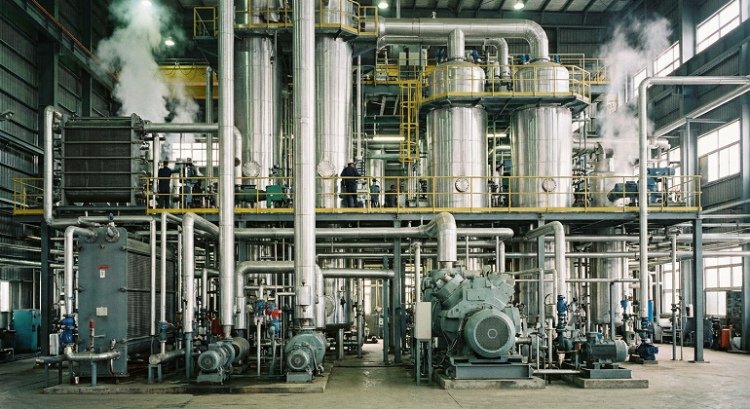
That distinction becomes particularly important in industrial treatment systems. Chemical precipitation, biological treatment, clarification, flotation, or filtration may transfer contaminants into sludge, while dissolved salts and other soluble constituents remain in the liquid stream.
For a broader project, I’d write the process around three separate questions:
What stays in the treated water?
This determines whether polishing, membrane treatment, adsorption, oxidation, or another downstream barrier is necessary.
What becomes sludge?
This determines thickening, polymer conditioning, dewatering, cake storage, and final residual management.
What returns with the filtrate?
This determines whether recycling pressate creates a significant hydraulic or contaminant load upstream.
This system-level approach is relevant to Memva because the company’s current industrial wastewater treatment engineering focuses on configuring equipment around wastewater composition and the final treatment objective instead of selecting machinery from nominal flow alone.
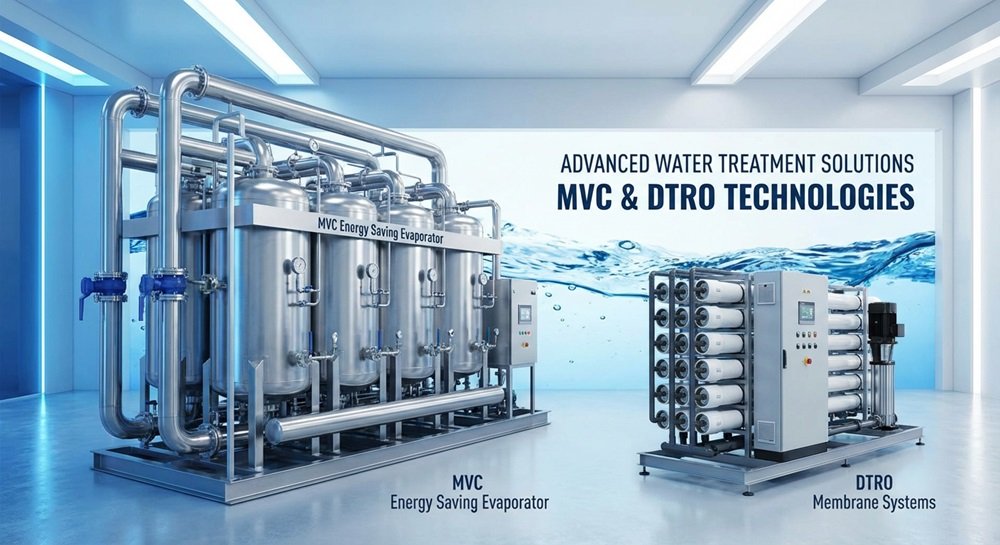
Where dissolved salts remain after suspended-solids treatment, pressure-driven membrane concentration or thermal concentration may become separate downstream decisions. Those stages do not replace sludge dewatering; they solve a different separation problem.
For buyers comparing an integrated project rather than one isolated machine, I’d review the manufacturer’s engineering and manufacturing scope and ask exactly who owns the interfaces between pretreatment, sludge handling, membrane treatment, evaporation, controls, and residual disposal.
How I Would Compare Screw Press Manufacturers
I would not rank suppliers from website claims alone. I’d compare the documents they are willing to put behind the quotation.
A capable proposal should make the design assumptions visible.
1. Does the manufacturer request real sludge data?
A quotation produced from only “20 m³/day wastewater” tells me very little about the dewatering duty.
The manufacturer should request sludge flow, feed solids, sludge source, upstream process, operating schedule, chemical history, pH, temperature, unusual contaminants, and the cake-handling objective.
2. Is capacity stated as dry solids?
I’d give more weight to kgDS/h or equivalent dry-solids loading than to a large hydraulic-flow number presented without feed concentration.
3. Are performance claims conditional?
Credible guarantees define the feed envelope, polymer conditions, sampling procedure, throughput, and test duration.
4. Can the manufacturer arrange sludge testing?
For unfamiliar industrial sludge, testing can be more valuable than another round of spreadsheet comparison.
5. Are materials clearly specified?
“Stainless steel body” does not tell the buyer the grade of the screw, rings, screen, tank, shaft, fasteners, piping, or polymer-system components.
6. Are wear parts identified?
I’d request part numbers, expected service inspection points, replacement procedure, lead time, and price for critical components.
7. Is the control narrative available?
The PLC sequence should explain startup, normal operation, washing, abnormal conditions, interlocks, alarms, and shutdown.
8. Does the supplier distinguish FAT from process testing?
A dry factory test verifies assembly and controls. A sludge performance test verifies separation performance. Calling them the same thing creates confusion.
Where Memva fits
If the requirement is a customized industrial wastewater treatment package rather than only a stand-alone dewatering machine, I’d include Мемва in the supplier review because its published engineering approach starts with wastewater analysis, treatment objectives, materials, utilities, controls, and process integration.
I would still apply the same rule to Memva that I would apply to any equipment manufacturer: the final screw-press configuration and any performance commitment should be supported by the actual sludge data, agreed test conditions, and a clearly written scope. Brand reputation cannot replace a process design basis.
What to Send a Manufacturer Before Requesting a Quotation
A detailed inquiry usually produces a much more useful quotation than asking for “the price of a 10 m³/h sludge press.”
I’d send the following information in the first technical inquiry:
- Sludge source and upstream treatment process
- Average and maximum sludge flow
- Minimum, normal, and maximum total solids
- Calculated daily dry-solids production
- Operating hours available for dewatering
- pH и температура
- Organic or volatile-solids data when available
- Oil and grease where relevant
- Known abrasive material or grit
- Relevant chlorides or corrosive constituents
- Existing coagulant and polymer
- Available wash-water pressure and flow
- Electrical supply
- Required automation interface
- Installation-space drawing
- Preferred cake-discharge arrangement
- Current cake or sludge disposal method
- Any required performance acceptance criteria
Laboratory sludge analysis is valuable, but I’d also send a description of how the sample was taken. A grab sample collected from the bottom of a storage tank can have a very different solids concentration from the normal material pumped to the dewatering system.
A Practical RFQ Specification
The following structure is more useful than requesting a model number first.
| RFQ Section | Information to Define |
|---|---|
| Process basis | Sludge source, chemistry, feed-solids range, hydraulic flow, dry-solids load |
| Operating basis | Hours/day, starts/day, turndown, peak duration, required availability |
| Performance | Throughput, cake-solids test, capture criterion, polymer basis, test duration |
| Mechanical | Screw configuration, filtration mechanism, drive, back-pressure system |
| Материалы | Material grade by wetted component |
| Polymer system | Product type, make-down system, tanks, pumps, dilution, controls |
| Wash system | Flow, pressure, frequency, valve control, nozzle service access |
| Instrumentation | Flow, level, pressure, motor load, alarms, other process signals |
| Элементы управления | PLC/HMI, communication protocol, remote signals, control narrative |
| Cake handling | Chute, hopper, conveyor, container interface |
| Documentation | GA, P&ID, wiring drawings, manuals, parts list, PLC backup |
| Testing | FAT procedure plus separate process-performance procedure |
| Support | Commissioning scope, training, troubleshooting, spare-parts supply |
Using the same RFQ basis for every supplier also makes commercial comparison much cleaner. Differences in price become easier to trace back to materials, instrumentation, included auxiliaries, performance assumptions, and scope exclusions.
How I Would Judge the Investment
I would not justify a screw press purchase from a generic payback claim.
I’d build the business case from the current sludge balance.
Current annual sludge-handling cost should include storage, hauling, disposal, operator time, chemicals, existing dewatering expense, and any production constraint created by insufficient sludge capacity.
Proposed annual cost should include electricity, polymer, wash water, labor, maintenance, replacement parts, cake disposal, monitoring, and any financing or service costs relevant to the facility.
The economic value is then:
Annual benefit = current annual cost − proposed annual cost
Simple payback can be calculated as:
Net installed investment ÷ annual operating benefit
I would run more than one scenario. Cake solids, polymer dose, annual production, disposal price, and operating hours are rarely known with perfect certainty.
A base case, conservative case, and higher-load case reveal whether the investment remains sensible when conditions change.
The Buying Decision I Would Make
I’d choose a customized screw press only after the sludge has been translated into an engineering design basis.
The most important numbers are usually not the number of touchscreen pages, polished stainless-steel surfaces, or maximum catalog flow. They are dry-solids loading, feed-solids range, tested cake performance, solids capture, polymer consumption, stable throughput, maintenance access, and the mass of cake that must still be handled after dewatering.
I think the strongest specification is also the easiest to audit. It should be possible to trace every major equipment decision back to a known sludge characteristic, operating requirement, or downstream constraint.
A buyer should therefore leave the quotation stage knowing exactly what sludge the machine was sized for, what operating range is expected, which auxiliaries are included, how acceptance will be measured, what parts will wear, and what happens when the sludge moves outside the normal design range.
That is the practical value of a genuinely customized wastewater sludge dewatering screw press. The customization is not the logo on the control cabinet. It is the engineering work that connects the sludge, machine, chemicals, controls, operators, and final residual-handling cost.
Часто задаваемые вопросы
What information is needed to size a wastewater sludge dewatering screw press?
The minimum useful information is average and peak sludge flow, feed-solids concentration, sludge source, daily dry-solids production, operating hours, pH, temperature, relevant corrosive constituents, and the required cake-handling method. For difficult sludge, I’d also provide oil and grease, volatile solids, grit, particle behavior, existing chemical conditioning, and a representative sludge sample.
What is the most useful capacity number for a screw press?
Dry-solids loading, normally expressed as kgDS/h or an equivalent mass basis, is one of the most useful numbers. Hydraulic flow should still be specified, but flow without feed-solids concentration can be misleading. A 10 m³/h feed at 0.5% solids and the same flow at 2% solids place very different loads on the dewatering equipment.
How dry can screw-press sludge cake become?
There is no defensible universal percentage. Sludge source, feed solids, biological characteristics, chemical conditioning, polymer selection, screw configuration, speed, back pressure, and operating conditions all influence cake solids. Published case data can provide context, but a project guarantee should be based on representative sludge testing and defined acceptance conditions.
Does a screw press always require polymer?
Many wastewater sludge applications rely on polymer conditioning because fine biological or chemical solids do not naturally form a strong, drainable structure. The polymer type and dose should be established by testing. Some materials with naturally coarse or fibrous solids behave differently, so the conditioning requirement should be confirmed for the actual feed.
Is a multi-disc screw press better than a centrifuge?
The two technologies solve the same broad dewatering problem through different mechanical principles. A multi-disc screw press uses slow progressive compression and drainage, while a decanter centrifuge uses high-speed centrifugal force. The practical comparison should include achievable cake solids on the actual sludge, solids capture, polymer use, energy, maintenance, footprint, noise, operator requirements, and lifecycle cost.
Should I buy the screw press alone or a complete dewatering package?
I’d usually define the entire sludge-dewatering boundary before deciding. Feed pumping, polymer preparation, flocculation, the press, wash water, filtrate collection, cake transport, controls, and access structures must work together. Buying only the press can make sense when those auxiliary systems already exist and their interfaces are well defined.
How should screw-press performance be verified?
Use representative sludge and a written test procedure. Define feed flow, feed solids, dry-solids loading, polymer conditions, stabilization time, sample locations, cake-solids analysis, filtrate or capture measurement, throughput, and test duration before testing begins. Factory mechanical and control testing should be treated separately from process-performance testing.
What should I compare when evaluating screw press suppliers?
I’d compare the design basis, dry-solids capacity, sludge-testing capability, performance conditions, material grades, polymer system, filtration design, wear parts, maintenance access, controls, wash-water requirements, documentation, FAT procedure, spare-parts support, and the exact limits of supply. A lower purchase price is meaningful only after those scopes are normalized.
References and Technical Sources
- Environmental Protection Agency. Emerging Technologies for Biosolids Management, EPA 832-R-06-005, 2006. Historical screw-press description and documented operating example. Просмотреть исходный код
- Stinner, W. et al. The Dewatering Performance of a Compact Screw Press Manure Separator for Non-Typical Substrates. Separations, 2024, 11(1), 28. Peer-reviewed discussion of feed material, back pressure, dry matter, and dewatering behavior. Просмотреть исходный код
- Международное общество автоматизации. ISA-105 Series of Standards, including ANSI/ISA-62381-2026 / IEC 62381:2024 covering FAT, SAT, and integration testing for industrial automation systems. Просмотреть исходный код
- Occupational Safety and Health Administration. General Requirements for All Machines — 1910.212. Reference for guarding of rotating parts, nip points, and other machine hazards where the standard is applicable. Просмотреть исходный код
Editorial and Technical Note
Memva designs and manufactures industrial wastewater treatment equipment and customized treatment systems. This article is written from an equipment-selection and process-integration perspective. Editorial judgments such as “I’d recommend,” “I’d choose,” and “I’d prioritize” describe evaluation methods rather than claims of personally operating, repairing, or independently testing every machine discussed.
Отказ от ответственности
This article is provided for technical education and preliminary equipment evaluation. Published performance data, worked calculations, and historical case information should not be interpreted as a guaranteed result for a specific sludge. Actual screw-press capacity, cake solids, solids capture, polymer consumption, wash-water demand, corrosion resistance, operating cost, and maintenance requirements depend on sludge characteristics, process design, equipment configuration, operating conditions, analytical methods, and site requirements. Final equipment selection should be supported by representative sludge data, appropriate testing, manufacturer engineering review, applicable safety requirements, and the environmental, electrical, mechanical, and occupational rules governing the installation. Illustrative financial calculations are examples only and should be replaced with actual project costs before an investment decision is made.