

Industrial RO reject is the concentrated stream left behind after a reverse osmosis system has done its job. Depending on your recovery rate, it can represent 15% to 50% of the feed volume, and it carries nearly all the salts, silica, hardness, and organics that the membranes rejected. In most plants I’ve worked on, this stream is the single biggest obstacle to hitting discharge limits or reaching zero liquid discharge. The good news is that you have eight practical routes to choose from, and the right one depends on your water chemistry, your discharge permit, and your operating budget. This article walks through each option from simplest to most complex, with the design trade-offs I’ve seen matter most in real projects.
Why RO Reject Is Harder to Treat Than You Think
People often assume RO reject is just “salty water.” That’s only part of the story. By the time water reaches the reject line, the concentration factor has multiplied everything the pre-treatment didn’t catch. Silica, barium, strontium, and calcium sulfate are all sitting near or above their solubility limits. If you simply push this stream into another membrane stage without adjusting chemistry, you get scaling within days.
Three properties drive every downstream decision:
- Osmotic pressure. At 2% TDS the osmotic pressure is manageable. At 8% it climbs into the 60-70 bar range, which is why standard brackish membranes stop working and you need something built for higher pressure.
- Scaling potential. Silica above roughly 120-150 mg/L at neutral pH becomes a real risk. Sulfate and carbonate hardness behave similarly.
- Organic and biological load. Antiscalants, residual coagulants, and trace organics concentrate along with the salts. They foul membranes and create foaming in evaporators.
I always tell clients to run a proper scaling projection and a lab evaporation test before committing to any technology. Skipping that step is the most common reason projects fail in the first year.
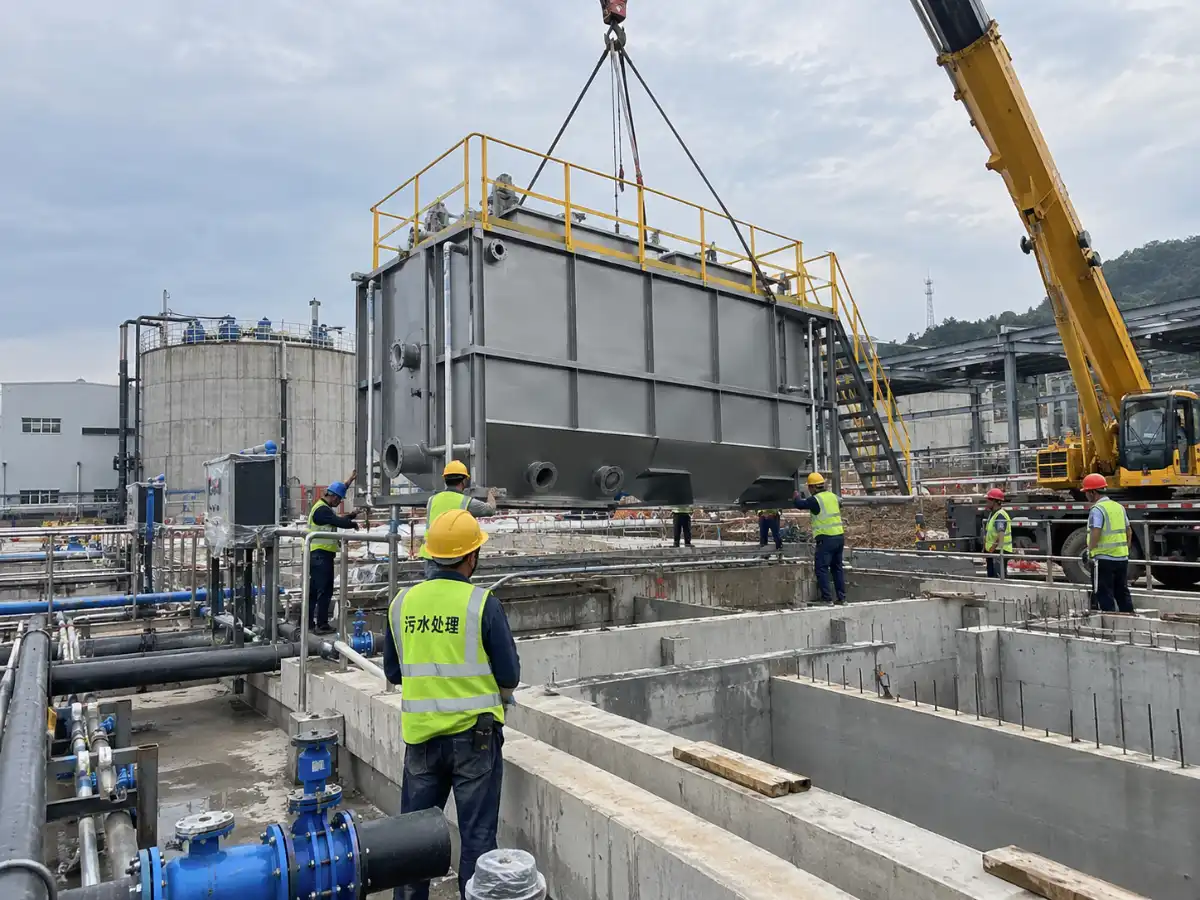
Option 1: Discharge to Sewer or Surface Water
The simplest option is also the one most plants start with. If your local authority accepts the salinity and your permit allows it, discharging RO reject to the sewer or an outfall is the lowest-cost path. The catch is that salinity limits are tightening in many regions, and some publicly owned treatment works now charge surcharges for high-TDS discharges or refuse them outright.
Before you rely on this route, confirm the chloride, sulfate, and TDS limits in writing. Also check whether your permit has a mass-based cap, not just a concentration cap. A concentration limit is easy to meet by dilution; a mass limit is not.
Option 2: Volume Reduction with a Second RO Stage
If the reject is only moderately concentrated, a second RO pass with a higher-pressure membrane can cut the volume significantly. This is the least expensive way to reduce the load on whatever comes next. You’re essentially converting part of the reject back into permeate and leaving a smaller, more concentrated brine.
The design constraint is osmotic pressure. Once you push past roughly 70-80 bar, standard elements are out and you need high-pressure RO membranes built for that service. Recovery in this stage is typically 30-50%, which means you can cut the reject volume by a third or more before it ever reaches a thermal system.
Option 3: DTRO for High-Fouling and High-Salinity Streams
Disk-tube reverse osmosis (DTRO) is the workhorse for the nastiest reject streams. The open-channel design handles suspended solids and fouling far better than spiral-wound elements, and it tolerates higher salinity without the same pre-treatment burden. I’ve seen it used successfully on landfill leachate and on mixed industrial brine where conventional RO would foul in weeks.
The trade-off is energy and membrane cost. DTRO runs at higher pressure and the elements are more expensive per square meter. But when your feed is dirty, the reliability gain usually outweighs the cost. A well-designed DTRO membrane system can push recovery to 75-85% on streams that would destroy a conventional train.
Option 4: Thermal Evaporation with Multi-Effect Distillation
When membrane concentration hits its ceiling, thermal evaporation takes over. Multi-effect evaporators use steam to boil the brine across a series of vessels at progressively lower pressure. Each additional effect reuses the vapor from the previous one, so energy consumption drops with each stage.
Rough guidance from projects I’ve been involved with:
| Настройка | Approx. steam consumption (kg per kg water evaporated) | Typical use case |
|---|---|---|
| Однократное воздействие | 1.0 – 1.1 | Small flows, high fouling, frequent cleaning |
| Двойной эффект | 0.55 – 0.65 | Moderate flows with available steam |
| Тройной эффект | 0.38 – 0.45 | Larger flows, steam cost sensitive |
| MVR (mechanical vapor recompression) | 0.0 (electric driven) | No steam available, electricity cheaper than steam |
These are indicative ranges only. Actual performance depends on boiling point elevation, scaling tendency, and whether you need a forced-circulation design for crystallizing service. A многоступенчатый выпариватель is usually the right call when you already have waste steam on site, because the operating cost can be very low.
Option 5: MVR Evaporation for Steam-Free Sites
Mechanical vapor recompression uses a compressor to raise the pressure and temperature of the evaporated vapor, then reuses it as the heating medium. The energy input is electrical, not thermal, which is a big advantage if your plant has cheap power and no steam header.
In my experience, MVR makes the most sense when:
- Electricity is reliably available and reasonably priced.
- Steam is expensive or simply not present.
- Flow rates are stable enough to keep the compressor running near its design point.
- The brine doesn’t scale aggressively, or you’ve designed for cleaning.
A properly sized испаритель с механическим сжатием пара (MVC) typically consumes 20-40 kWh per cubic meter of distillate, depending on boiling point elevation and compressor efficiency. That’s a useful number when you’re comparing it against the cost of purchased steam for a multi-effect system.
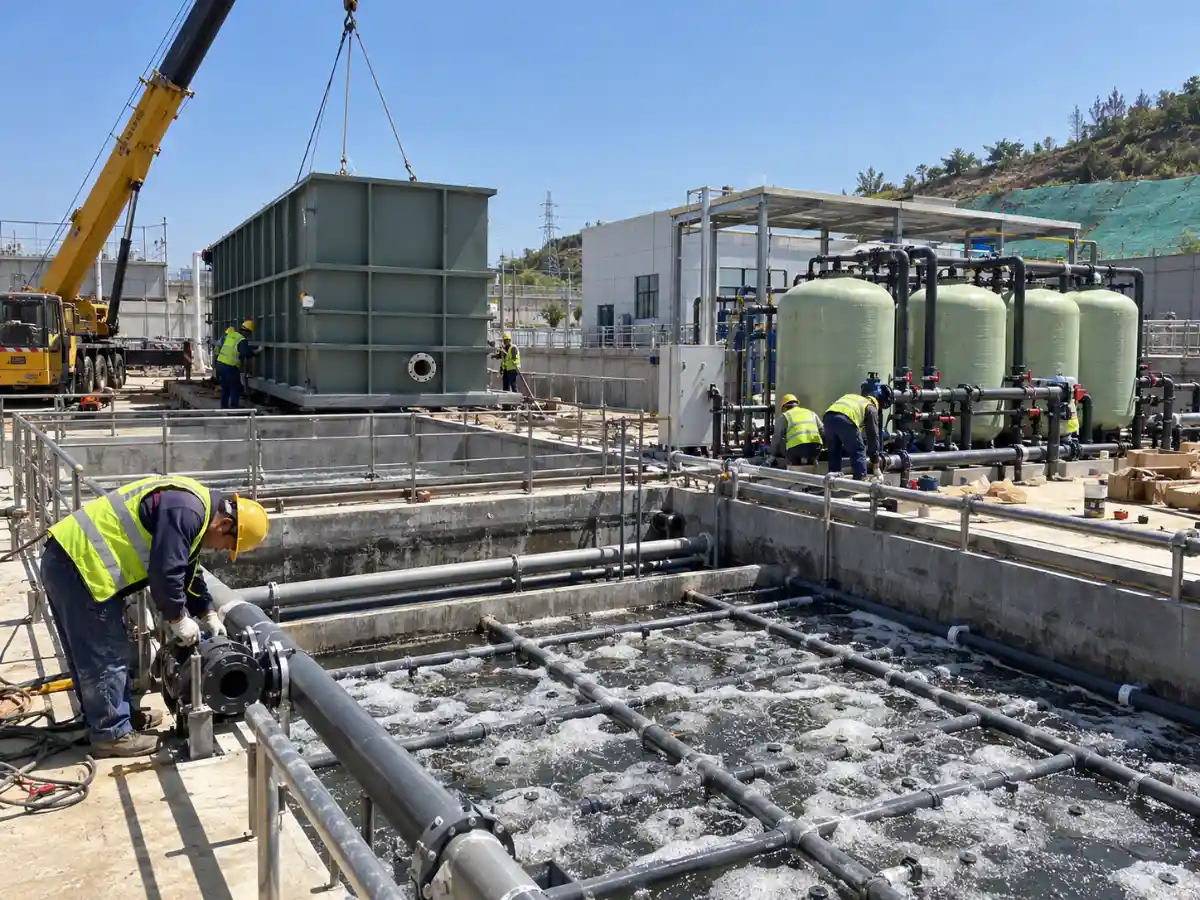
Option 6: Crystallization and True Zero Liquid Discharge
If your permit requires no liquid discharge at all, you need to go all the way to solid salt. A zero liquid discharge system typically combines membrane concentration, evaporation, and a crystallizer that boils off the remaining water and leaves a dry or semi-dry solid for landfill or recovery.
ZLD is expensive. Capital cost is high, energy demand is significant, and the solid waste still has to go somewhere. That said, for some facilities it’s the only compliant option, and it can be the right choice when water reuse value is high or when discharge is simply not permitted.
A well-designed zero liquid discharge system usually follows a staged approach: concentrate as much as possible with membranes, then evaporate, then crystallize. Pushing too much water into the crystallizer is the most common cost mistake I see. Every liter you remove upstream with membranes saves several times its cost in thermal energy downstream.
Option 7: Beneficial Reuse of the Concentrate
Not every reject stream is waste. In some facilities, the concentrate can be reused for:
- Dust suppression on roads or stockpiles, if salinity and metals allow.
- Cooling tower makeup, where the chemistry permits and the cycles of concentration are managed.
- Industrial process rinsing where high TDS is acceptable.
- Salt recovery, when the brine is clean enough and the market exists nearby.
Reuse is often the cheapest option when it’s technically feasible, but it requires careful analysis. You’re not eliminating the salt, you’re moving it. If the reuse stream eventually discharges somewhere, you may just be delaying the problem. Still, for plants with a genuine internal use for brackish water, this can cut both capital and operating cost dramatically.
Option 8: Hybrid Trains That Combine Several Steps
In practice, most industrial RO reject treatment projects use a hybrid. The typical pattern I’ve seen work well is:
- Pre-treatment to remove hardness, silica, and organics.
- High-pressure membrane or DTRO stage to reduce volume.
- MVR or multi-effect evaporation to concentrate further.
- Crystallization only if ZLD is required.
The reason this works is that each stage operates in the range where it’s most efficient. Membranes handle the bulk volume reduction cheaply. Evaporators handle the final concentration. Crystallizers handle only the small residual stream. Trying to do everything with one technology is almost always more expensive and less reliable.
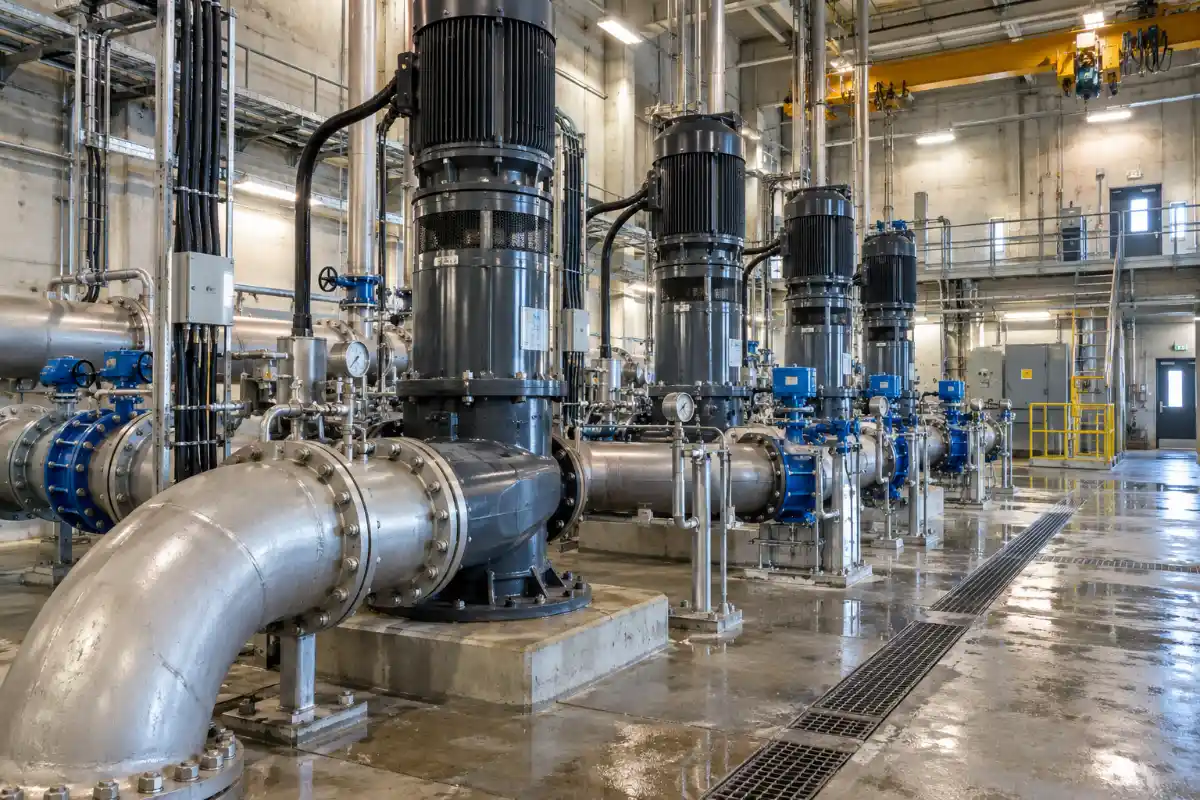
Comparing the Eight Options
| Option | Typical recovery | Relative capex | Relative opex | Best fit |
|---|---|---|---|---|
| Sewer / surface discharge | N/A | Very low | Very low | Permit allows, low salinity |
| Second RO stage | 30-50% of reject | Низкий | Низкий | Moderate salinity, clean feed |
| DTRO | 75-85% | Средний | Средний | High fouling, high salinity |
| Многоступенчатое выпаривание | Up to 90%+ | Medium-High | Low if steam cheap | Steam available on site |
| MVR evaporation | Up to 90%+ | Medium-High | Medium (electric) | No steam, stable power cost |
| ZLD with crystallizer | ~100% | Высокий | Высокий | No liquid discharge permitted |
| Beneficial reuse | Varies | Very low | Very low | Internal use available |
| Hybrid train | 85-100% | Medium-High | Optimized | Most industrial projects |
Treat these numbers as planning ranges, not guarantees. Every project depends on feed chemistry, site utilities, and permit limits.
What I Look At Before Recommending Anything
When a client sends me an RO reject problem, I ask for six things before I sketch a process flow:
- Complete water analysis, including silica, barium, strontium, and TOC. Not just TDS and conductivity.
- Flow rate and variability. A steady 100 m³/h is a very different design problem than a batch that swings between 20 and 120 m³/h.
- Discharge permit limits. Concentration or mass-based, and what the enforcement history looks like.
- Available utilities. Steam pressure and cost, electricity cost and reliability, cooling water availability.
- Site constraints. Footprint, elevation, noise limits, operator skill level.
- Lifecycle cost target. Some clients want the lowest capex. Others want the lowest 10-year cost. The answer is different for each.
The most common mistake I see is choosing a technology before the water chemistry is fully understood. It leads to scaling, fouling, and expensive retrofits within the first year.
Maintenance and Operating Realities
Whatever route you choose, plan for maintenance from day one. In my experience:
- Membrane systems need cleaning-in-place every 2-8 weeks depending on fouling. Budget for chemical cost and downtime.
- Evaporators need periodic boil-outs. Scaling on heat transfer surfaces is the number one cause of lost capacity.
- Compressors in MVR systems need regular inspection. They’re the heart of the system and the most expensive component to replace.
- Crystallizers need careful control of supersaturation. Poor control means fines, plugging, and unstable operation.
I always recommend a pilot test when the chemistry is uncertain or the scale is large. A few weeks of pilot data will save months of troubleshooting later.
“The best RO reject treatment design is the one that matches the site’s actual utilities, not the one that looks best on a process flow diagram.” — a lesson learned from more projects than I care to count.
Where to Focus Your Engineering Effort
If I had to give one piece of advice, it would be this: spend your design budget on pre-treatment and on getting the water chemistry right. Everything downstream depends on those two things. A modest membrane system with excellent pre-treatment will outperform a sophisticated evaporator train fed with poorly conditioned brine every time.
The second piece of advice is to think in stages. Concentrate with membranes as far as you can, then evaporate, then crystallize only if you must. Each stage has a sweet spot, and staying in that sweet spot is what keeps operating cost predictable over a 10-20 year asset life.
If you’re working through an RO reject problem and want to talk through the trade-offs, our engineering team reviews these cases regularly and can help you scope the right train for your site. Talk to an engineer about your RO reject stream
Часто задаваемые вопросы
What is the typical recovery rate for RO reject treatment?
It depends on the technology. A second RO stage typically recovers 30-50% of the reject volume. DTRO can reach 75-85% on suitable streams. Evaporation-based systems can recover 90% or more of the water as distillate, and ZLD approaches near 100%. The achievable number always depends on the feed chemistry and the scaling limits of the specific process.
How much does an RO reject treatment system cost?
Capital cost varies widely with flow rate, feed chemistry, and chosen technology. Membrane-based volume reduction is generally the least expensive per cubic meter treated. Evaporation adds significant capital and energy cost. ZLD with crystallization is the most expensive. I recommend getting a lifecycle cost comparison over 10 years rather than comparing capex alone, because the operating cost spread between options is often larger than the capex spread.
Can I just discharge RO reject to the sewer?
Sometimes, but it’s getting harder. Many publicly owned treatment works now limit TDS, chloride, or sulfate in industrial discharges, and some charge surcharges for high-salinity streams. Check your permit carefully, including any mass-based limits, before assuming this route is available.
What causes scaling in RO reject systems?
Silica, calcium carbonate, calcium sulfate, barium sulfate, and strontium sulfate are the usual culprits. They concentrate as water is removed and can exceed their solubility limits. Proper antiscalant dosing, pH adjustment, and pre-treatment softening are the standard defenses. For severe cases, you may need to remove silica upstream or use a seeded slurry evaporator design.
Should I choose MVR or multi-effect evaporation?
Choose MVR when you have no steam, reliable electricity, and stable flow. Choose multi-effect when you have cheap waste steam and want low electrical demand. In some facilities, a hybrid approach works best: MVR for base load with a multi-effect stage for peak flow. The decision usually comes down to the relative cost of steam versus electricity at your specific site.
How often do RO reject treatment systems need maintenance?
Membrane cleaning typically happens every 2-8 weeks depending on fouling rate. Evaporators need boil-outs every few months, sometimes more often with high-scaling feeds. Compressors and crystallizer components should be inspected on a scheduled basis, usually annually. A well-run system with good pre-treatment will need less frequent intervention than one that’s constantly fighting scaling.
Do I need a pilot test before designing a full-scale system?
For any project with uncertain chemistry, high salinity, or a large capital commitment, yes. A pilot test typically runs a few weeks and gives you real fouling rates, scaling behavior, and achievable recovery. The cost of a pilot is small compared to the cost of a full-scale system that doesn’t perform as expected.
What’s the most common design mistake in RO reject projects?
Choosing the technology before the water chemistry is fully characterized. I’ve seen clients commit to an evaporator before discovering that silica would scale the heat exchangers within weeks, or commit to a membrane system without accounting for organic fouling. Get the full analysis first, then design.
Can RO reject be reused instead of treated?
Sometimes. Dust suppression, cooling tower makeup, and certain process rinses can accept higher TDS water. But reuse doesn’t eliminate the salt, it just relocates it. If the reused water eventually discharges, you may still face the same permit limits. Reuse works best when there’s a genuine internal demand and the salt ends up in a product or a controlled waste stream.
How do I decide between ZLD and partial treatment?
Start with the permit. If liquid discharge is not allowed, ZLD may be your only option. If it is allowed, compare the lifecycle cost of partial treatment plus discharge against full ZLD. In many cases, partial treatment with a well-designed discharge is far cheaper and just as compliant. ZLD makes sense when discharge is prohibited, when water reuse value is very high, or when the site has no other disposal route.