

Textile dyeing wastewater is one of the hardest streams to close-loop. The color, salts, and hydrolyzed reactive dyes survive biological treatment, so a zero liquid discharge (ZLD) train almost always ends with membranes that produce a concentrated brine and an evaporator that boils it dry. The short answer: reverse osmosis (RO) recovers 60–85% of the flow as reusable permeate, and the remaining RO concentrate goes to a thermal evaporator — usually a mechanical vapor recompression (MVC) unit or a multi-effect evaporator — that reduces it to a solid or semi-solid residue. Getting that handoff right is where most projects succeed or fail.
I have commissioned dyehouse ZLD systems where the RO stage ran beautifully for months and the evaporator fouled in three weeks. The chemistry does not care about your P&ID. What follows is how I actually design and troubleshoot the RO-to-evaporator interface, with the numbers and trade-offs I use in real proposals.
Why dyeing wastewater breaks conventional treatment
Dyehouse effluent is not one stream. It is a batch cocktail of reactive, disperse, vat, and acid dye liquors, plus caustic scouring, soaping, and rinsing water. Three properties drive every downstream decision:
- Color and refractory organics. Reactive dyes are designed to bond to cellulose and resist washing off. That same stability makes them resistant to activated sludge. Chemical oxygen demand (COD) after biological treatment commonly sits in the 150–400 mg/L range, and the water still looks like weak tea.
- High total dissolved solids (TDS). Salt is the killer. Reactive dyeing uses 30–80 g/L of sodium chloride or sodium sulfate in the dyebath to drive exhaustion. Even after rinsing and equalization, combined effluent TDS often lands between 3,000 and 12,000 mg/L, with chloride and sulfate dominating.
- Hardness, silica, and color bodies. These are the three things that destroy evaporator heat transfer surfaces. Silica above roughly 100–150 mg/L as SiO₂ and total hardness above 200 mg/L as CaCO₃ will scale a falling-film exchanger fast if you do not pretreat.
That last point matters more than most vendors admit. An evaporator is a heat exchanger with a crystallization problem attached. If you feed it water that precipitates on the tube wall, you have bought a very expensive scaling experiment.
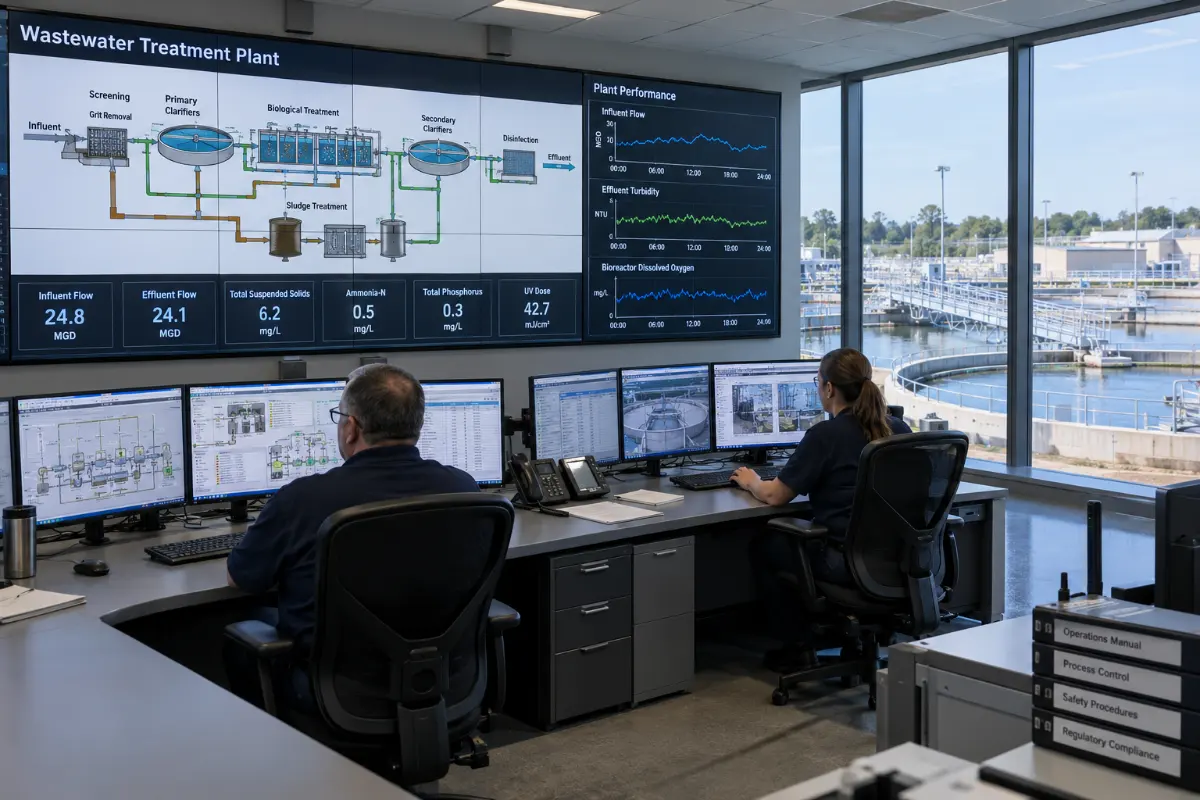
The ZLD train, stage by stage
A workable dyehouse ZLD line looks like this, in order:
- Equalization and homogenization. Batch dyeing means flow and load swing by a factor of three or more within a shift. A 12–24 hour equalization basin with mixing flattens the curve. Without it, every downstream unit is oversized and unstable.
- Chemical pretreatment. Coagulation and flocculation with iron or aluminum salts, sometimes plus a polymer, knock out suspended solids and a chunk of the color. Dissolved air flotation or clarification follows. This is where you decide how much of the problem goes to sludge versus to the membranes.
- Biological treatment. An activated sludge or membrane bioreactor (MBR) stage removes biodegradable COD. An MBR is worth the extra cost here because it delivers consistently low suspended solids to the RO, which extends membrane cleaning intervals considerably.
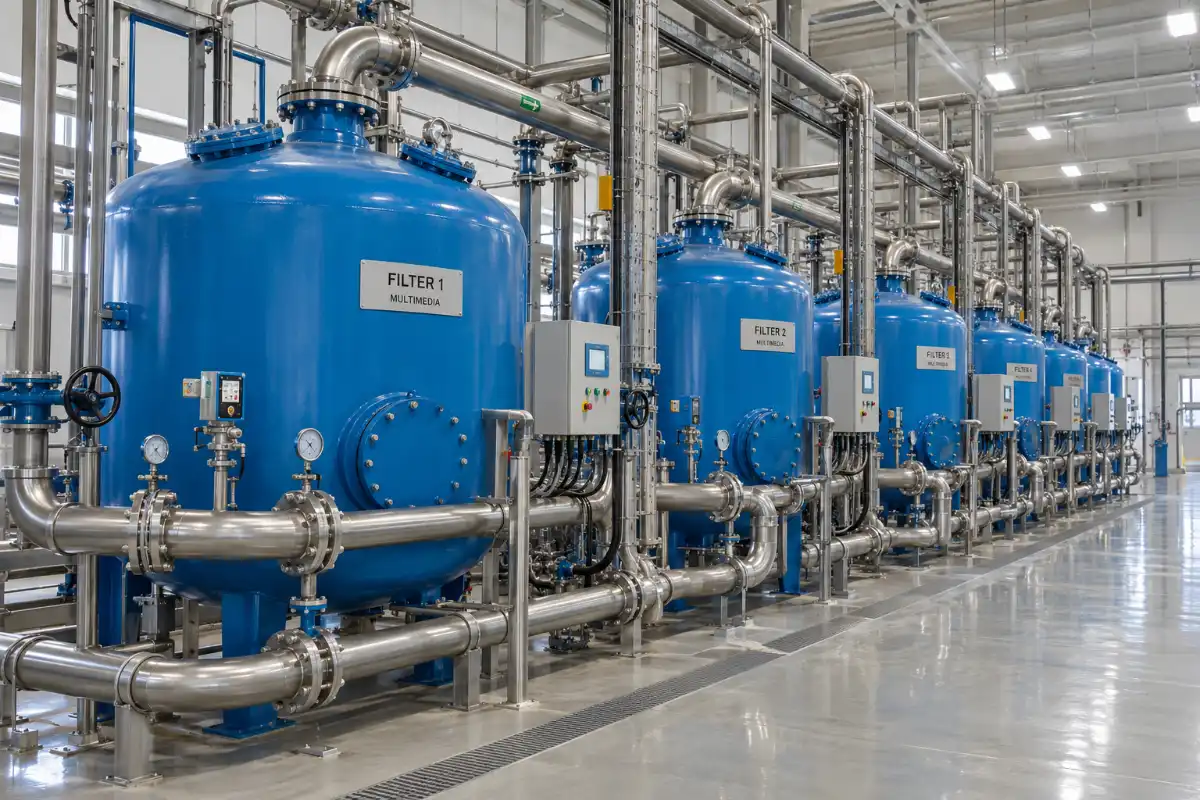
- Ultrafiltration or media filtration. A final barrier before the RO. Silt density index (SDI) below 3 is the target; below 5 you will be cleaning RO elements constantly.
- RO or high-pressure RO/DTRO. This is the volume reduction workhorse. Standard RO recovers 60–75%; a DTRO membrane system with disc-tube modules handles higher fouling potential and can push recovery toward 80–85% in a two-stage arrangement.
- Evaporator and crystallizer. The RO concentrate — typically 15–40% of the original flow, now at 3–8% TDS — is evaporated. Water leaves as distillate; salts leave as a damp solid or a crystallized cake.
Each stage exists to protect the next one. Skip the equalization and the RO sees shock loads. Skip the softening and the evaporator sees scale. The capital cost of the front end is almost always cheaper than the maintenance cost of the back end.
Designing the RO stage for a concentrate the evaporator can actually take
This is the part I see mishandled most often. Engineers design the RO for maximum recovery and then hand the evaporator a brine that is saturated with gypsum and silica. Two rules keep you out of trouble:
Set recovery by scaling chemistry, not by ambition
Concentration factors for sparingly soluble salts must stay below saturation at the highest brine concentration in the last stage. For a typical dyehouse concentrate, that usually means:
| Parameter | Typical feed to RO | Typical RO concentrate | Why it matters downstream |
|---|---|---|---|
| TDS | 3,000–12,000 mg/L | 15,000–40,000 mg/L | Sets evaporator boiling point rise and energy demand |
| COD | 150–400 mg/L | 600–2,000 mg/L | Foaming and organic fouling in the evaporator |
| Total hardness (as CaCO₃) | 150–600 mg/L | 800–3,000 mg/L | Carbonate and sulfate scaling on heat transfer surfaces |
| Silica (as SiO₂) | 20–120 mg/L | 100–500 mg/L | Hard, glassy scale that is very difficult to remove |
| Chloride | 1,000–6,000 mg/L | 6,000–25,000 mg/L | Drives material selection for wetted parts |
Typical design ranges. Actual values are project-dependent and must come from a full water analysis over several production cycles.
If your concentrate lands above roughly 200 mg/L silica and 500 mg/L hardness, add softening — lime-soda, ion exchange, or a combination — before the evaporator. It costs less than the downtime.
Choose the membrane format for the fouling you have
Spiral-wound RO elements are fine when pretreatment is solid and the feed is stable. When the feed carries residual color, colloidal matter, or high salinity, a high-pressure RO membrane in a disc-tube or open-channel configuration tolerates far more abuse. The trade-off is higher specific energy and a bigger footprint per unit of permeate. I have run both; the disc-tube arrangement wins on uptime in dyehouse service almost every time.
Rule of thumb from commissioning experience: every hour you spend stabilizing the RO feed saves you roughly a day of evaporator cleaning over the first year of operation.
Evaporator selection: MVC versus multi-effect
Once the concentrate is ready, you have two mainstream thermal options. The choice is driven by energy price, steam availability, and the electrical supply at the site.
| Factor | MVC evaporator | Multi-effect evaporator |
|---|---|---|
| Energy input | Electricity for the compressor | Steam (or hot water) for the first effect |
| Typical specific consumption | 20–40 kWh per m³ of distillate | 0.3–0.5 kg steam per kg of distillate, falling with more effects |
| Steam requirement | None after start-up | Continuous |
| Footprint | Compact | Larger, more vessels and piping |
| Best fit | No steam available, moderate capacity | Cheap steam available, large capacity |
| Turn-down flexibility | Good with variable-speed compressor | Moderate; needs stable load |
Indicative ranges. Real numbers depend on boiling point elevation, compressor efficiency, and effect count.
For most dyehouses I work with, there is no steam header, so the decision defaults to MVC. A mechanical vapor compression MVC evaporator compresses the vapor it generates and reuses it as the heating medium, which is why the electrical consumption stays in that 20–40 kWh/m³ band. If the plant already runs a boiler and steam is effectively free, a multi-effect evaporator with three or four effects can beat MVC on operating cost.
Where the two technologies touch is the heat exchanger. Both depend on clean, wetted surfaces. The design of the MVC evaporator heat exchangers — falling film versus forced circulation — determines how often you have to stop and clean. For high-scaling dyehouse brine, forced circulation with a crystallizer sump is more forgiving than a simple falling-film arrangement.
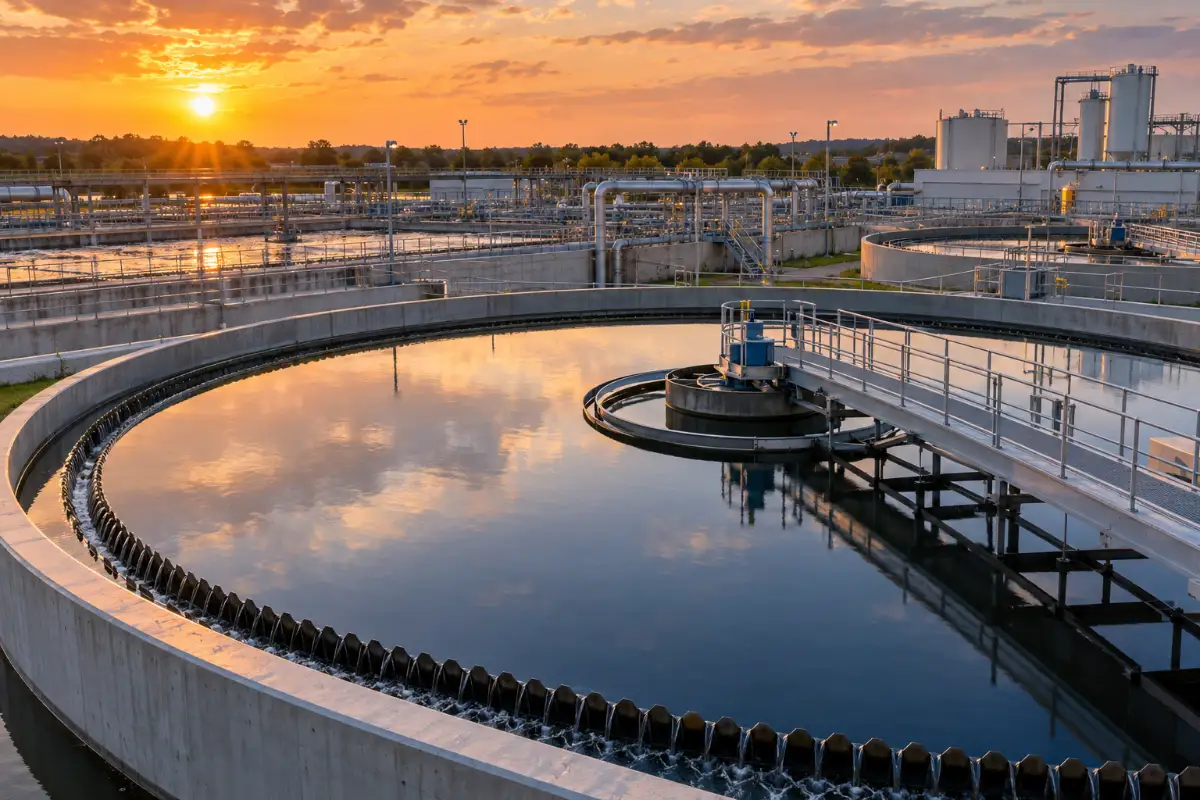
The crystallization end and solids handling
Evaporation alone gets you a concentrated brine, not a dry solid. To truly close the loop you need a crystallizer — usually a forced-circulation unit that operates past saturation and discharges a salt slurry to a centrifuge or filter press. In dyehouse service the solids are a mixed salt cake, often dark and hygroscopic, and it is rarely saleable. Plan for landfill or incineration and budget the disposal cost honestly.
Where solids handling is a bottleneck, a screw press sludge dewatering unit handles the biological and chemical sludge from the front end, and a separate centrifuge handles the crystallizer salt. Do not try to combine them; the properties are completely different.
Energy and lifecycle cost reality check
ZLD is an energy story. The membrane stage is cheap to run; the thermal stage is not. A rough breakdown for a 500 m³/day dyehouse ZLD system:
- Pretreatment and biological: 0.5–1.5 kWh/m³ of feed, plus chemical cost.
- RO/DTRO: 1.5–4 kWh/m³ of feed, rising with recovery and salinity.
- Evaporation of concentrate: the dominant term. If concentrate is 25% of feed at 30 kWh/m³, that is 7.5 kWh per m³ of original feed.
That last number is why recovery matters so much. Every percentage point of RO recovery you gain reduces evaporator load proportionally. It is also why the membrane stage deserves more engineering attention than it usually gets — it is the cheapest place to remove water.
Lifecycle cost also includes membrane replacement every three to five years, compressor overhaul on the MVC unit every five to seven years, and the labor for chemical cleaning. I tell clients to build a 15-year cash flow model before signing off on any ZLD design. The capital number is the easy part.
Common failure modes and how to avoid them
| Symptom | Likely root cause | Fix |
|---|---|---|
| RO flux declines within weeks | Organic or colloidal fouling from inadequate pretreatment | Improve coagulation, add UF, verify SDI |
| Evaporator heat transfer drops off | Silica or hardness scaling | Soften feed, add antiscalant, adjust pH |
| Foaming and carryover in evaporator | Surfactants and residual dye in concentrate | Antifoam dosing, better biological removal upstream |
| Compressor vibration or high discharge temperature | Fouled impeller or off-design operation | Clean, rebalance, check turndown control |
| Salt cake too wet for disposal | Centrifuge underperforming or crystal size too fine | Adjust crystallizer residence time, review centrifuge selection |
None of these are exotic. They are the predictable consequences of under-designing the front end and over-promising on the back end. The projects that run smoothly are the ones where the engineer treated the whole train as one system instead of a stack of vendor packages.
Practical engineering recommendations
- Characterize the wastewater over a full production cycle. A single grab sample will mislead you. Sample each dye class separately and then the combined stream.
- Design the RO for the evaporator, not for a recovery target. Saturation indices for gypsum, calcite, and silica set the real limit.
- Pilot the evaporator. Boiling point elevation, foaming tendency, and scaling rate cannot be predicted from a lab analysis alone.
- Keep the distillate quality in mind. Evaporator condensate often carries volatile organics; it may need a polishing step before reuse.
- Budget for cleaning, not just for capital. Chemical cleaning frequency is the number that decides whether the plant is profitable to operate.
- Plan the solids end from day one. Salt disposal is a real cost line, and it does not disappear because the water did.
If you are evaluating a ZLD project for a dyehouse and want a second opinion on the RO-to-evaporator interface, our team reviews system designs regularly. You can reach out through our contact page and we will walk through the concentrate chemistry with you.
Frequently asked questions
What recovery rate can I realistically expect from RO on dyeing wastewater?
Most dyehouse RO trains recover 60–75% of the feed as permeate. With disc-tube or high-pressure RO and softening, 80–85% is achievable, but the concentrate becomes harder to evaporate. The right number is the one that keeps sparingly soluble salts below saturation in the last stage, not the highest number you can find in a brochure.
Should I choose MVC or a multi-effect evaporator?
If you have no steam supply and moderate capacity, MVC is usually the better fit because it runs on electricity and needs no continuous steam. If you already have a boiler and cheap steam, a multi-effect evaporator with three or four effects will often have lower operating cost. The crossover point depends on your local electricity and steam prices.
How do I prevent silica scaling in the evaporator?
Softening before the evaporator is the most reliable control. Keep silica in the concentrate below roughly 150 mg/L as SiO₂ where possible, operate at a pH that discourages polymerization, and consider magnesium-based silica removal if the concentration is high. Once silica scale forms, it is difficult and expensive to remove.
What maintenance does the evaporator need?
Expect chemical cleaning of heat transfer surfaces every two to eight weeks depending on scaling tendency, compressor inspection annually, and a full overhaul every five to seven years. Continuous monitoring of concentrate conductivity, hardness, and silica is the best way to schedule cleaning before performance drops.
Is the salt cake from ZLD saleable?
In dyehouse service, usually not. The mixed salt cake contains residual organics and color, and it is rarely pure enough for industrial reuse. Plan for landfill or incineration and include the disposal cost in your operating budget from the start.
How much does ZLD cost to operate?
The evaporation stage dominates. A rough planning figure is 20–40 kWh per cubic meter of distillate for MVC, plus chemical and disposal costs. For a 500 m³/day plant with 25% concentrate, that is a meaningful electrical load. Always model it over 15 years before committing.
Can I reuse the permeate in the dyehouse?
Often yes, but it depends on the dye class and the process. RO permeate is typically low in TDS and suitable for rinsing and some preparation steps. For critical dyeing baths, you may need to blend it with fresh water or add a polishing step to control residual organics.
What is the biggest mistake in ZLD design for textile wastewater?
Under-designing the pretreatment and equalization. Every shortcut there shows up as membrane fouling and evaporator scaling later. The front end is where you buy reliability for the whole train.