

High-TDS industrial brine is one of the hardest wastewater streams to handle because conventional biological treatment simply cannot touch it. Once total dissolved solids climb past roughly 10,000–15,000 mg/L, activated sludge stops working, membranes foul fast, and discharge limits become nearly impossible to meet. The practical answer is a train that combines membrane preconcentration with thermal evaporation — usually MVC or MVR — and, where regulations demand it, a zero liquid discharge finish. In this article I walk through the technologies I actually specify, where each one fits, how they behave in real plants, and the trade-offs that decide whether a system runs smoothly for a decade or becomes a maintenance headache.
What Makes High-TDS Brine Different
Brine is not just “salty wastewater.” Its behavior changes with every constituent. Before I choose any equipment, I look at four things: TDS and ionic composition, scaling potential, organics, and volatility.
- TDS and ionic composition. Chloride-dominated brine behaves very differently from sulfate- or carbonate-dominated brine. Chlorides drive up corrosion risk on stainless steel; sulfates and calcium drive gypsum scaling; silica is the quiet killer in evaporators.
- Scaling potential. Calcium carbonate, calcium sulfate, barium sulfate, and silica all have solubility curves that fall as temperature rises. In an evaporator, that means the hottest surfaces are the ones most likely to scale.
- Organics and oil. Even a few hundred mg/L of oil or COD can foam an evaporator, foul heat exchangers, and turn a clean condensate into a problem stream. Organics often need removal before the thermal stage.
- Volatility. Ammonia, volatile organics, and some solvents will carry over into the distillate. That changes condensate polishing requirements and sometimes rules out simple evaporation.
I have seen projects fail because the design was based on a single TDS number and a lab analysis taken on one grab sample. Brine composition shifts with production campaigns and upstream processes. Sampling over time matters more than sampling precisely.
Membrane Preconcentration: Getting the Volume Down First
Evaporation is thermally expensive. Every cubic meter you can remove with membranes before the evaporator saves real money in both capital and operating cost. The question is how far you can push membranes before osmotic pressure and fouling stop you.
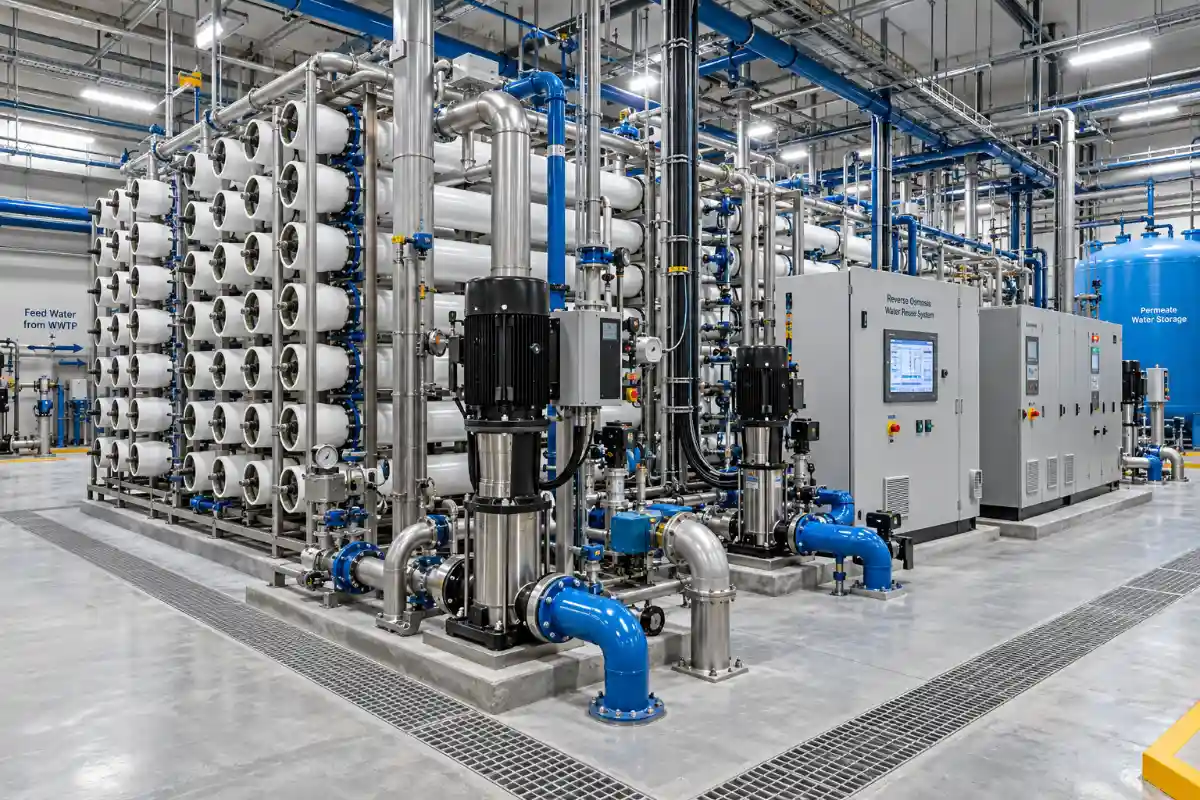
Industrial RO and High-Pressure RO
Standard industrial RO tops out around 1,200–1,500 psi (roughly 80–100 bar) in practical brine service. That gets you to maybe 70,000–80,000 mg/L TDS in the concentrate, and only with careful pretreatment and antiscalant selection. High-pressure RO membranes built for brine service can push a bit further, but recovery drops, flux drops, and the energy per cubic meter rises sharply. It is still usually cheaper than evaporating the same water.
DTRO Membrane Systems
Disk-tube reverse osmosis (DTRO) is the workhorse for dirty, high-TDS streams that would destroy a spiral-wound element. The open channel design tolerates suspended solids, higher fouling potential, and much higher salinity than conventional RO. In landfill leachate and some industrial brine projects, DTRO can concentrate to 80,000–100,000 mg/L before the evaporator takes over. It is not a silver bullet — it still needs cleaning cycles, and the concentrate has to go somewhere — but it reliably reduces evaporator load.
Where I see the biggest mistakes with membrane preconcentration: underestimating silica, ignoring the effect of temperature on scaling, and not planning for concentrate management from day one. A membrane stage that produces a concentrate nobody can handle is not a solution.
Thermal Evaporation: MVC, MVR, and Multi-Effect
Once membranes hit their limit, evaporation does the rest. There are three families worth knowing, and each has a clear place.
Mechanical Vapor Compression (MVC / MVR)
MVC and MVR are the same idea under different names: compress the vapor produced by boiling and use it to heat the same boiling liquid. The compressor does the work that a steam supply would otherwise do. For most industrial brine projects in the 5–50 m³/h range, MVC is the default choice because it needs no external steam and its specific energy consumption is the lowest of the thermal options — typically in the range of 15–40 kWh per cubic meter of distillate, project-dependent.
The compressor is the heart of the system and the biggest single point of failure. Its selection, materials, and turndown capability decide how well the whole plant runs. I pay close attention to the heat exchanger design too, because scaling on the evaporator side is what actually stops these systems in the field.
Multi-Effect Evaporation
Multi-effect evaporators reuse vapor across several stages. A double-effect unit delivers roughly 1.7–1.8 kg of distillate per kg of steam; a triple-effect unit gets to about 2.5–2.6 kg per kg of steam. The trade-off is more vessels, more piping, more instruments, and a need for steam. If you have cheap waste steam available, multi-effect can be the better economic choice. If you do not, MVC usually wins.
Single-Effect Evaporators
Single-effect units are simple, compact, and useful for small flows or for streams where the boiling point elevation is high enough that stacking effects does not pay. They are also common as the final concentrator or crystallizer in a ZLD train.
| Technology | Typical Feed TDS | Energy Source | Best Fit | Main Risk |
|---|---|---|---|---|
| Industrial RO | Up to ~50,000 mg/L | Electric | Bulk preconcentration | Scaling, fouling |
| High-pressure RO / DTRO | 50,000–100,000 mg/L | Electric | Dirty or very saline brine | Membrane life, cleaning frequency |
| MVC / MVR evaporator | 30,000–250,000 mg/L | Electric (compressor) | Most industrial brine | Compressor reliability, scaling |
| Multi-effect evaporator | 30,000–250,000 mg/L | Steam + electric | Plants with waste steam | Steam dependency, footprint |
| Crystallizer (ZLD finish) | Near saturation | Steam or electric | Zero liquid discharge | Salt handling, scaling |
If you want a deeper look at how these units are built and where they fit, the technical pages on mechanical vapor compression MVC evaporators and multi-effect evaporators cover the internals and typical configurations.
Zero Liquid Discharge: When You Cannot Send Concentrate Anywhere
ZLD means no liquid leaves the site. In practice, that means a concentrator followed by a crystallizer or spray dryer, and a solid salt or mixed-salt cake that goes to landfill or, in some cases, is recovered as a product. ZLD is expensive — capital and energy both — and it is usually driven by regulation or by the absence of any permitted discharge route.
The engineering challenge with ZLD is not the concept; it is the salt. Mixed salts are hard to sell, hard to dispose of cheaply, and hard to keep consistent. If the brine contains heavy metals or organics, the salt may be classified as hazardous waste, which changes the disposal cost entirely. I always ask clients two questions before recommending ZLD: what is the salt going to be, and who is going to take it?
For a broader view of how ZLD trains are configured and where they make sense, the zero liquid discharge systems overview is a useful reference.
Pretreatment: The Part That Decides Everything
No evaporator survives a poorly pretreated feed. In my experience, the difference between a system that runs for years and one that is cleaned every month is almost always upstream.
- Oil and grease removal. Dissolved air flotation or coalescing separators. Target below 10 mg/L, ideally below 5 mg/L, before the evaporator.
- Hardness and silica removal. Cold lime softening, ion exchange, or chemical precipitation depending on the stream. Silica is the one people forget; it needs its own removal step.
- Suspended solids. Filtration, sometimes ultrafiltration, ahead of membranes and evaporators.
- Organics. Advanced oxidation, activated carbon, or biological treatment if the stream allows it.
- pH adjustment. Often overlooked, but it controls scaling chemistry and corrosion.
I have seen a well-designed MVC evaporator scale up in three weeks because the client skipped silica removal to save capital. The cleaning cost and downtime in the first year exceeded the entire pretreatment budget. That is a lesson worth repeating.
Energy, Cost, and Lifecycle Thinking
Operating cost in a brine plant is dominated by electricity, steam (if used), chemicals, and maintenance. Capital cost is dominated by materials of construction, compressor selection, and the number of stages. I usually evaluate options over a 10-year horizon because the ranking of technologies often flips between year one and year ten.
Indicative ranges I use for early-stage comparison, all project-dependent:
- MVC evaporator electricity: roughly 15–40 kWh per m³ of distillate, rising with boiling point elevation and fouling margin.
- Multi-effect evaporator steam: about 0.55–0.6 kg steam per kg distillate for a double-effect, 0.38–0.4 for a triple-effect.
- Membrane preconcentration: 3–8 kWh per m³ of permeate for RO, higher for DTRO on difficult feeds.
- Chemical cleaning: typically 2–6% of annual operating cost in a well-run plant, much higher if pretreatment is weak.
These numbers are for orientation only. Real figures depend on feed composition, recovery target, ambient conditions, and how disciplined the operations team is. Anyone quoting a single number without a water analysis is guessing.
“The cheapest evaporator is the one you don’t have to clean. Pretreatment is not overhead — it is the design.”
Equipment Selection: What Actually Matters
When I review quotations from different suppliers, I look at the same handful of items every time. They separate serious designs from optimistic ones.
- Material selection. Duplex or super duplex stainless for chloride service, titanium or higher alloys where temperatures and chlorides are aggressive. Carbon steel is fine for some non-wetted parts, but not for brine-wetted surfaces.
- Compressor type and turndown. Centrifugal, roots, or screw depending on flow and compression ratio. Turndown below 50% is often where problems start.
- Heat exchanger design. Falling film, forced circulation, or plate. Each has a different scaling profile and a different cleaning routine.
- Antifoam and cleaning systems. Built in, not bolted on later. Foaming is the most common cause of distillate quality excursions.
- Control philosophy. Automatic conductivity blowdown, temperature control, and alarm logic that actually protects the compressor.
- Redundancy. Pumps, instruments, and sometimes the compressor itself. A single-point failure in a ZLD plant can shut down the whole factory.
For heat exchanger specifics and how they interact with scaling and cleaning, the MVC evaporator heat exchangers page goes into detail on the trade-offs.
Operating Experience: What Goes Wrong and Why
After enough projects, patterns show up. These are the failures I see most often, and what prevents them.
- Scaling on the heat transfer surface. Usually caused by inadequate pretreatment or by pushing concentration beyond the design point. Fixed by softening, antiscalant, and honest operating limits.
- Foaming and carryover. Organics and surfactants in the feed. Fixed by defoamer dosing, mechanical foam breaking, and better upstream removal.
- Compressor vibration and bearing wear. Often from liquid carryover or from running outside the design envelope. Fixed by mist eliminators, knock-out drums, and disciplined startup procedures.
- Corrosion in the vapor and condensate lines. Chlorides plus heat plus oxygen. Fixed by material upgrade and careful attention to stagnant areas.
- Distillate quality excursions. Almost always a foam or entrainment event. Fixed by better separation and by monitoring conductivity continuously.
- Salt crystallization in the wrong place. Happens when the brine is concentrated past saturation in a section that was not designed for solids. Fixed by controlling the concentration setpoint and designing the crystallizer properly.
None of these are exotic. They are the daily reality of running a brine plant. A good design anticipates them; a bad one is surprised by them every quarter.
Matching the Train to the Stream
There is no universal brine treatment solution. The right train depends on the specific stream and the specific site. A few patterns I have seen work well:
- Electroplating rinse and spent bath brine. Chemical precipitation for metals, then RO or DTRO for volume reduction, then MVC for final concentration. Metals are recovered or stabilized before they reach the evaporator.
- Pharmaceutical brine with high COD. Advanced oxidation or wet air oxidation upstream, then MVC. The organics have to come out before the evaporator, or the distillate will not meet discharge limits.
- Landfill leachate with high ammonia and TDS. Ammonia stripping, then DTRO, then MVC. Ammonia is the swing factor; if it is not removed, it ends up in the condensate.
- Chemical plant brine with mixed salts. Often a multi-effect evaporator followed by a crystallizer, especially if waste steam is available on site.
For a closer look at how these trains come together in practice, the project write-ups on electroplating wastewater treatment and landfill leachate treatment show the design logic step by step.
Practical Engineering Advice
If you are planning a high-TDS brine project, these are the points I would insist on before signing anything:
- Get a proper water analysis over time, not a single grab sample. Include silica, boron, and organics.
- Pilot the evaporator if the stream is unusual. A pilot costs a fraction of a failed full-scale unit.
- Design pretreatment for the worst credible feed, not the average.
- Plan concentrate and salt management before you buy equipment, not after.
- Insist on clear operating envelopes and a maintenance plan in the contract.
- Budget for spares and for a service relationship. Compressors and membranes are not commodity items.
Brine treatment is a long-game business. The plants that run well for fifteen years are the ones that were designed for reality, not for the sales brochure.
Planning a high-TDS brine project?
Share your water analysis and flow rate. We will review the treatment train and flag the risks before you commit capital.
Frequently Asked Questions
What TDS level makes biological treatment impractical?
Most conventional activated sludge systems start losing efficiency above roughly 10,000–15,000 mg/L TDS, and many fail well before that depending on the ionic composition. Chlorides and sulfates are especially hard on nitrifying bacteria. If your stream is above that range, plan on a membrane and thermal train rather than trying to adapt a biological process.
How do I choose between MVC and multi-effect evaporation?
Look at your steam supply and your electricity cost. MVC needs no steam and has lower specific energy consumption, so it usually wins where steam is expensive or unavailable. Multi-effect wins where you have cheap waste steam and want to minimize electrical demand. For flows above roughly 50 m³/h, multi-effect with MVC hybrid configurations sometimes make sense, but the analysis has to be done on real numbers.
What causes scaling in a brine evaporator, and how is it controlled?
Calcium carbonate, calcium sulfate, barium sulfate, and silica are the usual culprits. They precipitate when their solubility limits are exceeded, and solubility generally falls as temperature rises. Control comes from pretreatment (softening, silica removal), antiscalant dosing, and honest operating limits on concentration factor. Regular cleaning is a backup, not a strategy.
How often does an MVC evaporator need to be cleaned?
In a well-pretreated plant, chemical cleaning might be needed every three to twelve months depending on the feed. In a plant with weak pretreatment, it can be monthly or worse. The cleaning frequency is a direct indicator of how well the upstream stages are doing their job.
Can I achieve zero liquid discharge without a crystallizer?
Not really, if the goal is truly zero liquid discharge. A concentrator can reduce the volume dramatically, but the remaining brine still has to go somewhere. A crystallizer or spray dryer is what turns that brine into a solid. Some sites use evaporation ponds instead, but those are site-specific and increasingly restricted.
What is the biggest cause of project failure in high-TDS brine treatment?
In my experience, it is inadequate pretreatment driven by capital cost pressure. Skipping silica removal, oil removal, or hardness control shifts the cost from a modest upfront investment to years of cleaning, downtime, and premature equipment replacement. The second most common cause is designing for average feed quality instead of worst-case feed quality.