

Condensate from a wastewater evaporator is almost never clean water, and treating it like clean water is one of the most common mistakes I see on industrial sites. In most systems, the distillate still carries measurable COD, ammonia, and volatile organics, and the exact levels depend on the feed chemistry, the evaporation temperature, the de-entrainment design, and how the unit is operated. If you are planning to reuse that condensate, discharge it, or feed it to a downstream membrane or biological stage, you need to know what is actually coming out of the vapor side, not what the mass balance on paper promises. This article walks through where carryover comes from, how to predict it, and how to design around it.
Why evaporator condensate is not distilled water
When people hear “evaporation,” they picture a clean phase change. In real industrial wastewater, the vapor leaving the boiling surface is a mixture, not a pure compound. Three mechanisms drive contaminants into the condensate:
- Volatile carryover. Compounds with a low Henry’s law constant and a boiling point below or near water — ammonia, short-chain amines, ketones, some alcohols, and certain solvents — partition into the vapor phase and travel with the steam.
- Entrainment. Fine droplets of concentrated brine get physically dragged into the vapor stream. This is a mechanical problem, not a chemical one, and it is the biggest single cause of high COD in condensate.
- Foaming and surface active agents. Oils, surfactants, and dissolved organics stabilize foam, which raises the liquid surface and pushes droplets into the mist eliminator faster than it can drain them.
Understanding which mechanism dominates tells you what to fix. A condensate with high ammonia but low COD points to volatiles. High COD with a jump in conductivity points to entrainment. Both together usually means the unit is running above its design capacity or the feed has changed.
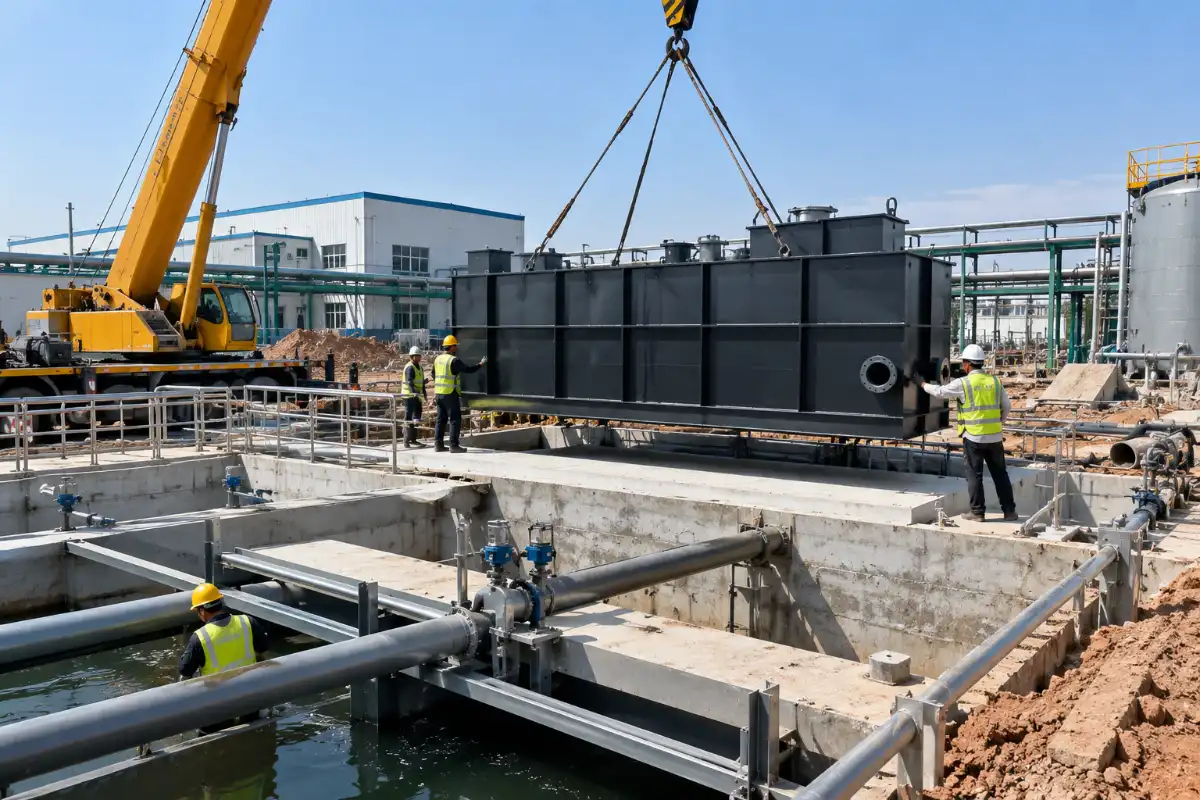
Typical condensate quality ranges by wastewater type
The table below shows indicative ranges I have seen across projects. Treat these as engineering starting points, not guarantees. Every one of them shifts with feed concentration, pH, and operating pressure.
| Wastewater source | Condensate COD (mg/L) | Ammonia-N (mg/L) | VOC / TOC tendency | Main driver |
|---|---|---|---|---|
| Electroplating rinse water | 50 – 300 | 10 – 80 | Low | Entrainment of metal-bearing brine |
| Pharmaceutical fermentation broth | 300 – 2,000 | 100 – 1,500 | Moderate to high | Volatile solvents and ammonia |
| Landfill leachate (MVC/MVR) | 200 – 1,500 | 300 – 2,500 | Moderate | Ammonia stripping plus organic volatiles |
| Chemical / petrochemical brine | 100 – 1,000 | 20 – 400 | High | Solvent partitioning and foaming |
| Battery / new energy wastewater | 80 – 600 | 50 – 500 | Low to moderate | Ammonium salts and entrainment |
If your condensate numbers are outside the upper end of these ranges, the problem is almost always operational rather than a fundamental design flaw. That is good news, because it can be fixed.
How ammonia ends up in the condensate
Ammonia is the contaminant that surprises people most. At neutral pH, a large fraction of ammonia exists as the ammonium ion, which does not volatilize. But as the wastewater concentrates inside the evaporator, the pH often drops or rises depending on the feed, and the free ammonia fraction grows. Once free ammonia is present, it follows the steam.
The distribution is governed by the vapor-liquid equilibrium at the operating temperature and pressure. Two practical consequences:
- Lower boiling temperature (vacuum operation) reduces ammonia carryover because the equilibrium shifts toward the liquid.
- Higher pH in the evaporator sump increases free ammonia and drives it into the vapor.
I have seen a leachate evaporator go from 200 mg/L to over 1,200 mg/L ammonia in the condensate simply because the feed pH drifted upward after a change in upstream lime dosing. Nothing in the evaporator changed. The chemistry did. This is why pH control on the feed is not optional — it is a condensate quality control parameter.
In my experience, the three variables that most often explain a sudden condensate quality change are feed pH, feed temperature, and the condition of the mist eliminator. Check those before you touch the compressor.
COD and VOC carryover: what actually partitions
COD in condensate comes from two sources: dissolved volatile organics that partitioned into the steam, and entrained brine droplets. You can separate them with a simple test. Filter the condensate through a 0.45 micron membrane and measure COD again. If the filtered COD is much lower, entrainment is your problem. If it barely changes, you have genuine volatile carryover.
Volatile organic carryover depends on the compound. Methanol, acetone, and light ketones partition strongly. Heavier organics, long-chain fatty acids, and most oils do not, unless foaming carries them over mechanically. This is why oily wastewater needs pretreatment before it reaches the evaporator — not because the oil evaporates, but because it destabilizes the boiling surface and destroys de-entrainment performance.
For systems where VOC carryover is a real concern, the design response is usually one of these:
- Two-stage condensation with a colder second stage to knock down the more volatile fraction.
- Higher-efficiency mist eliminators, sometimes with a wash cycle.
- Feed pretreatment to strip or oxidize the volatile fraction before evaporation.
- Post-treatment of condensate — activated carbon, biological polishing, or advanced oxidation.
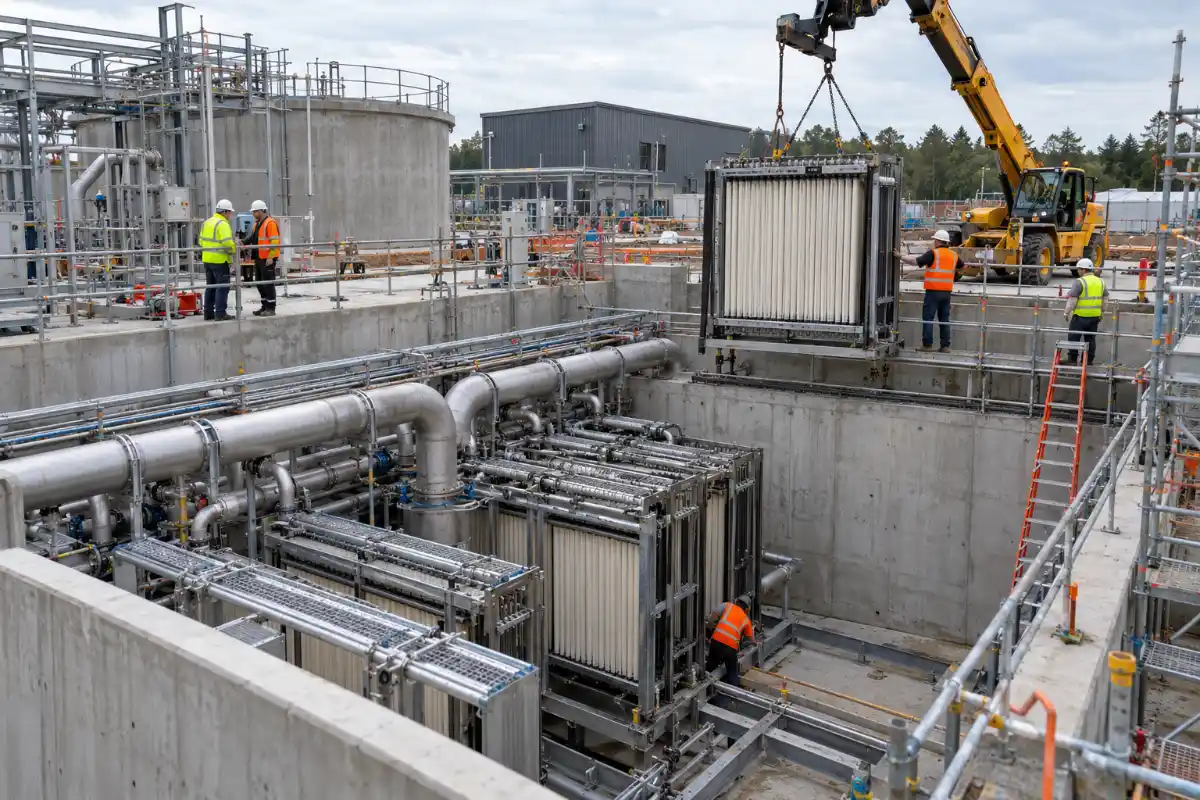
Design choices that control condensate quality
Evaporator type and operating temperature
Mechanical vapor recompression and multi-effect systems operate at different temperature and pressure profiles, and that affects volatiles. A mechanical vapor compression MVC evaporator typically runs with a modest temperature lift, which keeps the boiling point moderate. Multi-effect trains can run hotter in the first effect, which pushes more ammonia and light organics into the vapor. If condensate quality is critical, vacuum operation and lower top temperature usually help.
The number of effects also matters for energy and for how the vapor is handled. A multi-effect evaporator reuses vapor between stages, which means the condensate from each effect can have a different composition. The first-effect condensate is usually the dirtiest. Sometimes it makes sense to segregate it rather than blend everything into one tank.
De-entrainment and mist elimination
This is where most condensate quality is won or lost. A well-designed vapor path includes:
- Adequate vapor space above the boiling surface to let droplets settle.
- A mesh pad or vane-type mist eliminator sized for the actual vapor load, not the nominal load.
- Proper drainage from the mist eliminator back to the sump, so captured liquid does not re-entrain.
- Anti-foam control or mechanical foam breaking where surfactants are present.
When a unit is pushed above design capacity, vapor velocity rises, droplet settling time drops, and carryover climbs fast. Operators often do not realize they have crossed that line until the condensate conductivity alarm trips.
Heat exchanger and fouling effects
Fouling on the MVC evaporator heat exchangers raises the required temperature difference and can force higher boiling temperatures. That in turn increases volatile carryover. Keeping the heat transfer surfaces clean is not just an efficiency issue — it is a condensate quality issue.
When condensate needs post-treatment
Not every condensate can go straight to discharge or reuse. The decision depends on where it is going:
| Condensate destination | Typical concern | Common post-treatment |
|---|---|---|
| Discharge to surface water | Ammonia and COD limits | Biological nitrification, activated carbon |
| Discharge to municipal sewer | COD, ammonia, pH | Equalization, pH adjustment, polishing |
| Reuse as cooling tower makeup | Ammonia (biological growth), conductivity | Stripping, ion exchange, RO |
| Reuse as boiler feed | Conductivity, silica, organics | RO, mixed bed, degassing |
| Feed to ZLD polishing | Trace organics, ammonia | RO or DTRO membrane systems |
For projects targeting near-total water recovery, condensate polishing is often integrated into the zero liquid discharge system rather than treated as a separate stream. That keeps the overall water balance simpler and avoids a second discharge point.
Planning a new evaporator or troubleshooting condensate quality?
Send us your feed analysis and target condensate limits. We will review the vapor path, de-entrainment design, and post-treatment options for your specific stream.
Monitoring and troubleshooting in operation
You cannot control what you do not measure. At minimum, a condensate monitoring program should track:
- Conductivity — continuous, with alarm. It is the fastest indicator of entrainment events.
- COD or TOC — daily or per batch, depending on variability.
- Ammonia-N — daily where ammonia is present in the feed.
- pH — continuous on both feed and condensate.
- Visual clarity — a hazy condensate almost always means droplets, not dissolved volatiles.
When condensate quality degrades, work through the causes in this order: feed chemistry change, feed pH drift, foam in the sump, mist eliminator fouling or damage, operation above design capacity, and finally heat exchanger fouling. In my experience, that sequence resolves the majority of complaints.
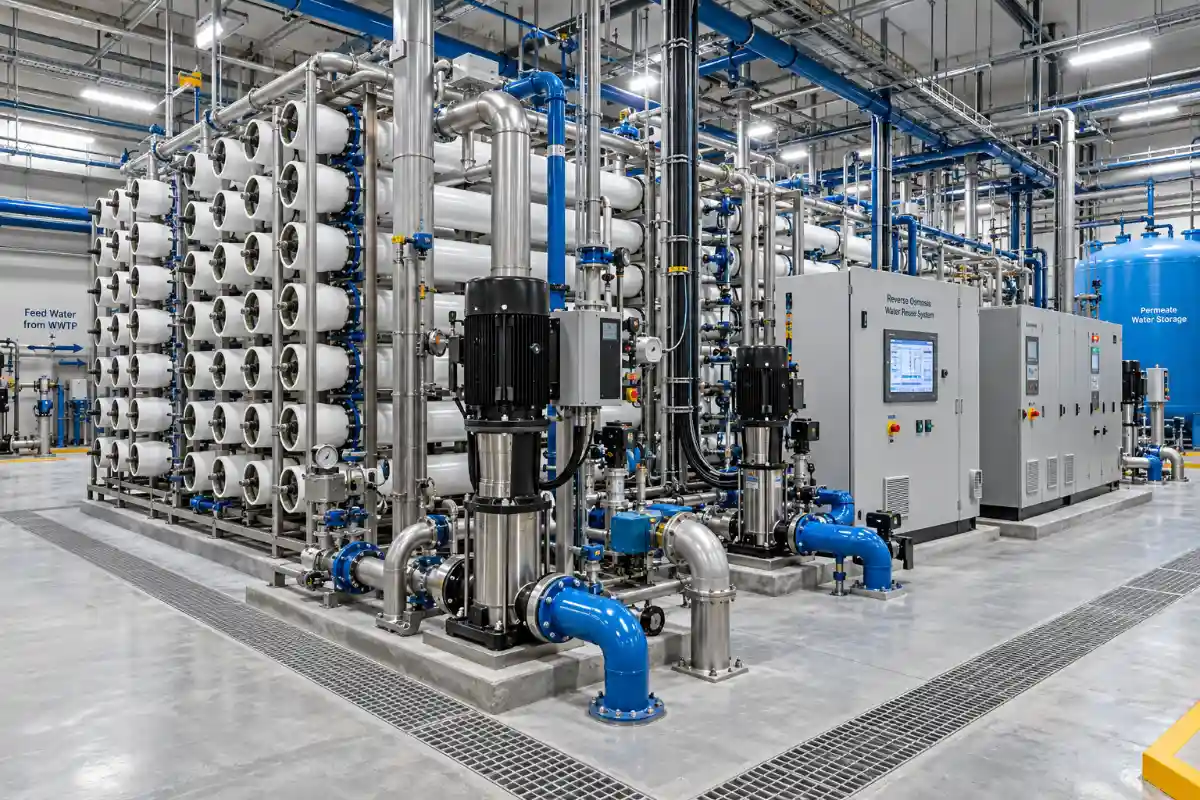
Cost and lifecycle considerations
Condensate quality affects lifecycle cost in ways that are easy to underestimate at the proposal stage:
- Post-treatment CAPEX and OPEX. A condensate that needs biological polishing or activated carbon adds both capital and operating cost.
- Energy. Higher boiling temperatures improve evaporation rate but increase volatile carryover and downstream treatment load. The trade-off should be evaluated as a system, not stage by stage.
- Maintenance. Mist eliminator cleaning frequency, anti-foam consumption, and heat exchanger cleaning all scale with how hard the unit is pushed.
- Compliance risk. A condensate that occasionally exceeds ammonia limits creates permit exposure that is far more expensive than designing for it up front.
For a broader view of how evaporation fits into a full treatment train, see our overview of process design in water treatment. The condensate is one stream in a system, and it should be designed as part of that system from day one.
Where regulations apply, the discharge limits themselves are the starting point for the design. The U.S. EPA effluent guidelines program and the World Bank water resources work are useful references for understanding how ammonia and organic limits are typically framed. Always confirm against the specific permit that governs your site.
FAQ
Why does my evaporator condensate have high COD even though the feed is mostly inorganic?
High COD in condensate from an inorganic feed almost always means entrainment of brine droplets or carryover of foam-stabilized organics. Check the mist eliminator, vapor velocity, and foam level first. Filter a sample through 0.45 micron and re-test COD — if it drops significantly, you have a mechanical carryover problem, not a chemical one.
How do I reduce ammonia in evaporator condensate?
Lower the boiling temperature by operating under vacuum, keep the evaporator sump pH in a range that favors the ammonium ion rather than free ammonia, and consider feed-side stripping if ammonia is very high. In some cases, post-treatment with biological nitrification or air stripping on the condensate is more economical than trying to prevent carryover entirely.
What mist eliminator design gives the lowest carryover?
There is no single best design. Mesh pads work well at lower vapor velocities and are easy to clean. Vane-type eliminators handle higher velocities and are more tolerant of fouling. The key is sizing for actual vapor load and ensuring proper drainage back to the sump. A correctly sized eliminator that cannot drain will perform worse than a smaller one that drains freely.
Can evaporator condensate be reused as boiler feedwater?
Sometimes, but not without polishing. Condensate typically needs reverse osmosis or ion exchange to bring conductivity and silica down to boiler feed quality, and organics must be removed to prevent carryover and corrosion. Ammonia is particularly problematic because it concentrates in the boiler and can attack copper alloys. Test the condensate against your boiler water specification before committing to reuse.
How often should I clean the mist eliminator?
It depends on the feed. With clean, low-foaming feeds, inspection every three to six months is reasonable. With oily or surfactant-laden feeds, monthly inspection is safer. Watch the condensate conductivity trend — a slow upward drift between cleanings is the clearest signal that the eliminator is loading up.
Does operating at higher temperature improve or hurt condensate quality?
It hurts volatile carryover. Higher boiling temperature increases the fraction of ammonia and light organics that partition into the vapor. If condensate quality is a constraint, operate at the lowest temperature that still meets your evaporation rate requirement, and make sure the heat exchanger is clean so you are not forced to raise temperature to compensate for fouling.
What is the most common cause of sudden condensate quality changes?
Feed chemistry changes. A pH shift, a new upstream process chemical, or a change in the ratio of blended waste streams will show up in the condensate before anything else changes. If your condensate quality moves and the evaporator operating parameters have not, look upstream first.
The bottom line
Condensate quality is a design and operating outcome, not a fixed property of the evaporator. The same unit can produce 100 mg/L COD condensate on one feed and 1,500 mg/L on another. What matters is understanding which carryover mechanism dominates for your stream, designing the vapor path and de-entrainment accordingly, and controlling the operating variables that shift the equilibrium — temperature, pH, foam, and capacity. Get those right, and the condensate becomes a predictable, manageable stream instead of a recurring compliance headache.