

If you’re dealing with a reverse osmosis concentrate stream that keeps growing and nowhere to send it, the short answer is this: membranes polish it, evaporation concentrates it, and crystallization turns the last of it into solid salt. Most plants end up using two or three of these together, not one. RO concentrate treatment is rarely a single-technology decision — it’s a sequence decision. I’ve commissioned enough systems to know that the choice comes down to three things: how much brine you produce per day, what’s dissolved in it, and what your discharge permit actually allows. Get those three right and the rest of the design tends to fall into place.
Below I’ll walk through how I evaluate each option, where they work well, where they fail, and how to combine them without doubling your operating costs.
What Makes RO Concentrate Hard to Treat
RO concentrate is not just “dirty water.” It’s the reject stream from a membrane process, and by the time it leaves the last stage it has typically been concentrated 3 to 6 times relative to the feed. That means everything the membrane rejected is still in there — just tighter.
What I watch for in the lab report before I size anything:
- Silica — the number one killer of evaporator heat transfer. Above roughly 100–150 mg/L, you need to plan for scaling control or precipitation ahead of the evaporator.
- Calcium and magnesium hardness — drives scaling in both membranes and evaporators.
- Sulfate and carbonate — combine with hardness to form the deposits that foul heat exchangers.
- Organics and COD — cause membrane fouling and foaming in evaporators.
- Osmotic pressure — the real ceiling on how far membranes can push.
- TDS — determines which evaporation technology makes economic sense.
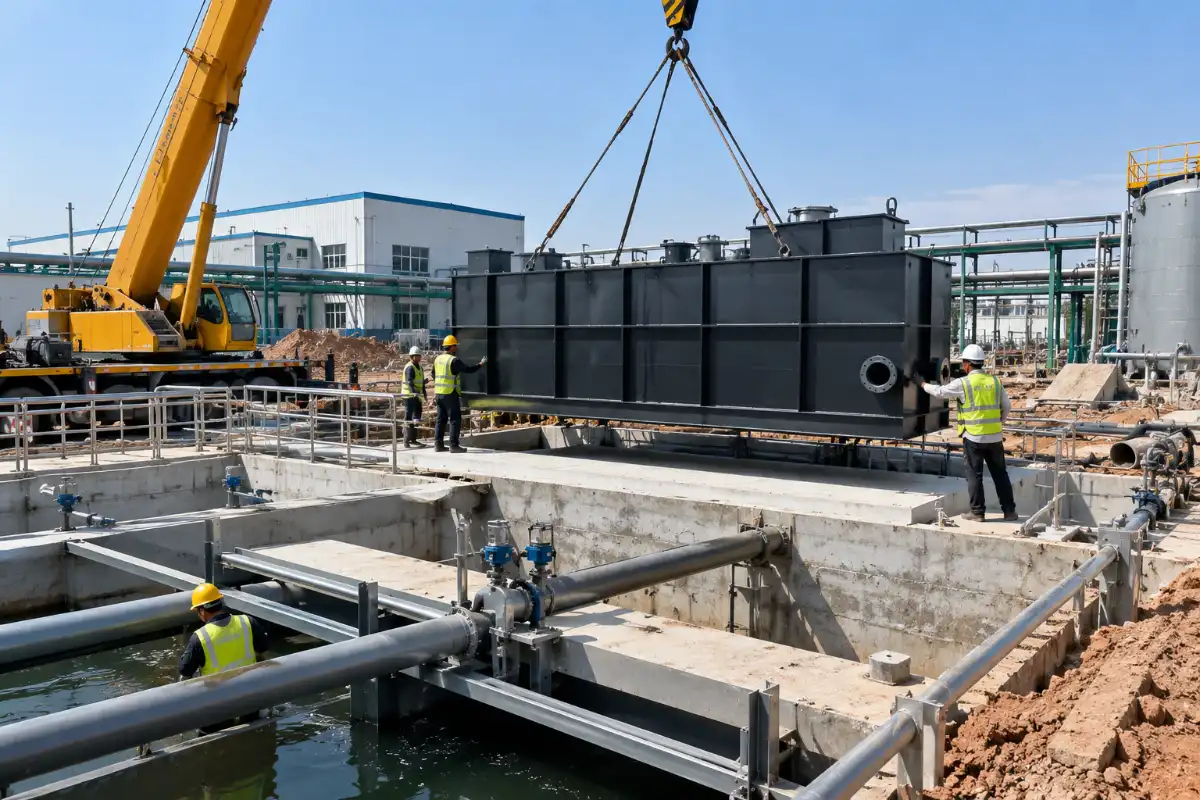
I’ve seen plants try to skip this step and pay for it later. A leachate project I reviewed had silica levels that nobody modeled, and the first evaporator bundle had to be acid-cleaned every three weeks. Once they added a softening step upstream, cleaning dropped to once a quarter.
Membrane Options: Pushing RO Concentrate Further
When someone asks me whether they can just run the concentrate through another RO, my honest answer is usually “yes, but.” Standard RO tops out around 70–80 bar, which caps practical brine concentration at roughly 70,000–85,000 mg/L TDS. Beyond that, osmotic pressure wins and you’re just burning pump energy.
High-Pressure RO and DTRO
Disc-tube reverse osmosis (DTRO) is the workhorse for this job. The open-channel disc design handles higher solids and fouling loads than spiral-wound elements, and it can operate at 90–120 bar. In landfill leachate and electroplating rinse water, DTRO systems frequently cut concentrate volume by 50–70% compared to a single-pass RO. That reduction alone can be the difference between paying for trucking and running an on-site evaporator.
You can review typical DTRO membrane system configurations to see how staging and pressure vessels are arranged. For higher-pressure applications, high-pressure RO membranes are typically specified with disk or tubular form factors.
When Membranes Stop Making Sense
I stop recommending membrane-only approaches when:
- Concentrate TDS already exceeds ~60,000 mg/L
- Silica is above 150 mg/L without pretreatment
- Organic fouling requires cleaning more than twice a month
- You need a solid salt product, not just a smaller liquid stream
At that point evaporation takes over. Membranes become the polishing stage, not the primary concentrator.
Evaporation: The Volume Reduction Workhorse
Evaporation is where most industrial RO concentrate treatment actually lives. You’re boiling water off and leaving the salts behind. The question is how you pay for the energy.
Mechanical Vapor Compression (MVC / MVR)
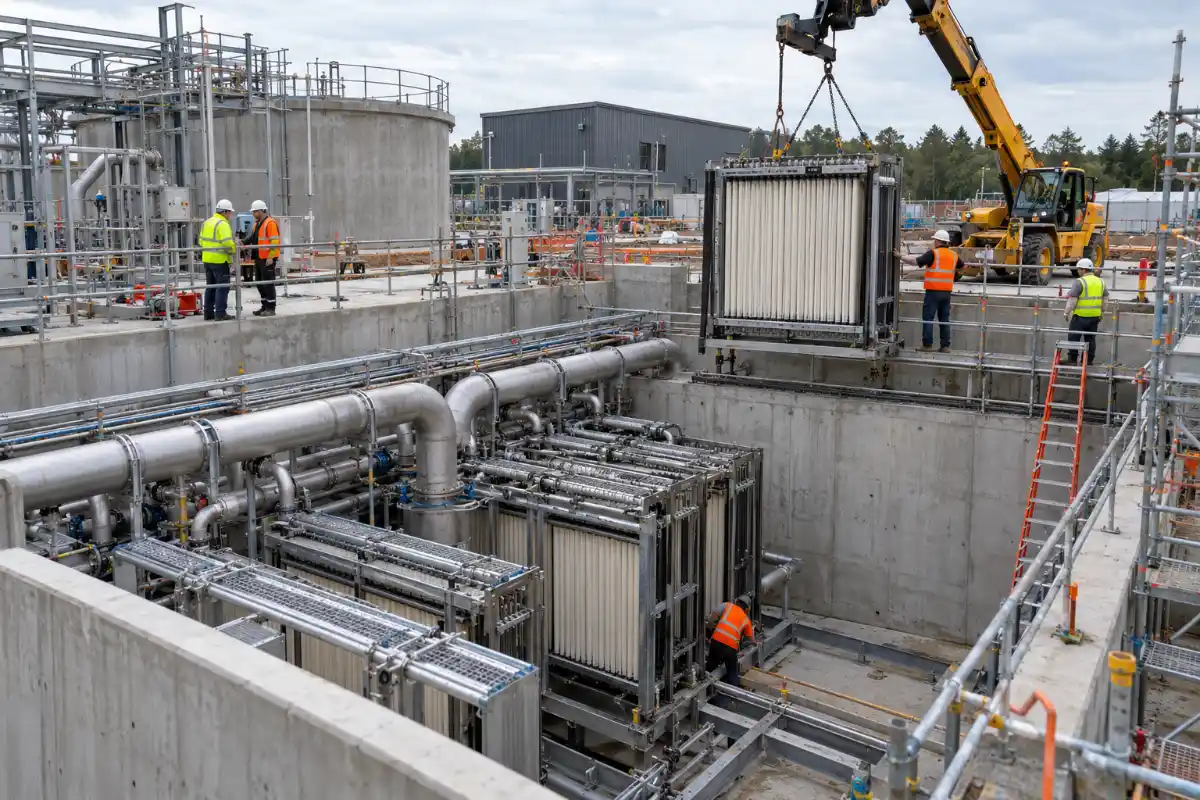
MVC — also called MVR — uses a compressor to recompress the vapor you just generated and reuse it as the heating medium. In the right application, this cuts specific energy consumption to roughly 15–40 kWh per cubic meter of distillate, versus 200+ kWh/m³ for a simple single-effect thermal evaporator. That’s not a small difference. On a 50 m³/day system, it’s the difference between a manageable utility bill and a painful one.
The catch: MVC works best with relatively clean, low-boiling-point-rise liquids. High salinity or high organic content raises the boiling point elevation, which forces the compressor to work harder and can erode the efficiency advantage. I usually recommend MVC when TDS is moderate, feed is fairly consistent, and electricity is reasonably priced.
You can read more about how these systems are built at mechanical vapor compression MVC evaporators, and the heat exchanger design is worth understanding because that’s where most scaling problems show up first.
Multi-Effect Evaporation
Multi-effect evaporators reuse vapor across successive stages. A triple-effect system can achieve roughly 2.5–3 kg of distillate per kg of steam, versus 1 kg for a single effect. If you have cheap waste steam available — and a lot of chemical plants do — this is often the lowest-operating-cost option.
I typically evaluate double-effect and triple-effect evaporators when steam is on site and electricity is expensive. The trade-off is more vessels, more instrumentation, and a bigger footprint.
Quick Comparison
| Technology | Typical Feed TDS | Energy Source | Distillate Quality | Best Fit |
|---|---|---|---|---|
| High-pressure RO / DTRO | Up to ~60,000 mg/L | Electric | High | Volume reduction before evaporation |
| MVC / MVR | 20,000–200,000 mg/L | Electric | High | Moderate salinity, consistent feed |
| Multi-effect | 20,000–250,000 mg/L | Steam | High | Cheap waste steam available |
| Crystallization | 200,000+ mg/L | Electric or steam | High | Zero liquid discharge, solid salt output |
These ranges are indicative and project-dependent. Feed chemistry, boiling point elevation, and site utilities shift the numbers significantly.
Crystallization: When You Need a Solid, Not a Slurry
Crystallization is the final step in a zero liquid discharge (ZLD) train. You push the brine past saturation, force salt to precipitate, and dewater the crystals into a solid you can landfill or sell. The liquid stream leaving the crystallizer is essentially gone — recycled back or evaporated to dryness.
I don’t recommend crystallization unless you actually need it. It’s capital-intensive, energy-hungry, and the solids handling adds maintenance. But in places where liquid discharge is banned or prohibitively expensive, it’s the only path. If you’re evaluating a full ZLD system, crystallization is usually the last 10–20% of the flow and 30–40% of the capital cost.
Typical configurations I’ve seen work well:
- DTRO reduces concentrate volume by 60–70%
- MVC evaporates the remaining brine to near-saturation
- Forced-circulation crystallizer produces solid salt
- Centrifuge or filter press dewaters the crystals
Each stage needs its own scaling and fouling strategy. Skipping pretreatment between stages is the most common mistake I run into.
How I Actually Choose
When I sit down with a client’s water analysis and discharge permit, I run through a decision sequence that looks like this:
Step 1 — Can membranes get me to where I need to be?
If the answer is yes and the concentrate can go to a permitted discharge, stop here. Don’t over-engineer.
Step 2 — Is there a waste steam source on site?
If yes, multi-effect evaporation usually wins on operating cost. If no, MVC is the default.
Step 3 — What’s the final destination of the concentrated stream?
Liquid hauling, deep well injection, or solid salt? That answer determines whether you need crystallization at all.
Step 4 — What’s the fouling profile?
High silica, high hardness, or high organics means more pretreatment, more cleaning, and more conservative design margins.
I’ve walked through this with clients on landfill leachate projects and electroplating wastewater projects, and the sequence holds up. The technology choice follows the water chemistry, not the other way around.
“The most expensive mistake I see is treating evaporation as a black box. If you can’t describe your feed chemistry in detail, you’re not ready to size an evaporator.” — something I tell every project team in the kickoff meeting.
Operating Cost Reality Check
Nobody likes surprises on the utility bill. Here’s how the numbers typically shake out for a 50 m³/day concentrate stream, using indicative ranges:
| System | Relative CAPEX | Relative OPEX | Main Maintenance Driver |
|---|---|---|---|
| DTRO only | Low | Low | Membrane replacement, cleaning chemicals |
| MVC evaporator | Medium | Medium | Compressor, heat exchanger scaling |
| Multi-effect evaporator | Medium-High | Low (with cheap steam) | Tube scaling, steam system |
| ZLD with crystallizer | High | High | Crystal handling, solids wear, energy |
These are qualitative. Real numbers depend on electricity price, steam cost, labor rates, and how aggressive your scaling profile is. I’ve seen MVC systems with a five-year payback and I’ve seen them with a fifteen-year payback — same nominal capacity, completely different feed chemistry.
Maintenance and the Problems That Actually Bite
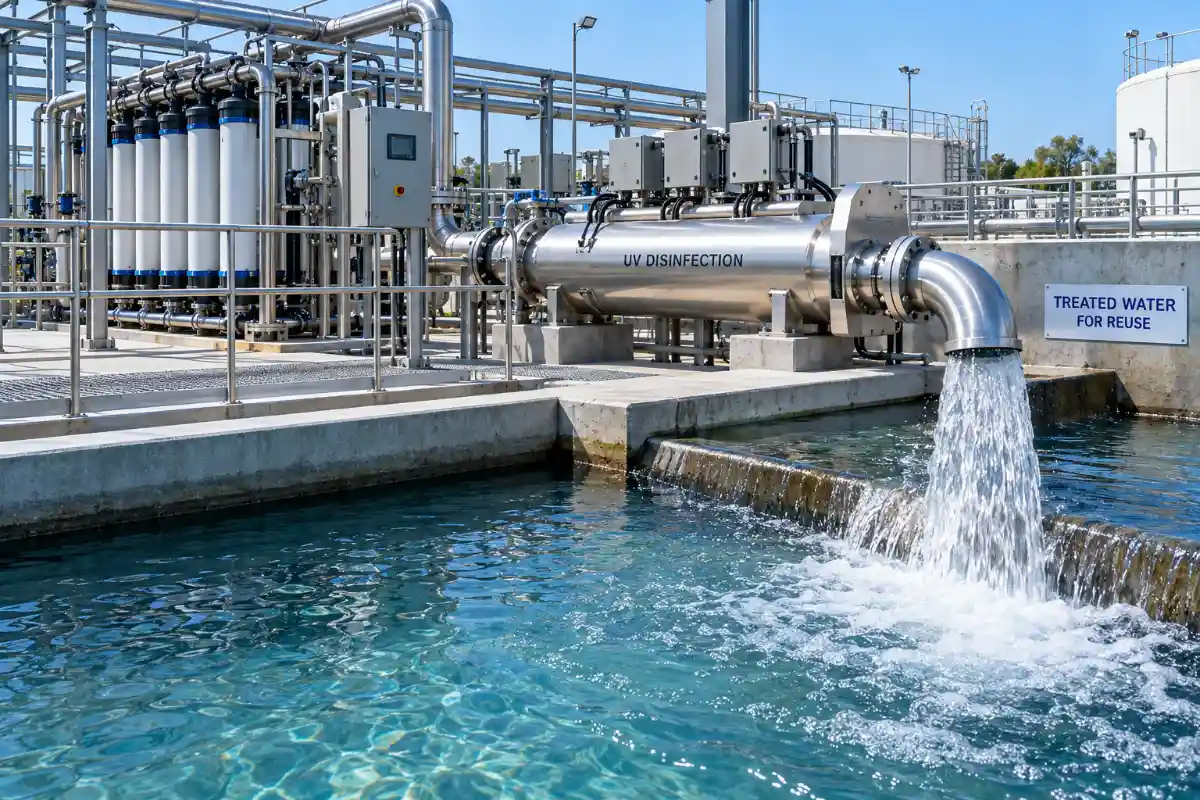
The design phase is where you prevent 80% of the operating headaches. Here’s what I watch for after commissioning:
Scaling in Heat Exchangers
This is the number one issue. Silica, calcium sulfate, and calcium carbonate all deposit on hot surfaces. Mitigation comes down to:
- Softening or lime-soda pretreatment ahead of the evaporator
- Antiscalant dosing tuned to the actual chemistry, not a generic recipe
- Regular CIP cycles with the right acid or chelant
- Designing for a lower top temperature where possible
Foaming
Organics and surfactants in the concentrate cause foaming, which carries liquid into the vapor line and contaminates distillate. Defoamers help, but the real fix is upstream — reduce surfactant load or add a pre-concentration step.
Compressor Wear
In MVC systems, the compressor is the heart and the most expensive component. Droplets in the vapor stream, corrosive gases, and off-design operation all shorten its life. I always recommend a mist eliminator with generous margin and a vibration monitoring system from day one.
Membrane Fouling in DTRO
Even disc-tube membranes foul. The open channel helps, but organics and biofilms still build up. A well-run DTRO system cleans every 4–8 weeks. If you’re cleaning weekly, something upstream is wrong.
Putting It Together: A Practical Design Sequence
For most industrial RO concentrate streams I’ve worked with, the sensible architecture looks like this:
- Pretreatment — softening, pH adjustment, and antiscalant dosing
- DTRO or high-pressure RO — reduce volume by 50–70%
- MVC or multi-effect evaporator — concentrate to near-saturation
- Crystallizer — only if ZLD is required
- Solids dewatering — centrifuge or filter press for the salt cake
Not every project needs all five. A plant with a permitted brine discharge might stop at step 2. A plant in a zero-discharge jurisdiction needs all five. The point is to design each stage with the next one in mind, so you’re not adding a crystallizer later because the evaporator can’t reach saturation.
If you’re working through this kind of decision on a live project, it usually helps to walk through the feed chemistry and permit constraints with an engineer who has commissioned these systems. You can talk through your concentrate stream with our team — no obligation, and I’d rather help you avoid a bad sizing than sell you a system you don’t need.
FAQ
Can I just use RO to treat RO concentrate?
Sometimes. High-pressure RO and DTRO can push concentrate from ~30,000 mg/L up to 60,000–80,000 mg/L TDS. Beyond that, osmotic pressure makes further concentration impractical. If your permit allows liquid discharge at that concentration, membrane-only treatment can be the simplest and cheapest solution.
What’s the difference between MVC and MVR?
Nothing functional — they’re the same technology. MVC stands for mechanical vapor compression; MVR stands for mechanical vapor recompression. Different regions and vendors use different terms. The principle is identical: compress the vapor you generated and reuse it as heating energy.
How much does an MVC evaporator cost to run?
For a well-designed system on a moderate-salinity feed, expect roughly 15–40 kWh per cubic meter of distillate. That’s a typical range and depends heavily on boiling point elevation, feed temperature, and compressor efficiency. High-salinity feeds can push this higher.
When do I actually need crystallization?
Only when liquid discharge is not an option — either because of a zero liquid discharge permit, no available disposal route, or prohibitive hauling costs. Crystallization is capital-intensive and adds significant maintenance. If you have a permitted liquid discharge, evaporation to a concentrated brine is usually the better economic choice.
How often will my evaporator need cleaning?
With proper pretreatment and antiscalant dosing, most MVC systems clean every 4–12 weeks. Multi-effect systems can go longer if steam quality and feed chemistry are stable. If you’re cleaning more often than monthly, the issue is usually upstream — inadequate softening, wrong antiscalant, or feed chemistry that shifted without the design being updated.
What’s the most common design mistake in RO concentrate treatment?
Sizing the evaporator without enough pretreatment. Silica, hardness, and organics all concentrate as water evaporates, and if you don’t remove or stabilize them upstream, they’ll deposit on your heat exchanger surfaces. I’ve seen projects cut pretreatment to save capital and then spend multiples of that on cleaning chemicals and downtime within the first year.