

If you are evaluating OEM industrial wastewater equipment manufacturers, the short answer is this: the right partner is the one who designs around your actual water chemistry, not the one with the biggest catalog. In my experience delivering systems for plating lines, pharmaceutical plants, chemical facilities, and landfill leachate sites, projects fail far more often from a bad fit between process and equipment than from poor fabrication. An OEM that understands your influent, your discharge limits, and your operating budget will save you more money over ten years than any discount on the initial purchase. This article walks through how I assess manufacturers, what to demand in a technical proposal, and where the real cost drivers hide.
What “OEM” Actually Means in This Industry
The term gets used loosely. In industrial wastewater, an original equipment manufacturer is a company that engineers and builds the core process equipment — evaporators, membrane skids, dewatering units, pretreatment systems — rather than reselling someone else’s boxes with a new nameplate. That distinction matters because it determines who owns the performance guarantee when something does not work.
I have walked into plants where the “manufacturer” was a trading company that subcontracted fabrication to three different shops. When the evaporator could not hit design concentration, nobody could answer basic questions about heat exchanger surface area or compressor turndown. The plant spent eight months chasing a fix that a real OEM would have caught in the design review.
When you screen suppliers, ask directly: Do you fabricate the pressure vessels and heat exchangers in-house or through a controlled facility? Who signs the performance curve? Who holds the spare parts inventory? A genuine OEM answers these without hesitation.
Start With Your Water, Not the Equipment List
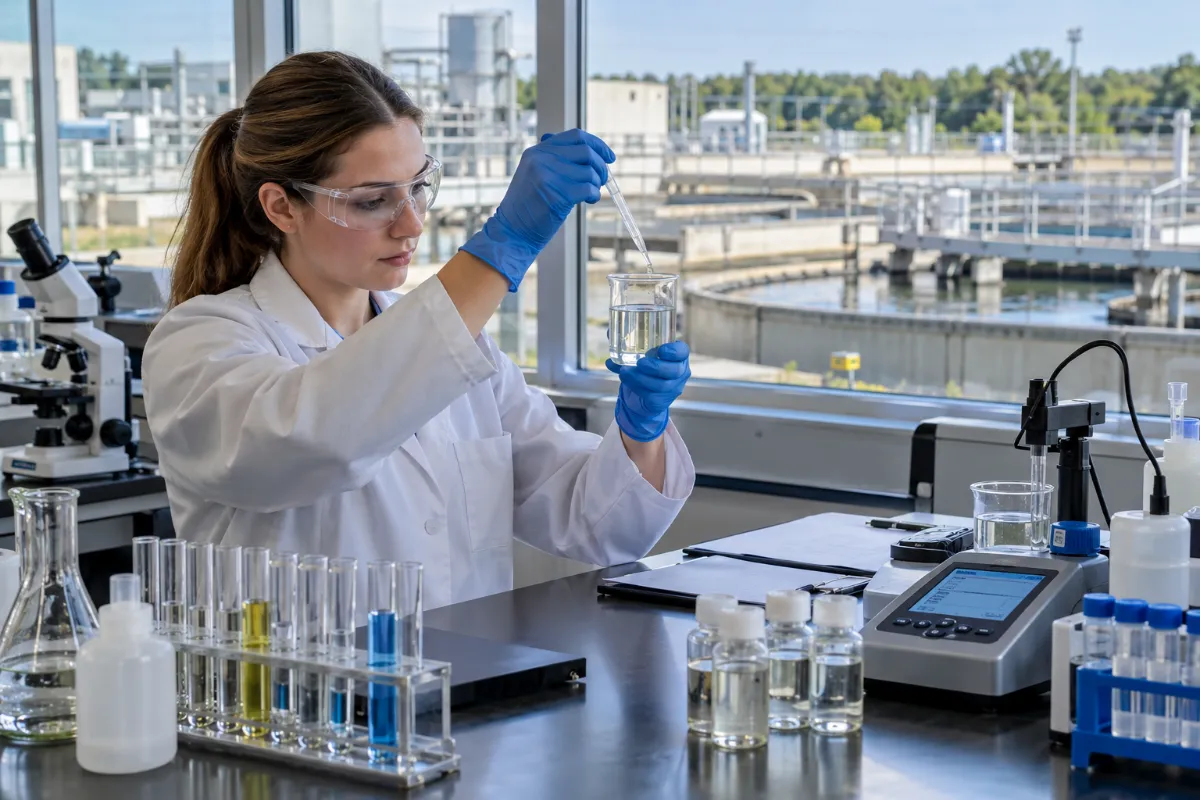
Every good design conversation I have starts the same way: characterization data. Not a single grab sample, but a composite over several days, ideally covering a full production cycle. You need to know what you are actually treating before anyone can select equipment honestly.
The parameters that drive equipment selection
- Total dissolved solids (TDS) — determines whether membranes are viable or whether you are heading toward evaporation.
- Chemical oxygen demand (COD) — high COD often means fouling risk and possible need for pretreatment.
- Hardness and scaling ions — calcium, magnesium, silica, and sulfate dictate heat exchanger design and cleaning frequency.
- Oil and grease — even modest concentrations can blind membranes and coat evaporator surfaces.
- pH and alkalinity — affects material selection and chemical dosing strategy.
- Heavy metals — often require precipitation before any concentration step.
- Volatile organics — can carry over in distillate and create a compliance problem downstream.
I have seen more than one project where the client supplied a single sample from a quiet weekend. The real production stream was three times the strength and contained a solvent that attacked the gaskets. That is an expensive lesson.
Core Process Options and When Each Makes Sense
There is no universal best technology. There is only the right fit for a given stream, footprint, and budget. Here is how I think through the main categories.
Membrane systems
Reverse osmosis and its high-pressure variants work well when TDS is moderate and the stream is relatively clean. For challenging streams — high salinity, high organics, or both — disk-tube reverse osmosis handles fouling better than spiral-wound elements. If you are dealing with a difficult leachate or industrial brine, a DTRO membrane system is often the practical choice because it tolerates suspended solids and can be cleaned in place without full teardown.
For very high-pressure duties, you need to look carefully at pump selection and membrane element ratings. Systems operating above standard seawater pressures require different materials and staging, and a high-pressure RO membrane supply chain that actually supports the operating envelope you need.
Evaporation and concentration
When TDS climbs past the point where membranes make economic sense, evaporation takes over. Mechanical vapor recompression is the workhorse for most industrial concentration duties because it recovers latent heat and cuts energy demand substantially compared to once-through boiling. A well-designed mechanical vapor compression MVC evaporator typically lands in the range of 15 to 40 kWh per cubic meter of distillate for many aqueous streams, though that figure moves a lot with boiling point elevation and compressor efficiency.
Multi-effect evaporators remain a solid option when you have waste steam available or when electricity is expensive relative to thermal energy. The tradeoff is more vessels, more instrumentation, and a larger footprint. For a comparison of how the effect count changes steam economy, the multi-effect evaporator overview is a reasonable starting point.
Dewatering and solids handling
Sludge volume drives your disposal cost, which is often the largest recurring line item. A screw press is a low-attention, low-power option that handles a wide range of sludges without the operator burden of a filter press. The tradeoff is cake dryness — you will typically see somewhere in the low-to-mid twenties percent dry solids depending on the feed, versus higher numbers from a well-run plate-and-frame press. If disposal cost is your dominant expense, that gap matters and you should model it.
How to Compare Manufacturers: A Practical Scorecard
Price is the easiest thing to compare and the least useful. I use a structured evaluation that weights the things that actually determine lifecycle cost.
| Evaluation Area | What to Look For | Why It Matters |
|---|---|---|
| Process engineering depth | Mass and energy balance provided with proposal; not just a datasheet | Reveals whether they actually designed your system or copied a template |
| Pilot or bench testing | Willingness to run your water before committing to a guarantee | Reduces scale-up risk, especially for high-fouling streams |
| Material selection | Specific alloys and elastomers named, with justification | Corrosion is the number one cause of premature failure |
| Control philosophy | Clear description of automated vs. manual operation | Determines your labor cost for the next decade |
| Spare parts strategy | Named critical spares, lead times, local availability | Downtime cost usually dwarfs parts cost |
| Reference installations | Similar streams and scale, with contactable operators | Past performance on comparable duty is the best predictor |
| Service model | Commissioning support, training, remote diagnostics | Most problems surface in the first six months of operation |
I weight the first two rows heavily. A manufacturer who will not run a pilot on a difficult stream is telling you something about their confidence in the design.
The Cost Conversation Nobody Wants to Have Up Front
Capital cost is visible. Operating cost is where projects quietly bleed. I have seen two systems with nearly identical purchase prices diverge by a factor of three in annual operating expense because of compressor efficiency, chemical consumption, and cleaning frequency.
Where the money actually goes
- Electrical power — for evaporators, this is usually the dominant recurring cost. Compressor efficiency and boiling point elevation drive it.
- Thermal energy — relevant for multi-effect and thermal systems; often the deciding factor between MVC and MEE.
- Membrane and element replacement — typically a three-to-seven-year cycle depending on feed quality and cleaning discipline.
- Chemicals — antiscalant, cleaning agents, pH adjustment. Easy to underestimate during design.
- Sludge and concentrate disposal — frequently the largest single line item. Reducing volume here pays back fast.
- Labor — automation level directly sets your headcount requirement.
If you are pushing toward near-total water recovery, the economics change again. A zero liquid discharge system adds a crystallizer or spray dryer at the tail end, which raises both capital and energy cost meaningfully. It makes sense when discharge is not permitted or when disposal costs are extreme. It rarely makes sense purely on operating cost alone.
Design Details That Separate Good OEMs From Average Ones
After enough site visits, you start noticing patterns. The systems that run quietly for years share certain design habits.
Heat exchanger design and fouling margin
Ask what fouling factor was applied. A manufacturer who sized the exchanger with zero margin is planning to sell you a replacement in two years. I want to see a stated margin and a cleaning strategy that does not require a full plant shutdown. The heat exchanger is where most evaporator problems show up first, so it deserves scrutiny during bid review.
Turn-down and turndown reality
Plants rarely run at nameplate. If your production swings between 40 and 100 percent, the system must handle that range without scaling up or losing efficiency. Compressor turndown, recirculation design, and control logic all matter here. A system that only works at design point is a system that will frustrate your operators.
Materials and corrosion allowance
Duplex stainless, titanium, and high-nickel alloys all have their place. The right choice depends on chloride content, temperature, and pH. A manufacturer who specifies the same material for every project is not engineering — they are defaulting. Ask for the corrosion basis in writing.
Instrumentation and control
Cheap instrumentation is a false economy. Conductivity, density, temperature, and pressure transmitters are how the system protects itself. I would rather cut a vessel’s cosmetic finish than cut the sensor package.
Typical Project Scenarios and What They Teach
I will describe a few anonymized situations that reflect common patterns. These are illustrative of design logic, not specific verified installations.
Electroplating rinse water
These streams are usually moderate volume, contain heavy metals, and have strict discharge limits on metals. The typical approach is chemical precipitation and clarification first, then concentration of the remaining brine if recovery is required. The key design question is how much water you can return to the rinse line versus how much goes to disposal. A closed-loop plating wastewater approach can work well, but it lives or dies on pretreatment reliability.
Landfill leachate
Leachate is the hardest stream most engineers will encounter. It varies seasonally, contains high ammonia, high COD, and a shifting cocktail of organics. Membrane systems foul, evaporators scale, and biological treatment struggles with the ammonia load. Most successful designs combine biological pretreatment, membrane concentration, and evaporation in series. The landfill leachate treatment approach usually includes ammonia stripping or a dedicated biological stage before any concentration step.
Pharmaceutical and fine chemical
These streams often carry solvents, high COD, and variable salinity. Material compatibility is critical because trace solvents can attack elastomers and gaskets. Evaporation is common, but the distillate quality matters if you intend to reuse it. A pharmaceutical wastewater treatment design typically includes solvent recovery or destruction upstream.
Battery and new energy manufacturing
These facilities generate high-salinity streams with specific ion profiles. Sodium sulfate recovery is often the goal, which pushes toward crystallization. The new energy wastewater treatment pattern usually involves membrane preconcentration followed by evaporative crystallization.
Commissioning, Training, and the First Six Months
This is where I see the most avoidable pain. A system that was perfect on paper can stumble badly during startup if the operating team was not involved early.
What I insist on for any project I am involved with:
- Operator involvement during design review. They will spot the maintenance nightmare before it is built.
- Factory acceptance testing with your water, not theirs. If that is not possible, at minimum run a representative synthetic feed.
- Structured commissioning with written procedures. Not a two-day walkthrough.
- Hands-on training on the actual equipment, including cleaning and fault recovery, not just a slide deck.
- A defined performance test period with agreed acceptance criteria before final payment.
The manufacturers who resist these items are usually the ones who know their design has weak points. The good ones welcome the scrutiny because it protects both parties.
Maintenance Planning Before You Sign
Every system needs maintenance. The question is whether it is planned or reactive. Before you commit, get a written maintenance schedule that covers:
- Routine cleaning intervals and the chemicals required
- Consumable replacement cycles and current pricing
- Critical spares list with recommended on-site stock
- Inspection points and wear items
- Calibration schedule for instrumentation
- Recommended shutdown and layup procedures
A manufacturer who cannot produce this is not finished with their own design. I have used this as a filter many times, and it has saved clients from at least a few bad decisions.
Common Failure Modes and How to Avoid Them
These show up repeatedly across industries and equipment types.
Scaling in the evaporator
Usually caused by inadequate pretreatment, wrong antiscalant, or operating above the solubility limit for calcium or silica. The fix is upstream — either soften, dose correctly, or run at lower concentration. Cleaning is a symptom treatment, not a solution.
Membrane fouling and flux loss
Organic fouling, biofouling, and scaling all present similarly. Diagnosis requires autopsies and cleaning trials. Prevention is better pretreatment and honest pilot testing.
Compressor vibration and bearing failure
Often traced to liquid carryover, imbalance, or operation outside the design envelope. Proper demister design and level control prevent most of these.
Corrosion at welds and flanges
Material selection errors or poor welding practice. This is where a real OEM’s fabrication control shows. Ask to see weld procedures and inspection records.
Control system instability
Usually a tuning problem or an undersized control valve. Sometimes it is a fundamental design issue where the turndown range was never properly considered.
Questions I Ask Every Manufacturer Before Shortlisting
These are the questions that separate serious suppliers from catalog sellers.
- Can you provide a heat and mass balance for my specific stream?
- What fouling factor and margin did you apply to the heat exchangers?
- What is the guaranteed performance, and what are the conditions for that guarantee?
- Will you run a pilot or bench test on my actual water?
- Who fabricates the pressure vessels, and where?
- What is the turndown range, and how does efficiency change across it?
- What are the critical spares, and what is their lead time?
- Can you provide three references on similar streams?
- What is your commissioning and training scope?
- What happens if the system does not meet the performance test?
If a supplier dodges more than two of these, move on. There are enough competent manufacturers that you do not need to accept vague answers.
Working on a difficult stream and want a second opinion?
Send us your water analysis and flow data. We will tell you honestly whether evaporation, membranes, or a hybrid approach fits — and what the realistic operating cost looks like.
Where the Industry Is Heading
Three shifts are shaping equipment selection right now. First, discharge limits keep tightening, which pushes more facilities toward concentration and near-zero discharge whether they want to or not. Second, energy costs have made efficiency a first-order design criterion rather than an afterthought — this favors MVR and hybrid thermal designs in many cases. Third, automation is reducing the labor penalty that used to make complex systems hard to justify.
What has not changed is the fundamental rule: match the process to the water. I have watched plants spend seven figures on equipment that was technically excellent but wrong for their stream. It is an expensive way to learn a simple lesson.
If you take one thing from this article, make it this: treat the manufacturer selection as an engineering exercise, not a purchasing exercise. The right partner will push back on your assumptions, ask for better data, and tell you when a simpler solution will do. That is worth more than any line-item discount.
Frequently Asked Questions
How do I know if I need evaporation or membranes?
Start with TDS and the nature of the organics. Below roughly 30,000–40,000 mg/L TDS with a clean stream, membranes are usually viable and cheaper to run. Above that, or with high fouling potential, evaporation becomes more attractive. The crossover point depends on your specific water, energy costs, and disposal costs — it is worth modeling both.
What is a realistic operating cost for an MVR evaporator?
Power consumption for many aqueous streams lands in the 15–40 kWh per cubic meter of distillate range, but this varies significantly with boiling point elevation, compressor efficiency, and required concentration. Multiply by your local power rate and add chemicals, maintenance, and labor. Do not accept a single number without understanding the assumptions behind it.
How long should a membrane system last before element replacement?
With good pretreatment and disciplined cleaning, three to seven years is a reasonable expectation for industrial RO elements. Aggressive streams or poor operation can cut that to eighteen months. The dominant factor is what you feed the membranes, not the membranes themselves.
Can I add zero liquid discharge later, or do I need to design for it now?
You can retrofit, but it is much cheaper to plan for it. The preconcentration stage, utility capacity, and civil works should be sized for the eventual ZLD train even if you install it in a second phase. Retrofitting a crystallizer into a system that was never designed for it usually means replacing the evaporator too.
What is the most common cause of poor dewatering performance?
Inconsistent feed characteristics and inadequate conditioning. Sludge that changes composition hour to hour will not dewater consistently no matter what equipment you install. Stabilize the upstream process first, then tune polymer dosing and machine settings. If you are comparing press types, understand the tradeoff between cake dryness and operator attention before committing.
How much operator attention does an industrial wastewater system need?
Fully automated systems can run with a few hours of attention per shift, mostly for checks and cleaning. Manual systems can consume a full-time operator or more. This is a design decision, not a fixed cost — pay for automation up front if your labor rates are high or your team is stretched.
What should I do if my current system cannot meet discharge limits?
First, verify the influent is what you think it is. A surprising number of compliance problems trace back to an upstream change nobody communicated. If the influent is confirmed, you need to identify which parameter is out of spec and whether it is a capacity issue, a fouling issue, or a fundamental process mismatch. That diagnosis determines whether you need a modification or a different technology.