

Produced water evaporation is worth the energy bill when the dissolved solids load is too high for membranes, the discharge permit is tightening, or the cost of trucking brine offsite has become the single largest line item on your utility sheet. In my experience designing and commissioning thermal systems for oil and gas, mining, and chemical plants, thermal treatment makes sense when the total dissolved solids (TDS) climb above roughly 50,000–70,000 mg/L, when you need near-zero liquid discharge (ZLD), or when the waste stream contains organics and scaling species that would foul a reverse osmosis train within weeks. Below those thresholds, membranes almost always win on lifecycle cost. Above them, evaporation stops being a luxury and starts being the only reliable option.
What Produced Water Actually Looks Like at the Evaporator Inlet
Before you size any evaporator, you need to know what you are feeding it. Produced water is not a single stream — it changes with the field, the formation, and the stage of the well’s life. A typical composition range I see in project data sheets looks like this:
| Параметр | Типичный диапазон | What It Means for Thermal Design |
|---|---|---|
| TDS | 20,000 – 250,000 mg/L | Drives boiling point elevation and scaling risk |
| Chlorides | 10,000 – 150,000 mg/L | Material selection: 2205, 2507, or titanium |
| Hardness (Ca, Mg, Ba, Sr) | 500 – 20,000 mg/L | Primary scaling mechanism on heat transfer surfaces |
| Oil & grease | 10 – 500 mg/L | Foaming, fouling, pre-treatment requirement |
| Кремнезем | 10 – 200 mg/L | Hard scale that is difficult to remove chemically |
| Benzene, BTEX, phenols | 5 – 200 mg/L | Vapor quality, condensate polishing, permits |
These numbers are indicative only. Every field is different, and I have seen barium concentrations high enough to precipitate sulfate scale in the feed line before the water ever reached the first effect. That is why a proper water analysis — ion by ion, plus organics — is the first deliverable on any thermal project.
Where Membranes Stop and Thermal Treatment Starts
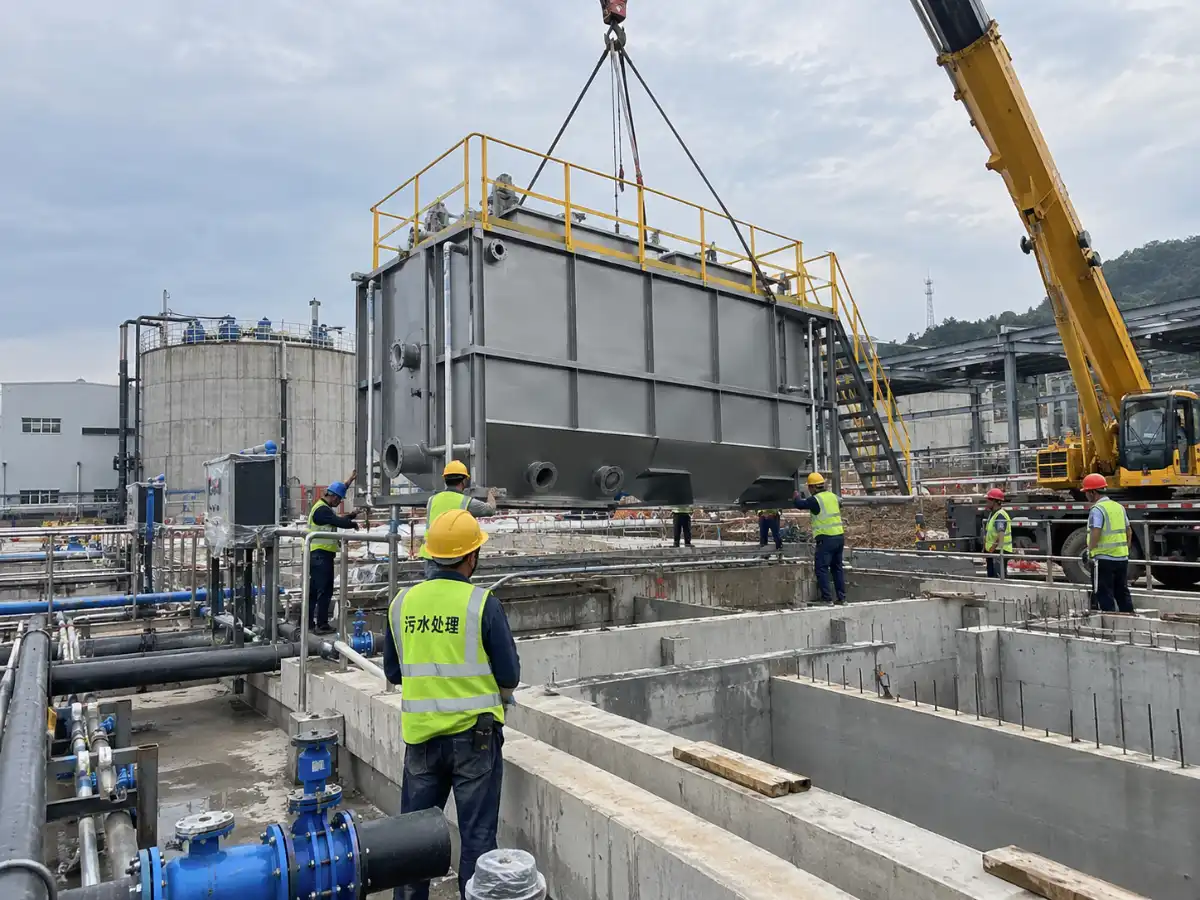
I always push clients to exhaust membrane options first, because the operating cost gap is enormous. A high-pressure RO or Мембранная система DTRO can concentrate produced water to maybe 60,000–80,000 mg/L TDS before osmotic pressure becomes impractical. Beyond that, you are fighting physics.
The decision points I use in screening studies:
- Below 40,000 mg/L TDS: Membrane concentration is usually the lowest-cost path. Thermal only if organics or scaling species are unmanageable.
- 40,000 – 70,000 mg/L TDS: Hybrid approach — membrane pre-concentration followed by thermal finishing. This is often the sweet spot for lifecycle cost.
- Above 70,000 mg/L TDS: Thermal evaporation directly, because membrane flux collapses and cleaning frequency becomes uneconomic.
- ZLD required by permit: Thermal is almost always the final step regardless of TDS, because you need a solid salt or a crystallizer feed.
There is also the question of what you do with the concentrate. If you can permitted-deep-well inject it, thermal may not be necessary at all. If you cannot — and in many basins you cannot — then evaporation becomes the backbone of the disposal strategy.
Choosing Between MVC, MVR, and Multi-Effect Evaporation
This is where most of the engineering arguments happen, and rightly so. The three main thermal platforms behave very differently on energy, maintenance, and turndown.
Mechanical Vapor Compression (MVC / MVR)
В Испаритель MVC, a compressor takes the vapor boiled off the liquid and recompresses it, raising its temperature enough to reuse it as the heating medium. The compressor is the energy consumer, and for a well-designed unit, specific power consumption typically lands in the 15–35 kWh per cubic meter of distillate range, depending on boiling point elevation and compressor efficiency. That is dramatically lower than a steam-driven single-effect system, which is why MVC dominates new produced water installations where electricity is available.
The trade-offs: compressor capital cost is high, and the compressor does not like carryover, foaming, or sudden load swings. Feed quality matters more than in a multi-effect design.
Многоступенчатое испарение
A многоступенчатый выпариватель reuses vapor by passing it through successive effects at progressively lower pressure and temperature. A triple-effect system can achieve roughly 0.4 kg of steam per kg of water evaporated, compared to about 1.1 for a single effect. If you have cheap waste steam available — say from a refinery or a power plant — this is often the lowest operating cost option. If you are generating steam with a boiler, the economics flip toward MVC.
Multi-effect systems are also more tolerant of foaming and carryover because there is no mechanical compressor to protect. They handle turndown better and are easier to clean. The penalty is a larger footprint and more complex inter-effect piping.
Quick Comparison
| Factor | MVC / MVR | Мультиэффект | Hybrid (Membrane + Thermal) |
|---|---|---|---|
| Typical energy use | 15–35 kWh/m³ distillate | Depends on steam cost; ~0.3–0.5 kg steam/kg water | Lowest overall if membranes do the bulk of concentration |
| Капитальные затраты | High (compressor) | Moderate to high | Highest (two trains) |
| Площадь занимаемой территории | Компактный | Большой | Largest |
| Turndown | Умеренный | Good | Good if designed for it |
| Best when | Electricity is available and cheap; moderate TDS | Waste steam is available; high scaling risk | Discharge limits are strict and volume is large |
I have seen projects where the client insisted on MVC and later regretted it because the compressor could not handle the foaming tendency of their particular produced water. I have also seen multi-effect systems that were oversized because the steam was “free” but the condensate return was contaminated. There is no universal answer — the right choice comes from the energy balance, the water chemistry, and the site utilities.
Pre-Treatment: The Part That Decides Whether the Project Succeeds
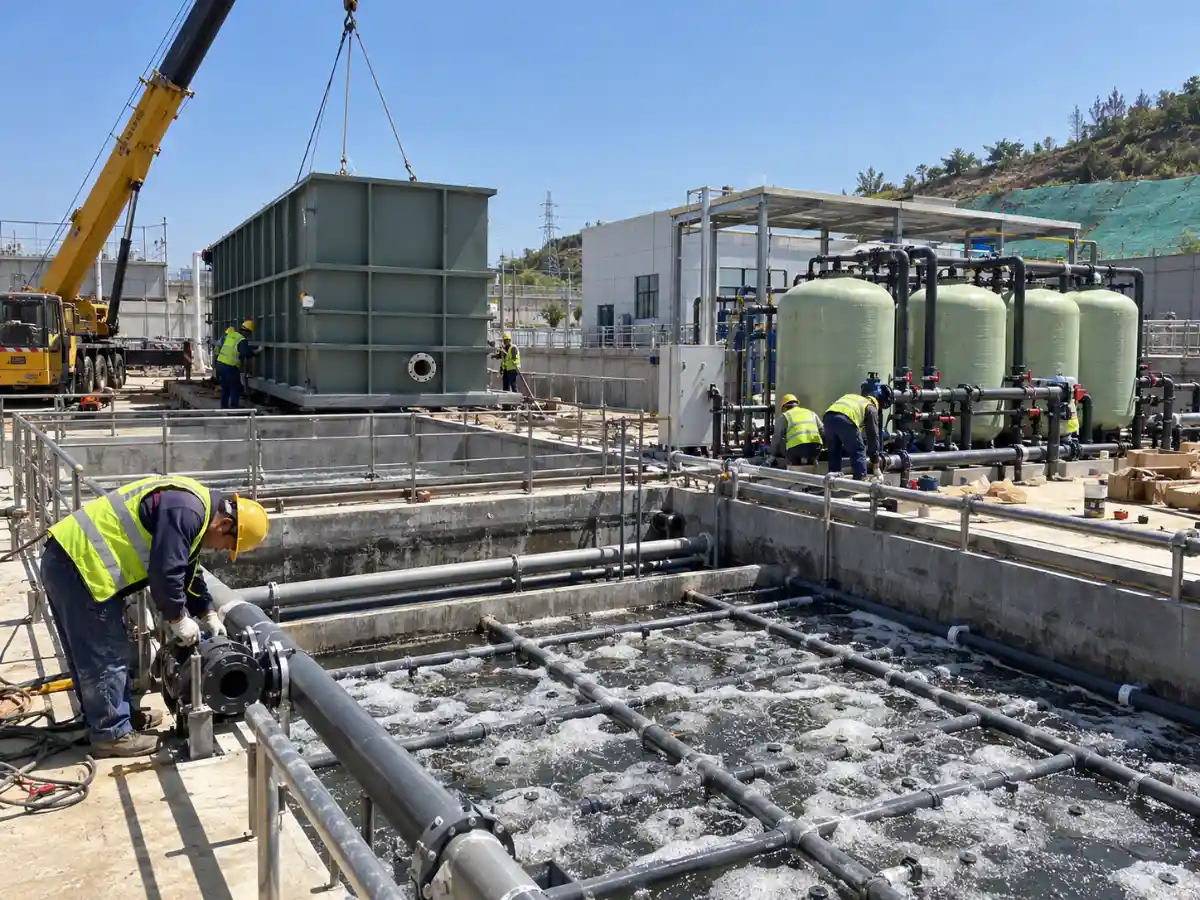
If I could give one piece of advice to anyone planning a produced water evaporator, it would be this: spend the money on pre-treatment. The evaporator itself is a heat exchanger and a vessel. The pre-treatment train is what keeps it running.
A typical pre-treatment sequence for produced water looks like:
- Free water knockout and skim tank — remove bulk oil. Target less than 20 mg/L oil and grease before the next step.
- Chemical softening — lime or caustic soda plus soda ash to precipitate calcium, magnesium, and barium as carbonate and hydroxide sludge. This is the single most important step for scaling control.
- Clarification or DAF — separate the softening sludge. A dissolved air flotation unit is common here when oil carryover is still a concern.
- Filtration — multi-media or ultrafiltration to remove residual suspended solids. Target SDI below 3 for downstream membrane protection, or below 5 for evaporator feed.
- Deaeration and pH adjustment — control corrosion and scale chemistry in the evaporator.
Skipping softening is the most common mistake I see. The client wants to save on chemical cost and sludge handling, and six months later the heat exchanger tubes are scaled solid. Cleaning a scaled MVC heat exchanger is not a weekend job — it can take a week of downtime and, in bad cases, require tube replacement.
Energy, Cost, and the Lifecycle View
Produced water evaporation is energy-intensive, and I will not pretend otherwise. But the comparison is not against zero cost — it is against the alternatives: trucking, deep-well injection, or a permit violation.
Typical cost drivers I model in a feasibility study:
- Electricity: For MVC, the compressor dominates. At 25 kWh/m³ and $0.08/kWh, that is $2.00 per cubic meter of distillate. At $0.15/kWh, it is $3.75. The spread matters.
- Steam: For multi-effect, steam at $15–30 per tonne can make the operating cost competitive with MVC, but only if the steam is genuinely available and not needed elsewhere.
- Chemicals: Softening chemicals and antiscalant typically add $0.50–$2.00 per cubic meter of feed, depending on hardness.
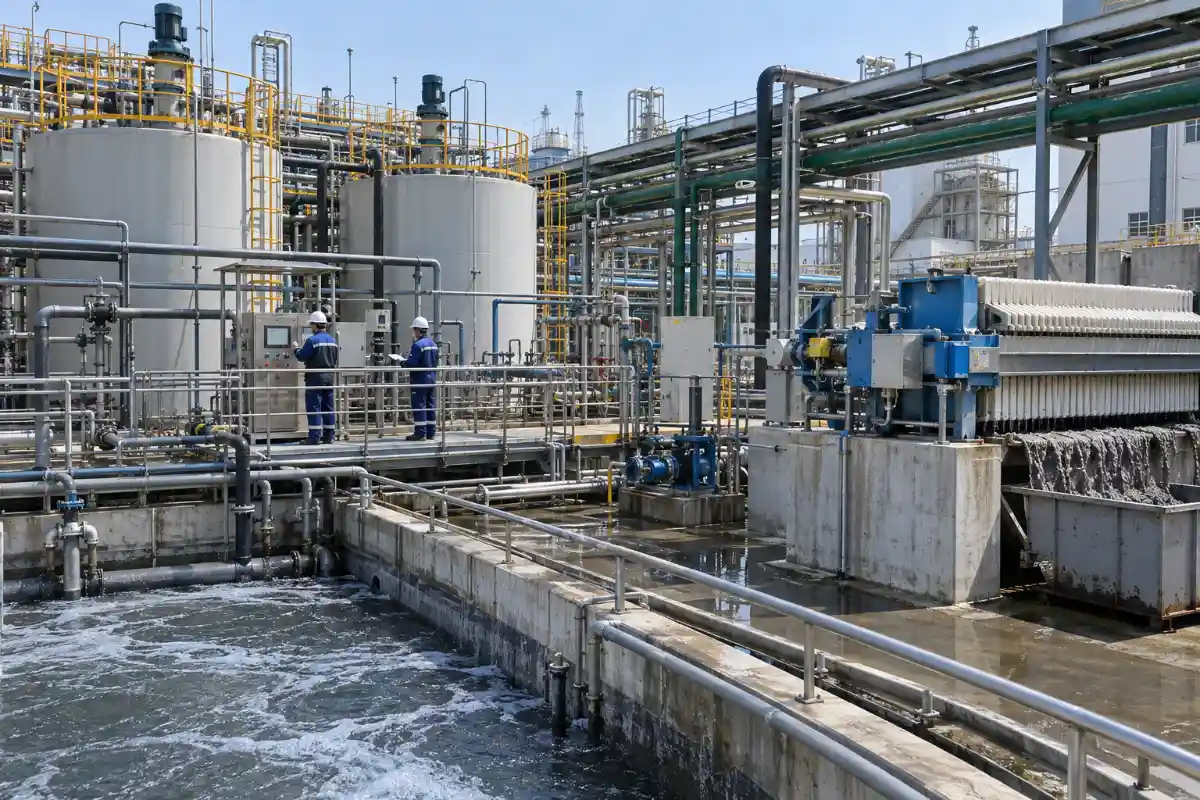
- Sludge handling: The softening sludge is a real cost. Dewatering with a screw press sludge dewatering system can reduce volume significantly, but the cake still needs disposal.
- Maintenance: Compressor overhauls, heat exchanger cleaning, and pump maintenance. Budget 3–5% of capital cost per year for a well-run system.
- Disposal of concentrate: If you are not going all the way to ZLD, the concentrated brine still needs a home. This is often the largest single cost.
I usually run the numbers three ways: MVC with grid power, multi-effect with waste steam, and hybrid membrane-thermal. The answer is rarely obvious without the model, and it changes with energy prices. A project that looked great at $0.06/kWh can look marginal at $0.14/kWh.
Operating Experience: What Actually Goes Wrong
I have spent enough time on commissioning and troubleshooting to know that the failure modes are predictable. Here are the ones I see most often:
Scaling on Heat Transfer Surfaces
Even with softening, some hardness slips through. Calcium sulfate and barium sulfate are the worst because they are hard to remove. The fix is usually a combination of better softening, antiscalant dosing, and operating at a lower concentration factor. Sometimes the answer is simply to accept more frequent cleaning and design for it — include cleaning-in-place connections and spare heat exchanger capacity.
Foaming and Carryover
Produced water with residual oil and surfactants foams easily. Foam carries liquid droplets into the vapor line, which contaminates the distillate and can damage the compressor in an MVC system. Antifoam helps, but the real fix is better oil removal upstream. I have also seen demister pads installed incorrectly or sized too small — that is a design error, not an operating one.
Compressor Fouling and Vibration
In MVC systems, the compressor is the heart and the most expensive component. Fouling on the impeller from carryover changes the balance and causes vibration. Vibration monitoring is not optional — it is how you catch a problem before it becomes a failure. I recommend continuous vibration monitoring with alarm setpoints tied to shutdown.
Corrosion in the Condensate System
Distillate from produced water is not pure water. It can contain ammonia, phenols, and traces of chlorides, and it is often hot. Carbon steel condensate lines will corrode. Use stainless or lined pipe, and monitor condensate quality if you plan to reuse it.
Turn-down and Cycling Problems
Many produced water evaporators are designed for a single operating point and then asked to run at 40% capacity because the well is declining. That is a recipe for fouling and poor control. If you know the flow will decline, design for it — multiple smaller trains, variable frequency drives on pumps and compressors, and control logic that can handle low flow without scaling.
When ZLD Is the Real Driver
In some basins, the permit does not allow any liquid discharge, and deep-well injection is either unavailable or too expensive. That is when you go all the way to полное отсутствие сброса жидкости. A ZLD train typically combines membrane concentration, evaporation, and crystallization. The evaporator is the workhorse, and the crystallizer handles the final salt.
ZLD is expensive — capital and operating — but it is sometimes the only permitted option. I have seen projects where the ZLD train cost more than the rest of the plant combined. If you are in that situation, the engineering effort should go into minimizing the volume that reaches the crystallizer, because that is where the cost is concentrated.
If you want to talk through whether thermal treatment makes sense for your specific stream, reach out to our engineering team and we can walk through the screening together.
Часто задаваемые вопросы
At what TDS level does thermal evaporation become more economical than membrane treatment?
There is no single number, but in most of my projects the crossover is somewhere between 50,000 and 80,000 mg/L TDS. Below that, high-pressure RO or DTRO usually wins on lifecycle cost. Above it, osmotic pressure and fouling make membranes uneconomic, and thermal becomes the better choice. The exact crossover depends on energy prices, membrane cleaning frequency, and the specific ions in the water.
How much does a produced water evaporator cost to operate?
For an MVC system, electricity is the dominant cost, typically $2–$4 per cubic meter of distillate at industrial power rates. Multi-effect systems trade electricity for steam, so the cost depends heavily on whether you have waste steam available. Add chemicals, sludge handling, maintenance, and concentrate disposal, and the all-in operating cost often lands between $5 and $15 per cubic meter of feed, depending on the site.
What pre-treatment is absolutely required before evaporation?
At minimum, you need oil removal to below 20 mg/L, hardness removal by softening, and suspended solids removal by filtration. Skipping softening is the most common and most expensive mistake. Without it, you will scale the heat exchanger and lose capacity within months.
Can I use an MVC evaporator if I do not have a reliable electricity supply?
MVC is electricity-intensive, so a stable supply matters. If your site has limited power, a multi-effect evaporator driven by steam or a hybrid approach may be more practical. Some sites use a combination — MVC for base load and a steam-driven effect for peak capacity.
How do I handle foaming in a produced water evaporator?
Start with better oil and grease removal upstream. Antifoam can help as a temporary measure, but it is not a fix. Check that the demister is correctly sized and installed. If foaming persists, you may need to reduce the concentration factor or add a pre-treatment step such as dissolved air flotation.
What is the typical maintenance cost for a thermal evaporator?
Budget 3–5% of capital cost per year for a well-maintained system. This covers compressor overhauls (for MVC), heat exchanger cleaning, pump maintenance, instrumentation calibration, and consumables. Systems that skip pre-treatment or run at high concentration factors will be at the high end or above.
How do I decide between MVC and multi-effect evaporation?
Start with your energy sources. If you have cheap waste steam, multi-effect is usually the lower operating cost. If you have reliable electricity and no steam, MVC is the better fit. Then consider water chemistry — MVC is less tolerant of foaming and carryover — and footprint. Multi-effect takes up more space, but it is more forgiving.
Can produced water evaporator distillate be reused?
Often yes, but it depends on quality. Distillate can contain ammonia, phenols, and trace chlorides, so it is not automatically clean water. If you plan to reuse it for irrigation, boiler feed, or process water, you need to test it and likely polish it. Many projects send distillate to a polishing RO or a carbon filter before reuse.