

Landfill leachate concentrate is the stubborn reject stream left behind after membrane treatment, and it is usually the reason a leachate plant never truly closes its water balance. The practical answer most engineers land on is a two-stage approach: DTRO to squeeze more clean permeate out of the concentrate, then Испарение по методу MVR to reduce what remains to a small brine or solid residue, often as part of a полное отсутствие сброса жидкости (ZLD) train. There is no single best configuration. The right choice depends on your concentrate flow, salt load, scaling ions, and how much you are willing to pay per cubic meter to make the problem disappear.
Why Leachate Concentrate Is Harder Than Raw Leachate
Raw leachate is already a moving target. Its composition shifts with landfill age, rainfall, waste type, and how the cap performs. But concentrate is worse, because every treatment step before it has removed water and left the dissolved solids behind.
What you typically inherit in a concentrate stream:
- High conductivity, often several times higher than the incoming leachate
- Concentrated chlorides, sulfates, and sodium or calcium hardness
- Refractory organics that survived biological treatment
- Silica, which is the quiet killer of evaporator heat transfer
- Ammonia that can carry over into condensate if pH is not managed
If you want a deeper look at what is actually dissolved in this water, it is worth reviewing the chemistry breakdown in Какие химические вещества содержатся в фильтратах с полигонов отходов? before you size anything. Design decisions made on wrong assumptions about chloride or silica will show up as tube fouling within months.
DTRO as the First Line of Defense
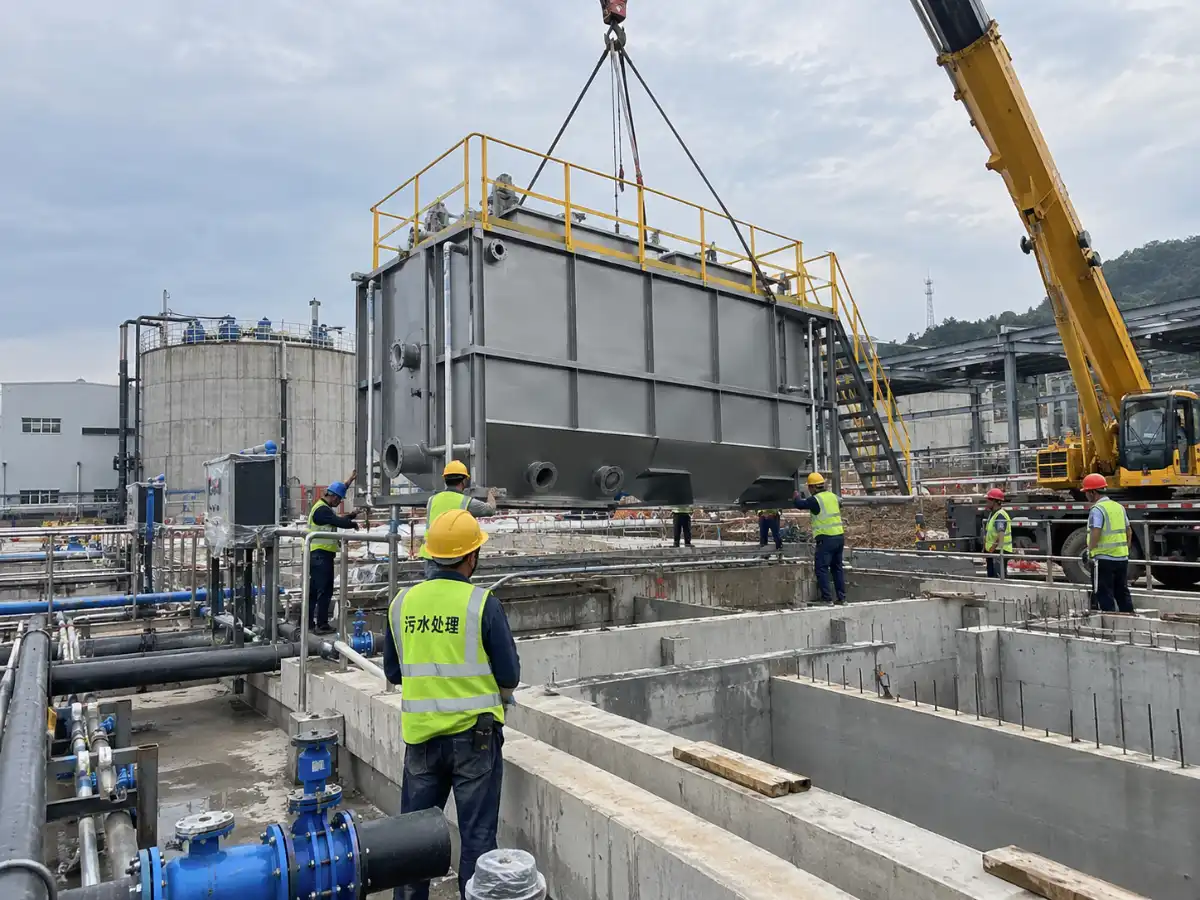
Disc tube reverse osmosis exists for one reason: standard spiral-wound RO elements plug too fast on high-fouling streams. The DTRO design uses open-channel hydraulic paths that tolerate suspended solids, and it handles the high pressures needed to push water through a concentrated brine.
Where DTRO earns its place
In most leachate projects I have been involved with, DTRO sits downstream of a biological or pre-treatment stage and upstream of evaporation. Its job is to reduce concentrate volume before the thermal step, because every cubic meter you remove here is a cubic meter you do not have to boil later.
Typical design ranges for leachate DTRO service:
| Параметр | Indicative range | Примечания |
|---|---|---|
| Рабочее давление | 60–120 bar | Depends on target recovery and osmotic pressure |
| System recovery | 70–85% | Project-dependent; falls as conductivity rises |
| Concentrate TDS | 30,000–60,000 mg/L | Practical limit before osmotic pressure dominates |
| Membrane life | 2–4 years | Shorter with poor pre-treatment or high scaling potential |
These are planning numbers, not guarantees. A site with high calcium and sulfate will hit its practical recovery ceiling earlier than a chloride-dominated site, because scaling risk, not pressure, becomes the binding constraint.
If you are comparing membrane configurations for this duty, the engineering notes on Мембранные системы DTRO cover how staging and pressure vessels are arranged for high-fouling industrial streams.
The limits of pushing recovery
There is a temptation to keep adding membrane stages to avoid the evaporator. That works up to a point. Past roughly 80% recovery on leachate concentrate, the osmotic pressure climbs fast, energy per cubic meter of permeate rises sharply, and you start needing pretreatment that costs as much as the evaporation you were trying to avoid. In my experience, chasing the last 5% of membrane recovery is usually the wrong trade.
MVR Evaporation: Where the Concentrate Finally Breaks
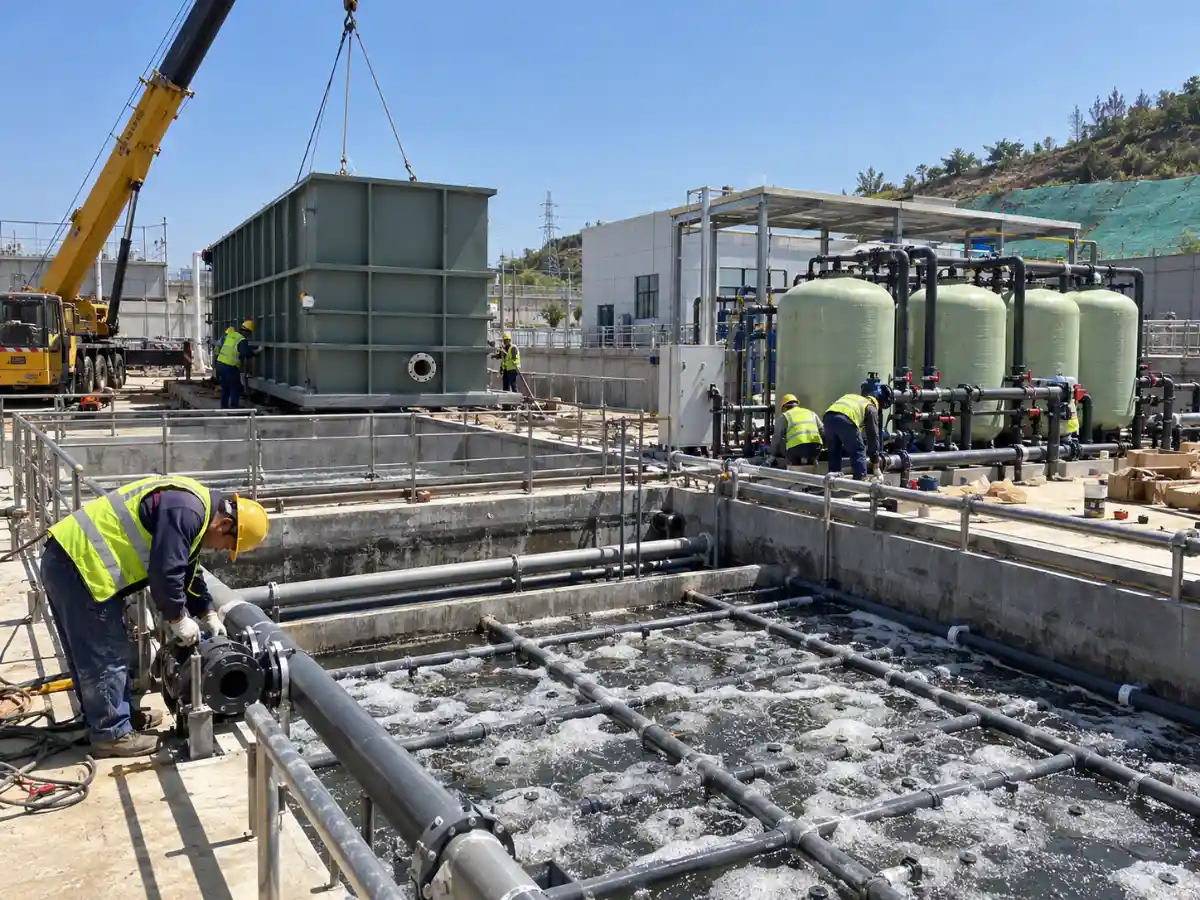
Mechanical vapor recompression takes the vapor boiled off the concentrate, compresses it, and reuses it as the heating medium. The compressor does the work instead of a continuous steam supply, which is why MVR is the default choice for leachate concentrate in places where steam is expensive or unavailable.
For a concentrate stream, MVR does three jobs at once:
- It reduces volume dramatically, often to 5–15% of the feed
- It produces a distillate clean enough for reuse or discharge, depending on ammonia and VOC control
- It leaves a brine or crystallized salt that can be dewatered and sent for disposal
Этот Технология MVR behind this is straightforward in principle and unforgiving in practice. Fouling control, material selection, and compressor reliability decide whether the unit runs at design capacity or limps along at half load.
Choosing between MVR and multi-effect evaporation
MVR is not always the answer. If you have cheap waste steam available, a multi-effect evaporator can have a lower electrical demand and simpler maintenance. The trade-off comes down to your energy price and steam availability.
| Factor | MVR | Multi-effect |
|---|---|---|
| Primary energy | Электроэнергия | Steam |
| Specific energy use | Lower when steam is scarce | Lower when steam is cheap |
| Compressor maintenance | Significant | Minimal |
| Startup time | Быстрее | Медленнее |
| Наилучшее соответствие | Remote sites, no steam | Sites with existing boiler capacity |
For a leachate plant with no steam header, MVR almost always wins. If you already run a boiler and have surplus steam, run the numbers on a double or triple effect before committing. The comparison between Испарение по методу MVR and multi-effect designs is worth doing at the concept stage, not after equipment is ordered.
Building a ZLD Train Around Them
Zero liquid discharge is not a single piece of equipment. It is a sequence, and the sequence matters more than any individual unit.
A workable ZLD train for leachate concentrate usually looks like this:
- Softening and pre-treatment — remove hardness and silica before they reach the evaporator
- DTRO polishing — recover additional permeate and shrink the feed to evaporation
- Испарение по методу MVR — concentrate to brine or crystallizer feed
- Crystallization or brine drying — produce a handleable solid
- Distillate polishing — strip ammonia, remove residual organics, confirm discharge quality
Where people get into trouble is skipping step one. An MVR evaporator fed with unsoftened concentrate will scale its heat exchangers, lose capacity, and require frequent chemical cleaning. The cost of that cleaning, in downtime and chemicals, usually exceeds what was saved by omitting softening.
The broader design logic behind these trains is covered in the notes on ZLD systems, which walk through how membrane and thermal stages are balanced against each other.
Material selection is not optional
Chloride-rich concentrate at temperature will eat carbon steel and standard stainless. Heat exchanger tubes and vessel internals in leachate MVR service generally need higher-grade alloys or titanium, depending on chloride level and temperature. This is a cost you cannot design around, and it is one of the main reasons leachate ZLD capex runs higher than a comparable industrial evaporator.
Energy, Cost, and the Honest Math
Leachate concentrate treatment is expensive. There is no way to present it otherwise. The question is not whether it costs money, but where the money goes and whether you can reduce it.
Major cost drivers:
- Электроэнергия — compressor power for MVR, high-pressure pumps for DTRO
- Тепловая энергия — if you use multi-effect instead of MVR
- Химические вещества — antiscalant, cleaning agents, pH adjustment, ammonia stripping acid
- Замена мембраны — DTRO elements are consumables
- Residue disposal — the salt or brine you produce still has to go somewhere
In most projects I have reviewed, electricity dominates the operating cost of an MVR-based train, and membrane replacement dominates the maintenance budget of the DTRO stage. If you want a realistic view of where the money lands, the breakdown in Факторы, влияющие на стоимость испарителя MVR is a useful reference for building your own model.
One practical note: the cost per cubic meter of concentrate treated is a poor comparison metric between sites, because concentrate strength varies so widely. Compare on cost per kilogram of salt removed, or cost per cubic meter of total leachate processed. Those numbers travel better across projects.
Maintenance and the Failures That Actually Happen
Most leachate concentrate systems fail in predictable ways. Knowing them in advance is cheaper than learning them on site.
Common failure modes
| Failure | Root cause | Mitigation |
|---|---|---|
| DTRO flux decline | Organic and biological fouling | Regular cleaning cycle, biocide dosing |
| Scaling in evaporator | Insufficient softening, silica carryover | Upstream softening, antiscalant, periodic CIP |
| Compressor vibration | Liquid carryover, bearing wear | Demister maintenance, vibration monitoring |
| Ammonia in distillate | pH drift in feed | pH control, stripping stage |
| Foaming in evaporator | Surfactants and organics | Antifoam, feed dilution, pre-treatment |
Two of these deserve emphasis. First, fouling of DTRO elements is normal and should be planned for with a cleaning schedule, not treated as a fault. Second, ammonia control is often underestimated. Leachate concentrate can carry significant ammonia, and if the evaporator feed pH is not controlled, that ammonia travels with the vapor into the distillate and forces you to add a downstream treatment step you did not budget for.
Selection Logic: How to Decide
When I help clients scope a leachate concentrate system, the decision usually comes down to a few questions:
- What is the concentrate flow and salt load? Small flows with high salt favor evaporation; large flows with moderate salt justify more membrane stages.
- Is steam available? If yes, evaluate multi-effect. If no, MVR is the default.
- What are the scaling ions? High calcium, sulfate, or silica pushes you toward more aggressive softening and lower recovery targets.
- What is the discharge or reuse target? If distillate must meet strict ammonia or COD limits, plan the polishing stage from day one.
- What is the disposal route for residue? If there is no landfill or salt disposal option, ZLD becomes mandatory rather than optional.
Answer those five questions honestly and the configuration usually selects itself. The mistakes come from answering them optimistically.
In my experience, the projects that run well are the ones where the engineer sized the softening and pre-treatment generously and the evaporator conservatively. The projects that struggle did the opposite.
Where This Fits in a Broader Treatment Train
Concentrate treatment is the tail end of a leachate plant, but it is not isolated. Its performance depends on everything upstream. If the biological stage is unstable, the membrane stage sees more organics. If the membrane stage fouls, the evaporator sees more load. If the evaporator scales, the whole plant backs up.
For context on how leachate fits into a full industrial wastewater treatment sequence, the overview in процесс очистки воды is a reasonable starting point, and the reference material on нормы сброса сточных вод helps you set realistic distillate targets before you design anything.
If you are working through a specific concentrate problem and want a second opinion on configuration, the engineering team here is happy to review your water analysis and flow data. You can start that conversation through our contact page.
Часто задаваемые вопросы
How much can DTRO reduce leachate concentrate volume before evaporation?
In typical leachate service, DTRO can recover roughly 70–85% of the feed as permeate, depending on conductivity and scaling potential. That means the evaporator only sees 15–30% of the original concentrate flow. Higher recovery is possible but usually requires more pre-treatment and higher operating pressure, which shifts cost rather than eliminating it.
Is MVR always better than multi-effect evaporation for leachate concentrate?
No. MVR is better when steam is unavailable or expensive, because it runs on electricity and reuses its own vapor. If you already have surplus low-pressure steam, a multi-effect evaporator can have lower operating cost and simpler maintenance. The right choice depends on your site energy balance.
What causes scaling in the evaporator, and how do I prevent it?
Calcium, magnesium, sulfate, and silica are the usual culprits. Prevention starts upstream with softening and, where needed, silica removal. Antiscalant dosing and a defined clean-in-place schedule handle the rest. Skipping softening to save capex almost always costs more in downtime and chemical cleaning.
How do I control ammonia in the distillate?
Ammonia carries over with vapor when feed pH is high. Control feed pH carefully, and if ammonia levels are significant, add a stripping stage or a downstream polishing step. This is a design decision, not something to fix after commissioning.
What is the realistic operating cost of a leachate ZLD train?
It varies widely with concentrate strength, electricity price, and residue disposal cost. Electricity for the MVR compressor and high-pressure pumps is usually the largest single line item, followed by membrane replacement and chemicals. Build your own model using your local energy and disposal prices rather than relying on generic benchmarks.
How long do DTRO membranes last in leachate service?
Two to four years is a reasonable planning range. Actual life depends heavily on pre-treatment quality, cleaning frequency, and how aggressively you push recovery. Poor pre-treatment can cut membrane life in half.
Can I avoid ZLD if I do not have a residue disposal route?
If there is no viable route for brine or salt disposal, ZLD is effectively mandatory. That means adding crystallization or brine drying after evaporation. Plan for it at the concept stage, because retrofitting a crystallizer into an existing evaporator train is expensive and disruptive.