

If you’re treating textile wastewater, the right equipment train usually comes down to four workhorses: equalization and chemical pretreatment, biological treatment (typically extended aeration or MBBR), dissolved air flotation or clarifiers for solids, and then a membrane or evaporation stage if you’re chasing reuse or zero liquid discharge. Everything upstream of that is basically protecting those four stages. In my experience on dyehouse and finishing plant projects, the plants that run smoothly aren’t the ones that bought the biggest equipment — they’re the ones that matched the train to their actual effluent profile instead of a generic spec sheet.
Why Textile Wastewater Is Harder Than It Looks
Textile effluent is not one stream. It’s several, and they behave nothing alike:
- Desizing wastewater — high BOD and COD from starch and sizing agents. Often the dirtiest single stream in the plant.
- Scouring and bleaching — alkaline, hot, high in suspended solids and sometimes surfactants.
- Dyeing and printing — the color problem. Reactive dyes, disperse dyes, and auxiliaries that resist conventional biological treatment.
- Finishing — softeners, resins, and sometimes solvents. Low volume, high nuisance value.
If you blend all four into one sump and send it to a single treatment line, you inherit every problem at once. In my experience, source separation of the desizing stream alone can cut the organic load on the biological stage by a meaningful margin, and it costs far less than upsizing the aeration basin later.
The other reality: textile plants change their product mix. A dyehouse running pale shades in March may be running deep blacks in September, and the color and salt load swing with it. Design for the swing, not the average.
The Core Equipment Train, Stage by Stage
1. Equalization and Flow Balancing
This is the least glamorous tank in the plant and the one that saves the most downstream equipment. Textile batch processes dump effluent in slugs — a dye bath here, a rinse cycle there. Without equalization, your biological system sees shock loads and your membranes see spikes in fouling potential.
What I look for: enough volume for 8–24 hours of retention depending on batch frequency, mechanical mixing that actually moves the tank (not just a token air line), and pH correction upstream of anything biological or membrane-based. A well-mixed equalization tank also gives you a place to blend incompatible streams before they cause precipitation problems.
2. Chemical Pretreatment and Coagulation
For dye-heavy effluent, chemical pretreatment is usually non-negotiable. The goal is to break the colloidal stability of dye molecules and let them agglomerate into something you can physically remove.
Typical setup: pH adjustment, coagulant dosing (often an inorganic salt), flocculant dosing, and a slow-mix zone that gives the floc time to grow. Get the mixing energy wrong and you either shear the floc apart or never form it in the first place. This is where a lot of underperforming plants actually fail — not in the biology, but in the jar test they never ran properly.
3. Dissolved Air Flotation (DAF)
DAF is the workhorse for textile pretreatment. It floats the coagulated dye floc and suspended solids to the surface, where a scraper removes them as sludge. Compared to plain settling, DAF handles lighter floc and needs less footprint.
Key operating parameters I watch:
- Air-to-solids ratio — too low and you don’t float the floc; too high and you waste energy and create foam.
- Recycle ratio — usually in the 20–40% range, but it depends on your solids loading.
- Chemical dosing balance — overdosing coagulant is a common and expensive mistake.
For heavier sludge streams, a properly sized thickening step before dewatering pays for itself quickly. The same logic applies whether you’re running a DAF unit or a gravity thickener — you’re trying to reduce the volume your dewatering equipment has to handle. There’s a useful breakdown of DAF sludge thickening practice that covers the operating side well.
4. Biological Treatment
After chemical pretreatment knocks down color and suspended solids, the biological stage handles dissolved organics. For textile effluent, extended aeration activated sludge and MBBR are the two most common choices.
Extended aeration gives you long sludge age, which helps with the slowly biodegradable fractions in textile auxiliaries. MBBR adds biofilm carriers that resist shock loads better and can be a good fit when you have limited tank volume or highly variable loading.
What matters more than the technology label: dissolved oxygen control, nutrient dosing (textile effluent is often short on nitrogen and phosphorus for the biology), and sludge age management. I’ve seen MBBR systems underperform because nobody bothered to check whether the carriers were actually fluidizing.
5. Secondary Clarification or Membrane Separation
If you’re discharging to a municipal sewer or surface water, secondary clarification followed by polishing is often enough. If you’re pursuing reuse or zero liquid discharge, membrane separation enters the picture.
For textile effluent reuse, the usual progression is ultrafiltration to remove residual solids and colloids, then reverse osmosis to remove dissolved salts and remaining color. High-pressure RO is often required because textile effluent after biological treatment can still carry significant salinity from dye bath salts.
The operating pressure you need depends on your feed salinity, but textile RO trains commonly run in the 20–40 bar range, with higher-pressure stages needed when the brine concentrates. If you want to understand how pressure requirements scale with salinity, this piece on typical RO operating pressure ranges gives useful context.
6. Evaporation and ZLD
When discharge limits tighten or the plant commits to zero liquid discharge, evaporation becomes the final stage. The RO concentrate has to go somewhere, and evaporators reduce that volume to a solid or near-solid waste.
Two main options:
- Multi-effect evaporators — use steam to drive multiple evaporation stages. Lower electrical demand, but you need a steam source and the capital cost is higher.
- Mechanical vapor compression (MVC/MVR) — uses a compressor to recompress the vapor and reuse its latent heat. Lower energy cost per unit of water evaporated if electricity is cheaper than steam at your site.
For textile ZLD projects, MVC evaporators are often the better fit because many dyehouses don’t have a reliable steam supply and electricity is more available. The trade-off is compressor maintenance and the need for careful scaling control in the heat exchangers. If scaling is a concern with your brine chemistry, this overview of MVC evaporator heat exchanger design is worth reading before you spec anything.
Equipment Comparison Table
The table below compares the main equipment categories you’ll be choosing between for a textile wastewater project. Ranges are indicative and depend on your specific effluent, site conditions, and discharge requirements.
| Equipment | Primary Function | Typical Capacity Range | Energy Demand | Best Fit | Key Maintenance Concern |
|---|---|---|---|---|---|
| Equalization tank + mixer | Flow and load balancing | 8–24 hr retention | Low | All textile plants | Mixer seal wear, sludge accumulation |
| Chemical dosing + coagulation | Destabilize dyes and colloids | Scalable to flow | Low | Dye-heavy effluent | Dosing pump calibration, chemical cost |
| DAF unit | Float and remove floc | 10–500 m³/hr | Moderate | Pretreatment before biology | Recycle pump, scraper, air saturation |
| Extended aeration / MBBR | Biological COD/BOD removal | Project-dependent | Moderate–high (aeration) | Dissolved organics | Blower, DO control, nutrient balance |
| Secondary clarifier | Solids separation | Matched to biology | Low | Discharge-oriented plants | Sludge blanket control, RAS rate |
| Ultrafiltration | Colloid and solids removal | Modular | Moderate | Pre-RO polishing | Membrane cleaning frequency |
| Industrial RO | Desalination and color removal | Modular | Moderate–high | Reuse or ZLD feed | Membrane fouling, scaling, pressure drop |
| MVC/MVR evaporator | Concentrate brine | Project-dependent | High (compressor) | ZLD, no steam available | Compressor, heat exchanger scaling |
| Multi-effect evaporator | Concentrate brine | Project-dependent | Moderate (steam-driven) | ZLD, steam available | Scaling, steam trap maintenance |
| Screw press dewatering | Dewater sludge | Matched to sludge volume | Low | All plants with sludge | Screw wear, polymer dosing |
The single biggest mistake I see in equipment selection is treating this table as a shopping list instead of a sequence. Each stage protects the next. Skip the equalization tank and your DAF runs on shock loads. Skip the DAF and your membranes foul in weeks. Skip the UF and your RO membranes are gone in months.
Sludge Handling: The Part Everyone Underestimates
Textile sludge is bulky, and chemical pretreatment produces more of it than biological treatment alone. If you’re running coagulation and DAF, expect significant sludge volume, and plan for dewatering from day one.
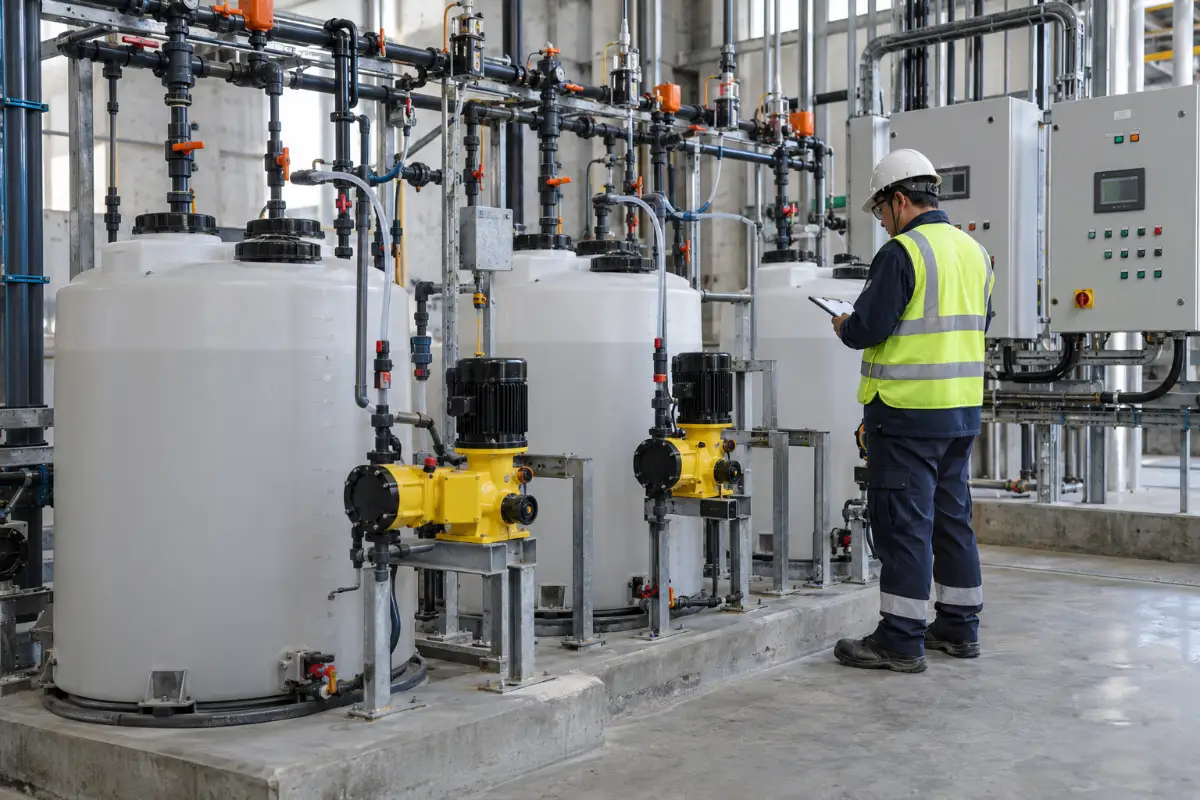
Screw press dewatering has become the default for many textile plants because it’s continuous, low-attention, and handles the fibrous character of textile sludge reasonably well. The trade-off is that it needs the right polymer dose and the right screw geometry for your sludge. A poorly matched screw press will produce cake that’s still too wet to haul economically.
For a practical walkthrough of what to check, this screw press dewatering guide covers the selection logic without overselling any single design.
Energy and Lifecycle Cost: Where the Money Actually Goes
I’ve sat through enough budget reviews to know that capital cost gets all the attention and operating cost decides whether the plant survives. For textile wastewater, the operating cost picture looks roughly like this:
- Biological aeration — often the largest single electrical load in a conventional plant. Blower efficiency and DO control strategy matter more than the tank design.
- Chemical dosing — coagulant and polymer costs scale with load, and overdosing is the most common waste I see.
- Membrane replacement — a slow, predictable cost if pretreatment is right, and a sudden, painful cost if it isn’t.
- Evaporator compressor power — the dominant cost in ZLD plants. MVC systems trade capital cost for operating cost, and the balance point depends on your local electricity and steam prices.
- Sludge hauling — proportional to cake volume. A few percentage points of cake dryness translates into real money over a year.
When I’m comparing evaporator options for a client, I run the numbers on a per-cubic-meter-of-feed basis, not on nameplate capacity. The compressor power per unit of water evaporated is the number that matters, and it varies with the boiling point elevation of your brine. Higher dissolved solids means more power per unit of water removed. That’s why concentrating the feed as far as possible with RO before it reaches the evaporator is almost always the right move.
“The cheapest evaporator is the one you don’t have to run, because you already squeezed the water out with membranes upstream.” — a sentiment I’ve heard from more than one project engineer, and it holds up in the numbers.
Common Failure Modes and How to Avoid Them
These are the problems I see repeatedly on textile wastewater projects, along with the root causes:
Membrane fouling within months
Almost always a pretreatment failure. Either the DAF isn’t removing enough colloidal material, the UF is bypassing, or the antiscalant dose is wrong for the brine chemistry. Fix the front end before you replace the membranes.
Biological system losing nitrification
Textile effluent is often nutrient-deficient. If you’re not dosing nitrogen and phosphorus, the biology will struggle. Check the ratio before you blame the aeration.
Color breakthrough after biological treatment
Some reactive dyes are simply not biodegradable. If the color standard is tight, you need chemical or membrane removal, not a bigger aeration basin.
Evaporator scaling and frequent cleaning
Brine chemistry drives this. If your feed has high hardness or silica, you need softening upstream or a forced-circulation design that tolerates scaling better. Cleaning frequency is a design outcome, not an operator failure.
Sludge cake too wet for economical hauling
Usually a polymer selection or dosing issue, sometimes a screw press that’s undersized for the actual sludge volume. Run jar tests with your actual sludge, not a sample from another plant.
How to Think About Selection
If you take one thing from this article, make it this: selection is a sequence, not a menu. Work backward from your discharge or reuse target, and let each stage’s performance define what the next stage has to handle.
- Define the endpoint. Sewer discharge, surface water, reuse, or ZLD. Everything else follows from this.
- Characterize the effluent properly. Not one composite sample — a proper campaign across your product mix and seasons.
- Separate streams where it pays. Desizing and dye baths are usually worth isolating.
- Size the biological stage for the load, not the average flow. Peak loads drive failures.
- Treat membranes as a commitment, not an add-on. They need pretreatment, cleaning, and replacement budget.
- Only reach for evaporation when you’ve exhausted cheaper concentration options. RO concentrate is much cheaper to evaporate than raw effluent.
For a broader view of how these stages fit together across different industrial applications, this overview of treatment process stages is a useful reference when you’re sketching out a flowsheet.
Regulatory context matters too. Discharge limits for color, COD, and salinity continue to tighten in most industrial regions, and the U.S. EPA effluent guidelines program is one reference point for how textile limits are structured. The World Bank’s water resources work also publishes useful context on industrial water management trends. I mention these not as a compliance checklist but because your equipment selection should be informed by where limits are heading, not just where they are today.
Frequently Asked Questions
What’s the minimum equipment I need to treat textile wastewater for sewer discharge?
At minimum, you need equalization, chemical pretreatment with coagulation and flocculation, a DAF or settling stage for solids removal, and biological treatment with secondary clarification. If your local limits include color, you may also need an oxidation or adsorption polishing step. The exact train depends on your effluent characteristics and the specific discharge limits you’re held to.
How do I choose between MBBR and conventional activated sludge for textile effluent?
MBBR tends to handle shock loads and load variability better because the biofilm is more resilient than suspended biomass. Conventional activated sludge can achieve lower effluent concentrations when it’s well-controlled and the load is stable. For dyehouses with highly variable production, MBBR is often the more forgiving choice. For plants with steady output and tight nutrient limits, activated sludge with proper nutrient dosing can be more efficient.
Why does my RO system foul so quickly on textile effluent?
Nearly always a pretreatment gap. Residual dyes, colloidal material, and organics that pass through the DAF and UF will concentrate on the RO membrane surface. Check your UF integrity, your coagulant dose, and your antiscalant selection against your actual brine chemistry. Sometimes the issue is that the feed water quality changed without anyone updating the pretreatment setpoints.
Is MVC or multi-effect evaporation better for a textile ZLD project?
It depends on your site. MVC has lower operating cost if electricity is reasonably priced and you don’t have a steam supply. Multi-effect has lower electrical demand but needs a steam source and typically higher capital cost. Run the numbers on a per-cubic-meter basis using your actual energy prices and brine chemistry. Also factor in compressor maintenance for MVC and steam system maintenance for multi-effect — both have real costs that don’t show up in the energy calculation.
How often should I expect to clean my evaporator heat exchangers?
That depends entirely on your brine chemistry and the evaporator design. Well-designed systems with proper upstream softening might run for months between cleanings. Systems handling hard or silica-rich brine may need cleaning far more often. If you’re cleaning more than a few times a year, the problem is usually upstream — either insufficient softening or a design that doesn’t tolerate your scaling tendency. Treat frequent cleaning as a signal to investigate, not a normal operating condition.
What’s the biggest mistake in textile wastewater equipment selection?
Sizing for average conditions instead of peak loads and future limits. Textile plants change their product mix, discharge limits tighten over time, and batch processes create peaks that average data hides. Build in margin at the biological and membrane stages, and make sure your equalization volume reflects your actual batch cycle, not a rule of thumb from a different industry.
Can I reuse treated textile wastewater in my process?
Yes, but the required treatment level depends on where you’re reusing it. Rinse water for dark shades is more forgiving than water for a final bleach or finishing step. Most reuse projects need at least UF and RO, and some need additional polishing for color or specific ions. The economics usually work best when you’re displacing expensive purchased water, so run the comparison against your actual water cost, not a generic figure.
Planning a textile wastewater project or upgrading an existing train?
Send us your effluent profile and discharge target. We’ll help you map the right equipment sequence — no obligation, just engineering input.
Closing Thoughts
The best equipment for textile wastewater isn’t a single machine — it’s a sequence that matches your actual effluent, your discharge target, and your operating reality. Equalization, chemical pretreatment, DAF, biological treatment, and then membranes or evaporation if you need them. Each stage earns its place by protecting the next one.
When I walk into a struggling plant, the fix is rarely a bigger unit. It’s usually a missing stage, a dosing setpoint that drifted, or a design that assumed steady-state conditions in a batch process. Get the sequence right, size for the peaks, and budget for the operating cost — the equipment will do its job.