

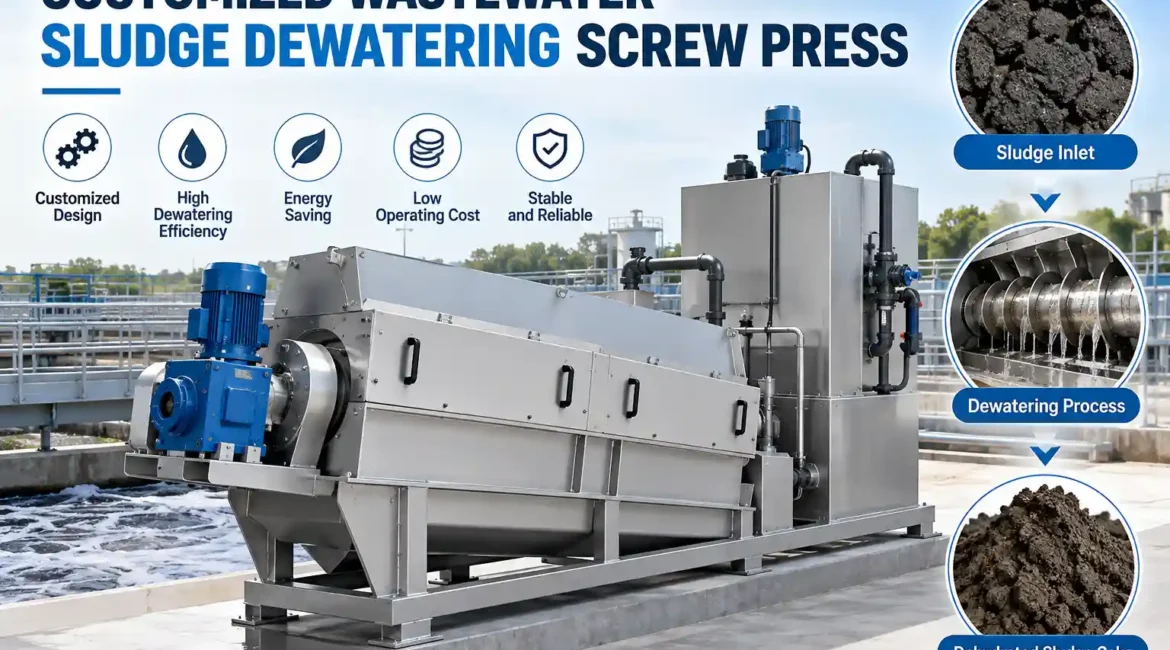
Dissolved air flotation sludge thickening is used to concentrate low-density sludge by attaching fine air bubbles to suspended solids and lifting those solids to the surface for removal. In practical wastewater treatment, the main value is not simply “making sludge thicker.” The real benefit is reducing the volume that must be pumped, stored, digested, dewatered, hauled, or otherwise handled downstream. A properly selected dissolved air flotation thickener can be especially effective with waste activated sludge, but performance depends heavily on solids loading, recycle flow, air-to-solids ratio, polymer conditioning, sludge age, and the way the float layer is removed. I’d recommend treating DAF thickening as a solids-management process, not as a stand-alone tank purchase. The equipment only performs well when the upstream sludge characteristics and downstream handling requirements are understood together.
What a Dissolved Air Flotation Thickener Actually Does
A sludge thickener removes water while keeping the remaining solids pumpable. That distinction matters. Thickening is not the same as dewatering. A thickened sludge may still contain more than 90% water, yet the reduction in total volume can be large enough to change the economics of every process downstream.
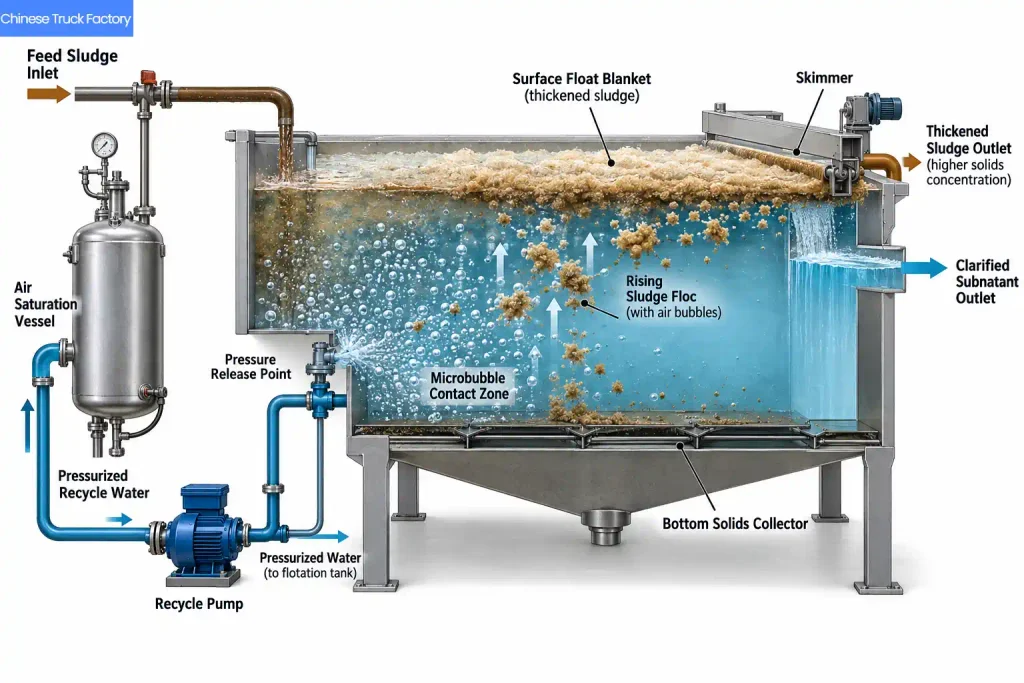
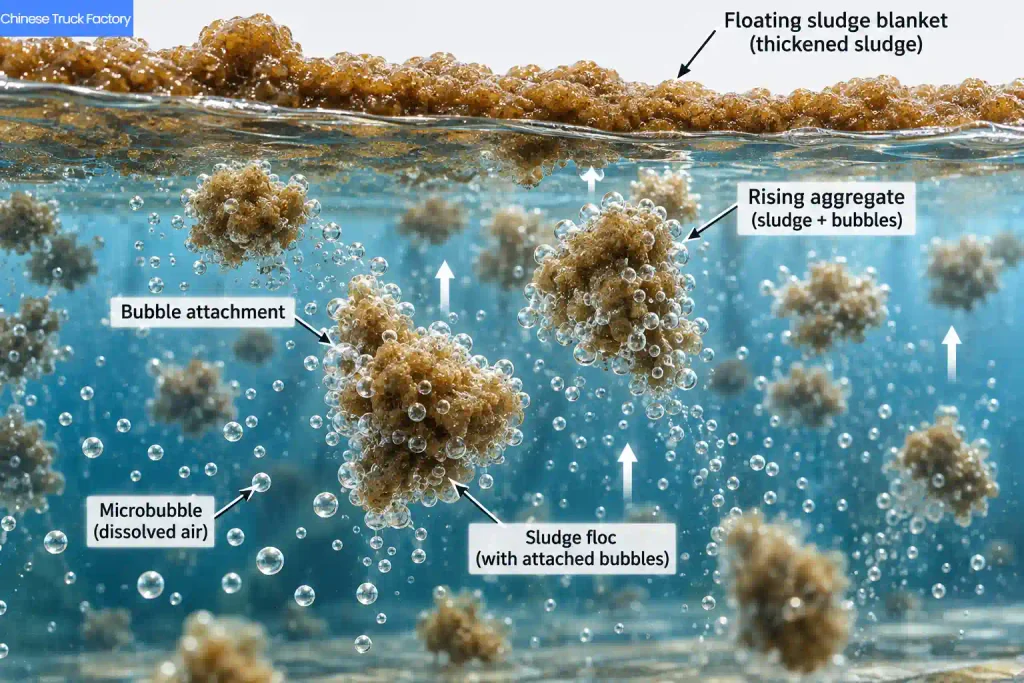
DAF thickening works by changing the apparent density of suspended solids. A recycle stream is pressurized and saturated with air. When that pressurized liquid is released into the flotation vessel, dissolved air comes out of solution as small bubbles. Those bubbles attach to or become trapped inside biological floc. The combined bubble-solids structure becomes buoyant and rises instead of settling.
The floating solids form a concentrated surface blanket. A skimmer removes that blanket to a hopper or trough, while clarified subnatant leaves the unit separately. Heavier material that cannot float may settle, so a DAF thickener handling mixed sludge often needs bottom collection as well as surface skimming.
This is why waste activated sludge thickening is such a common application. Biological sludge can be light, compressible, and reluctant to settle. Gravity thickening depends on settling behavior. DAF deliberately reverses that logic and gives the solids lift.
Thickening versus clarification
DAF equipment is also used to clarify wastewater containing suspended solids, oil, grease, or chemically formed floc. The mechanical principle is similar, but the design objective is different. A clarification unit is judged mainly by treated-water quality and contaminant removal. A sludge flotation thickener is judged by solids capture, float concentration, sludge volume reduction, and the stability of the thickened stream sent downstream.
I’d separate those two duties clearly in a specification. A quotation that simply states “DAF capacity” without defining whether the unit is sized for clarification or sludge thickening leaves too much open to interpretation.
Where DAF Thickening Fits Best
The strongest application is normally a sludge that contains a significant fraction of low-density biological solids. Waste activated sludge is the classic example. Mixed primary and secondary sludge can also be treated, but heavier primary solids, grit, or dense precipitates may settle rather than float. Those materials should be considered in the bottom collection and sludge withdrawal design.
Published engineering guidance has long shown that DAF can concentrate waste activated sludge beyond the levels commonly achieved by unassisted gravity thickening. An Environmental Protection Agency reference reports broad historical design ranges of approximately 0.3% to 2.0% feed solids and 3% to 12% thickened solids, with actual results strongly dependent on sludge type, polymer use, loading, and equipment conditions.[1] I would use that range only as a screening reference, not as a guarantee for a new project.
There are also situations where I would not make DAF the automatic choice. Sludge dominated by dense mineral solids may respond better to gravity separation or mechanical thickening. Highly variable industrial sludge may need bench testing before equipment selection. Sludge containing excessive free oil, unusual surfactants, solvents, or chemistry that changes surface tension may also behave very differently from ordinary activated sludge.
| Sludge condition | DAF suitability | Reason for the judgment | What I would verify before purchase |
|---|---|---|---|
| Waste activated sludge with poor gravity settling | Strong candidate | Low-density biological floc can respond well to microbubble attachment | Feed solids range, sludge age, polymer response, capture target |
| Mixed primary and secondary sludge | Project-dependent | Biological solids may float while dense primary particles or grit settle | Bottom scraper, settled-solids withdrawal, representative pilot testing |
| Chemically precipitated sludge | Often testable | Floc structure and density depend on chemistry and dosing | Jar or pilot testing, polymer compatibility, floc shear sensitivity |
| Mineral-rich or gritty sludge | Use caution | Dense particles may not gain enough buoyancy | Grit removal, bottom collection, alternative thickening methods |
| Highly variable industrial sludge | Testing recommended | Viscosity, pH, salinity, surface chemistry, and particle size may shift flotation behavior | Multiple representative samples instead of one grab sample |
| Very small flow with simple sludge handling | Economic review needed | Pressurization, controls, polymer equipment, and maintenance may outweigh volume-reduction savings | Total lifecycle cost rather than tank price alone |
How the Flotation Thickening Process Works Step by Step
1. Sludge enters at a controlled solids load
The feed pump should deliver a reasonably stable flow. A DAF thickener can tolerate variation, but rapid swings in feed solids or hydraulic rate make control harder because the required air, polymer, recycle, and skimming rate all change with the actual solids load.
For this reason, I’d size from dry solids mass as well as liquid flow. A feed of 50 cubic meters per day at 0.5% solids is not equivalent to the same flow at 1.5% solids. The hydraulic load is identical, but the dry solids load is three times higher.
2. Recycle water is pressurized and saturated with air
Part of the clarified subnatant is commonly recycled through a pressurization system. Air dissolves into this stream under pressure. Historical design guidance cites pressurization in the approximate range of 30 to 70 psig, or about 207 to 483 kPa gauge, depending on system design.[1]
Higher pressure does not automatically mean better thickening. Pressure, air dissolution, recycle flow, temperature, and release conditions work together. The useful output is a stable population of fine bubbles delivered where the solids can capture them.
3. Pressure is released and microbubbles form
When the saturated recycle enters the flotation zone at lower pressure, excess dissolved air is released. The resulting bubbles attach to floc surfaces, become trapped within floc structures, or collide with particles as they rise.
A 2022 review of dissolved air flotation research emphasized that viscosity, temperature, pH, salinity, surface tension, solids concentration, and particle size can influence air dissolution, bubble size, and bubble rise velocity.[2] That is one reason I would avoid copying a recycle percentage from another plant without checking the feed conditions.
4. Solids rise and form a float blanket
Once the bubble-solids aggregate becomes less dense than the surrounding liquid, it rises. The solids accumulate at the surface and begin draining water. Blanket residence time affects concentration, but leaving the float too long can also create instability, gas release, odor, or solids break-up.
The skimmer therefore does more than move sludge. Skimmer speed and withdrawal timing influence the thickness and consistency of the final product. Aggressive skimming may produce a wetter float. Excessively slow removal may allow the blanket to become difficult to move or may release solids back into the liquid.
5. Clarified subnatant exits and part may return as recycle
The clarified liquid leaves through the outlet or overflow structure. Part of this stream may return to the air-dissolution loop. The rest normally returns to another point in the treatment train according to the site mass balance.
Subnatant quality deserves attention because solids that escape the thickener do not disappear. They are simply returned to another treatment stage. A thickener with an impressive float concentration but poor solids capture can shift a large solids load back upstream.
The Design Variables That Control Performance
Most DAF thickening problems can be traced to a small group of variables that interact with one another. I’d recommend reviewing them as a system rather than adjusting one control in isolation.
Solids loading rate
Solids loading is the dry mass of solids applied per unit flotation area over time. This is one of the most useful sizing variables because it reflects the actual job the thickener must perform.
Historical Environmental Protection Agency guidance lists a broad design range of roughly 5 to 55 lb/ft²/day, equivalent to about 24 to 269 kg/m²/day, depending on sludge type and whether flotation aids are used.[1] The width of that range should be a warning against selecting equipment from one generic loading number.
The correct loading depends on sludge origin, solids concentration, floc characteristics, polymer response, capture target, thickened-solids target, and the available flotation area. If a vendor proposes the same loading for every biological or industrial sludge, I would ask for the basis.
Hydraulic loading rate
Hydraulic loading describes liquid flow per unit surface area. A thickener can be solids-limited, hydraulically limited, or constrained by both. Historical guidance reports approximately 0.4 to 2.0 gpm/ft², equal to about 1.0 to 4.9 m³/m²/h, as a broad reference range for DAF thickening.[1]
The important point is not the exact number. The important point is checking both solids and water. A dilute sludge can create a large hydraulic load before it reaches the maximum dry-solids load. A concentrated sludge may reach the solids limit first.
Air-to-solids ratio
The air-to-solids ratio compares the mass of available dissolved air with the mass of solids applied. It is not simply the compressor airflow setting. Historical guidance lists an air-to-solids ratio around 0.02 lb air per lb solids as a reference design value for certain applications.[1]
I would treat that value as a starting point for evaluation. The amount of air that dissolves and becomes useful for flotation depends on saturation efficiency, pressure, temperature, recycle flow, and actual release conditions. More air can also increase turbulence or operating cost without improving capture if the rest of the process is already limiting.
Recycle ratio
The recycle ratio is the pressurized recycle flow divided by the sludge feed flow. A historical reference range of about 30% to 150% appears in Environmental Protection Agency guidance.[1] The wide range reflects different sludge properties and system configurations.
A higher recycle rate can increase the quantity of whitewater available to carry microbubbles, but it also increases hydraulic loading through the vessel and energy use through the recycle pump. I’d optimize recycle against solids capture and float quality rather than treating maximum recycle as a performance target.
Polymer dose and floc condition
Polymer can make a major difference because DAF relies on particle-bubble interaction. A well-formed floc gives bubbles a larger, stronger structure to attach to. A poorly selected polymer can produce fragile, slimy, or excessively large floc that breaks under shear.
Published research on flotation thickening has shown that polymer dosage can increase the rising velocity of sludge under tested conditions.[3] That supports the operating experience behind routine polymer optimization: the goal is not simply adding more polymer; the goal is creating a floc that floats efficiently and releases water well.
Blanket depth and skimming rate
The float blanket must remain long enough to drain but not so long that it becomes unstable. Operators should be able to adjust skimmer speed or operating cycle and observe the effect on thickened solids concentration, subnatant quality, and float movement.
If the surface looks thick but the discharged sludge is unexpectedly dilute, I would check whether the skimmer is cutting too deeply into the liquid layer, whether the float is moving unevenly, or whether excessive water is being carried into the sludge trough.
Feed age, septicity, and gas formation
Sludge condition changes with storage time. Biological activity, dissolved gas formation, floc deterioration, and changes in extracellular material can alter flotation behavior. Equalization can make feed rate more stable, but excessive holding time without appropriate control may create a different set of problems.
The thickener should therefore be designed as part of the sludge train. Feed storage volume, mixing, pumping, return liquors, and downstream withdrawal schedules can affect performance as much as the tank itself.
| Variable | Published reference range or value | How I would use it | Why it should not be copied blindly |
|---|---|---|---|
| Feed solids | About 0.3% to 2.0% | Check whether the application resembles traditional sludge thickening duty | Industrial and mixed sludges can behave differently |
| Thickened solids | About 3% to 12% | Establish a realistic target range for discussion | Actual concentration depends strongly on sludge and conditioning |
| Pressurization | About 30 to 70 psig | Screen recycle-system design | Dissolution efficiency and release design matter as much as pressure |
| Recycle ratio | About 30% to 150% of feed flow | Check pump and hydraulic design envelope | Higher recycle also increases vessel hydraulic load |
| Air-to-solids ratio | About 0.02 lb/lb | Initial air-system check | Actual air availability depends on pressure, temperature, dissolution, and recycle |
| Solids loading | About 5 to 55 lb/ft²/day | Preliminary surface-area screening | Sludge type and polymer response can shift allowable loading significantly |
| Hydraulic loading | About 0.4 to 2.0 gpm/ft² | Check whether liquid flow controls area | Dilute sludge may reach the hydraulic limit before the solids limit |
Source note: The numerical values above are historical published design guidance, not current project guarantees.[1] I’d require representative testing, vendor calculations, or both before converting any reference value into a guaranteed design condition.
A Simple Mass Balance Shows Why Thickening Can Be Valuable
The economic case becomes much clearer when sludge concentration is converted into sludge volume. A small percentage-point increase in solids concentration can remove a large amount of water from the downstream handling load.
Consider a hypothetical feed of 100 m³/day at 0.8% total solids. For a screening calculation, assume the sludge density is close to 1,000 kg/m³. That gives approximately 800 kg/day of dry solids entering the thickener.
If the DAF captures 95% of those solids, the float contains approximately 760 kg/day of dry solids. If the float is discharged at 4.5% solids, the thickened sludge mass is about 16,889 kg/day. With density approximated as 1,000 kg/m³, the volume is about 16.9 m³/day.
- Feed sludge volume: 100 m³/day
- Feed dry solids: approximately 800 kg/day
- Assumed solids capture: 95%
- Dry solids recovered in float: approximately 760 kg/day
- Assumed float solids concentration: 4.5%
- Approximate thickened sludge volume: 16.9 m³/day
- Approximate reduction in downstream liquid volume: 83.1 m³/day
This example is intentionally transparent. The 95% capture and 4.5% float solids are assumptions for the calculation, not promised performance. The purpose is to show the leverage created by solids concentration.
If a downstream process is charged by volume, limited by hydraulic capacity, or consuming energy to move and heat water that does not need to be there, reducing 100 m³/day to about 17 m³/day can be economically significant.
What Equipment Belongs in a Complete DAF Thickening System
A reliable package is more than a flotation vessel. Procurement problems often appear because one supplier prices the tank while another prices the complete operating system. I’d normalize the scope before comparing quotations.
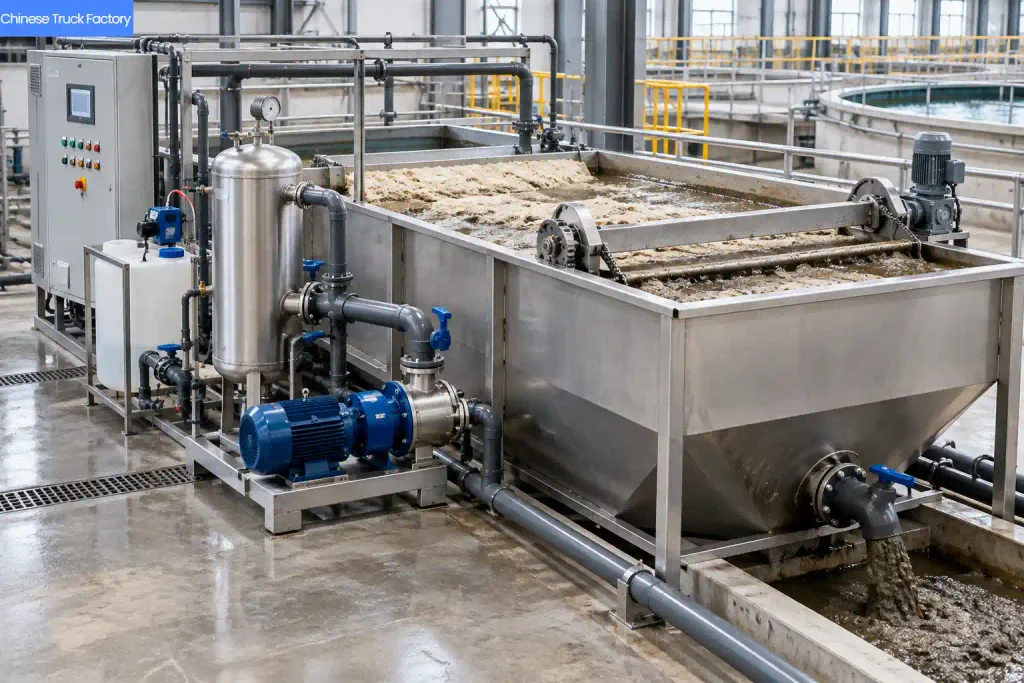
Flotation vessel
The vessel provides the contact, rise, separation, and collection zones. Rectangular and circular configurations are both used. The geometry should distribute feed and recycle evenly while avoiding short-circuiting, excessive turbulence, and stagnant areas.
Recycle pump
The recycle pump must provide the required flow at the pressure needed by the saturation system. Pump efficiency matters because this is a continuous energy load in many installations. The pump should also operate within a stable hydraulic range as recycle demand changes.
For broader pump-selection principles, the wastewater pump selection guide is useful for reviewing solids handling, duty point, maintenance access, and lifecycle considerations. A DAF recycle pump and a thickened-sludge pump perform very different jobs, so they should not be specified from the same rule of thumb.
Air dissolution or saturation system
The system may include an air compressor, saturation vessel, air-handling pump, or another whitewater generation arrangement. The quotation should explain how air is introduced, what operating pressure is expected, how excess air is handled, and what instruments confirm stable operation.
Pressure release devices
Nozzles, valves, or other pressure-release components determine how the saturated recycle converts into microbubbles. Fouling, wear, poor distribution, or plugging at these points can quietly reduce performance even when the recycle pump and compressor appear to be running normally.
Surface skimmer
The skimmer must move float without excessive dilution. Chain-and-flight systems, rotating skimmers, paddles, or other arrangements may be used depending on vessel geometry. I’d pay attention to torque, corrosion resistance, access, adjustable speed, and the ability to remove stringy material.
Bottom solids collection
If dense solids, grit, precipitates, or non-floating particles can enter the unit, a bottom scraper or sludge collection system may be necessary. Ignoring settled solids can lead to capacity loss, abrasion, odor, or difficult cleanout.
Polymer make-down and dosing
The chemical system should provide controlled preparation and an adjustable dose. A complete scope may include storage, transfer, make-down, aging, dosing pumps, calibration provisions, dilution water, containment, and interlocks.
For integrated package planning, Memva’s pre-packaged industrial wastewater treatment guide provides a useful framework for defining mechanical scope, instrumentation, controls, battery limits, and factory testing before equipment is ordered.
Instrumentation and controls
At minimum, I would want the operating team to be able to see feed flow, recycle flow, relevant pressure, tank level, pump status, polymer dosing status, alarms, and sludge withdrawal operation. Additional instrumentation may be justified by the process risk.
Instrumentation should support decisions. A screen full of values is not useful if the operators cannot tell which variable explains poor float formation or deteriorating subnatant quality.
Polymer Conditioning: Usually More Important Than Buyers Expect
Polymer is often treated as a minor chemical accessory during equipment procurement. I would give it more attention. The cost, performance, and reliability of the thickener can change materially with polymer type, charge density, molecular weight, make-down quality, injection point, mixing energy, and dose.
Too little polymer may leave weak or dispersed solids that do not attach efficiently to bubbles. Too much may increase chemical cost, create sticky float, reduce drainage, or interfere with downstream dewatering. Poor make-down can waste polymer before it ever reaches the process.
Bench testing should therefore examine more than a single “best dose.” I’d test a practical operating window. If the optimum result exists only at one narrow dose under one sample condition, the full-scale process may be difficult to operate when sludge quality changes.
The injection point also matters. Polymer needs enough mixing to contact the sludge, but excessive shear after floc formation can destroy the structure that flotation depends on. Pump type, static mixers, bends, control valves, and piping velocity can all contribute shear.
Research published in Water Science and Technology found that increasing polymer dosage under the tested conditions increased sludge rising velocity, and the authors used solids-flux relationships to evaluate an appropriate dose.[3] I think the practical lesson is straightforward: polymer should be optimized against flotation behavior, not selected only from a supplier’s nominal dose range.
DAF Thickening Compared with Other Sludge Thickening Methods
There is no useful reason to declare one thickening technology universally superior. The right choice depends on sludge behavior, available space, power, operator capability, chemical cost, desired solids concentration, downstream equipment, and project economics.
For this comparison, I’m prioritizing the factors that usually change an equipment decision: sludge compatibility, space, energy, chemical reliance, achievable concentration, maintenance complexity, and downstream impact.
| Decision factor | Dissolved air flotation | Gravity thickening | Mechanical drum or belt thickening | Centrifugal thickening |
|---|---|---|---|---|
| Best process strength | Low-density biological solids that respond well to flotation | Dense, settleable solids with adequate residence time | Compact mechanical thickening with polymer conditioning | High-rate mechanical separation in a compact footprint |
| Main separation force | Buoyancy from attached microbubbles | Gravity | Drainage through screen or belt media | Centrifugal force |
| Energy demand | Recycle pumping and air system | Generally low mechanical energy | Drive, washwater, pumps, auxiliaries | High-speed drive and auxiliaries |
| Chemical dependence | Polymer often useful or necessary | May operate without polymer for suitable sludge | Polymer commonly important | Polymer commonly important |
| Footprint | Often compact compared with slow gravity thickening | Can require substantial tank area | Compact equipment | Compact equipment |
| Operator sensitivity | Air, recycle, polymer, skimming, and loading interact | Hydraulic and solids loading, blanket control, sludge age | Polymer, washwater, screen condition, feed control | Polymer, bowl speed, differential speed, torque, wear |
| Maintenance character | Pumps, skimmers, saturation equipment, nozzles, compressor | Scraper drive, pumps, sludge withdrawal | Screens or belts, wash system, bearings, polymer system | High-speed rotating assembly, wear components, controls |
| Good reason to pilot test | Variable sludge or uncertain polymer response | Poor settleability or uncertain compaction | Screening, drainage, and polymer uncertainty | Feed variability, wear risk, desired cake or thickened solids |
If I were choosing for low-density waste activated sludge where gravity settling is weak and space is valuable, DAF would be high on the evaluation list. If the sludge settles cleanly and land or tank volume is already available, gravity thickening may offer lower mechanical complexity. If the project needs a very compact mechanical package and accepts higher rotating-equipment intensity, a centrifuge or mechanical thickener may deserve equal consideration.
How to Size a DAF Thickener Without Hiding the Assumptions
A serious preliminary design starts with a design envelope, not one average flow value. The supplier should know the normal and peak sludge flow, minimum and maximum feed solids, solids mass per day, sludge source, temperature range, pH, expected polymer use, and target thickened-solids concentration.
I’d recommend the following sizing sequence.
- Calculate the dry solids load. Multiply sludge flow by solids concentration and density on a consistent basis.
- Define normal and peak operating cases. Include production peaks, wasting schedules, cleaning events, batch releases, or seasonal biological changes where relevant.
- Set the required solids capture. The design should state how much solids loss to subnatant is acceptable.
- Set the target float concentration. This target should be linked to the downstream process rather than chosen for appearance.
- Check solids loading area. Use test data or a documented design basis rather than a generic maximum.
- Check hydraulic loading area. The larger required area from the solids and hydraulic checks normally controls.
- Calculate recycle duty. Confirm flow, pressure, available air, saturation method, and total vessel hydraulic load.
- Evaluate polymer. Use representative bench or pilot data where sludge behavior is uncertain.
- Verify surface removal capacity. Skimmer and trough capacity must match the actual float production.
- Verify bottom solids management. Dense material needs a defined removal path.
The supplier should also state what happens when the feed moves outside the normal case. A design that performs well at average solids loading but has no operating margin for peak wasting can create a daily bottleneck.
What Does a DAF Sludge Thickener Cost?
A useful cost discussion needs to separate equipment price, installed capital cost, and operating cost. Those three numbers can be very different. I would not publish or accept a universal price-per-flow figure because DAF thickener cost changes with material, area, air system, skimming design, polymer package, controls, redundancy, enclosure, electrical standard, site work, shipping scope, and the required performance guarantee.
Capital cost drivers
- Required flotation surface area and tank volume
- Stainless steel, coated carbon steel, concrete, or other materials
- Recycle pump duty and redundancy
- Air compressor, air-handling pump, or saturation equipment
- Polymer storage, make-down, and dosing scope
- Surface skimmer and bottom collection mechanism
- Instrumentation, PLC, HMI, remote communication, and plant integration
- Access platforms, covers, ventilation, drains, and safety equipment
- Factory assembly versus field construction
- Site piping, electrical work, civil foundations, and installation labor
Operating cost drivers
- Recycle pump electricity
- Compressed air or air-handling energy
- Polymer consumption
- Sludge transfer pumping
- Washwater where required
- Operator attention
- Replacement parts and lubrication
- Nozzle, valve, pump, and skimmer maintenance
- Cleaning caused by scaling, fouling, grease, fibers, or biological buildup
The largest financial benefit may appear outside the DAF itself. Lower sludge volume can reduce downstream tank volume, dewatering operating hours, heat demand in some processes, transport volume, storage requirements, and the hydraulic load presented to later treatment stages.
A defensible payback calculation
I’d calculate annual economics from measured site costs instead of industry averages:
Annual gross savings = avoided downstream sludge volume × actual variable handling cost + other verified avoided costs.
Annual net benefit = annual gross savings − DAF electricity − polymer − maintenance − additional labor − other recurring costs.
Simple payback = total installed project cost ÷ annual net benefit.
If the earlier hypothetical example reduces downstream sludge volume by about 83.1 m³/day, the project team can multiply that reduction by the site’s documented cost per cubic meter for the affected downstream step. If disposal is charged by wet volume, the calculation may be direct. If the next step is a dewatering machine, the benefit may instead appear as shorter runtime, smaller equipment, lower washwater consumption, or increased spare capacity.
I would not count the same saving twice. For example, if the dewatering contractor already charges a complete price per wet ton that includes transport, transport should not be added again unless it is a separate cost.
| Cost item | What to request | Common mistake |
|---|---|---|
| Equipment capital | Itemized scope and exclusions | Comparing a bare tank with a complete packaged system |
| Installation | Civil, mechanical, electrical, commissioning responsibilities | Ignoring field piping, cable, foundations, lifting, or access platforms |
| Power | Expected operating kW at defined duty, not connected motor nameplate only | Using total motor nameplate as annual consumption |
| Polymer | Tested dose range and dry-product basis | Applying one assumed dose to every sludge condition |
| Maintenance | Wear parts, recommended spares, service access, expected inspection tasks | Ignoring compressor, skimmer, nozzle, and pump maintenance |
| Downstream savings | Measured sludge volume reduction linked to an actual site cost | Using theoretical volume reduction without checking solids capture |
Operating the DAF Thickener for Stable Solids, Not Just Clear Water
A DAF thickener can produce visually clear subnatant and still deliver inconsistent thickened sludge. The operating target should therefore include both liquid quality and float quality.
Start with a stable feed
Rapidly changing sludge flow is one of the easiest ways to make chemical and air settings chase the process. Equalization or controlled wasting can make the thickener easier to tune. The objective is not to eliminate normal variation but to avoid unnecessary shocks.
Watch the float texture
Surface appearance contains useful information. A strong float often looks cohesive and moves as a blanket. A watery, fragile, rapidly collapsing surface may indicate insufficient conditioning, inadequate air, excessive hydraulic loading, or shear damage. A very sticky or rubbery float may suggest overdosing or unusual sludge chemistry.
Visual observation should be paired with measurements. I’d trend feed flow, feed solids, polymer dose, recycle flow, recycle pressure, subnatant solids, thickened-sludge solids, and sludge withdrawal rate. Trends reveal cause and effect much better than isolated samples.
Control polymer on dry solids, not only liquid flow
If feed solids concentration changes while the dosing pump remains linked only to liquid flow, the polymer dose per mass of dry solids changes automatically. That can create apparent process instability even though the flow-proportional control is working exactly as programmed.
Where practical, polymer control should be related to dry solids load or at least corrected when feed solids change materially. Regular verification of actual dosing-pump output is also useful because pump stroke or speed does not always equal delivered chemical.
Do not use pressure alone as proof of whitewater quality
A pressure gauge can show the expected value while air dissolution or release remains poor. Air supply, liquid temperature, recycle flow, saturation contact, nozzle condition, and downstream restriction all influence the result.
If flotation suddenly deteriorates without a major feed change, I would inspect whitewater appearance and pressure-release hardware before simply increasing polymer.
Keep the skimmer synchronized with float production
Skimming too fast can remove excess water. Skimming too slowly can create a thick layer that becomes hard to move or begins releasing solids. Variable speed is valuable because float production changes with solids load and operating conditions.
The discharge trough should also drain freely. A good surface blanket does not help if the removed float backs up, bridges, or becomes diluted by poorly arranged washwater.
Troubleshooting: Symptoms, Likely Causes, and What I Would Check First
| Observed symptom | Likely causes | First checks | Possible corrective direction |
|---|---|---|---|
| High suspended solids in subnatant | Low air availability, weak floc, hydraulic overload, solids overload, poor distribution | Feed solids, recycle flow, pressure, whitewater, polymer condition, tank hydraulics | Restore air/recycle performance, optimize polymer, reduce peak loading, correct distribution |
| Float forms but is too watery | Skimming too deep or too fast, insufficient drainage time, weak floc | Skimmer position/speed, blanket depth, float residence time, polymer response | Adjust surface removal and conditioning |
| Float is sticky or difficult to move | Polymer overdose, high grease, unusual extracellular material, long blanket residence | Polymer dose, feed composition, skimmer frequency | Reduce or change polymer, increase appropriate removal rate, investigate feed changes |
| Large bubbles instead of fine whitewater | Poor saturation, pressure-release problem, air imbalance, blocked or damaged nozzle | Saturator pressure, air supply, recycle flow, release device condition | Restore saturation and pressure-release performance |
| Solids accumulate on the bottom | Dense sludge, grit, primary solids, inadequate bottom withdrawal | Feed composition, bottom scraper operation, withdrawal frequency | Improve grit control or bottom solids removal |
| Sudden increase in polymer demand | Feed solids increase, pH shift, sludge age change, chemical interference, poor polymer make-down | Feed analysis, dry solids load, make-down concentration, aging time, dosing calibration | Re-test dose, correct preparation, investigate upstream change |
| Uneven float across the tank | Maldistribution, plugged release points, uneven skimmer action, short-circuiting | Inlet distribution, nozzles, skimmer alignment, weir levels | Correct hydraulic or mechanical distribution |
| Good capture but low thickened solids | Excess skimmer dilution, inadequate drainage, float withdrawal too frequent | Surface layer depth, skimmer speed, trough design, sludge sampling point | Increase drainage opportunity without destabilizing the blanket |
The sequence matters. If feed solids doubled during the last shift, recalibrating the pressure-control valve may be the wrong response. I’d check process loading first, then chemical conditioning, then air/recycle performance, then mechanical removal.
Maintenance Priorities That Affect Performance Directly
DAF maintenance is not limited to keeping equipment running. Several mechanical items directly determine separation quality. A worn pump, partially plugged release valve, drifting dosing pump, or misaligned skimmer can change process results before it triggers an obvious failure.
I’d build the preventive-maintenance plan around inspection condition, operating hours, manufacturer instructions, and observed process performance rather than inventing universal replacement intervals.
| Component | What to inspect | Why it matters |
|---|---|---|
| Recycle pump | Flow, pressure, vibration, seal leakage, motor load | Loss of recycle duty reduces available whitewater |
| Air system | Air delivery, filters, leaks, compressor condition, control stability | Air availability influences bubble generation |
| Saturation vessel | Pressure stability, level, air-water contact, internal fouling | Poor saturation reduces dissolved-air efficiency |
| Release nozzles or valves | Plugging, erosion, scaling, uneven discharge | Pressure release controls bubble generation and distribution |
| Skimmer | Chain tension, paddles, alignment, drive torque, corrosion | Surface-removal failure changes blanket depth and float concentration |
| Bottom scraper | Torque, wear, accumulation, discharge path | Dense solids can reduce effective tank volume or cause mechanical load |
| Polymer system | Concentration, mixing, aging, pump calibration, blocked lines | Floc quality can change before a mechanical alarm appears |
| Weirs and launders | Level, fouling, overflow distribution | Uneven withdrawal can create hydraulic short-circuiting |
How DAF Thickening Affects Dewatering and Digestion
The thickener should be selected around the next process. If the sludge goes to a belt press, screw press, centrifuge, filter press, aerobic digester, anaerobic digester, drying system, or thermal process, each downstream step has a different preferred feed condition.
A higher feed solids concentration can reduce the amount of water that downstream equipment must process. That may reduce runtime or increase effective capacity. However, polymer used in the DAF can influence downstream dewatering chemistry, and a highly conditioned float may not behave the same way as unconditioned sludge.
I’d therefore test the complete sequence whenever dewatering performance is economically important. A polymer that gives the highest DAF float solids is not automatically the polymer that gives the lowest total sludge-handling cost.
For digestion, concentration can reduce hydraulic volume entering the digester. The effect on mixing, pumping, heat transfer, retention time, and gas production should still be checked. Published research from 2019 demonstrated a specific high-rate activated sludge and DAF configuration that produced separated sludge with concentrations reported up to 47 g COD/L and removed up to 78% of influent solids in the tested HRAS-DAF system.[4] Those results are valuable evidence that DAF can support concentrated solids recovery, but they belong to that specific process configuration and should not be converted into a universal design guarantee.
Industrial Wastewater Requires a Wider Process View
Industrial sludge can contain metals, oil, fibers, precipitated salts, surfactants, cleaning chemicals, product residues, biological solids, or combinations of all of them. DAF behavior can change sharply when the process recipe or cleaning cycle changes.
I’d request representative wastewater and sludge data before deciding whether a DAF thickener belongs in the treatment train. Useful information includes flow, TSS, total solids, volatile solids where relevant, oil and grease, pH, temperature, conductivity, major chemicals, particle behavior, sludge source, current polymer, and the final sludge-handling requirement.
The mass balance should also show what happens after thickening. If the site uses membranes, evaporation, or a concentrated residual stream process, returning high-solids subnatant or poorly captured particles upstream may create fouling or scaling problems elsewhere.
Memva’s wastewater treatment project examples show the broader project principle I would apply here: the equipment sequence should be selected from actual wastewater conditions and the final treatment objective instead of forcing one machine to solve every separation problem.
What I Would Ask a DAF Thickener Supplier Before Requesting a Final Price
A quotation becomes easier to compare when every supplier receives the same design basis. I’d send a structured data sheet rather than a short message asking for “a 50 m³/day DAF.”
- Average, minimum, and maximum sludge flow
- Normal and peak dry solids load
- Feed solids concentration range
- Sludge source and current treatment process
- Primary, secondary, chemical, biological, or mixed sludge fraction
- Temperature and pH range
- Oil, grease, fibers, grit, or unusual contaminants
- Current polymer type and approximate dose if known
- Required solids capture
- Required thickened-solids concentration
- Downstream process and allowable feed range
- Available power, water, air, and chemical utilities
- Preferred materials of construction
- Available footprint and maintenance clearance
- Automation and plant communication requirements
The supplier should respond with more than a model number. I would expect a process description, design basis, solids loading, hydraulic loading, recycle duty, operating pressure, proposed air system, chemical assumptions, surface area, expected performance conditions, equipment list, material specification, motor list, control scope, utility demand, and exclusions.
Questions that expose weak proposals quickly
- What dry-solids load is the unit designed for at normal and peak conditions?
- What hydraulic loading controls the flotation area?
- What feed-solids range is included in the performance guarantee?
- What polymer assumption was used?
- How is the air-to-solids requirement calculated?
- What recycle flow and pressure are required?
- How are settled heavy solids removed?
- What happens if feed solids increase while liquid flow remains unchanged?
- How is thickened sludge concentration measured for acceptance testing?
- How is solids capture measured?
- Which parts are excluded from the supplier’s battery limits?
If a vendor cannot show the mass balance behind the equipment size, I would not treat a low price as a meaningful advantage.
How I Would Evaluate the Manufacturer, Not Just the Machine
The thickener will eventually need drawings, spare parts, troubleshooting, control changes, pump data, chemical-system support, and clarification of design assumptions. Supplier capability therefore matters beyond fabrication quality.
For this comparison, I’m prioritizing process transparency, engineering documentation, scope definition, factory testing, controls, material selection, and after-sales technical support. I would also check whether the company asks for wastewater data before offering a fixed configuration.
For an integrated industrial wastewater project, I’d include Memva in the early process discussion because its published material emphasizes water-analysis-based equipment selection, packaged-system scope, factory testing, process integration, membranes, evaporation, and residual-stream management. I would still require the quotation to state specifically whether DAF thickening is included in the supplied scope; the public product catalog currently emphasizes other wastewater equipment rather than presenting a standard DAF thickener as a catalog product.
That distinction is important. A manufacturer should be evaluated on the equipment and guarantees actually offered in the proposal, not on assumptions made from a company description. Buyers can use Memva’s current equipment overview to review its published treatment equipment and then submit wastewater data for a project-specific technical discussion when an integrated process evaluation is needed.
Factory Acceptance Testing and Site Acceptance
A factory test cannot prove sludge separation if representative sludge is not available, but it can still verify a large part of the mechanical and control scope before shipment.
I’d include checks for pump rotation, valves, instruments, motors, skimmer travel, scraper operation, control sequences, alarms, emergency stops, panel functions, interlocks, pressure testing where applicable, and documentation completeness.
Site performance testing should define the feed condition before defining the guarantee. If the contract requires a specific thickened-solids percentage and capture efficiency, the test protocol should also specify feed flow, feed solids, sludge type, polymer, temperature, operating duration, sampling method, analytical method, recycle setting, and allowable stabilization period.
Without those conditions, a performance number can create more argument than certainty.
My Practical Decision Framework
I’d choose DAF thickening for serious evaluation when the sludge is light, biological, difficult to settle, and the project benefits materially from reducing downstream water volume. I’d also favor it when site area is constrained and the operating team can manage recycle pressure, polymer, and surface removal.
I’d rank pilot testing as a high priority when the sludge is industrial, chemically complex, seasonally variable, mixed with dense primary solids, or affected by surfactants and oils. A short test can answer questions that a long equipment datasheet cannot.
I’d rank downstream compatibility just as highly as DAF performance. The best thickener setting is the one that lowers total solids-management cost while preserving stable digestion, dewatering, pumping, or final residual handling.
And I’d rank transparent design calculations above headline capacity. A supplier that shows dry solids loading, hydraulic loading, recycle conditions, chemical assumptions, and mass balance gives the buyer something that can be reviewed, tested, and held accountable.
Frequently Asked Questions
What is dissolved air flotation sludge thickening?
Dissolved air flotation sludge thickening is a solids-concentration process that uses pressurized, air-saturated recycle water to generate fine bubbles. The bubbles attach to suspended sludge solids and lift them to the surface, where a skimmer removes a concentrated float layer. The purpose is to reduce sludge volume before digestion, dewatering, storage, transport, or another solids-handling step.
What sludge is best suited to a DAF thickener?
Waste activated sludge is one of the strongest candidates because biological floc can have poor settling characteristics and relatively low density. Mixed sludge and chemically precipitated sludge may also be treatable, but representative testing becomes more important when the feed contains grit, dense mineral solids, grease, fibers, or unusual process chemicals.
What solids concentration can a DAF thickener produce?
Historical published guidance reports broad thickened-solids values of roughly 3% to 12% for different DAF thickening conditions.[1] That is not a universal expected range for every project. Actual performance depends on feed solids, sludge type, polymer conditioning, loading rate, air availability, recycle rate, skimming, and the target solids capture. A purchase specification should use representative sludge data or test results whenever possible.
Does DAF thickening require polymer?
Not every sludge requires the same conditioning, but polymer is commonly used because stronger floc can improve bubble attachment, rising behavior, solids capture, and float concentration. The dose should remain adjustable. Bench testing should compare several polymer types and doses under representative feed conditions instead of assuming that more polymer always improves performance.
How do I calculate the required DAF thickener size?
Start with dry solids load and hydraulic flow. Calculate normal and peak kilograms of dry solids per day, establish an allowable solids loading rate from testing or documented design criteria, and calculate the required flotation area. Then perform a separate hydraulic loading check. The larger required area normally controls. Recycle flow, air-to-solids ratio, pressurization, polymer, skimmer capacity, and bottom solids removal must then be checked against the same design envelope.
How much does a DAF sludge thickener cost?
There is no reliable universal price because equipment size and scope vary widely. Cost depends on flotation area, materials, recycle pump duty, air system, polymer equipment, skimmers, bottom collection, controls, instrumentation, redundancy, platforms, site installation, and required guarantees. I’d compare total installed cost and annual operating cost against the verified savings created by lower downstream sludge volume.
How can I tell whether a DAF thickener will pay for itself?
Measure the current wet sludge volume and actual downstream cost. Estimate the thickened-sludge volume from a documented capture rate and target solids concentration. Calculate savings from reduced hauling, dewatering runtime, storage, pumping, heating, disposal, or other affected steps. Then subtract DAF electricity, polymer, maintenance, and labor. Divide installed project cost by annual net benefit for a simple payback estimate. Use site data rather than generic industry averages.
What should I send a manufacturer before requesting a quotation?
Send average and peak sludge flow, feed solids concentration range, dry solids load, sludge source, temperature, pH, known oils or chemicals, current polymer information, target capture, target thickened-solids concentration, downstream process, utility conditions, available footprint, and automation requirements. Representative laboratory data and several samples taken under different operating conditions are more useful than a single average value.
References
- Environmental Protection Agency. Thickening, Dissolved Air Flotation — Fact Sheet 6.3.6, in the Innovative and Alternative Technology Assessment Manual. Used here for published historical ranges covering pressurization, recycle ratio, air-to-solids ratio, solids loading, hydraulic loading, feed solids, thickened solids, and solids capture.
- Effects of influent physicochemical characteristics on air dissolution, bubble size and rise velocity in dissolved air flotation: A review. Separation and Purification Technology, 2022, Volume 289, Article 120772. DOI: 10.1016/j.seppur.2022.120772.
- Dockko, S.; Park, S. C.; Kwon, S. B.; Han, M. Y. Application of the flotation process to thicken the sludge from a DAF plant. Water Science and Technology, 2006, 53(7), 159–165. DOI: 10.2166/wst.2006.220.
- Cagnetta, C., et al. High-rate activated sludge systems combined with dissolved air flotation enable effective organics removal and recovery. Bioresource Technology, 2019, Volume 291, Article 121833. DOI: 10.1016/j.biortech.2019.121833.
Disclaimer
This article is provided for technical education, preliminary equipment evaluation, and procurement planning. Published operating ranges and worked examples are not performance guarantees and should not replace project-specific testing, engineering calculations, manufacturer documentation, site safety review, or applicable regulatory requirements. Wastewater and sludge characteristics can change materially between facilities and over time. Final equipment sizing, chemical selection, pressure design, electrical design, materials of construction, operating procedures, and acceptance criteria should be reviewed by qualified professionals using representative project data.