

High-salinity wastewater from chemical plants is one of the hardest streams to treat because the salt content, not the organic load, drives most of your design decisions. In practice, you are dealing with total dissolved solids (TDS) that often run from 20,000 mg/L up to saturation, plus residual solvents, heavy metals, and scaling ions that punish any equipment you get wrong. The core answer is this: the right treatment train almost always combines pretreatment, membrane concentration, and evaporation or crystallization, and the specific choice depends on your salt chemistry, discharge limits, and whether you need zero liquid discharge (ZLD). Get the salt balance right first, and everything downstream becomes manageable.
What Makes Chemical Plant Brine Different From Other Wastewater
I have walked through enough chemical plant projects to know that high-salinity wastewater rarely behaves the way the lab report suggests. The numbers on paper look stable, but the stream changes with production campaigns, batch dumps, and cleaning cycles. That variability is what breaks systems that were sized on a single composite sample.
The main characteristics you need to pin down before selecting any process:
- Salt composition, not just TDS. Sodium chloride behaves very differently from sodium sulfate, calcium chloride, or mixed brine. Chloride drives corrosion; sulfate and carbonate drive scaling.
- Scaling potential. Calcium, magnesium, barium, strontium, and silica will precipitate on heat transfer surfaces as temperature and concentration rise. This is the single biggest cause of evaporator downtime I see.
- Organic load and COD. Solvents, phenols, and amines can foul membranes, foam in evaporators, and carry over into condensate.
- Volatile components. Ammonia, light organics, and some acids partition into the vapor phase and contaminate distillate if you do not plan for it.
- pH and corrosivity. Low pH combined with high chloride is aggressive to standard stainless steel. Material selection is not optional here.
If you skip a proper characterization study, you will end up oversizing equipment or, worse, installing a train that cannot reach the discharge limit. I always recommend a minimum two-week sampling campaign that captures batch cycles, not just average-day conditions.
Building the Right Treatment Train
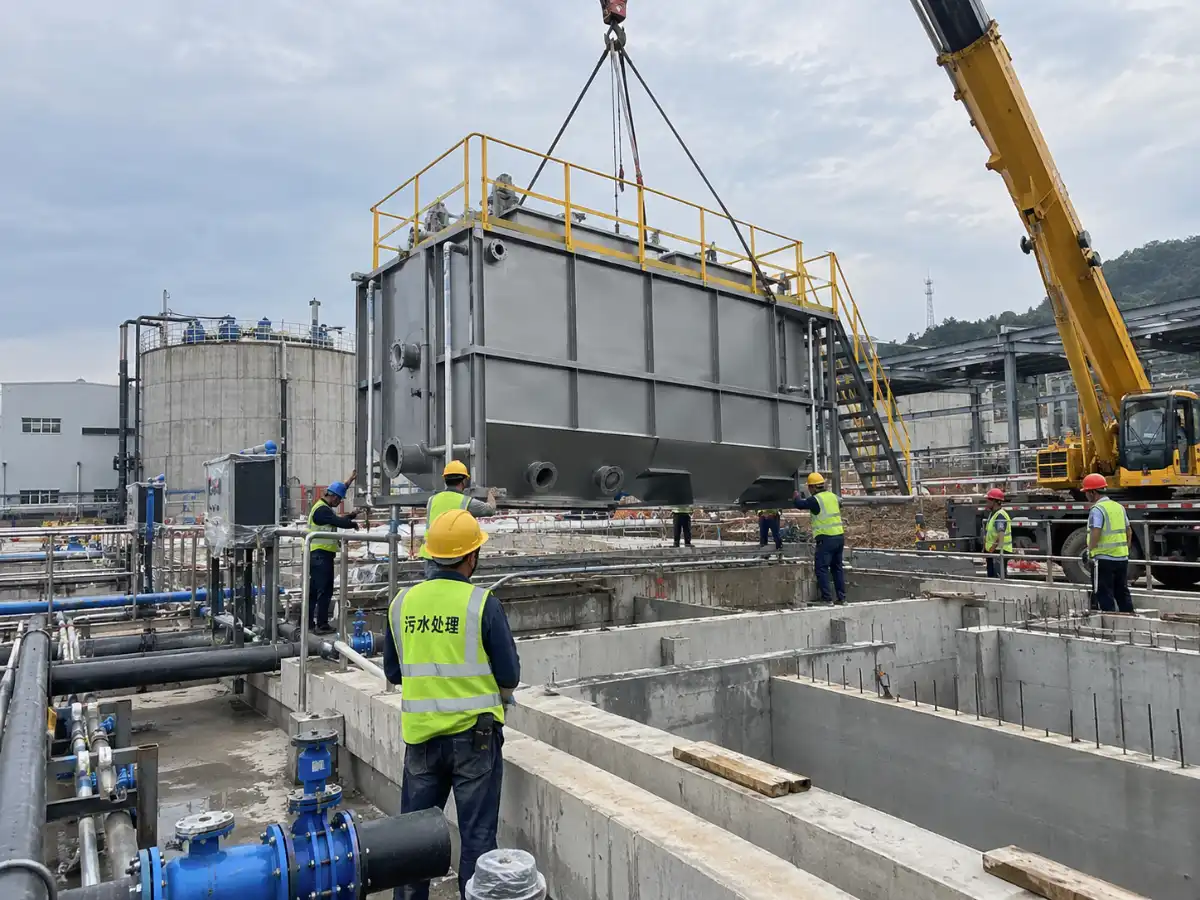
There is no single machine that solves high-salinity wastewater. The realistic approach is a staged train where each stage removes a specific barrier and passes a cleaner stream to the next. Think of it as reducing volume while protecting the most expensive equipment at the back end.
Step 1: Pretreatment and Conditioning
Pretreatment protects everything downstream. Depending on your stream, this typically includes:
- Chemical softening or lime softening to drop calcium and magnesium hardness before thermal or membrane concentration.
- pH adjustment to bring the stream into a range that suits both membrane life and scaling control.
- Removal of suspended solids, oil, and grease through coagulation, flotation, or filtration.
- Heavy metal precipitation if the plant uses catalysts or metal-bearing process streams.
This stage is unglamorous but it decides whether your evaporator runs for years or clogs in months. A well-designed water treatment process front end pays for itself many times over in reduced cleaning frequency.
Step 2: Membrane Concentration
Membranes do the heavy lifting on volume reduction because they are far cheaper to operate per cubic meter than thermal systems. Standard reverse osmosis tops out around 70,000 to 80,000 mg/L TDS, so for high-salinity streams you typically move to high-pressure RO or disc-tube reverse osmosis (DTRO).
DTRO handles higher fouling potential and higher salinity than spiral-wound membranes, which makes it a common choice for chemical and leachate-type streams. A properly configured DTRO membrane system can push concentration well beyond conventional RO limits and cut the volume that reaches the evaporator.
Step 3: Thermal Concentration and Crystallization
Once membranes hit their practical limit, thermal processes take over. This is where most of your operating cost sits, so the selection matters enormously.
| Technology | Typical Use Case | Energy Profile | Key Consideration |
|---|---|---|---|
| Multi-effect evaporator (MEE) | Medium to large flows, steam available | Lower energy per kg with more effects | Needs steam supply; scaling control critical |
| Mechanical vapor recompression (MVC/MVR) | Moderate flows, electricity available | Electric-driven, low external steam | Compressor is the heart; power quality matters |
| Membrane + evaporator hybrid | High salinity with volume reduction goals | Balanced electrical + thermal | Best overall lifecycle cost in many cases |
| ZLD train | Discharge prohibited or heavily restricted | Highest, but often mandatory | Crystallizer and solids handling add complexity |
For plants with cheap steam, a multi-effect evaporator is often the most economical. For plants where steam is scarce but power is reliable, mechanical vapor compression usually wins on operating cost. I have seen both choices go wrong when the site’s actual utility profile was ignored during design.
Choosing Between Evaporator Configurations
The number of effects is a direct trade-off between capital cost and energy consumption. More effects mean better steam economy but higher upfront cost and more footprint.
- A single-effect evaporator is simple and cheap but uses roughly one kilogram of steam per kilogram of water evaporated. It suits small flows or pilot duty.
- A double-effect evaporator roughly halves steam consumption and is a common middle ground for moderate flows.
- A triple-effect evaporator pushes steam economy further and is often the sweet spot for continuous chemical plant brine.
Beyond three or four effects, the marginal energy gain shrinks while capital cost and complexity climb. I rarely recommend going past four effects unless the flow is very large and steam is genuinely expensive.
Rule of thumb from project experience: pick the configuration that matches your utility reality, not the one with the best theoretical steam economy. A triple-effect unit running steadily beats a five-effect unit that nobody can operate.
Energy, Cost, and Lifecycle Thinking
Operating cost in high-salinity treatment is dominated by two things: thermal energy and electricity for compressors or high-pressure pumps. Everything else is secondary.
Indicative ranges I use for early-stage planning (project-dependent, verify with your own utility rates):
- Membrane concentration: roughly 1 to 4 kWh per cubic meter of feed, rising sharply as you approach osmotic limits.
- MVC evaporation: typically 15 to 40 kWh per cubic meter of water evaporated, depending on compressor efficiency and boiling point elevation.
- Multi-effect evaporation: steam consumption drops roughly in proportion to the number of effects, but you must add cooling water and pumping power.
Capital cost is driven by materials of construction, compressor or steam system size, and the solids handling tail end. A realistic cost breakdown for MVR systems shows that the compressor and heat exchangers together can account for more than half the equipment budget, which is why getting the heat exchanger design right matters so much.
Lifecycle cost is where the real decision lives. A cheaper evaporator that fouls every three weeks will cost more over ten years than a well-designed unit with proper scaling control. I always ask clients to model cleaning frequency, chemical use, and downtime into the comparison, not just purchase price.
Scaling, Fouling, and Corrosion: The Real Enemies
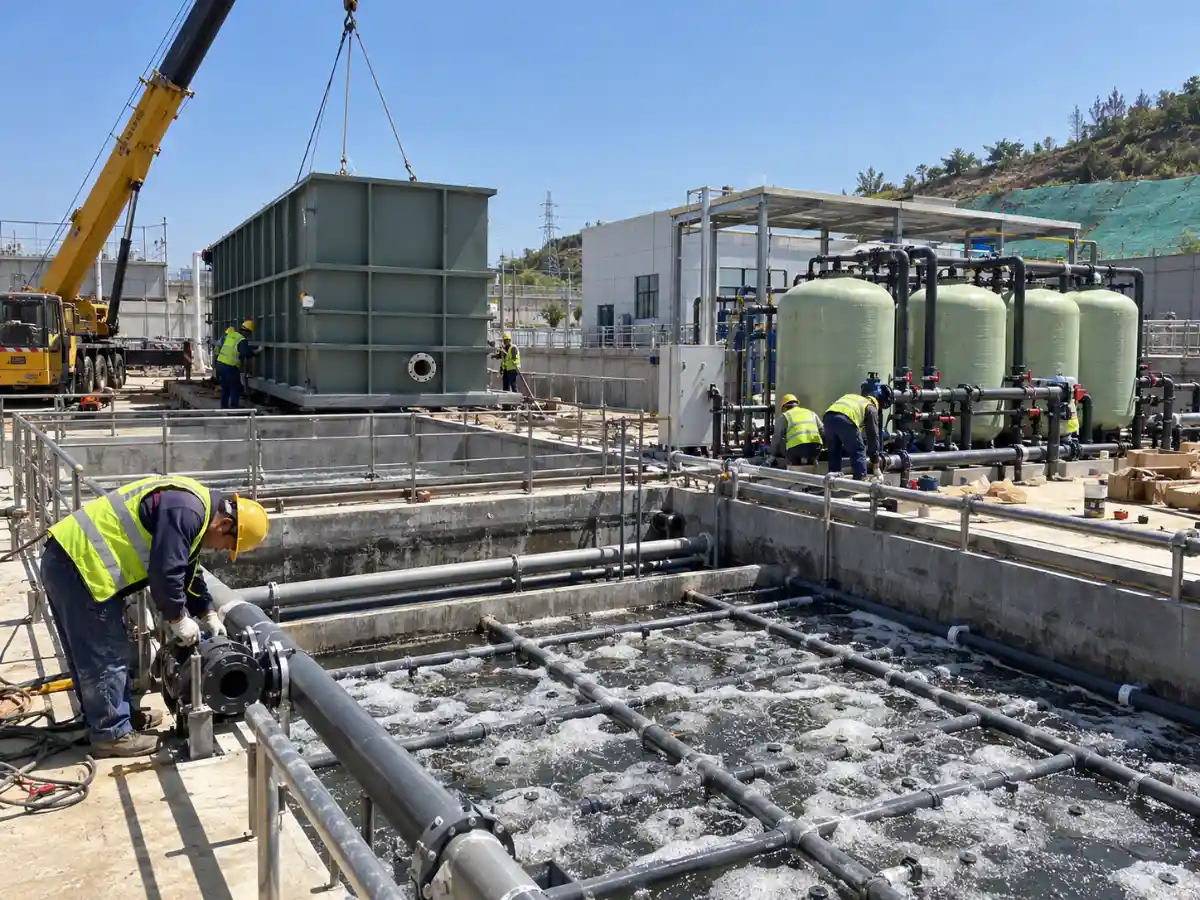
Almost every operational problem I have seen in high-salinity systems traces back to one of three root causes.
Scaling
Calcium carbonate, calcium sulfate, and silica precipitate as concentration and temperature rise. Mitigation includes softening upstream, operating below saturation limits, seeding crystals, and periodic cleaning. In severe cases, a crystallizer or forced-circulation design is the only way to keep surfaces clean.
Fouling
Organics, oils, and biological growth coat heat transfer surfaces and membranes. Antifoam, oxidation, and filtration help, but the most effective control is removing foulants before they reach the sensitive equipment.
Corrosion
High chloride plus high temperature is a corrosion nightmare. Material selection should be based on actual chloride concentration, temperature, and pH, not on general guidance. Duplex and super duplex stainless steels, titanium, and high-alloy grades are common, but each has limits.
For streams that combine salinity with oil, a dedicated approach to oily wastewater evaporation is necessary because oil changes foaming behavior and can foul heat exchangers in ways that standard designs do not anticipate.
When Zero Liquid Discharge Becomes the Only Option
Many chemical plants face discharge limits that make conventional disposal impossible. When that happens, the train ends with a zero liquid discharge system that concentrates brine to a solid or near-solid and recovers water for reuse.
A typical ZLD train looks like this:
- Pretreatment and softening to remove scaling ions.
- Membrane concentration to reduce volume.
- Thermal evaporation to further concentrate brine.
- Crystallization to produce solid salt for disposal or reuse.
- Condensate polishing for water reuse.
ZLD is capital-intensive and energy-hungry, but it eliminates discharge risk and often recovers usable water. In regions where discharge permits are effectively unavailable, it is not a choice, it is a requirement. I have seen plants recover a meaningful fraction of their process water this way, which offsets part of the operating cost.
If your discharge limits are tightening, it is worth reviewing the full wastewater discharge standards that apply to your operation before committing to a design, because the target numbers shape the entire train.
Practical Design and Operating Recommendations
After enough projects, a few principles hold true regardless of the specific chemistry:
- Characterize thoroughly and repeatedly. One sample is never enough. Capture variability across production cycles.
- Protect the expensive equipment. Pretreatment is cheap insurance for membranes and evaporators.
- Match the technology to your utilities. Steam availability, power reliability, and cooling water capacity all matter more than theoretical efficiency.
- Design for cleaning, not just for running. Access, isolation, and cleaning-in-place provisions determine real uptime.
- Plan the solids end from day one. Salt and sludge handling is where projects quietly go over budget.
- Pilot when the chemistry is uncertain. A pilot evaporator or membrane skid costs far less than a failed full-scale installation.
One more thing: operator training and clear standard operating procedures matter as much as equipment quality. I have seen identical systems perform very differently purely because of how well the operating team understood scaling control and cleaning routines.
Need help sizing a treatment train for your brine?
Share your water analysis, flow rate, and discharge limits. We can outline a realistic process configuration and flag the risks before you commit capital.
Case-Style Scenario: Mixed Chemical Brine With High Chloride
A mid-sized chemical facility produced roughly 150 cubic meters per day of brine with TDS around 45,000 mg/L, high chloride, moderate COD from solvents, and calcium hardness that scaled everything it touched. The existing disposal route was becoming too costly and the discharge permit was tightening.
The train we evaluated moved through three stages:
- Softening and pH adjustment to knock down hardness and stabilize the stream.
- DTRO concentration to cut volume by roughly half before thermal treatment.
- MVC evaporation to concentrate the remaining brine, with condensate routed back for reuse.
The key finding was not the equipment selection but the pretreatment. Once hardness and organics were controlled, the evaporator ran with predictable cleaning intervals instead of constant shutdowns. The lesson applies broadly: in high-salinity treatment, the front end determines the back end’s success.
Common Failure Modes and How to Avoid Them
| Failure Mode | Typical Cause | Mitigation |
|---|---|---|
| Rapid scaling on heat exchangers | Insufficient softening, operating above saturation | Upstream softening, saturation monitoring, periodic cleaning |
| Membrane fouling and flux loss | Organics, oils, or biological growth | Better pretreatment, antiscalant dosing, cleaning protocols |
| Compressor vibration or failure | Carryover, liquid entrainment, poor power quality | Proper demister design, stable power supply, vibration monitoring |
| Condensate contamination | Volatile organics or ammonia carryover | Stripping upstream, condensate polishing, better separation |
| Corrosion and pitting | Wrong material for chloride and temperature | Material selection based on actual conditions, not general rules |
Most of these failures are preventable at the design stage. The ones that are not preventable are at least manageable if you build in monitoring and cleaning provisions from the start.
Frequently Asked Questions
What TDS level makes evaporation necessary instead of membranes?
Conventional RO becomes impractical above roughly 70,000 to 80,000 mg/L TDS because osmotic pressure climbs too high. High-pressure RO and DTRO can push further, but once you are dealing with saturated or near-saturated brine, thermal evaporation is usually the practical answer. The exact crossover depends on your specific salt composition and the target concentration.
How do I decide between MVC and a multi-effect evaporator?
Look at your utilities first. If you have reliable, low-cost steam, a multi-effect evaporator often has lower operating cost. If steam is limited but electricity is available and stable, MVC is usually the better fit because it recompresses its own vapor and needs very little external steam. Flow rate, boiling point elevation, and scaling tendency also shift the answer.
How often will an evaporator need cleaning on high-salinity brine?
That depends almost entirely on pretreatment quality and scaling chemistry. With good softening and saturation control, cleaning intervals can stretch to weeks or months. Without it, you may be cleaning weekly. I always recommend designing for the worst realistic case and then improving from there.
Is zero liquid discharge always required for chemical plant brine?
No. ZLD is required only when discharge limits or local regulations prohibit liquid disposal, or when water reuse economics justify it. Many plants operate successfully with membrane and evaporator concentration plus permitted discharge or offsite disposal of concentrated brine. The decision is regulatory and economic, not technical preference.
What pretreatment is essential before a thermal evaporator?
At minimum, remove suspended solids and control hardness and silica to below their scaling thresholds at the maximum concentration and temperature the evaporator will see. If organics or volatiles are present, address those too, because they affect foaming, fouling, and condensate quality. Skipping pretreatment is the most common and most expensive mistake in high-salinity treatment.
Can I reuse the condensate from evaporation?
Often yes, but it depends on volatile content. Clean condensate can typically be reused as process water or boiler feed makeup after polishing. If ammonia, light organics, or acids carry over, you need stripping or additional treatment before reuse. Condensate quality should be part of the original design basis, not an afterthought.
What is the biggest cost driver in a high-salinity treatment project?
Energy and materials of construction. Thermal energy or compressor power dominates operating cost, while corrosion-resistant alloys drive capital cost. The compressor and heat exchangers are typically the largest single equipment items in an MVC system. Getting the heat exchanger design and material selection right has the biggest impact on both capital and long-term reliability.
High-salinity wastewater treatment in chemical plants is a systems problem, not an equipment problem. The plants that succeed are the ones that characterize their stream honestly, protect their expensive equipment with solid pretreatment, and choose technologies that match their real utility and regulatory situation. Get those three things right, and the rest of the design follows.