

If you’re dealing with landfill leachate, you already know the problem: it’s dark, it smells, it’s loaded with ammonia, salts, and organics that shift with every rainfall and every new cell you open. A containerized DTRO system handles this by putting disc-tube reverse osmosis membranes inside a skid-mounted, factory-built unit that can be trucked in, bolted down, and started up in weeks rather than seasons. I’ve commissioned these units on sites where the leachate quality changed so fast that a fixed concrete plant would have been obsolete before the concrete cured. The container format lets you match capacity to the actual waste you have, not the waste you predicted five years ago.
What Makes Landfill Leachate So Hard to Treat
Leachate is not one wastewater. It’s a moving target. A young landfill produces leachate high in volatile fatty acids, with BOD often exceeding 10,000 mg/L and a pH that can sit below 6. An older, stabilized landfill flips the ratio: BOD drops, COD stays stubbornly high, and ammonia-nitrogen climbs into the 1,500–3,000 mg/L range. Add chloride from road salt and industrial dumping, plus heavy metals and trace organics, and you have a stream that breaks conventional biological treatment.
I’ve watched activated sludge systems get shocked into failure after a single heavy rain event diluted the feed and washed out the biomass. The biology is simply too fragile for this kind of variability. That’s the core reason membrane-based and thermal processes dominate leachate treatment today. They don’t care whether the bugs are happy.
For a deeper look at what’s actually dissolved in this stuff, the chemistry breakdown here is worth reading before you size anything.
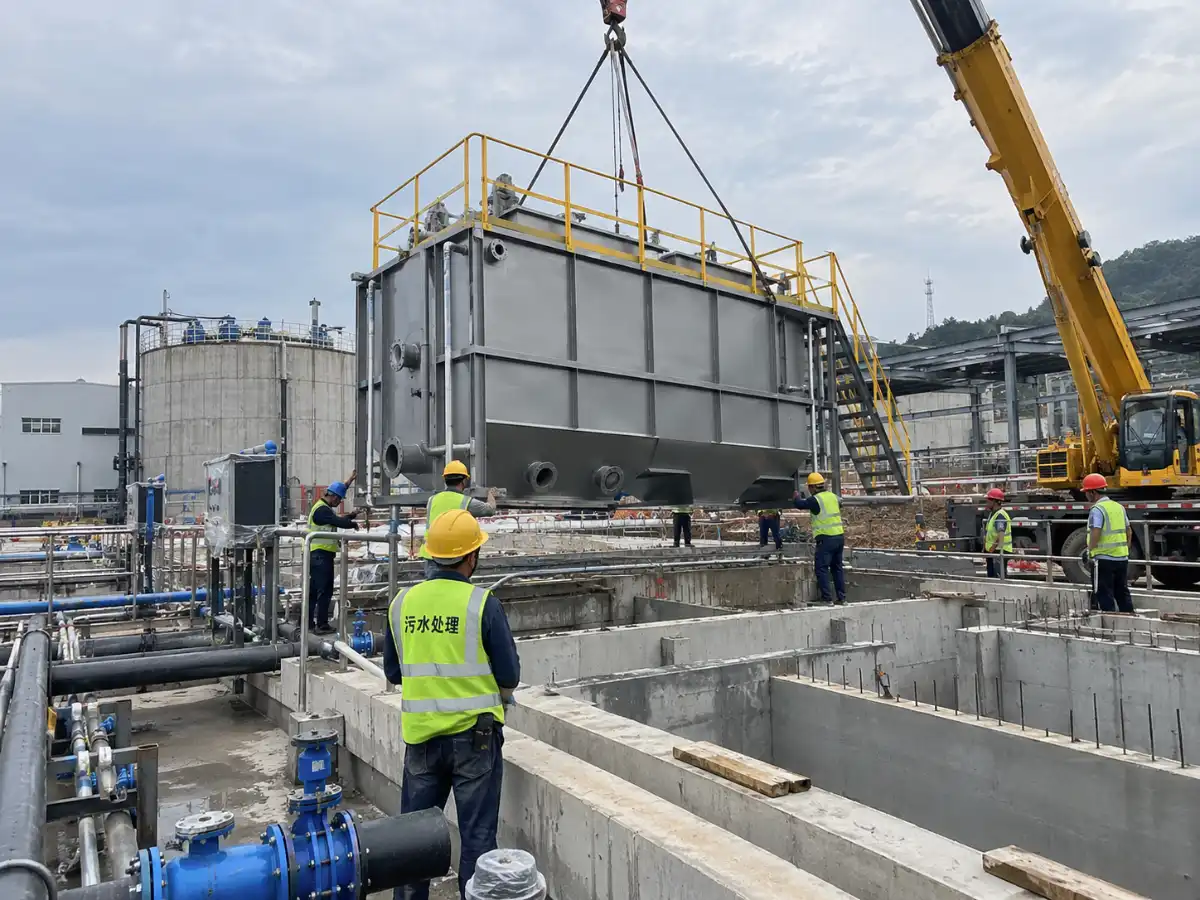
Why Containerized DTRO Beats Traditional Leachate Plants
DTRO stands for disc-tube reverse osmosis. Instead of the flat spiral-wound membranes you see in standard RO, the membrane sits in a disc stack with an open channel on the feed side. That open channel is the whole point. Leachate fouls membranes fast, and a conventional spiral element with a 28-mil feed spacer will plug within days. The disc-tube design tolerates suspended solids, scaling, and high concentration factors that would kill a spiral system.
The Concentration Factor Advantage
Here’s the number that matters: a DTRO train can concentrate leachate 4x to 6x before you need to deal with the reject. Some well-designed two-stage systems push higher. That means if you’re feeding 100 m³/day, you’re only managing 15–25 m³/day of concentrate. Compare that to a conventional RO that tops out around 75–80% recovery and leaves you with a much larger reject stream to evaporate or haul away.
Containerization Solves Real Site Problems
Landfills are rarely blessed with flat, serviced land next to a power drop. A containerized unit arrives on a flatbed, gets set on a prepared pad, and connects to power, feed, and drain. I’ve seen 40-foot containers hold a complete two-stage DTRO train with pre-treatment, chemical dosing, and controls. Everything is tested at the factory before it ships, which means commissioning is mostly about piping and power, not debugging a prototype.
If you want to see the membrane platform these systems are built on, the DTRO membrane system overview covers the disc stack architecture in detail.
How a Containerized DTRO Train Is Put Together
Let me walk through the actual sequence, because the order matters and skipping a step is how projects fail.
Pre-Treatment
Raw leachate hits a screening or settling step first. You’re removing grit, trash, and anything that will wrap around a pump impeller. Next comes chemical conditioning: pH adjustment to keep metals in solution or precipitate them out, plus antiscalant dosing. Some designs add a softening step if hardness is high enough to threaten the membranes. I’ve seen projects skip softening to save capital and then pay for it in membrane replacements within eighteen months.
First-Stage DTRO
The feed enters the disc-tube stack at 40–75 bar, depending on the osmotic pressure of your particular leachate. Permeate passes through the membrane; concentrate stays behind and recirculates. The first stage does the heavy lifting, removing the bulk of salts and organics. Permeate quality here is typically good enough that a second stage is polishing rather than rescuing.
Second-Stage DTRO
The first-stage permeate goes through a second, tighter membrane set. This is where you get the final polish to meet discharge limits or reuse quality. Two-stage systems routinely hit 85–90% overall recovery on leachate, and with careful design you can push toward 95% before the concentrate becomes unmanageable.
Concentrate Handling
This is the part nobody likes to talk about at the sales meeting. You still have a concentrate stream. On a 100 m³/day plant running 90% recovery, that’s 10 m³/day of brine with maybe 5–8% total dissolved solids. Your options are evaporation, solidification, or off-site disposal. Evaporation is usually the long-term economic answer, and that’s where thermal systems come in.
| Parameter | Typical Design Range | Notes |
|---|---|---|
| Feed COD | 2,000–15,000 mg/L | Highly dependent on landfill age |
| Feed ammonia-N | 500–3,000 mg/L | Rises as landfill stabilizes |
| Operating pressure | 40–75 bar | Set by osmotic pressure |
| System recovery | 80–90% | Two-stage; project-dependent |
| Concentration factor | 4x–6x | Before concentrate handling |
| Permeate TDS | Under 1,000 mg/L | With proper pre-treatment |
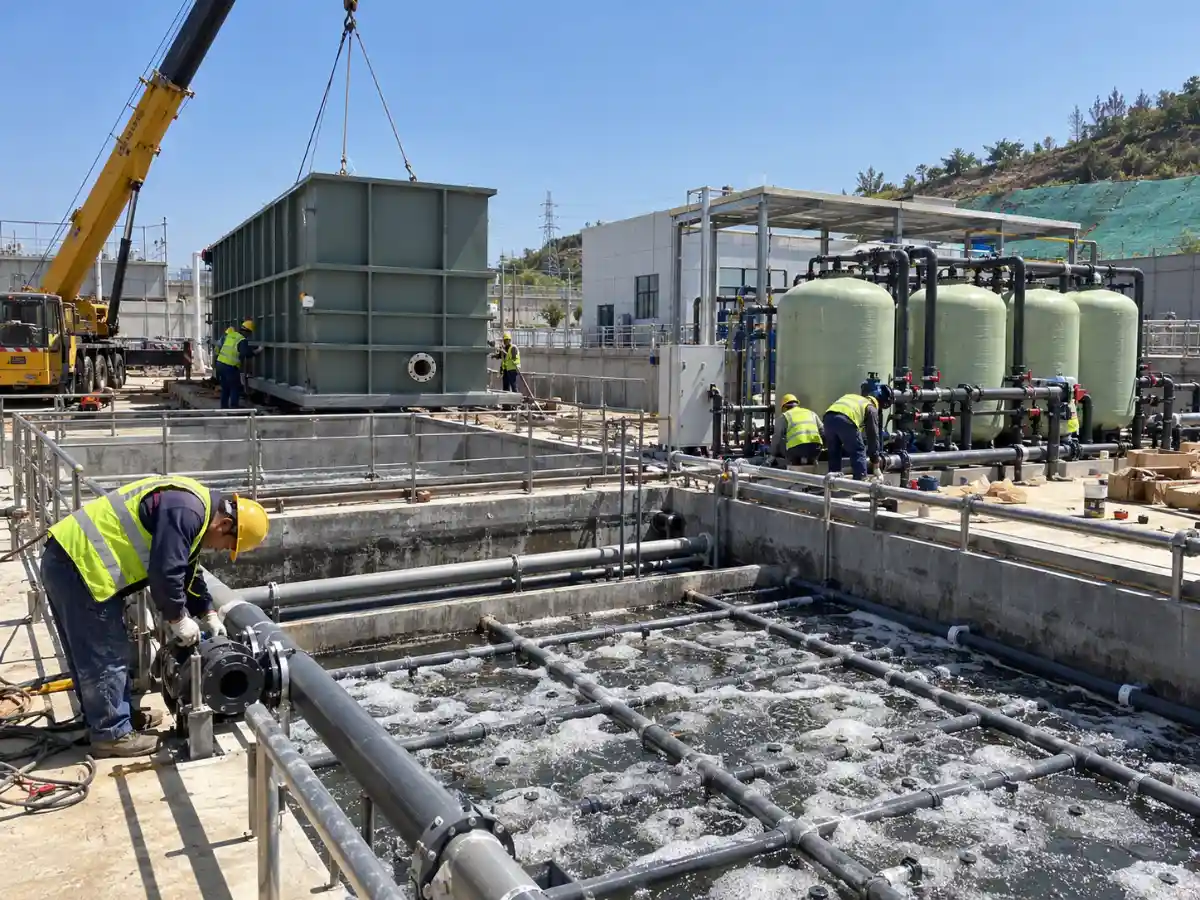
Matching DTRO With Evaporation for Near-Zero Discharge
When disposal costs for concentrate climb, or when you simply can’t truck brine off-site anymore, evaporation closes the loop. The concentrate from a DTRO train is a perfect feed for a thermal evaporator because it’s already reduced in volume and relatively clean of suspended solids.
Mechanical vapor compression (MVC) is my usual recommendation for this duty. The compressor recompresses the vapor boiled off the concentrate and reuses it as the heating medium. Energy consumption lands in the range of 20–40 kWh per cubic meter of distillate, which is far better than a single-effect evaporator running on live steam. For a leachate plant, the MVC evaporator design handles the scaling and foaming that leachate concentrate throws at it, provided you’ve done the pre-treatment honestly.
If you have waste heat available — say from a landfill gas engine — a multi-effect arrangement can make more sense. Three effects cut steam consumption to roughly a third of a single effect. But you need the steam, and most landfills don’t have it. That’s why MVC dominates this application.
Combining the Two
The classic near-zero-liquid-discharge (ZLD) train for leachate looks like this:
- Pre-treatment: screening, pH adjustment, antiscalant
- Two-stage DTRO: 85–90% recovery to permeate
- MVC evaporation: concentrate reduced to a solid or near-solid brine
- Solidification or crystallization: final disposal of salts
Permeate from the DTRO stage is usually clean enough to discharge or reuse for dust control on the landfill itself. Distillate from the evaporator is essentially distilled water. The only waste leaving the site is a small volume of dry salt or solidified brine. If that’s your target, a ZLD system approach ties the two stages together with proper buffer tanks and controls.
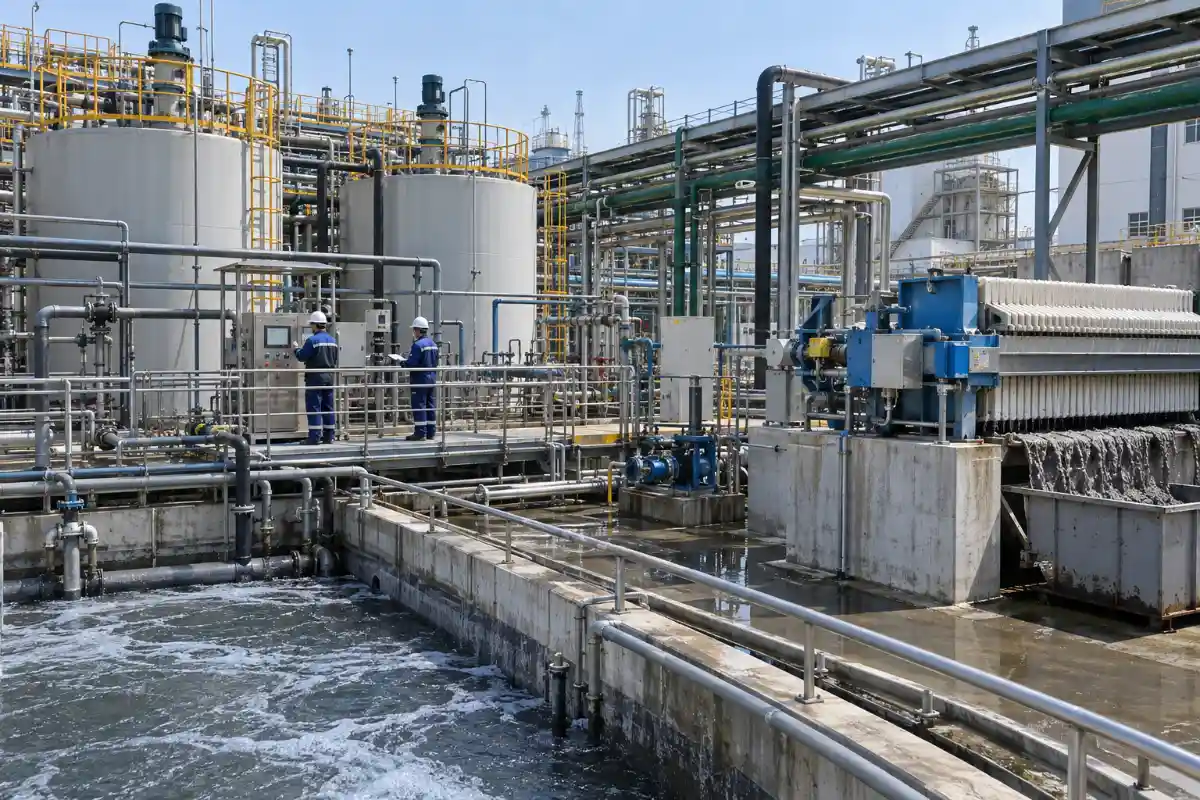
Energy, Cost, and the Real Numbers
Let’s talk money, because that’s what decides whether a project moves forward.
Capital Cost Drivers
The containerized DTRO skid itself is the smaller part of the budget. The big-ticket items are pre-treatment, the concentrate handling system, and site work. A 100 m³/day two-stage containerized DTRO train might land in the range of $400,000–$800,000 installed, depending on pre-treatment complexity and whether you’re adding evaporation. A full ZLD train with MVC evaporation can push total capital to two to three times the membrane-only number.
Operating Cost Reality
Electricity is the dominant operating cost for DTRO. High-pressure pumps on a two-stage system draw real power — figure 8–15 kWh per cubic meter of feed for the membrane stage alone. Add MVC evaporation at 20–40 kWh per cubic meter of distillate and your energy bill gets serious. Chemicals for cleaning and antiscalant add another few dollars per cubic meter. Membrane replacement is the wild card: DTRO discs last two to four years in leachate service if pre-treatment is solid, and half that if it isn’t.
| Cost Component | Indicative Range | Influencing Factors |
|---|---|---|
| DTRO energy | 8–15 kWh/m³ feed | Pressure, recovery, pump efficiency |
| MVC evaporation energy | 20–40 kWh/m³ distillate | Concentration, compressor type |
| Membrane replacement | 2–4 year cycle | Pre-treatment quality, cleaning frequency |
| Chemical cost | $1–4/m³ | Antiscalant, cleaning agents, pH control |
| Concentrate disposal | Highly variable | Local regulations, hauling distance |
These are indicative ranges. Your actual numbers depend on leachate strength, local power rates, and how disciplined you are about pre-treatment. I’ve seen plants run 30% over budget on energy because nobody checked the feed pressure setpoint against the actual osmotic pressure after a year of operation.
Maintenance and the Failures I See Most Often
Containerized systems are not maintenance-free. They’re maintenance-concentrated. Everything is in one box, which makes it easy to service but also means a failure in one subsystem can shut the whole train down.
Membrane Fouling and Scaling
This is the number one issue. Leachate carries calcium, magnesium, silica, and organics that deposit on the membrane surface. The disc-tube design tolerates more fouling than spiral-wound, but it still fouls. Typical cleaning frequency is every two to four weeks, using a caustic wash followed by an acid wash. If you’re cleaning weekly, your pre-treatment is failing and you need to fix that, not clean more often.
High-Pressure Pump Wear
These pumps run continuously at 40–75 bar. Seals and check valves wear. I recommend keeping a full seal kit and valve set on site. The downtime from waiting on a $200 seal is far more expensive than the seal itself.
Antiscalant Dosing Failures
A failed dosing pump is a silent killer. The system keeps running, the membranes keep scaling, and you don’t find out until recovery drops and pressures climb. Install a flow verification on the dosing line and alarm it. This one change prevents more membrane damage than any other single fix.
Compressor Maintenance on MVC Units
If you’re running evaporation, the compressor is the heart of the system. It needs regular oil changes, vibration monitoring, and impeller inspection. On leachate duty, entrainment of fine droplets can erode impellers faster than expected. A well-designed mist eliminator upstream of the compressor is not optional.
In my experience, the projects that run smoothly for a decade are the ones where the operations team was involved in design review. The projects that fail are the ones where the vendor handed over a manual and walked away.
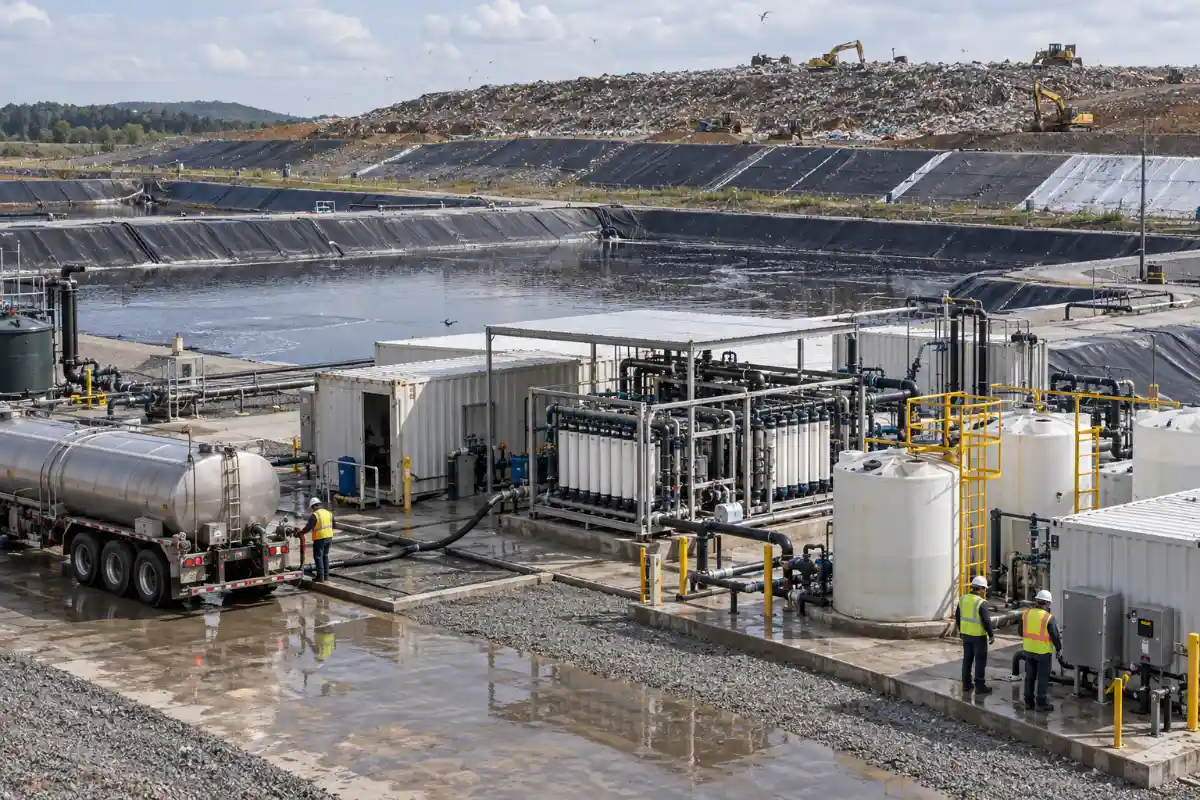
Selection Logic: When Containerized DTRO Makes Sense
Not every landfill needs this. Here’s how I think about it.
Choose containerized DTRO when:
- Leachate quality is variable and biological treatment is unreliable
- Site space is limited or land is expensive
- You need fast deployment — months, not years
- Discharge limits are tight, especially for ammonia and salts
- You want the option to relocate the unit as landfill cells close
Consider alternatives when:
- Leachate is dilute and consistent — conventional biological treatment may be cheaper
- You have abundant low-cost land and time for a concrete plant
- Discharge limits are loose and volume is small
The containerized format also shines when you’re dealing with multiple landfill sites under one operator. You can build a standard design, deploy it where the need is greatest, and move it later. That flexibility has real value that doesn’t show up in a simple capital cost comparison.
For projects that need a tighter integration of membrane and thermal stages, pre-packaged treatment systems are worth evaluating against a fully custom build.
Engineering Trade-Offs You Should Know About
Recovery vs. Concentrate Volume
Pushing recovery higher reduces concentrate volume but increases osmotic pressure, scaling risk, and energy consumption. There’s a sweet spot for every leachate, usually between 80% and 90%. Above that, the marginal cost of concentrate handling often exceeds the savings from reduced volume.
Membrane Life vs. Pre-Treatment Cost
More pre-treatment costs more capital and more operating complexity. But it extends membrane life and reduces cleaning frequency. I’ve seen projects cut pre-treatment to save 10% on capital and then spend 40% more on membrane replacements over five years. Do the lifecycle math, not the capital math.
Container Size vs. Redundancy
A single 40-foot container is efficient but has no redundancy. If you need 99% uptime, you’re looking at either a spare train or a modular design with parallel skids. For most landfill applications, a single train with good spare parts inventory is acceptable. For sites with strict discharge permits and no holding capacity, redundancy is not optional.
Automation Level
Fully automated systems reduce labor but add sensors, PLCs, and complexity. On remote sites, I lean toward robust automation with remote monitoring, because sending a technician out for every alarm is expensive. But I keep critical controls local, because a network outage should not shut down your treatment plant.
Frequently Asked Questions
How much does a containerized DTRO system cost?
For a 100 m³/day two-stage system, expect $400,000–$800,000 installed, depending on pre-treatment and whether you include evaporation. A full ZLD train with MVC evaporation can run two to three times that. These are indicative ranges; your actual cost depends on leachate strength, site conditions, and local labor rates.
How long does installation take?
A containerized unit can be set and connected in two to four weeks if the site pad, power, and piping are ready. Factory testing before shipment eliminates most commissioning surprises. Compare that to 12–18 months for a conventional concrete plant.
What maintenance is required?
Membrane cleaning every two to four weeks, high-pressure pump seal and valve inspection quarterly, antiscalant dosing verification continuously, and compressor maintenance if you’re running evaporation. Keep spare membranes, seals, and valves on site.
Can DTRO handle ammonia in leachate?
Yes. Reverse osmosis rejects ammonia ions effectively, provided the pH is managed so ammonia stays in its ionic form. At high pH, ammonia becomes a gas and passes through the membrane. pH control upstream of the membrane is essential.
What happens to the concentrate?
Options are evaporation, solidification, or off-site disposal. Evaporation with MVC is the most common long-term solution because it reduces concentrate to a small volume of dry salt or brine. The choice depends on local disposal costs and regulations.
How long do DTRO membranes last?
Two to four years in leachate service with good pre-treatment. Poor pre-treatment, frequent pH excursions, or failed antiscalant dosing can cut that to a year or less. Membrane life is a direct function of how well you protect them.
Is containerized DTRO suitable for small landfills?
It can be, but the economics favor larger sites. For very small volumes, a simpler treatment train or off-site disposal may be more cost-effective. The container format does allow you to start small and add capacity as the landfill grows.
What pre-treatment is required?
At minimum: screening or settling to remove gross solids, pH adjustment, and antiscalant dosing. If hardness or silica is high, add softening. If oil and grease are present, add separation. The pre-treatment train is where most project failures originate.
Final Thoughts
Containerized DTRO systems work because they accept reality: leachate is variable, sites are constrained, and timelines are short. The technology is proven, the disc-tube design handles fouling better than anything else in its class, and the container format gets you operational fast. But none of that matters if you skip pre-treatment, ignore concentrate handling, or treat maintenance as an afterthought.
The projects I’ve seen succeed share a pattern. The owner understood the leachate chemistry before sizing the plant. The design included realistic concentrate management from day one. The operations team was trained on the actual equipment, not a generic manual. And the system was instrumented well enough to catch problems before they became failures.
If you’re planning a leachate treatment project and want to talk through the design trade-offs, reach out to our engineering team. We’ve commissioned these systems on sites where nothing went according to plan, and we can help you avoid the mistakes that cost the most.