

If you’re dealing with brine that sits above 30,000 mg/L TDS, a multi-effect evaporator is usually the most energy-efficient way to concentrate it before disposal or crystallization. I’ve designed and commissioned these systems for more than a decade, and the pattern is always the same: the more effects you run, the less steam you buy — but the more you pay in capital, fouling risk, and operating complexity. A multi-effect evaporator reuses the vapor from one stage to boil the next, so a triple-effect unit can cut steam demand to roughly one-third of a single-effect system. The catch is that high-TDS wastewater rarely behaves like clean water. Scaling salts, organics, and foaming agents all push back on the textbook numbers. This article walks through how I actually size, select, and operate multi-effect evaporators for high-TDS duty, and where the real trade-offs live.
What Makes High-TDS Wastewater Different
High-TDS wastewater is not just concentrated water. The dissolved solids change the physical properties that every evaporator calculation depends on: boiling point elevation, viscosity, density, specific heat, and heat transfer coefficient. At 20,000 mg/L TDS, boiling point elevation is modest. Push past 200,000 mg/L and you can lose 8–15 °C of effective temperature difference across the heating surface. That directly reduces capacity unless you compensate with more surface area or higher driving temperature.
The second issue is scaling. Calcium, magnesium, silica, sulfate, and carbonate salts all have inverse solubility or near-solubility limits that get exceeded as concentration rises. Once you cross saturation, scale deposits on the heat transfer surface, and a 1 mm scale layer can cut the overall heat transfer coefficient by 10–20%. In high-TDS service, fouling control is not a maintenance detail — it is a design constraint.
The third issue is foaming and organic load. Landfill leachate, pharmaceutical mother liquor, and some chemical plant brines carry surfactants and volatile organics that foam in the boiling chambers, carry over into the vapor, and contaminate condensate. This is why pretreatment selection matters as much as the evaporator body itself.
How a Multi-Effect Evaporator Actually Works
A multi-effect evaporator arranges several boiling stages in series. Steam enters the first effect and heats the liquor, producing vapor. That vapor — still carrying latent heat — becomes the heating medium for the second effect, which boils at a lower pressure and therefore a lower temperature. The chain continues through each effect. Only the first effect needs fresh steam; the rest run on recycled vapor.
The practical result is a steam economy roughly equal to the number of effects, minus losses. A single-effect unit needs about 1.1 kg steam per kg evaporated water. A double-effect is around 0.55–0.6, a triple-effect around 0.38–0.42, and a quadruple-effect can reach 0.3 or lower. In regions with expensive steam, that difference pays back the extra capital quickly. In regions with cheap steam or unstable power, it may not.
There are two main configurations:
- Forward feed — liquor flows in the same direction as steam. Simple, low pumping, but the last effect handles the most concentrated and most viscous liquid at the lowest temperature. Good for scaling-prone streams where you want the hottest effect to see the dilute feed.
- Backward feed — liquor flows opposite to steam. Higher pumping demand, but the concentrated liquor stays hot, which keeps viscosity down. Better for high-viscosity or high-boiling-point-elevation brines.
Mixed and parallel feed arrangements exist for specific duties, but forward and backward cover most industrial high-TDS cases.
Effect Count Selection: Where the Real Trade-Off Sits
Effect count is the single biggest design decision. More effects mean lower steam consumption but higher capital cost, larger footprint, more pumps, more instrumentation, and more fouling surface to manage. The optimum depends on steam price, electricity price, operating hours, and how much the stream fouls.
| Configuration | Typical steam economy (kg evap / kg steam) | Indicative steam demand vs single-effect | Typical use case |
|---|---|---|---|
| Single-effect | ~0.9–1.0 | 100% | Small flow, intermittent duty, cheap steam |
| Double-effect | ~1.7–1.9 | ~55% | Medium flow, moderate scaling |
| Triple-effect | ~2.4–2.7 | ~38% | Continuous high-TDS duty, expensive steam |
| Quadruple-effect | ~3.0–3.4 | ~30% | Large flow, low scaling, stable steam supply |
These are indicative ranges. Real numbers shift with boiling point elevation, heat losses, condensate flashing, and whether you use thermal or mechanical vapor recompression on top of the effect train. I’ve seen triple-effect systems deliver 2.2 kg/kg on a scaling brine and 2.9 kg/kg on a clean one — same hardware, different feed chemistry.
One more point that gets missed: beyond four or five effects, the marginal steam savings get small, but the temperature drop per effect gets very tight. If your total available temperature difference is only 40 °C, a quadruple-effect train leaves roughly 10 °C per effect. Add 8 °C of boiling point elevation and you have almost nothing left to drive heat transfer. That is why very high-TDS brines often top out at three or four effects regardless of steam price.
MVR vs Multi-Effect: When to Choose Which
Mechanical vapor recompression (MVR) is the main alternative to a multi-effect train. Instead of cascading vapor through effects, MVR compresses the vapor from a single body and reuses it as the heating medium. It runs on electricity, not steam, and achieves steam economy equivalent to a very large number of effects — often 8 to 15 in equivalent terms.
The choice usually comes down to three factors:
- Steam availability. If you have no steam boiler and no cheap waste heat, MVR is almost always the better fit.
- Electricity cost and reliability. MVR compressors are power-hungry. A 10 t/h evaporation duty can draw 1–2 MW. If power is expensive or unstable, multi-effect wins.
- Turndown and scale. Multi-effect trains tolerate wide flow turndown better and can be built with more fouling-resistant geometry per effect. MVR compressors lose efficiency at low load.
In practice, many high-TDS projects use a hybrid: a multi-effect train for the bulk concentration step, followed by an MVC evaporator or crystallizer for the final volume reduction. This splits the duty where each technology is strongest.
If you want to go deeper on the compression side, the MVR technology overview covers compressor types, sealing, and control philosophy in more detail than I can fit here.
Heat Exchanger Design for Scaling Brines
The heat exchanger is where multi-effect evaporators succeed or fail. Falling film, rising film, and forced circulation are the three common geometries, and each has a clear niche in high-TDS service.
Falling Film
Liquid flows down the inside of tubes as a thin film, heated by steam on the shell side. Low residence time, low pressure drop, good for heat-sensitive streams. Weakness: if the film breaks or dries out, you get localized scaling fast. Needs good liquid distribution and generous recirculation.
Rising Film
Liquid boils inside vertical tubes, and the generated vapor lifts the mixture upward. Simple and self-circulating. Weakness: high boiling point elevation and high viscosity reduce circulation, and the tubes can foul on the hot wall. Less common in modern high-TDS designs.
Forced Circulation
A pump drives the liquor through the tubes at 1.5–3 m/s, which suppresses boiling on the tube wall and keeps crystals suspended. This is the workhorse for scaling and crystallizing brines. It costs more in pumping power and needs larger tubes, but it tolerates supersaturation far better than film-type designs.
Material selection matters here too. For chloride-rich brines, I default to duplex stainless or titanium for wetted surfaces, with higher-alloy grades where temperature and chloride concentration push the pitting resistance equivalent number past safe limits. For sulfate-rich streams, 316L often works, but verify with the actual ionic composition — not a TDS number alone.
For a closer look at how heat exchanger geometry interacts with evaporator performance, the heat exchanger design notes walk through tube-side versus shell-side trade-offs.
Pretreatment: The Step Most Projects Underestimate
I have never seen a multi-effect evaporator fail because the effect count was wrong. I have seen several fail because pretreatment was undersized. High-TDS wastewater almost always needs at least three pretreatment steps before it reaches the first effect:
- Solids removal — fine filtration or clarification to protect spray nozzles and prevent deposit buildup.
- Hardness and silica control — chemical softening, ion exchange, or seeded slurry crystallization depending on the scaling species.
- Deaeration and pH adjustment — to control corrosion and volatile carryover.
For streams with high organic content, an upstream oxidation or biological step often pays for itself by reducing foaming and COD in the condensate. In landfill leachate duty, for example, the organic load is high enough that a membrane or biological step before evaporation changes the whole operating cost picture.
Where the feed TDS is high but the flow is moderate, a DTRO membrane system can pre-concentrate the stream, cutting the evaporator duty by 40–60% and reducing both capital and operating cost. This is a common arrangement in leachate and reverse osmosis concentrate service.
Operating Parameters That Actually Matter
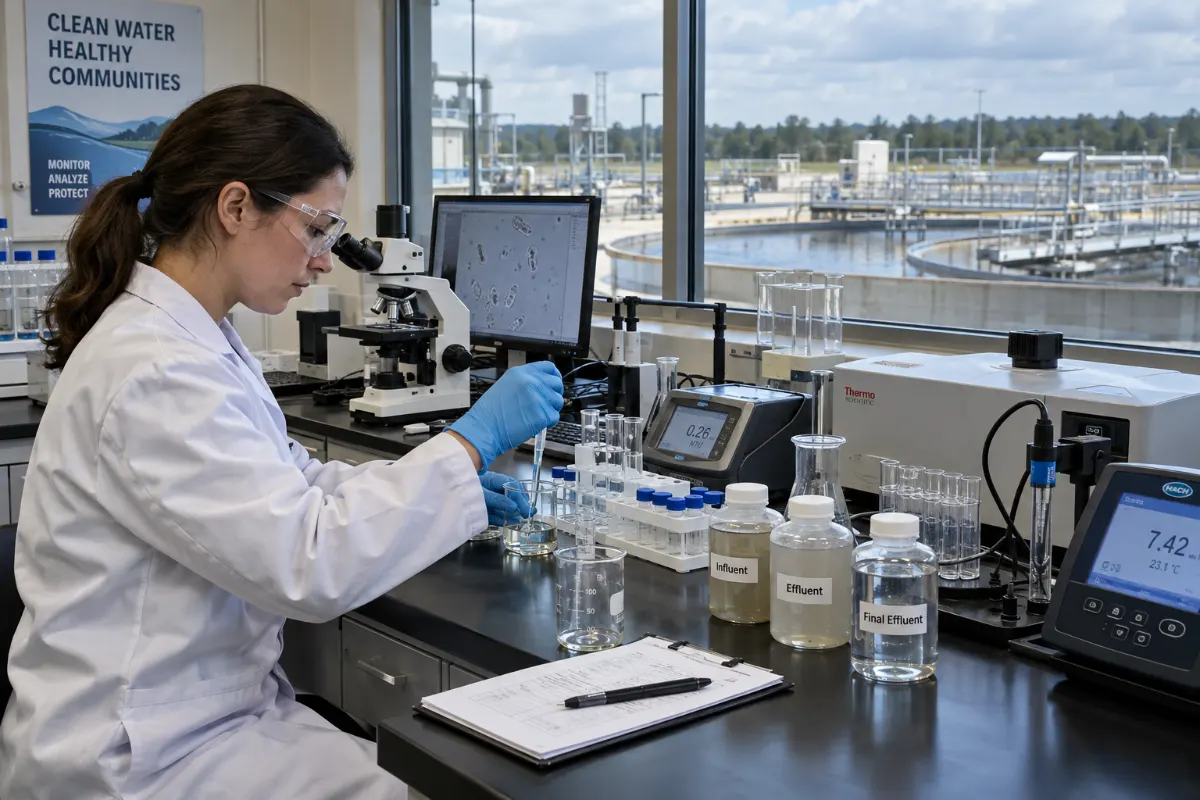
Once the system is running, a handful of parameters drive performance and reliability. I track these on every site:
| Parameter | Typical target range | Why it matters |
|---|---|---|
| First-effect temperature | 90–110 °C (project-dependent) | Higher temperature improves heat transfer but accelerates scaling and corrosion |
| Last-effect temperature | 45–60 °C | Set by condenser vacuum and cooling water temperature |
| Concentration factor | 3–10x feed TDS (project-dependent) | Higher factor means less volume but more scaling risk |
| Circulation velocity (forced circulation) | 1.5–3 m/s | Below 1.5 m/s, wall boiling and scaling increase sharply |
| Condensate conductivity | < 50 µS/cm typical | Rising value signals carryover or tube leak |
| Overall heat transfer coefficient | Declining trend is the key signal | A 15–20% drop over a run cycle usually means it’s time to clean |
The single most useful diagnostic is the trend of the overall heat transfer coefficient. If it drops steadily over a two-week run, you have a fouling problem. If it drops suddenly, you likely have a tube leak, a pump issue, or a feed chemistry change. Watching the trend, not the absolute value, tells you what’s happening.
Energy and Lifecycle Cost Logic
Multi-effect evaporators are capital-heavy and energy-light compared to single-effect designs. The lifecycle cost calculation has four main components:
- Capital cost — grows roughly linearly with effect count for the evaporator body, plus a step increase for the first effect (highest temperature and pressure duty) and the condenser.
- Steam cost — falls with effect count. At $20–40 per tonne of steam, this dominates operating cost in most regions.
- Electricity cost — pumps, vacuum systems, and any MVR assist. Rises modestly with effect count.
- Maintenance and cleaning — grows with effect count because there are more surfaces to foul and more downtime to schedule.
The break-even effect count depends heavily on the ratio of steam price to electricity price and on annual operating hours. For a plant running 8,000 hours per year with steam at $25/tonne, a triple-effect system usually beats a double-effect within two to three years. For a plant running 2,000 hours per year, the extra capital rarely pays back.
I always run this calculation with the client’s actual utility prices, not generic assumptions. The difference between a good and bad effect-count decision is often just getting the local steam and power numbers right.
If you’re comparing evaporator options and want to see how capital and operating cost drivers break down, the cost driver analysis is a useful reference for framing the trade-offs.
Common Failure Modes and How to Avoid Them
After commissioning dozens of these systems, I’ve seen the same failure patterns repeat. Here are the ones that cost the most money:
Scaling on the First Effect
The first effect runs hottest, so it fouls first. If your cleaning cycle is driven by first-effect performance, you’re already behind. Mitigation: keep first-effect temperature as low as the duty allows, use forced circulation, and dose antiscalant based on measured supersaturation — not a fixed ppm.
Foaming and Carryover
Foam in the boiling chamber carries liquid droplets into the vapor line, contaminating condensate and eventually the downstream treatment. Mitigation: adequate vapor space, mist eliminators, antifoam dosing, and — most importantly — reducing surfactant load in pretreatment.
Condenser Vacuum Loss
The last effect depends on vacuum to boil at low temperature. A fouled condenser, air leak, or cooling water temperature rise kills the vacuum and the whole train loses capacity. Mitigation: monitor vacuum continuously, maintain the ejector or vacuum pump, and design condenser surface with margin.
Pump Cavitation in Forced Circulation
Hot, high-TDS liquor has a low net positive suction head margin. Pumps cavitate, lose flow, and the tubes foul. Mitigation: generous suction head, low-speed pumps, and correct impeller selection for the actual density and vapor pressure.
Condensate Contamination
A tube leak or carryover sends salts into the condensate, which then goes to the wrong place. Mitigation: online conductivity monitoring on each effect’s condensate, with automated diversion to a holding tank on alarm.
Integration with ZLD and Downstream Systems
Multi-effect evaporators rarely stand alone. In zero liquid discharge (ZLD) schemes, they typically sit between a membrane pre-concentration step and a crystallizer. The evaporator’s job is to reduce volume to the point where the crystallizer can handle the remaining brine economically.
Getting the interface right matters. The evaporator should deliver a consistent concentration and temperature to the crystallizer, because crystallizer performance is sensitive to both. If the evaporator’s outlet concentration swings, the crystallizer either starves or floods, and product quality suffers.
For projects targeting full ZLD, the ZLD system architecture overview shows how evaporators, crystallizers, and membrane stages are typically sequenced. The key design decision is where to place the evaporator in the train — before or after the membrane — and that depends on the scaling behavior of the concentrate.
One practical note: if the final brine contains high chloride and the crystallizer runs hot, material selection for the evaporator discharge line and any transfer pumps needs to be checked against the actual chloride level and temperature. I’ve seen 316L lines fail in months where duplex would have lasted years.
Design Checklist for High-TDS Multi-Effect Projects
Before you commit to a configuration, run through this list. It has saved me from several bad decisions:
- Full ionic analysis of the feed, not just TDS — including silica, hardness, chloride, sulfate, and organic content.
- Boiling point elevation curve at the expected concentration range.
- Scaling tendency assessment with a recognized saturation index method.
- Steam and electricity price, and annual operating hours.
- Required concentration factor and final brine handling route.
- Condensate quality target and downstream use or discharge.
- Fouling allowance in heat transfer surface — typically 10–20% extra area.
- Turndown requirement and how it will be met.
- Cleaning strategy: chemical, mechanical, or both, and the expected frequency.
- Materials of construction verified against actual ionic composition and temperature.
If you can answer all ten, the configuration usually falls out naturally. If you can’t answer three or four, that’s where the project risk lives.
Frequently Asked Questions
How many effects should I use for a high-TDS wastewater stream?
Most high-TDS projects land on two to four effects. The limit is usually temperature difference, not steam economy. If boiling point elevation eats most of your available ΔT, adding effects stops helping. Run the lifecycle cost with your actual steam and power prices before deciding — the answer is project-specific.
Can a multi-effect evaporator handle scaling brines without pretreatment?
No. Pretreatment is mandatory for any brine that will exceed saturation for calcium, magnesium, silica, or sulfate salts. Without it, you’ll scale the first effect within days and lose capacity. Softening, ion exchange, or seeded slurry crystallization are the usual choices, depending on the scaling species.
What’s the difference between multi-effect and MVR in operating cost?
Multi-effect runs primarily on steam; MVR runs primarily on electricity. If steam is cheap and power is expensive, multi-effect wins. If you have no steam and reliable power, MVR wins. Many projects use a hybrid to get the best of both. The crossover point depends entirely on local utility prices and annual hours.
How often will I need to clean the heat exchangers?
For a well-designed system on a properly pretreated feed, expect cleaning every 30–90 days. For scaling-prone brines with marginal pretreatment, it can be weekly. The overall heat transfer coefficient trend tells you when — a 15–20% drop from baseline is the usual trigger.
What causes condensate contamination in a multi-effect evaporator?
Two things: foam carryover and tube leaks. Carryover happens when surfactants or organics foam in the boiling chamber and droplets get entrained in the vapor. Tube leaks happen from corrosion or thermal fatigue. Online conductivity monitoring on each effect’s condensate catches both early.
Is a multi-effect evaporator suitable for zero liquid discharge?
Yes, and it’s often the core concentration step. It reduces brine volume before the crystallizer, which is where the biggest capital and energy savings come from. The key is matching the evaporator’s outlet concentration and temperature to what the crystallizer can handle reliably.
What materials should I specify for high-chloride brines?
For chloride-rich streams at elevated temperature, 316L is usually not enough. Duplex stainless, super duplex, or titanium are common choices. The correct grade depends on chloride concentration, temperature, pH, and oxygen level. Verify against the actual ionic composition — a TDS number alone tells you nothing about corrosion risk.
Planning a high-TDS evaporation project?
Share your feed analysis and duty requirements, and we’ll walk through the effect-count trade-offs with you — no obligation, no sales pitch.
Final Thoughts
A multi-effect evaporator is a powerful tool for high-TDS wastewater, but it’s not a black box. The design logic is straightforward: pretreat to control scaling, choose effect count based on real utility prices, select heat exchanger geometry for the fouling behavior, and monitor the heat transfer coefficient as your primary health signal. Get those four right, and the system will run reliably for years. Get them wrong, and you’ll spend your maintenance budget on cleaning chemicals and downtime.
Every high-TDS stream is different, and the numbers in this article are engineering ranges, not guarantees. The right configuration comes from a proper feed analysis, a realistic operating profile, and a lifecycle cost model built on your actual steam and power prices. That’s the work that separates a system that runs from one that just looks good on a datasheet.