

Pretreatment for DTRO systems is the set of physical and chemical steps placed ahead of the disc-tube reverse osmosis membranes to remove or control whatever would foul, scale, or destroy them. The short answer: you build the pretreatment train around three questions — what is in the water, what the DTRO membranes can tolerate, and what the concentrate side will do to you. Get those wrong and you will replace membrane discs far more often than your budget allows. I have commissioned enough leachate and industrial brine plants to know that the pretreatment decision is usually made too cheaply and too late, and it is the single biggest driver of whether the DTRO skid runs at design flux or limps along at half capacity.
Why DTRO Changes the Pretreatment Conversation
Disc-tube reverse osmosis was developed for exactly the kind of water that destroys spiral-wound elements: landfill leachate, high-salinity industrial brine, and streams with heavy organic loading. The open-channel disc-tube design handles suspended solids and fouling far better than a spiral element because there is no feed spacer to clog and the flow path is wide.
That robustness is a trap. Operators read “fouling-resistant” and conclude they can skip pretreatment. In my experience, that is where projects go wrong. DTRO tolerates solids, but it does not tolerate everything. It still scales, it still fouls with organics and biofilms, and it is very sensitive to anything that damages the membrane surface or the seals. Pretreatment for a DTRO membrane system is not about protecting a fragile element — it is about controlling the chemistry and biology that will degrade performance over months, not days.
The other factor people miss: DTRO runs at high pressure, often 60 to 120 bar depending on salinity and concentration target. At those pressures, any scaling precursor that reaches the membrane gets compacted into a hard deposit that is genuinely difficult to remove. Pretreatment has to be more conservative than it would be for a low-pressure RO train.
Start With a Real Water Analysis, Not a Generic One
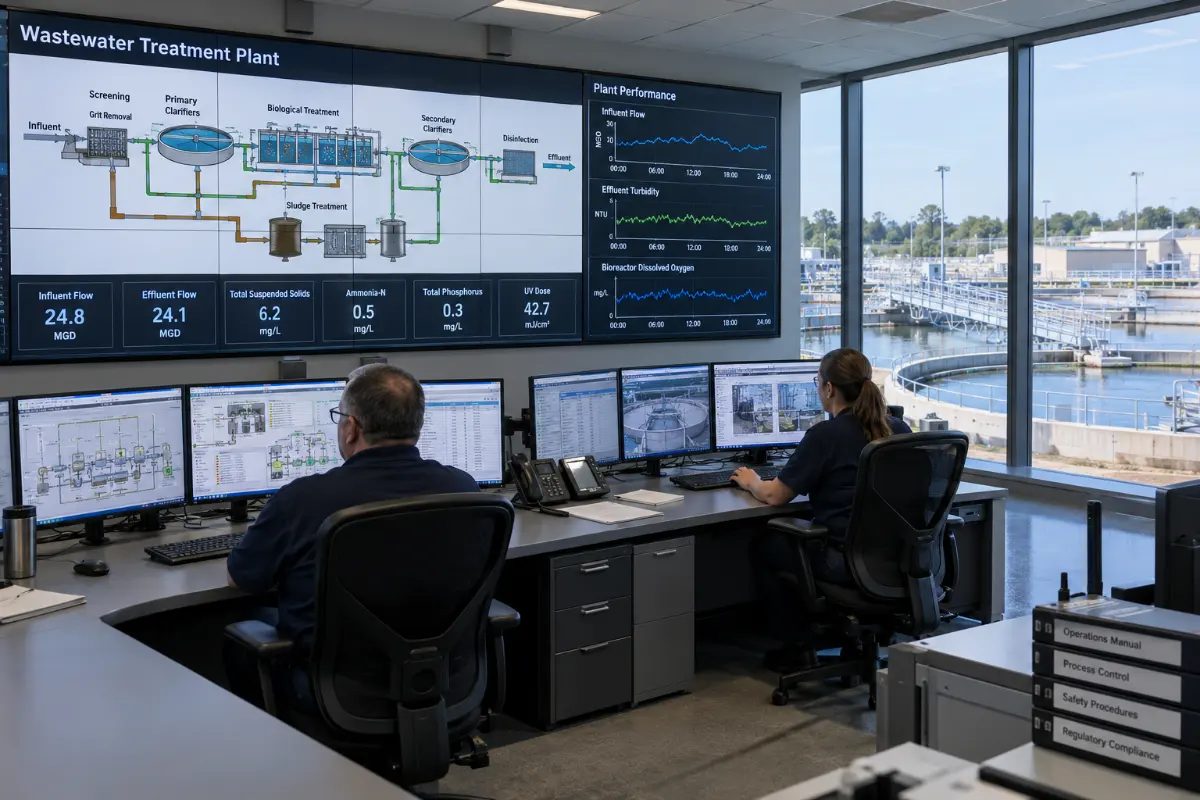
You cannot select pretreatment from a standard potable water panel. For DTRO feed you need a specific set of parameters, and you need them as ranges, not single grab samples.
Parameters that actually drive the design
- Silt Density Index (SDI) and turbidity — the baseline for solids removal.
- Total suspended solids (TSS) — determines whether you need clarification or just filtration.
- Hardness, calcium, magnesium, barium, strontium, silica — the scaling drivers, especially on the concentrate side.
- COD and TOC — organic fouling potential.
- Iron and manganese — these oxidize and foul membranes badly.
- Oil and grease — even low levels will blind a membrane over time.
- pH, alkalinity, conductivity, and temperature range — the operating envelope.
- Biological oxygen demand and microbial counts — biofilm risk.
- Heavy metals and specific ions — process-specific, but critical for leachate and plating streams.
I always push clients for a minimum of a two-week sampling campaign that captures variability. A single sample from a landfill leachate pond tells you almost nothing, because that water changes with rainfall, season, and the age of the waste cell. If you design pretreatment off one sample, you are designing for a condition that may not exist next month.
Concentrate chemistry is half the design
DTRO concentrates salts and organics into a much smaller volume. That means the scaling risk is not at the feed — it is at the concentrate, where concentrations can be five to ten times higher. Saturation indices for calcium carbonate, calcium sulfate, barium sulfate, and silica must be calculated at the maximum concentration factor, not at the feed. A pretreatment train that looks fine on feed water will fail at the concentrate end.
The Pretreatment Building Blocks
There is no single correct pretreatment train. There is a set of building blocks, and you assemble the ones your water demands. Here is how I think about them.
1. Equalization and solids removal
Almost every DTRO system benefits from equalization upstream. It damps variability, protects downstream units from shock loads, and gives chemical dosing time to work. For streams with meaningful TSS, you then need clarification, dissolved air flotation, or a similar solids separation step. For high-solids sludge streams, mechanical dewatering such as a screw press sludge dewatering system may sit upstream as part of the overall plant, though it is usually not directly in the DTRO feed path.
2. Filtration
Multi-media filtration, then cartridge filtration, is the standard backbone. The job is to get SDI below the membrane manufacturer’s limit — typically under 5, and I prefer under 3 for high-pressure DTRO service. Ultrafiltration is a stronger option when the water carries colloidal or organic load that media filters cannot hold. UF gives you consistent filtrate quality and a much more stable feed to the membranes, at the cost of more equipment and more maintenance.
3. Chemical conditioning
This is where most of the engineering judgment lives:
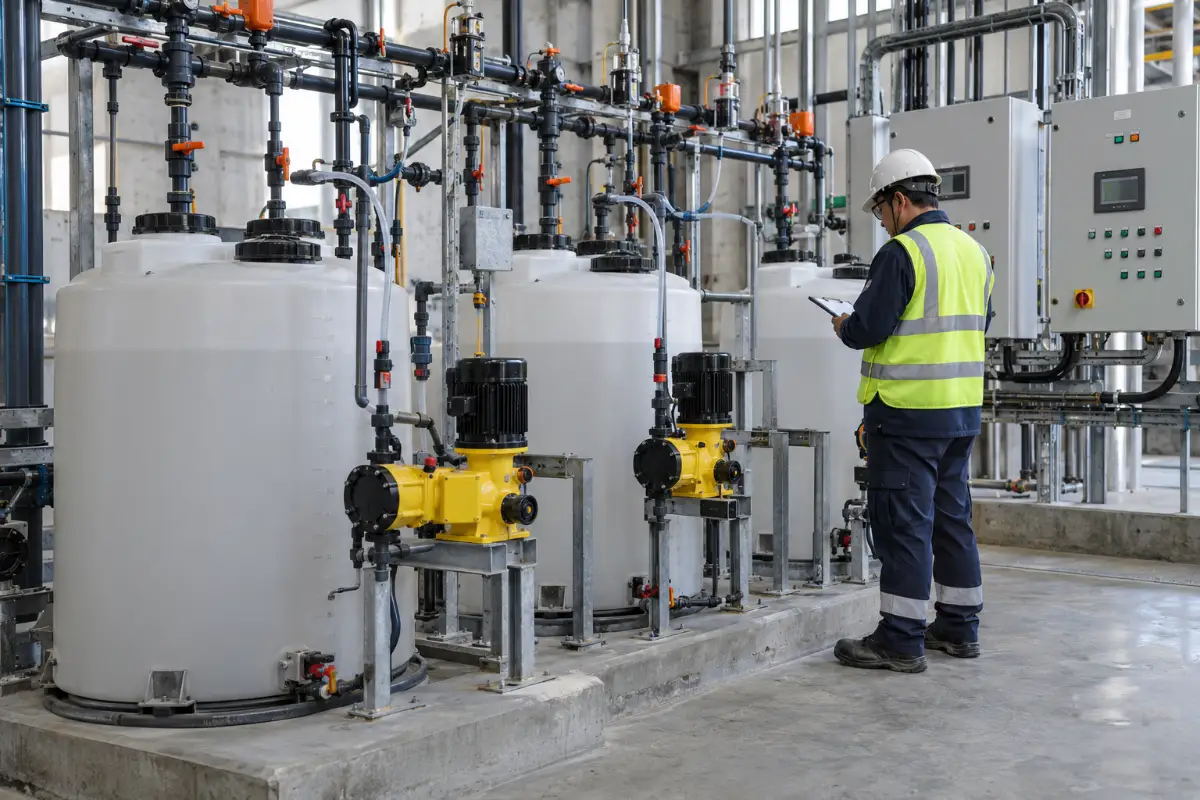
- Antiscalant dosing — selected for the specific scaling species, not a generic product. Silica, sulfate, and carbonate each need different chemistry.
- pH adjustment — often used to keep silica soluble or to control carbonate scaling.
- Oxidation and precipitation — for iron, manganese, and some heavy metals.
- Coagulation and flocculation — ahead of clarification or UF.
- Biocide or bio-dispersant — where biological fouling is a real risk.
Antiscalant selection deserves more attention than it usually gets. I have seen plants dosed with a product chosen because it was available, not because it was matched to the water. The result was sulfate scaling that took months to show up and was expensive to reverse. Get the antiscalant vendor to run the saturation calculations with you, and verify the dosing point is far enough upstream to give full mixing.
4. Organics and oil removal
If COD is high, you need an organics removal step. Options include activated carbon, advanced oxidation, or biological treatment ahead of the membranes. For oily streams, oil-water separation and possibly dissolved air flotation are non-negotiable — oil will foul DTRO faster than almost anything else. There is a useful discussion of how oil behaves in thermal and membrane systems in this material on evaporation with oily wastewater, and the same fouling logic applies to membranes.
Matching Pretreatment to Wastewater Type
The right train depends heavily on the source. Here is a comparison I use when scoping projects. The ranges are indicative and project-dependent — actual selection requires water-specific testing.
| Wastewater type | Dominant fouling risk | Typical pretreatment building blocks | Key watch-out |
|---|---|---|---|
| Landfill leachate | Organics, hardness, ammonia, iron | Equalization, biological or oxidation step, UF, antiscalant, pH control | Highly variable quality; concentrate scaling |
| Electroplating / metal finishing | Heavy metals, particulates, oil | Chemical precipitation, clarification, filtration, UF | Metal hydroxide carryover |
| Pharmaceutical | Organics, solvents, biofouling | Biological or AOP, carbon, UF, biocide | Variable batch composition |
| High-salinity brine | Scaling (sulfate, carbonate, silica) | Softening, antiscalant, pH control, fine filtration | Concentrate saturation limits |
| Oily industrial water | Oil and grease, emulsified organics | Oil-water separation, DAF, UF, carbon | Emulsified oil passes filters |
These categories are not rigid. A leachate stream with a plating waste co-disposal can behave like both. The point is to identify the dominant fouling mechanism first, then build the train to defeat it.
When softening is worth the cost
Lime or ion-exchange softening is expensive to run and produces its own waste stream, so people avoid it. But if your concentrate saturation calculations show calcium carbonate or sulfate well above saturation, softening upstream is often cheaper than living with frequent cleaning and short membrane life. I have seen plants try to solve hardness scaling with antiscalant alone and fail. There is a threshold where chemistry stops working and you need to remove the hardness physically.
Design Details That Decide Whether It Works
Redundancy and monitoring
Pretreatment equipment fails. Filters clog, dosing pumps lose calibration, UF membranes break. If your DTRO feed has no redundancy and no monitoring, a pretreatment upset goes straight into the membranes. I specify:
- Duplicate cartridge filter housings with differential pressure monitoring and alarms.
- Redundant chemical dosing pumps with flow-paced control, not just manual setting.
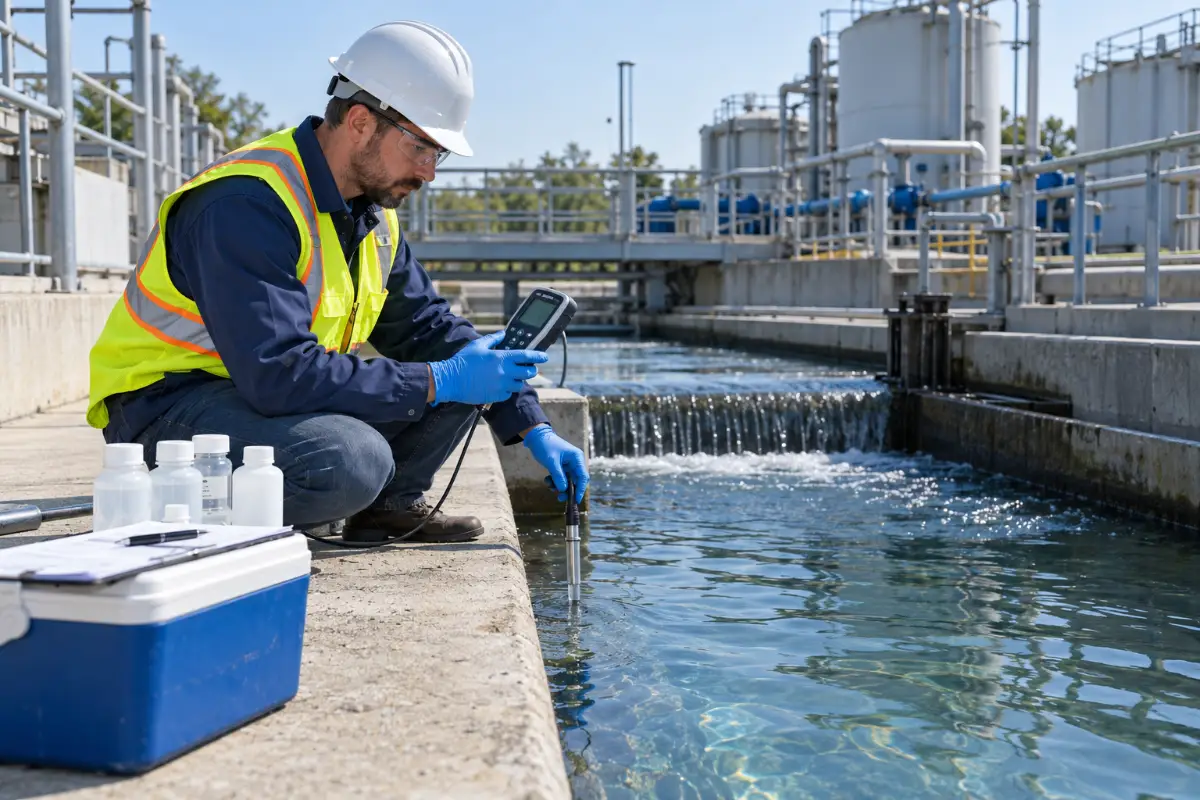
- Continuous SDI or turbidity monitoring on the feed to the DTRO skid.
- Online conductivity and pH on feed and concentrate.
- Automatic shutdown interlocks if feed quality goes out of range.
The interlock is the one people resist. Nobody wants the plant to trip. But a trip is cheaper than a set of destroyed discs.
Dosing points and mixing
Chemical dosing needs enough residence time and turbulence to mix fully. Injecting antiscalant two meters before the membrane is useless. I look for at least 30 to 60 seconds of contact time, usually through a static mixer or a dedicated reaction tank. Same for pH adjustment — you need the pH to be stable at the membrane, not oscillating.
Temperature
Membrane flux and scaling behavior both change with temperature. If your feed temperature swings significantly, the pretreatment design has to account for it. Antiscalant performance, in particular, is temperature-sensitive.
Energy and Lifecycle Cost
Pretreatment is not free, and the temptation is always to cut it to reduce capital cost. That is a false economy in DTRO service. Let me walk through where the money actually goes.
Capital cost drivers
- Number and type of filtration stages.
- Whether UF is required.
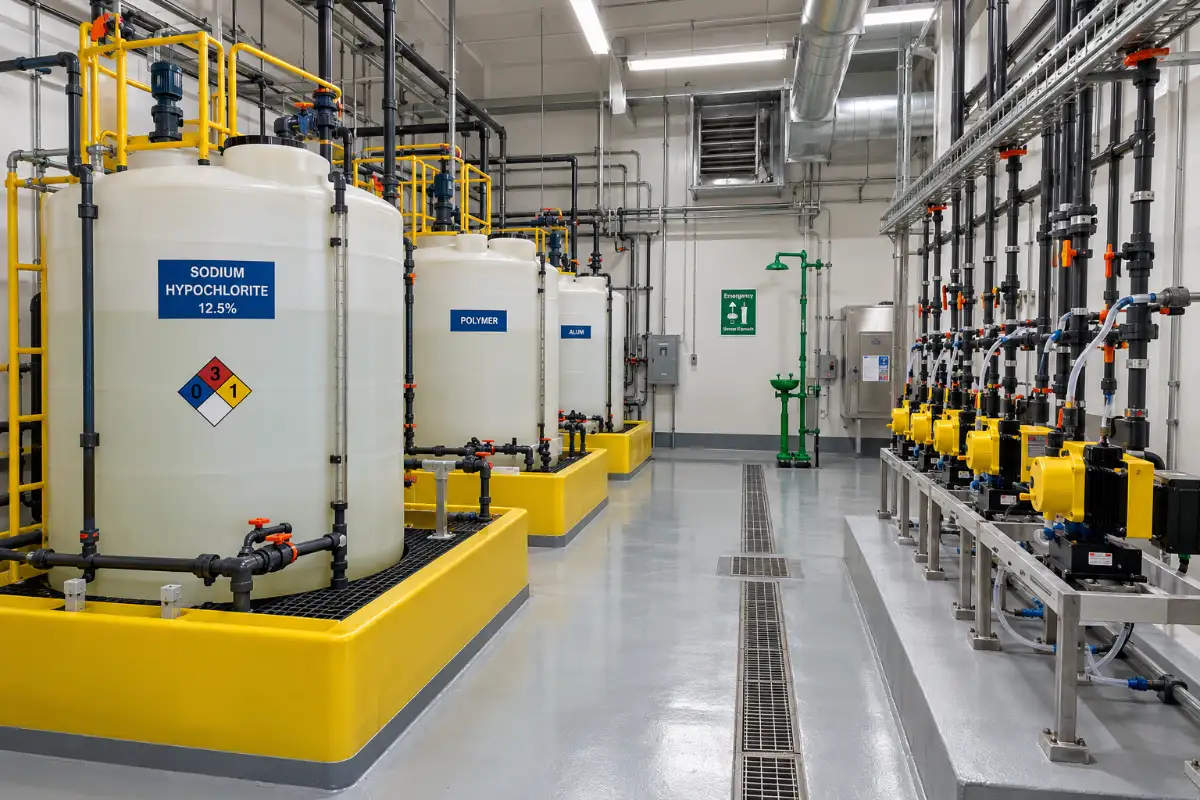
- Chemical dosing systems and storage.
- Instrumentation and controls.
- Civil works for equalization and clarification.
Operating cost drivers
- Chemical consumption — antiscalant, acid, caustic, biocide.
- Filter cartridge replacement frequency.
- UF membrane replacement every few years.
- Labor for monitoring and maintenance.
- Energy for pumps and any oxidation step.
The hidden cost is membrane cleaning and replacement on the DTRO side. A plant that skimps on pretreatment may save 15 to 20 percent on upfront capital and spend multiples of that on cleaning chemicals, downtime, and disc replacement over five years. When I model lifecycle cost, I always run two scenarios: adequate pretreatment and minimal pretreatment, and the numbers usually make the decision obvious.
For plants that also need to handle the DTRO concentrate, the downstream decision matters too. Thermal concentration with a mechanical vapor compression evaporator is common where discharge is restricted, and the pretreatment choices upstream affect how well the evaporator performs. If you are heading toward zero liquid discharge, the whole train — pretreatment, DTRO, and evaporation — has to be designed together, and there is useful context on ZLD system design that covers how these stages interact.
Maintenance and Common Failures
Most DTRO performance problems trace back to pretreatment. Here are the failures I see most often, and what they tell you.
Rapid differential pressure rise across cartridge filters
Usually means upstream solids removal is inadequate, or a coagulant is passing through and blinding the filters. Check clarifier performance and filter aid dosing.
Gradual flux decline with normal differential pressure
Classic organic or biological fouling. Look at COD removal, biocide dosing, and whether the system sits idle long enough for biofilm to grow.
Scaling on the concentrate end
Antiscalant underdosing, wrong antiscalant, or a saturation calculation that did not account for the real concentration factor. Recheck the concentrate chemistry.
Membrane damage and seal failures
Often caused by oxidative chemicals, extreme pH excursions, or particulate abrasion. Verify that cleaning chemicals are compatible and that pH control is reliable.
Erratic performance after a shutdown
Systems that sit idle without preservation grow biofilm and corrode. Have a documented layup procedure and follow it.
I keep a simple rule: if the DTRO membranes are failing, fix the pretreatment first, then look at the membranes. In most cases the membranes are the messenger, not the cause.
A Practical Selection Sequence
When I scope a new DTRO project, I work through the same sequence every time. It keeps me from skipping steps.
- Characterize the water. Full analysis, multiple samples, seasonal variability.
- Define the target. Recovery rate, concentrate quality, discharge or reuse requirement.
- Calculate concentrate chemistry. Saturation indices at maximum concentration factor.
- Identify the dominant fouling mechanism. Solids, scaling, organics, oil, or biological.
- Select building blocks to address each mechanism.
- Size each unit with margin, not to the bare minimum.
- Add monitoring and interlocks.
- Model lifecycle cost for at least two pretreatment scenarios.
- Pilot if the water is unusual. A short pilot with the actual membrane and pretreatment train removes most of the risk.
The pilot step is the one clients most often want to skip to save time and money. For a well-understood stream, that is defensible. For leachate, mixed industrial waste, or anything with unusual chemistry, piloting is the cheapest insurance you can buy.
Working with the membrane supplier
DTRO membrane suppliers publish feed water limits, and those limits are the floor, not the target. I design to be comfortably inside them, because real plants operate outside ideal conditions. Bring the supplier into the pretreatment discussion early. They have seen failures across many sites and can tell you where their limits are conservative and where they are optimistic.
If you are at the stage of comparing pretreatment options and want a second opinion on the train, it helps to talk through the water analysis with someone who has commissioned these systems. You can reach our engineering team here to review your feed data and concentrate calculations before you commit to equipment.
Where Evaporation Fits in the Train
Not every DTRO plant needs evaporation, but many do — especially where the concentrate cannot be discharged and hauling costs are high. When evaporation is part of the picture, the pretreatment design has to serve both the membranes and the evaporator.
Evaporators are more forgiving of suspended solids than membranes but less forgiving of scaling and foaming. If you are using a multi-effect evaporator downstream, the scaling species you removed for the DTRO benefit the evaporator too. Conversely, some pretreatment choices — like certain antiscalants — can cause foaming or carryover in the evaporator. This is why the whole train needs to be designed as a system, not as separate packages bolted together.
For high-salinity streams where DTRO alone cannot reach the required concentration, a hybrid approach with membranes followed by thermal concentration is common. The pretreatment for the membrane stage is usually more demanding than for the evaporator, so it makes sense to put the effort where it protects the most sensitive equipment.
FAQ
What is the minimum pretreatment for a DTRO system?
At absolute minimum, you need equalization, fine filtration to control SDI, and antiscalant dosing matched to your scaling species. That is the floor. Any stream with meaningful organics, oil, or biological activity needs more. I would not commission a DTRO system on a complex industrial stream with only those three steps.
How do I know if I need ultrafiltration ahead of DTRO?
If multi-media and cartridge filtration cannot consistently hold SDI below the membrane limit, or if your water carries colloidal or organic load that varies, UF is the better choice. UF gives stable filtrate quality regardless of feed swings, which matters more on variable streams like leachate.
Can I use a generic antiscalant instead of a water-specific one?
You can, but you should not. Different scaling species need different chemistry. A product that controls carbonate scaling may do nothing for silica or sulfate. Have the antiscalant supplier run saturation calculations on your actual concentrate chemistry and recommend a product for your specific species.
How often should I expect to clean DTRO membranes?
With good pretreatment, cleaning intervals of several months are achievable on many streams. With poor pretreatment, you may be cleaning monthly or more. Cleaning frequency is one of the clearest indicators of whether your pretreatment is working. If it is climbing, investigate the pretreatment before you blame the membranes.
What causes sudden DTRO performance loss?
Sudden loss usually points to a pretreatment upset — a dosing pump failure, a filter bypass, a coagulant overdose, or an oxidation event. Gradual loss points to fouling or scaling. The pattern of the loss tells you where to look first.
Is softening always necessary for high-hardness feed?
No. If the concentrate saturation calculations show you can stay within limits with antiscalant and pH control, softening may not be needed. But if you are well above saturation at the maximum concentration factor, softening upstream is usually cheaper than living with frequent cleaning and shortened membrane life.
How much does pretreatment add to the project cost?
It varies widely with water quality. On a simple stream, pretreatment might be 10 to 15 percent of the total system cost. On a complex leachate or mixed industrial stream, it can be 30 percent or more. The right way to evaluate it is on lifecycle cost, not capital cost alone, because the operating penalty of inadequate pretreatment is severe.
Should I pilot before full-scale design?
For well-understood streams, a pilot may not be necessary. For leachate, mixed industrial waste, or any water with unusual chemistry, piloting is the cheapest risk reduction available. A short pilot with the actual membrane and pretreatment train will tell you more than any amount of desktop analysis.