

Mining wastewater is one of the hardest streams I deal with. It combines high total dissolved solids, dissolved metals, sulfate, residual reagents, and often arsenic or selenium at levels that make conventional biological treatment useless. The core answer is this: mining wastewater and brine treatment almost always requires a staged approach — metals removal and neutralization first, then membrane concentration, then evaporation or crystallization to handle the brine. You cannot treat a 60,000 mg/L TDS stream with a single technology, and anyone who tells you otherwise has never watched a membrane train foul in three weeks. What follows is how I actually design these systems, where they fail, and how to keep them running.
What Makes Mining Wastewater Different From Other Industrial Streams
Before I size anything, I want a full water analysis and a mass balance. Mining water is not a single thing. It varies enormously by source:
- Acid mine drainage (AMD): Low pH, high iron, manganese, aluminum, sulfate. Often 2,000–15,000 mg/L TDS but with a very aggressive metal load.
- Tailings pond supernatant and decant water: Near-neutral pH, high sulfate, elevated TDS, residual flotation reagents, and fine suspended solids that never seem to settle.
- Process brine from concentrators: High TDS, high hardness, sometimes high chloride.
- Smelter and refining effluent: Heavy metals plus arsenic, selenium, and sometimes ammonia.
- Heap leach and runoff: Highly variable, storm-driven, hardest to design for because flow swings 5–10x.
Two numbers drive everything downstream: TDS and hardness. If TDS is under roughly 10,000 mg/L and hardness is controlled, reverse osmosis is viable. Above 30,000–40,000 mg/L, RO becomes a pre-concentration step at best, and thermal or evaporative technology takes over. Hardness matters because calcium and magnesium sulfate scale is the number one killer of both membranes and evaporator heat exchangers.
Stage One: Metals Removal and Neutralization
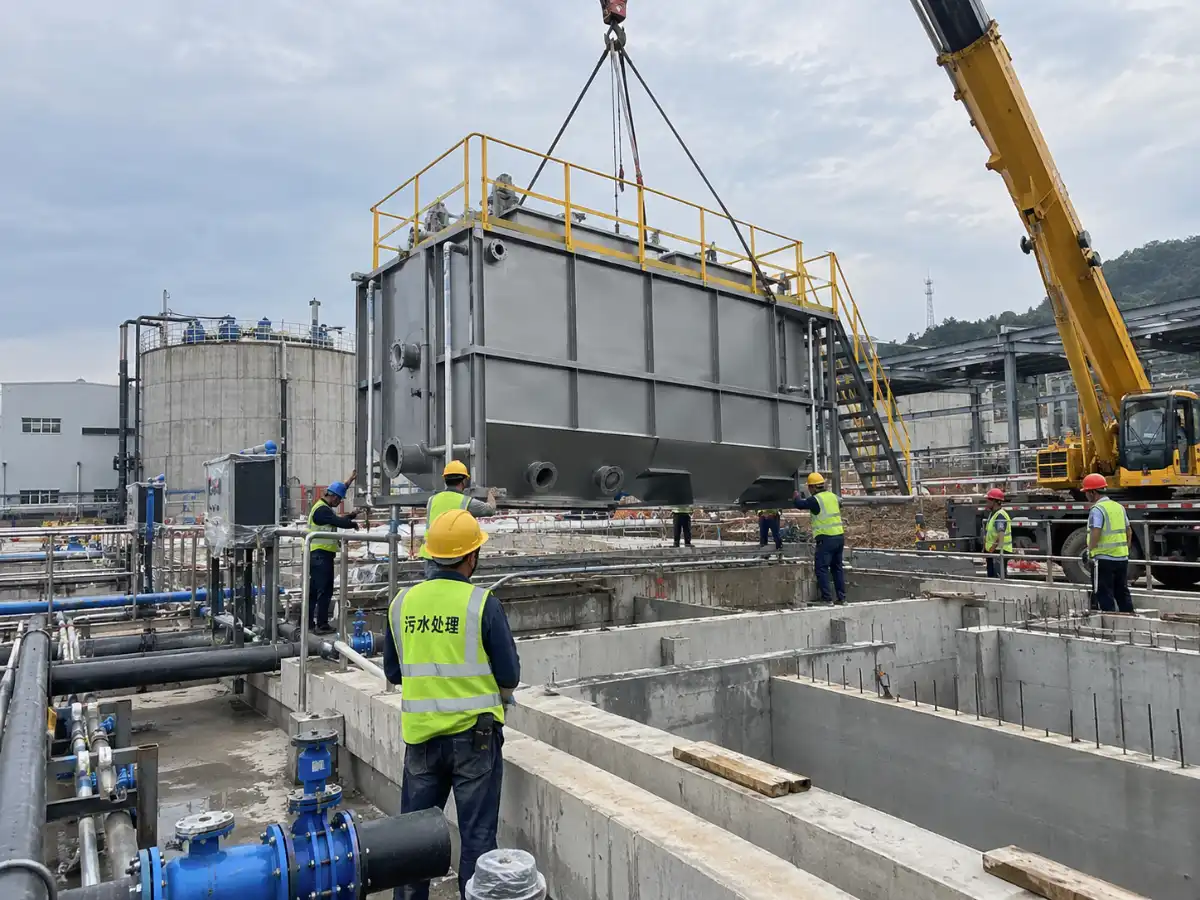
You do not send metal-laden water to a membrane or an evaporator. You will destroy it. The first stage is almost always chemical precipitation:
- pH adjustment and hydroxide precipitation. Lime or caustic raises pH to 8.5–10.5, dropping iron, aluminum, copper, zinc, nickel, and lead as hydroxides. Lime is cheaper per equivalent but produces far more sludge.
- Sulfide polishing. For metals that do not precipitate well as hydroxides — arsenic, antimony, molybdenum, and residual cadmium — a controlled sulfide dose gets you to low ppb. The catch is you must not overdose, or you create H₂S and a smell nobody forgives you for.
- Coagulation and flocculation. Iron chloride or alum plus polymer. Without good floc, your clarifier carries over and the downstream membranes pay the price.
- Solids separation. High-rate clarifier, lamella, or dissolved air flotation depending on floc density. Then sludge thickening and dewatering.
For sludge dewatering, I default to a screw press for mining sludges with high fines, because it handles variable feed and runs with low operator attention. Where the sludge is more fibrous or the plant wants higher cake dryness, a belt press or centrifuge may win. The decision is driven by cake disposal cost, not by the dewatering unit price. If you want the practical selection logic, this screw press sludge dewatering guide walks through the trade-offs honestly.
Field note: I have seen more mining projects fail at the clarifier than at the evaporator. If your metals stage is unstable, everything downstream inherits that instability, and no amount of clever membrane design fixes it.
Stage Two: Desalination and Concentration
Once metals are down and hardness is managed, you are dealing with a brine problem. This is where technology selection matters most, and where I see the biggest capital mistakes.
Membrane Options: RO and DTRO
Standard spiral-wound RO is fine up to roughly 15,000–25,000 mg/L feed TDS if you have good pretreatment and antiscalant control. Beyond that, osmotic pressure climbs fast and you either need very high pressure or you accept low recovery. For high-fouling, high-TDS, high-suspended-solids streams, I use DTRO membrane systems because the disc-tube design tolerates fouling far better and can be opened and cleaned without destroying the element. Recovery in these systems is project-dependent — typically 50–75% on a well-pretreated stream — and I never promise a number before piloting.
If you need to push concentration further before thermal, high-pressure RO can reach 80–120 bar, but you are now in a regime where every membrane replacement is expensive and every scaling event is a shutdown. This is a tool, not a default.
Evaporation: MVC, MVR, and Multi-Effect
For the concentrated brine, evaporation is the workhorse. Three families matter:
| Technology | Typical feed TDS | Energy profile | Best fit |
|---|---|---|---|
| Single-effect evaporator | Low to moderate | Highest steam demand per unit water evaporated | Small flows, intermittent duty, simple operation |
| Multi-effect (double, triple, more) | Moderate to high | Steam economy improves roughly with number of effects | Steady flows where steam is available and cheap |
| MVC / MVR | Moderate to very high | Electric-driven, low external steam | Where power is available and steam is not |
My rule of thumb: if the site has cheap waste steam, multi-effect wins on operating cost. If the site is electric-heavy and steam-poor, mechanical vapor compression wins, because it recycles the latent heat instead of throwing it away. In mining, most sites are remote and steam-poor, which is why MVC dominates. The compressor is the heart of the system, and its reliability determines your uptime. I spend more time specifying the compressor and the MVC heat exchangers than anything else in the evaporator package.
Why Scaling Control Decides the Whole Project
Mining brine is loaded with calcium sulfate, and CaSO₄ solubility actually decreases as temperature rises above about 40°C. That single fact traps a lot of engineers. A heat exchanger designed like a seawater evaporator will scale solid in weeks. You either seed the brine with gypsum crystals, operate at lower temperature, or use a forced-circulation design with enough velocity to keep solids suspended. I have seen plants that solved this and plants that did not, and the difference was entirely in the brine circulation design, not the compressor.
Stage Three: Zero Liquid Discharge and Crystallization
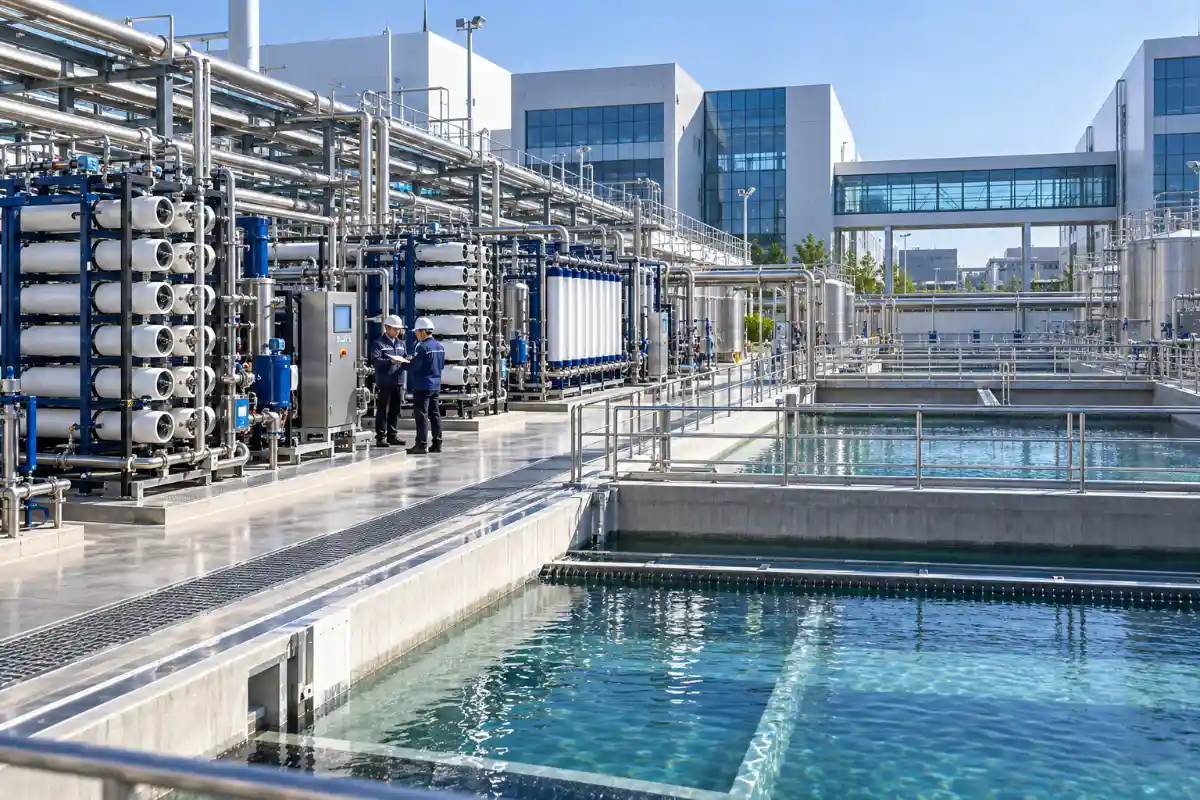
When discharge permits are tight or the site has no receiving water, you go to zero liquid discharge. A practical ZLD train looks like this:
- Metals removal and softening to remove hardness before the thermal stage.
- Membrane pre-concentration (RO or DTRO) to cut the volume going to the evaporator.
- Evaporator to bring the brine to near-saturation.
- Crystallizer to produce a solid salt for disposal or, in some cases, recovery.
- Distillate polishing so the recovered water can be reused in the process.
The economics live or die on the pre-concentration step. Every cubic meter you remove with membranes instead of evaporation saves roughly 15–25 kWh of thermal-equivalent energy. That is why I am stubborn about squeezing recovery out of the membrane stage before touching the evaporator.
Energy, Cost, and the Honest Numbers
I will not quote a single energy figure for mining brine because it depends on feed TDS, recovery, and technology. What I can give you are indicative ranges I use for early-stage budgeting, always confirmed by pilot or detailed design:
| Parameter | Indicative range | Main driver |
|---|---|---|
| RO / DTRO specific power | 2–6 kWh/m³ permeate | Feed TDS, recovery, pressure |
| MVC specific power | 15–35 kWh/m³ distillate | Boiling point elevation, compressor efficiency, scaling margin |
| Multi-effect steam demand | 0.3–0.5 kg steam per kg water (3-effect) | Number of effects, temperature profile |
| Chemical cost (metals stage) | Highly variable | Lime vs. caustic, sulfide dose, metal load |
Two costs get ignored in early budgets and then wreck the business case. First, sludge disposal. Lime precipitation can generate enormous sludge volumes, and hauling it is a recurring cost forever. Second, membrane and heat exchanger replacement. In aggressive brine service, you should assume shorter element life than a clean water plant, and you should price that in from day one. For a fuller breakdown of where the money actually goes, this analysis of MVR evaporator cost drivers is worth reading before you commit capital.
Design and Operating Pitfalls I See Repeatedly
- Designing for average flow instead of peak. Storm runoff and heap leach surges will overwhelm a plant sized on averages. Build in equalization, always.
- Underestimating hardness. If you do not soften properly, you will scale the evaporator and the membranes, and you will clean them more than you run them.
- Ignoring boiling point elevation. High-TDS brine boils at a higher temperature than water. If the compressor is sized on clean-water assumptions, it will not reach design capacity.
- Poor brine circulation in the evaporator. Low velocity means solids settle, heat transfer drops, and you get a shutdown.
- No pilot testing. I have never regretted piloting a mining brine. I have regretted skipping it.
- Operator training treated as an afterthought. These systems are not push-button. The plants that run well have operators who understand why the pH setpoint matters and why the antiscalant dose is not negotiable.
If you want a structured way to think about the overall process sequence before equipment selection, this overview of process stages in water treatment is a useful reference for framing the train.
Maintenance Reality: What Keeps You Running
Maintenance on a mining brine plant is not glamorous, but it is predictable if you plan for it:
- Daily: pH, conductivity, turbidity, antiscalant dosing verification, compressor vibration and temperature.
- Weekly: Membrane differential pressure trends, evaporator heat transfer coefficient tracking, brine density checks.
- Monthly: Compressor oil analysis, cleaning cycles, calibration of all analyzers.
- Annual: Heat exchanger inspection, membrane autopsies, mechanical integrity checks on all wetted parts.
The single most useful habit is trend logging. When the heat transfer coefficient starts drifting down, you have weeks of warning before you have a problem. If you only look at the plant when it alarms, you are always reacting.
Frequently Asked Questions
How do I decide between RO and an evaporator for high-TDS mining water?
Use TDS and osmotic pressure as the first filter. Below roughly 25,000 mg/L with good pretreatment, RO or DTRO is usually the economical pre-concentration step. Above that, evaporation becomes the primary technology, and membranes serve only to reduce the volume fed to the evaporator. The crossover point is project-specific and should be confirmed by piloting.
What pretreatment is mandatory before an evaporator?
At minimum, metals removal, hardness reduction or softening, and suspended solids removal. If you feed an evaporator with high hardness or high suspended solids, you will scale or foul the heat exchangers and lose capacity quickly. Some designs tolerate more than others, but none tolerate neglect.
How much does a mining brine treatment system cost?
Capital cost scales primarily with flow rate, feed TDS, and the level of ZLD required. Operating cost is dominated by energy, chemicals, and solids disposal. I never quote a single number without a water analysis and a mass balance, because the same flow rate can vary by a factor of three depending on water chemistry.
Why does my evaporator lose capacity over time?
Almost always scaling or fouling on the heat transfer surfaces. In mining brine, calcium sulfate and other sparingly soluble salts are the usual culprits. Check brine circulation velocity, temperature profile, and antiscalant or seeding strategy. Restoring capacity usually requires cleaning and then fixing the root cause, not just cleaning more often.
Can I reuse the distillate from the evaporator?
Yes, in most cases. Evaporator distillate is typically low in TDS and can be reused as process water or boiler feed after polishing. The exact quality depends on the volatile compounds in your feed — ammonia, organics, and some metals can carry over — so verify with testing before routing it to a sensitive use.
What is the biggest cause of project failure in mining brine treatment?
In my experience, it is inadequate characterization of the water and insufficient piloting. Teams design from a single grab sample, miss the seasonal variability, and then discover the plant cannot handle the real feed. Get a full year of water data if you can, and pilot the critical stages.
Planning a mining brine or ZLD project?
Send us your water analysis and flow data. We will come back with a process train, a preliminary mass balance, and an honest assessment of where the risks are.
Final Thoughts
Mining wastewater and brine treatment is a sequence problem, not a single-equipment problem. Get the metals out first. Control hardness ruthlessly. Pre-concentrate with membranes to shrink the thermal load. Then evaporate and, if required, crystallize. Every stage protects the next one, and skipping a stage is how projects end up with fouled membranes, scaled heat exchangers, and a plant that never quite reaches design capacity. Design for variability, pilot the critical steps, and give your operators the training and the instrumentation they need to see problems coming. Do that, and high-TDS mining brine becomes a manageable engineering challenge instead of an endless maintenance battle.
For broader context on discharge limits and how they shape design decisions, the U.S. EPA and the World Bank both publish guidance on industrial effluent standards that are worth reviewing early in the design process.