

If you’re specifying materials for an evaporator on a high-chloride or high-temperature duty, the short answer is this: 316L works fine for clean, low-chloride streams at moderate temperature, but duplex stainless steel (2205 or 2507) is the better choice once chloride content, temperature, or acid exposure climbs into the range where 316L starts pitting. In my experience, most evaporator failures I’ve been called in to look at were not caused by the wrong alloy on paper — they were caused by a material that was correct for the original design, then operated outside that envelope.
This article walks through how I actually make the 316L vs duplex stainless steel decision for evaporator bodies, heat exchangers, and wetted piping, based on chloride levels, temperature, pH, scaling tendency, and lifecycle cost. No marketing spin, just the trade-offs that show up after startup.
Why Material Selection Decides Whether Your Evaporator Lasts Five Years or Twenty
An evaporator is a corrosion reactor that happens to remove water. You are concentrating chlorides, sulfates, and often organic acids while holding the metal at 60–110 °C. That combination is exactly what drives pitting, crevice corrosion, and stress corrosion cracking (SCC) in austenitic stainless steels like 316L.
The mistake I see most often is treating material selection as a line item to be minimized. A heat exchanger tube bundle that costs 15% more in duplex usually pays for itself the first time you avoid a shutdown, a re-tube, or a product contamination event. The problem is that the failure mode is silent until it isn’t — you get a small pit, then a through-wall leak, then wet steam or product in your condensate, and suddenly you’re dealing with a full teardown.
So the question isn’t “which is stronger.” Both alloys are strong enough. The question is which one survives your specific chemistry over the design life of the plant.
The Two Alloys, Stripped Down to What Matters
316L: The Workhorse With a Chloride Ceiling
316L is an austenitic stainless steel with roughly 16–18% chromium, 10–14% nickel, and 2–3% molybdenum, with carbon held under 0.03% to improve weldability and reduce sensitization. It’s easy to fabricate, widely available in sheet, plate, tube, and fittings, and relatively forgiving for field repairs.
Its weakness is molybdenum content. The 2–3% Mo gives it decent resistance to general corrosion and mild chloride environments, but it has a practical chloride ceiling. As a rough engineering guide — and this is project-dependent, not a rule — 316L is usually acceptable in evaporator service when:
- Chloride concentration stays below roughly 200–500 mg/L
- Metal temperature stays below about 60 °C
- pH is neutral to mildly alkaline
- There is no free chlorine, hypochlorite, or strong oxidizing agent
- The stream is not prone to heavy scaling that traps chlorides at the surface
Push past those limits and you’re gambling. I’ve seen 316L tube sheets pit through in under three years on a stream that was only 800 mg/L chloride but ran at 95 °C with intermittent cleaning cycles.
Duplex Stainless Steel: Higher Strength, Higher Chloride Tolerance
Duplex grades like 2205 (UNS S32205/S31803) and 2507 super duplex are two-phase alloys — roughly equal parts austenite and ferrite. That microstructure gives them two advantages that matter in evaporators:
- Higher resistance to chloride pitting and SCC. The pitting resistance equivalent number (PREN) for 2205 is around 34–36, versus roughly 24–26 for 316L. That gap translates directly into a higher critical pitting temperature and a much higher chloride tolerance.
- Roughly double the yield strength — about 450 MPa minimum for 2205 versus 170–200 MPa for 316L. That lets you use thinner walls in pressure-bearing components, which sometimes offsets the higher per-kilogram cost.
2205 is the standard upgrade for most industrial evaporator service. 2507 (PREN above 40) is reserved for the nastiest duties — high chloride plus high temperature plus low pH, or streams with residual oxidizers.
Side-by-Side Comparison for Evaporator Service
| Property | 316L | Duplex 2205 | Super Duplex 2507 |
|---|---|---|---|
| PREN (typical) | 24–26 | 34–36 | 40–43 |
| Yield strength (MPa, min) | 170–200 | 450 | 550 |
| Practical chloride limit (neutral pH, ~60 °C) | ~200–500 mg/L | ~2,000–3,000 mg/L | >5,000 mg/L |
| Critical pitting temperature (ASTM G48, indicative) | ~20–30 °C | ~50–60 °C | ~80–90 °C |
| SCC resistance in chlorides | Poor above ~60 °C | Good | Excellent |
| Relative material cost (indicative) | 1.0 | 1.6–2.0 | 2.5–3.5 |
| Weldability | Easy | Requires controlled heat input and ferrite balance | More demanding; needs qualified WPS |
| Typical evaporator use | Low-chloride, low-temp MVC/MVR bodies | Most industrial wastewater evaporators | Leachate, high-chloride brine, acid streams |
Treat the numbers as indicative ranges, not specifications. Your actual limits depend on pH, dissolved oxygen, oxidizing species, flow velocity, and whether the surface stays clean or scales up.
How Chloride and Temperature Interact — The Real Decision Driver
If you take one thing from this article, take this: chloride and temperature are not independent variables. They multiply.
A stream at 500 mg/L chloride and 40 °C is a completely different corrosion problem than the same stream at 90 °C. In evaporators, the metal temperature is often 10–20 °C above the boiling temperature of the liquid, especially on the heating side of the heat exchanger. That’s where pitting starts.
Here’s the practical logic I use when sizing material for an evaporator:
- Below 60 °C, chlorides under 500 mg/L: 316L is usually defensible. Verify pH and check for oxidizing agents.
- 60–90 °C, chlorides 500–2,000 mg/L: Move to 2205 duplex. This is the most common upgrade point I see in industrial wastewater evaporators.
- Above 90 °C, or chlorides above 2,000 mg/L: 2205 minimum, and evaluate 2507 or a nickel alloy if pH is acidic or the stream contains oxidizers.
- Any temperature with free chlorine or hypochlorite present: Neither 316L nor duplex is safe. You need a different material class entirely, or you need to remove the oxidizer upstream.
This is why the heat exchanger design and the material specification have to be developed together. A heat exchanger that runs hot to save surface area may force you into a more expensive alloy than a slightly larger, cooler-running design.
Where Each Alloy Belongs in an Evaporator System
You rarely specify one alloy for the whole system. The right approach is to match material to the local conditions in each zone.
Evaporator Body and Vapor Space
The vapor space sees lower chloride and lower temperature than the liquid side, so 316L is often adequate here even when the sump and heat exchanger are duplex. But watch for droplet entrainment — if carryover deposits chloride-rich liquid on the vapor-side walls, you’ve recreated the corrosion problem in a place you weren’t monitoring.
Heat Exchanger Tubes and Tube Sheets
This is where duplex earns its cost. Tubes run hot, see the highest chloride concentration (especially at the point of highest evaporation), and often have crevices at the tube-to-tubesheet joint. If there’s one place in the system to spend the material budget, it’s here. For more on this, see our notes on MVC evaporator heat exchangers.
Circulation Piping and Pumps
Piping sees the same chemistry as the sump. If the sump is duplex, the piping should be too. Pump casings and impellers are often available in duplex or in higher alloys like CD4MCu — velocity matters here, because erosion-corrosion accelerates pitting.
Condensate Side
Condensate is usually low-chloride and can often stay in 316L. But if you have any risk of tube leakage, the condensate side is the first place contamination shows up. Some operators specify duplex on the condensate side too, purely as a barrier against cross-contamination.
Fabrication and Welding: Where Duplex Gets Complicated
Duplex is not hard to weld, but it is less forgiving than 316L. The heat-affected zone can lose its balanced ferrite-austenite microstructure if you use too much heat input or the wrong filler, and that imbalance creates a preferential corrosion path.
What this means in practice:
- You need a qualified welding procedure specification (WPS) and welders who have actually run duplex before — not just read the data sheet.
- Heat input is typically controlled in the range of 0.5–1.5 kJ/mm, with interpass temperature capped around 150 °C.
- Filler metal must be a matching or over-alloyed duplex consumable (e.g., 2209 for 2205).
- Post-weld cleanup matters more than with 316L. Iron contamination from carbon steel tooling is a common cause of early pitting.
- Pickling and passivation after welding is not optional on duplex in chloride service.
I’ve seen a duplex evaporator fail in two years because the fabricator treated it like 316L and used too much heat on the tube-to-tubesheet welds. The alloy was right; the execution wasn’t.
Lifecycle Cost: The Math That Actually Matters
Material cost comparisons on a per-kilogram basis are misleading. What matters is total cost of ownership over the design life.
Consider a mid-size MVR evaporator handling a chloride-bearing wastewater stream at 80 °C. If 316L is selected and fails at year four, the operator faces:
- Unplanned shutdown and lost production
- Replacement tube bundle or heat exchanger (often 30–50% of original equipment cost)
- Emergency procurement and expedited freight
- Possible product or condensate contamination and disposal
Compare that to a duplex upgrade that costs 20–40% more on the wetted components at the capital stage. In most cases I’ve worked through, the duplex option wins on a ten-year basis even if you assume the 316L unit survives — because the maintenance and downtime risk premium on 316L is real.
That said, duplex is not free money. If your stream is genuinely low-chloride and low-temperature, specifying duplex everywhere is over-engineering. Match the alloy to the duty. This is the same logic that shows up in MVR evaporator cost analysis — material selection is one of the top three drivers of both capex and opex.
Case-Style Example: Electroplating Rinse Water Concentrate
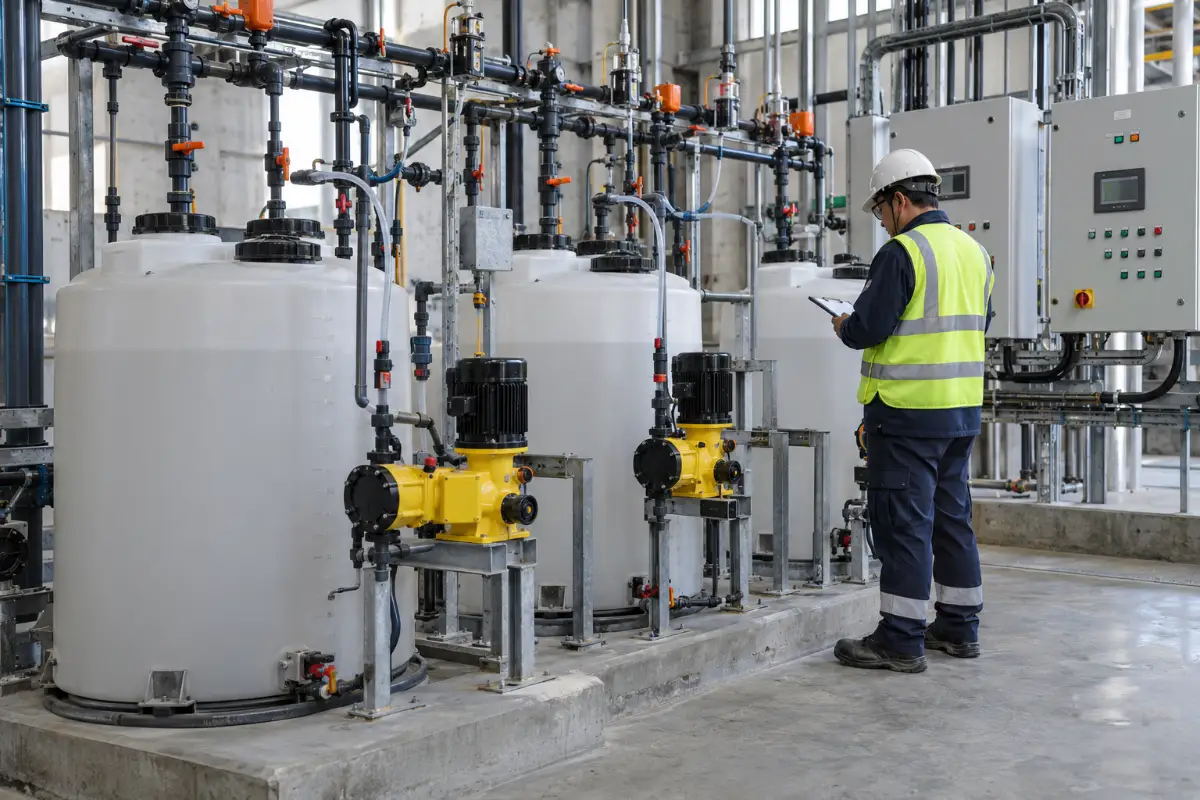
An electroplating operation was concentrating rinse water with an MVR evaporator to reduce disposal volume. Feed chloride was around 1,200 mg/L, sump temperature 85 °C, pH between 3 and 5 depending on the rinse stage.
The original unit was specified in 316L. Within 18 months, the tube sheet showed pitting at the tube-to-tubesheet joints and the plant was losing vacuum. The replacement bundle was specified in 2205 duplex with a slightly larger surface area to reduce the peak metal temperature by about 8 °C.
Indicative outcome over the following five years: no further tube failures, cleaning intervals extended from six weeks to about four months, and the plant was able to run the evaporator closer to design capacity. The duplex bundle cost roughly 35% more than the original 316L bundle, but the avoided downtime alone covered the difference within the first year. Project details are anonymized; actual numbers vary by site.
You can see the general architecture in our electroplating wastewater treatment reference.
When Duplex Isn’t Enough
There are duties where even 2507 super duplex is the wrong answer:
- Free chlorine or hypochlorite present. Both attack duplex. You need to remove the oxidizer or move to a nickel alloy.
- Very high chloride plus low pH (below 2). Consider 904L, 254 SMO, or a 6Mo super-austenitic grade.
- Fluoride-bearing streams. Fluoride attacks the passive layer on stainless steels; a different material class is usually needed.
- High-temperature, high-chloride, oxygen-saturated. This is the classic SCC scenario; duplex helps but a nickel alloy may be the safer call.
For leachate and other aggressive brines, the material decision often gets tied to the overall ZLD system design, because the upstream concentration step determines what the evaporator actually sees.
Practical Specification Checklist
Before you lock in a material, get clear answers on these points:
- Maximum chloride concentration at the point of highest concentration, not at the feed.
- Maximum metal temperature on the heating surface, not the bulk liquid temperature.
- pH range including upset conditions.
- Presence of oxidizing agents — free chlorine, hypochlorite, peroxide, ozone, nitrate.
- Presence of fluoride, sulfide, or organic acids.
- Scaling tendency and cleaning chemistry — what will be used to remove scale, and at what temperature.
- Velocity profile in tubes and piping.
- Weld procedure qualification for the specified alloy.
- Post-weld passivation and iron contamination control.
- Corrosion allowance and inspection access.
If you can’t answer items 1 through 4 with confidence, you’re not ready to pick an alloy. Get the water analysis and the process conditions locked first.
For a broader view of how material selection fits into overall evaporator design, see our overview of evaporators for wastewater treatment.
Maintenance Practices That Extend Life in Either Alloy
Material choice buys you margin. Maintenance practice determines whether you use it.
- Keep surfaces clean. Scale and deposits create crevices where chlorides concentrate. A clean heat exchanger runs cooler and corrodes slower.
- Control cleaning chemistry. Caustic and acid cleaning cycles should be temperature-controlled and time-limited. Over-cleaning is a real failure mode.
- Monitor condensate conductivity. A rising trend is the earliest signal of a tube leak. Catch it early and you replace a tube; catch it late and you replace a bundle.
- Inspect at planned outages. Visual inspection with a borescope at tube inlets and tube-to-tubesheet joints catches pitting before it becomes a leak.
- Log operating temperature and chloride. If the process drifts outside the material envelope, you want to know before the metal does.
For an overview of how these practices fit into a broader program, see the discussion of process control in water treatment.
Frequently Asked Questions
Is 316L ever the right choice for an evaporator?
Yes — when chlorides are low (typically under a few hundred mg/L), metal temperatures stay below about 60 °C, pH is neutral to alkaline, and there are no oxidizing agents. Many clean-water and low-chloride evaporators run for decades on 316L. The key is being honest about the actual operating envelope, not the design envelope.
How much more does duplex cost than 316L?
On a per-kilogram basis, 2205 duplex typically runs 1.6 to 2.0 times the cost of 316L, and 2507 super duplex runs 2.5 to 3.5 times. On a finished-component basis the gap is often smaller, because duplex’s higher strength allows thinner walls. Fabrication cost may also be higher due to more demanding welding procedures.
Can I mix 316L and duplex in the same evaporator?
Absolutely, and it’s often the smart approach. Use duplex where the corrosion risk is highest — heat exchanger tubes, tube sheets, sump, and hot circulation piping — and 316L in lower-risk zones like vapor space, condensate lines, and structural supports. Just make sure the transition joints are properly welded and that galvanic effects are considered.
What’s the most common reason a duplex evaporator still corrodes?
Welding and fabrication issues, in my experience. Poor heat input control, wrong filler metal, inadequate post-weld passivation, or iron contamination from carbon steel tooling. The alloy itself is rarely the problem — the execution is.
How do I know if my stream is too aggressive for 316L?
Run a corrosion assessment using the actual maximum chloride, temperature, and pH. If you’re near or above the practical limits — roughly 500 mg/L chloride at 60 °C — plan for duplex. If you have any history of pitting or SCC in similar service, treat that as a strong signal to upgrade. A small corrosion coupon test program before finalizing the design is cheap insurance.
Does duplex help with scaling or fouling?
Not directly. Duplex resists corrosion better, but scale forms on any surface. However, because duplex allows you to run with thinner walls and sometimes at lower metal temperatures, you may see secondary benefits in fouling rate. The bigger fouling lever is usually heat exchanger design and cleaning strategy, not alloy.
What about titanium or nickel alloys?
Titanium is excellent in seawater and chloride service but has limits in reducing acids and can be attacked by dry chlorine. Nickel alloys like C-276 handle extreme chloride and acid combinations but cost significantly more. For most industrial evaporator duties, duplex is the sweet spot between performance and cost. Titanium or nickel alloys come into play when duplex’s limits are exceeded.
Bottom Line
316L is the right choice when the duty is genuinely mild. Duplex 2205 is the right choice for most industrial wastewater evaporators where chlorides and temperatures push past 316L’s comfort zone. Super duplex 2507 is for the aggressive end of the spectrum. The decision should be driven by the actual maximum chloride, maximum metal temperature, pH, and the presence of oxidizers — not by the feed analysis alone and not by the initial purchase price.
Get the process conditions right, match the alloy to the local environment in each zone of the system, and make sure the fabricator knows how to weld what you specified. Do that, and the material decision stops being a recurring problem.
Working on an evaporator material spec right now?
Send us your water analysis and process conditions. We’ll help you map out where 316L is sufficient, where duplex is required, and where something else is the right call — before you commit to a fabrication package.
Further reading on corrosion and materials in water treatment systems: U.S. Environmental Protection Agency and World Bank publish guidance on industrial wastewater treatment and materials selection that is useful background for design decisions.