

A double-effect evaporator typically costs between $180,000 and $850,000 for a complete system, depending on capacity, materials of construction, and whether it runs on steam or a hybrid thermal setup. That range surprises people, so let me break it down the way I would in a bid review. The capital number is only half the story. What actually decides whether a double-effect evaporator makes sense for your plant is the trade between steam consumption, compressor power, and the fouling behavior of your specific wastewater. In this article I will walk through real cost drivers, where double-effect fits against single-effect and MVR designs, and the operational headaches I have seen repeatedly across electroplating, pharmaceutical, and landfill leachate projects.
What a Double-Effect Evaporator Actually Does
A double-effect evaporator uses the vapor boiled off in the first effect to heat the second effect. Instead of throwing that vapor away, you reuse it. The result is roughly half the steam demand of a single-effect unit for the same evaporation duty. That is the whole point.
The trade-off is temperature. The first effect runs hotter than the second, and the second runs hotter than the condenser. If your feed stream is heat-sensitive, or if scaling salts precipitate in a narrow temperature band, that temperature drop across two effects can become a design constraint rather than a benefit.
I usually describe it this way to plant engineers: single-effect is simple and forgiving, double-effect is efficient but less tolerant, and MVR replaces steam with electricity almost entirely. Each step up the ladder buys you energy savings at the cost of capital and operating complexity.
Where Double-Effect Evaporators Fit in Industrial Wastewater
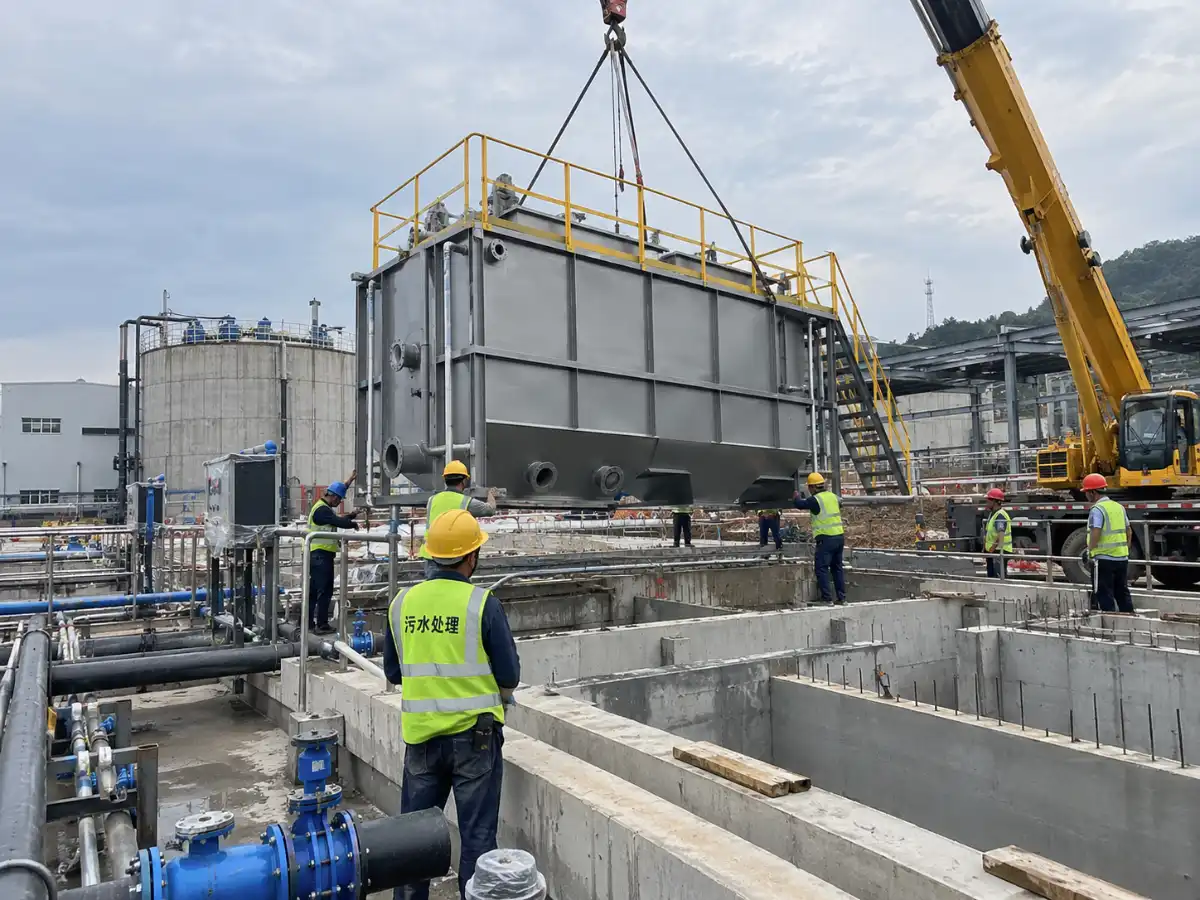
Double-effect systems show up most often in three situations:
- Moderate flow, high salt load. When you need to concentrate 5–20 m³/h of brine or reject stream and you have steam available at reasonable cost.
- Steam is cheap, power is expensive. In plants with waste heat or low-cost boiler steam, double-effect beats MVR on operating cost.
- Feed chemistry limits MVR. Foaming, high boiling point elevation, or corrosive condensate can make a mechanical compressor a bad fit.
I have also seen double-effect used as a pre-concentration stage ahead of a crystallizer in zero liquid discharge trains. It reduces the volume the crystallizer has to handle, which shrinks the downstream equipment and the overall footprint.
Applications I Have Seen Work Well
- Electroplating rinse water and spent plating baths — see a related electroplating wastewater treatment layout.
- Pharmaceutical process streams with high COD and dissolved solids.
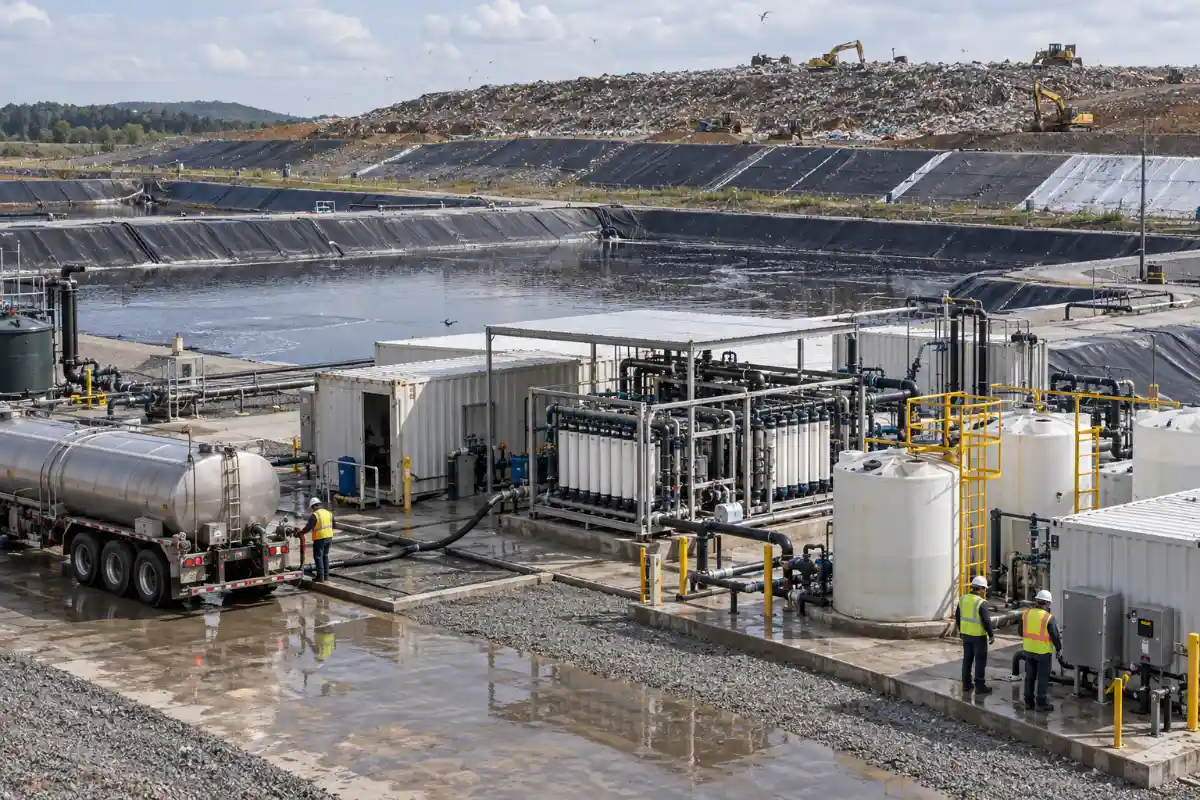
- Landfill leachate after membrane concentration, where the reject stream still carries 30,000–80,000 mg/L TDS.
- Chemical plant mother liquors and wash water.
In each case, the deciding factor was not the evaporation rate. It was whether the feed could be handled without rapid scale formation on the heat transfer surfaces.
Cost Breakdown: What You Are Actually Paying For
Let me put real numbers on the table. The table below reflects indicative ranges I have seen in recent project quotations for standard carbon steel or 316L construction, excluding civil works and site utilities.
| Cost Component | Typical Share of CAPEX | Notes |
|---|---|---|
| Heat exchangers (both effects) | 25–35% | Material choice drives this hard; titanium or duplex can double it |
| Vapor separator and vessels | 10–15% | Size grows with entrainment risk |
| Vacuum system and condenser | 10–18% | Surface condenser vs. direct contact changes the number |
| Pumps, piping, instrumentation | 15–20% | Corrosion-resistant wetted parts add cost |
| Control system and electrical | 8–12% | PLC with trending and alarm history is worth the extra |
| Fabrication, freight, installation | 10–15% | Skid-mounted units cut field labor |
For a 10 m³/h evaporation duty, I would expect a delivered and installed double-effect system to land somewhere between $350,000 and $600,000 in most configurations. Smaller skid units at 2–3 m³/h can come in under $200,000. Large custom systems at 25 m³/h and above with exotic alloys can push past $1 million.
These are planning ranges, not quotations. The only reliable number comes from a feed analysis and a proper heat and mass balance.
Operating Cost: The Part That Surprises People
Steam consumption for a double-effect unit runs roughly 0.55–0.65 kg steam per kg of water evaporated, compared to about 1.1–1.2 kg/kg for a single-effect. That is the headline saving.
But you also need:
- Cooling water for the condenser — typically 20–30 m³ per m³ of condensate, depending on ambient conditions.
- Electricity for pumps and the vacuum system — usually 8–15 kWh per m³ of water evaporated.
- Antiscalant or cleaning chemicals — highly variable, often $0.50–$3.00 per m³ of feed.
- Labor for monitoring, cleaning, and maintenance.
If steam costs $25 per ton, a double-effect unit evaporating 10 m³/h for 6,000 hours per year saves roughly $275,000 annually compared to a single-effect system. That is a compelling payback. But if you have no steam and would need to install a boiler, the math flips in favor of MVR.
Double-Effect vs. MVR vs. Single-Effect: How I Choose
This is the question I get asked most often, and the honest answer is that there is no universal winner. It depends on four things: steam availability, electricity price, feed chemistry, and scale of operation.
| Factor | Single-Effect | Double-Effect | MVR |
|---|---|---|---|
| Steam consumption | High (1.1–1.2 kg/kg) | Medium (0.55–0.65 kg/kg) | Very low (startup only) |
| Electricity demand | Low | Moderate | High (compressor) |
| CAPEX (relative) | Low | Medium | High |
| Fouling tolerance | Good | Moderate | Moderate to poor |
| Best when | Small flow, simple duty | Steam available, moderate flow | Power cheap, steam unavailable |
For a deeper look at the compressor-based alternative, the mechanical vapor compression MVC evaporator page covers the design logic in detail. And if your flow is small enough that a single stage makes more sense, I would point you to the single-effect evaporator overview before committing to a two-effect design.
One more option worth mentioning: triple-effect. If steam is very cheap and you have the plot space, a third effect drops steam consumption to about 0.4 kg/kg. The triple-effect evaporator comparison is worth reviewing if you are evaporating more than 15 m³/h continuously.
Design Details That Drive Real-World Performance
The differences between a system that runs for years and one that becomes a maintenance nightmare usually come down to a handful of design decisions made early.
Heat Exchanger Configuration
Falling film versus forced circulation is the first fork in the road. Falling film gives better heat transfer and lower residence time, which matters for heat-sensitive streams. Forced circulation handles higher solids and scaling feeds but costs more in pumping energy.
I have seen too many projects specify falling film because it looked good on paper, then struggle with frequent cleaning because the feed had a tendency to crystallize on the tube surface. For high-scaling brines, forced circulation with a larger recirculation ratio is usually the safer choice.
Material Selection
Chloride content is the deciding factor. Above 200 mg/L chloride, carbon steel is out. 316L works in many cases, but above roughly 500 mg/L chloride at elevated temperature, you should be looking at duplex stainless or titanium. This single decision can swing CAPEX by 30–50%.
Vacuum and Condensate Handling
Running the second effect under vacuum lowers the boiling point and improves the temperature driving force. But it also means you need a reliable vacuum system and a condenser sized for the worst-case ambient wet bulb temperature. I have seen condensers undersized for summer conditions, and the result is lost capacity every July and August.
Maintenance and Common Operating Problems
Double-effect systems are not high-maintenance in the way a membrane system is, but they have their own failure patterns. Here is what I watch for.
Scaling and Fouling
The first effect runs hottest, so it scales first. If your cleaning interval drops below 400–500 operating hours, something in the design or the pretreatment is wrong. Common causes:
- Insufficient antiscalant dosing or the wrong chemistry for the salt species present.
- Feed chemistry shifted — a new process line upstream, or a change in raw material supplier.
- Concentration factor pushed too high to chase recovery targets.
Foaming and Entrainment
Foaming carries liquid droplets into the vapor line, which fouls the second effect heat exchanger and contaminates the condensate. It is more common with streams containing surfactants, oils, or high COD. Defoamer helps, but the real fix is usually a taller vapor separator or a different feed arrangement.
Oily wastewater is a particular challenge — the evaporation with oily wastewater discussion covers what actually works when free oil is present.
Vacuum Loss and Capacity Drop
If capacity slowly drops over months, check the vacuum system first. Air leaks at flanges, worn seals on the vacuum pump, and condenser fouling are the usual suspects. A 50 mbar rise in second-effect pressure can cut capacity by 10% or more.
Condensate Quality Drift
Condensate conductivity is your early warning system. When it starts climbing, you are entraining liquid. Catch it early and you avoid contaminating a downstream treatment step.
When Double-Effect Is the Wrong Choice
I turn down double-effect proposals more often than you might expect. It is the wrong choice when:
- You have no steam and no cheap way to make it. MVR will win on lifecycle cost every time.
- Your feed has very high boiling point elevation. Salts like sodium hydroxide or certain organic streams raise the boiling point so much that the temperature drop across two effects is not enough to drive the second effect.
- Flow is very small. Below 1–2 m³/h, the added complexity rarely pays back.
- Feed chemistry is unstable. If you cannot predict what is coming in next month, a simpler single-effect or membrane-based approach is more forgiving.
I would rather tell a client to spend less now and avoid a system they will fight with for a decade than sell them a two-effect unit that never runs at design capacity.
What to Prepare Before You Request a Quote
If you are serious about a double-effect evaporator, gather this information first. It will save weeks in the proposal stage and prevent costly design assumptions.
- Complete feed analysis — TDS, TSS, chloride, sulfate, COD, pH, and any specific ions that can scale.
- Flow rate range — minimum, normal, and maximum, plus hours per day of operation.
- Steam availability — pressure, temperature, and cost per ton.
- Electricity cost per kWh and available voltage.
- Target concentration or recovery — what do you need the concentrate and condensate to look like?
- Discharge or reuse requirements for both streams.
- Plot space and elevation constraints.
- Any prior operating experience with evaporators at your site.
With that information, a competent vendor can give you a realistic budget number in days rather than months. Without it, you will get a placeholder figure that means nothing.
A Note on Total Lifecycle Cost
I have watched plants buy on CAPEX and regret it within two years. The pattern is consistent: a cheaper system with thinner heat exchanger tubes, a smaller condenser, or a less capable control system ends up costing more in cleaning chemicals, downtime, and replacement parts than a properly sized unit would have cost upfront.
When you compare quotes, normalize them. Ask each vendor for:
- Expected steam consumption at your specific feed conditions.
- Anticipated cleaning frequency and the cost of a cleaning cycle.
- Warranty terms on heat exchangers and the compressor or vacuum system.
- Spare parts lead time.
- Whether performance guarantees are tied to specific feed conditions.
That last point matters. A performance guarantee that assumes a feed composition you will never actually see is not a guarantee.
Practical Takeaways From the Field
After enough projects, a few things become clear:
- Double-effect evaporators are a strong fit when steam is available and flow is moderate — typically 3 to 20 m³/h.
- The cost range is wide because material selection and feed chemistry dominate the final number.
- Operating cost savings versus single-effect are real and often justify the added capital within 2–4 years.
- MVR beats double-effect when steam is unavailable or electricity is cheap.
- Most operating problems trace back to feed chemistry changes or undersized auxiliary equipment, not the evaporator itself.
If you want a second opinion on a specific stream, our team reviews feed analyses and gives honest feedback on whether double-effect, MVR, or a membrane approach is the better fit. You can reach out to our engineers with your water analysis and we will tell you what we would do in your position.
Frequently Asked Questions
How much does a double-effect evaporator cost?
For a complete installed system, expect roughly $180,000 to $850,000 depending on capacity and materials. Small skid-mounted units at 2–3 m³/h can come in under $200,000, while large custom systems with titanium heat exchangers can exceed $1 million. These are planning ranges — a firm number requires a feed analysis and heat balance.
What is the steam consumption of a double-effect evaporator?
Typically 0.55–0.65 kg of steam per kg of water evaporated, compared to 1.1–1.2 kg/kg for a single-effect unit. Actual consumption depends on boiling point elevation, feed temperature, and how well the second effect is optimized.
When should I choose MVR instead of double-effect?
Choose MVR when steam is not readily available, when electricity is cheap relative to steam, or when your feed chemistry allows a compressor to operate without frequent fouling. If you already have low-cost steam and moderate flow, double-effect usually wins on overall cost.
How often does a double-effect evaporator need cleaning?
With proper antiscalant dosing and stable feed chemistry, cleaning intervals of 500–1,000 operating hours are typical. If you are cleaning more often than every 400 hours, investigate the pretreatment, antiscalant selection, or concentration factor — something is out of balance.
What causes capacity loss in a double-effect evaporator?
The most common causes are vacuum loss from air leaks or a worn vacuum pump, fouling on the first-effect heat exchanger, and entrainment carrying liquid into the second effect. Condensate conductivity and effect pressure trends will tell you which one you are dealing with.
Can a double-effect evaporator handle high-chloride wastewater?
Yes, but material selection is critical. Above roughly 200 mg/L chloride, carbon steel is not suitable. Above 500 mg/L at elevated temperature, duplex stainless or titanium is usually required. This choice can increase CAPEX by 30–50%, so it needs to be made early.
What feed information do I need before requesting a quote?
At minimum: complete ionic analysis, TSS, COD, pH, flow range, operating hours, steam pressure and cost, electricity cost, target concentration, and discharge requirements for both concentrate and condensate. Without this, any quote you receive is a rough placeholder.