

If you are comparing low-temperature wastewater evaporators, the short answer is this: they work by boiling water at roughly 85–140°F (30–60°C) under vacuum, which cuts scaling and corrosion enough to make them practical for brines, leachate, and oily streams that would destroy a conventional boiler-driven system. I have specified and commissioned these units across electroplating, pharmaceutical, and landfill leachate projects, and the buying decision rarely comes down to price alone. It comes down to three things: what is actually in your water, how much you can spend on electricity, and how much operator attention you can realistically give the unit. Get those wrong and the cheapest quote becomes the most expensive machine you will ever own.
What “Low-Temperature” Actually Means in an Evaporator
Every evaporator boils water. The difference is the pressure at which it does so. Drop the pressure inside the vessel and water boils below 212°F (100°C). At 0.1 bar absolute, water boils near 113°F (45°C). At 0.05 bar, you are down around 90°F (32°C).
That single fact changes everything downstream:
- Calcium sulfate and calcium carbonate stop scaling aggressively below about 140°F (60°C).
- Chloride stress corrosion cracking in stainless steel slows dramatically.
- Volatile organics stay in the distillate or the concentrate instead of flashing off.
- Heat pumps and mechanical vapor recompression (MVR) become far more efficient because the compression ratio stays modest.
The trade-off is vacuum hardware. You need a vacuum pump, sealed vessels, and condensers that can handle non-condensable gases. That is real capital cost. Whether it pays back depends on your feed chemistry, not on marketing claims.
Start With the Water, Not the Equipment
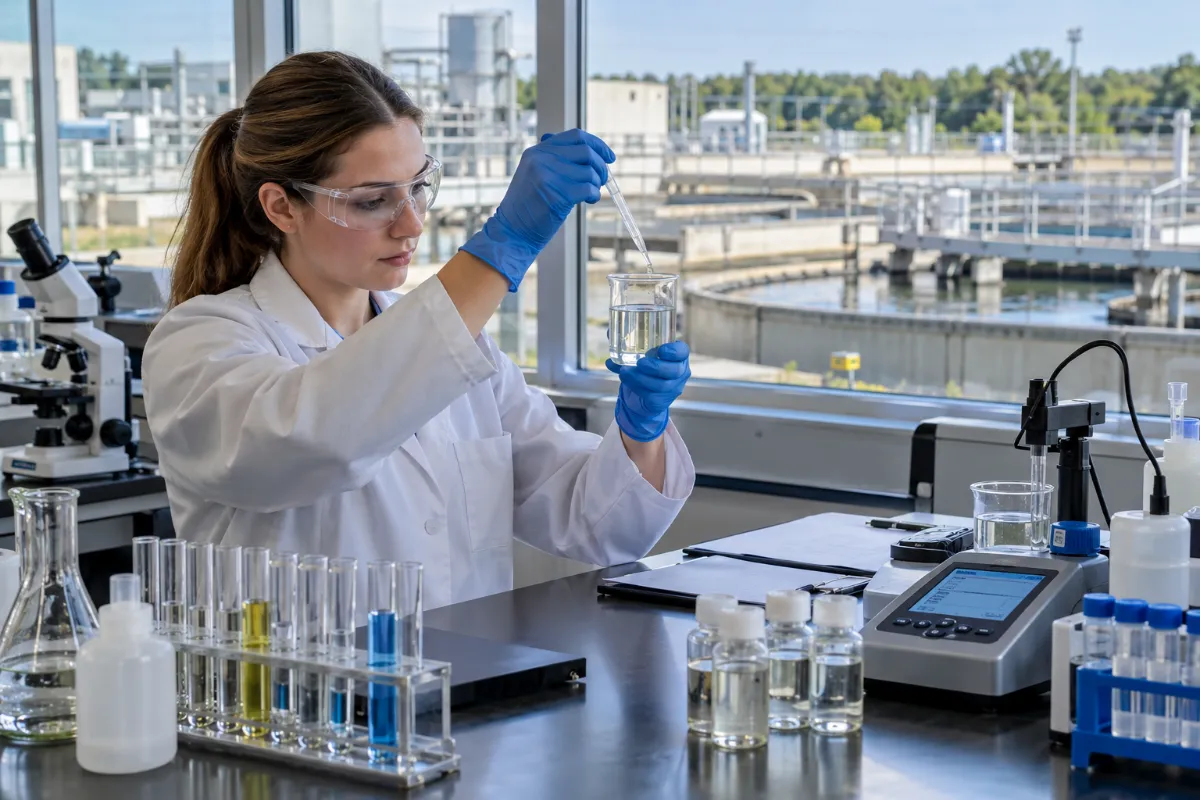
I have watched more projects fail at the sampling stage than at the commissioning stage. Before you talk to any vendor, get a full analysis of your feed stream. Not a pH and TDS reading — a full panel.
The parameters that actually drive selection
| Parameter | Why it matters | Typical concern threshold |
|---|---|---|
| Total dissolved solids (TDS) | Sets boiling point elevation and concentrate handling | >50,000 mg/L needs careful design |
| Hardness (Ca + Mg) | Drives scaling in the heat exchanger | >500 mg/L as CaCO₃ |
| Silica | Forms hard, glass-like deposits | >100 mg/L |
| Chlorides | Corrosion risk to stainless steel | >1,000 mg/L |
| Volatile organics | Carry over into distillate | Any detectable level |
| Oil and grease | Fouls heat transfer surfaces | >50 mg/L |
| Total suspended solids | Plugs distribution and pumps | >100 mg/L |
If your stream is high in suspended solids, you will need pre-treatment — typically a screw press sludge dewatering step or a dissolved air flotation unit — before the evaporator sees it. Evaporators are not filters. They concentrate dissolved solids; they do not remove particulate.
For a deeper look at what actually sits in a difficult stream, this breakdown of what chemicals are in landfill leachate is a useful reference — leachate is one of the hardest feeds you will ever encounter.
Choosing the Right Evaporator Type
There are four families you will see in proposals. Each has a place.
Mechanical Vapor Recompression (MVR / MVC)
This is the workhorse for high-volume industrial duty. A compressor takes the vapor you just generated, squeezes it, and puts the heat back into the boiling liquid. Electrical input replaces steam. Typical specific energy consumption sits in the range of 15–40 kWh per cubic meter of distillate, depending on boiling point elevation and compressor efficiency.
MVR shines when you have steady flow, high TDS, and access to three-phase power. It struggles with very high boiling point elevation and with feeds that fluctuate wildly. Learn more about the mechanical vapor compression MVC evaporator configuration if you are dealing with brine concentration.
Multi-Effect Evaporators
Instead of a compressor, you chain vessels together and reuse the vapor from one effect to heat the next. Two effects roughly halve your steam demand. Three effects cut it to about a third. The trade-off is capital cost and footprint.
Multi-effect units make sense when you have cheap steam and moderate electricity prices. They are common in food, chemical, and pharmaceutical plants where a boiler already exists. Review multi-effect evaporator designs if steam is your primary energy source.
Heat Pump Evaporators
A heat pump evaporator is essentially a closed-loop refrigeration cycle. It is electrically driven, compact, and works well for smaller flows — often under 5 m³/h. The catch is that heat pump efficiency drops as the boiling point elevation rises. Above about 15°F (8°C) of elevation, the compressor starts working hard and the energy advantage evaporates.
Single-Effect Evaporators
Simple, robust, and cheap to build. They consume more energy per unit of distillate than any other type, but they tolerate upset conditions better than anything else. For small streams, batch operation, or pilot work, a single-effect evaporator is often the right call.
Energy: The Number That Decides Everything
Capital cost is a one-time hit. Energy cost is forever. I always run a five-year operating cost model before recommending anything.
Here is a rough comparison for a 10 m³/h system, using indicative ranges only. Real numbers depend on your local power and steam prices, your boiling point elevation, and your uptime.
| Technology | Primary energy | Indicative consumption per m³ distillate | Best fit |
|---|---|---|---|
| MVR / MVC | Electricity | 15–40 kWh | High TDS, steady flow, cheap power |
| Double-effect | Steam + minor power | 0.35–0.5 t steam | Existing boiler, moderate TDS |
| Triple-effect | Steam + minor power | 0.25–0.35 t steam | Large flow, cheap steam |
| Heat pump | Electricity | 25–60 kWh | Small flow, low elevation |
Notice the spread. A poorly designed MVR unit can burn twice the power of a well-designed one on the same duty. The difference is almost always in the heat exchanger design and the compressor selection. The MVC evaporator heat exchangers deserve more scrutiny than most buyers give them.
Materials of Construction
This is where budgets get broken. A low-temperature evaporator is not automatically corrosion-proof just because it runs cool.
- 316L stainless steel — the default for most industrial wastewater. Works well up to about 1,000 mg/L chloride at low temperature.
- Duplex stainless (2205) — better chloride resistance, roughly 1.5–2× the cost of 316L. Worth it above 2,000 mg/L chloride.
- Titanium — excellent for chloride-rich streams and seawater-like brines. Expensive but often the only option for long service life.
- Graphite or PTFE-lined — for highly acidic or fluoride-bearing streams.
Do not let anyone sell you a 316L unit for a stream running 15,000 mg/L chloride and tell you “low temperature solves it.” It does not. It delays the failure. I have seen 316L heat exchanger tubes perforate in under 18 months on high-chloride leachate.
Pre-Treatment: The Part Everyone Underestimates
An evaporator is a concentration device. Everything you feed it either leaves in the distillate, leaves in the concentrate, or stays inside as fouling. Your job is to make sure as little as possible stays inside.
Typical pre-treatment train
- Equalization — smooth out flow and composition swings. A 24-hour buffer tank is usually enough.
- pH adjustment — bring the stream into a range that suits your materials and minimizes scaling.
- Chemical softening — lime or caustic soda plus soda ash to drop hardness below 100 mg/L as CaCO₃.
- Filtration — multimedia or ultrafiltration to catch fines.
- Antiscalant dosing — targeted chemistry for whatever remains.
If you skip softening on a hard feed, you will be cleaning the heat exchanger every two weeks. I have seen that movie. It does not end well.
For streams with very high scaling potential, some designs use membrane concentration first. A DTRO membrane system can concentrate the brine to a fraction of its original volume before the evaporator sees it, which shrinks the evaporator size and the energy bill.
Zero Liquid Discharge: When the Evaporator Is Not the Last Step
If your discharge permit is effectively zero, the evaporator is only part of the story. You need a crystallizer or a spray dryer downstream to turn the concentrate into a solid you can landfill or recover.
This is where zero liquid discharge ZLD systems come in. The evaporator concentrates; the crystallizer finishes the job. The economics of ZLD are brutal — energy and solids handling dominate — so it only makes sense where discharge is genuinely not an option or where you can recover a valuable salt.
If you are considering ZLD, get a full mass balance first. The salt composition determines whether you can sell the solids or pay to dispose of them, and that swing is enormous.
Control Strategy and Automation
The best evaporator in the world will underperform if the control loop is sloppy. The variables that matter most:
- Boiling temperature — held within ±2°F (±1°C). Drift here means either scaling or energy waste.
- Concentration — measured by density, conductivity, or refractive index. Density is the most reliable for brines.
- Vacuum level — tied to boiling temperature. A leaking vacuum system is the most common cause of “the unit is using too much power.”
- Compressor speed or valve position — the primary energy control.
- Antifoam and antiscalant dosing — often overlooked, always important.
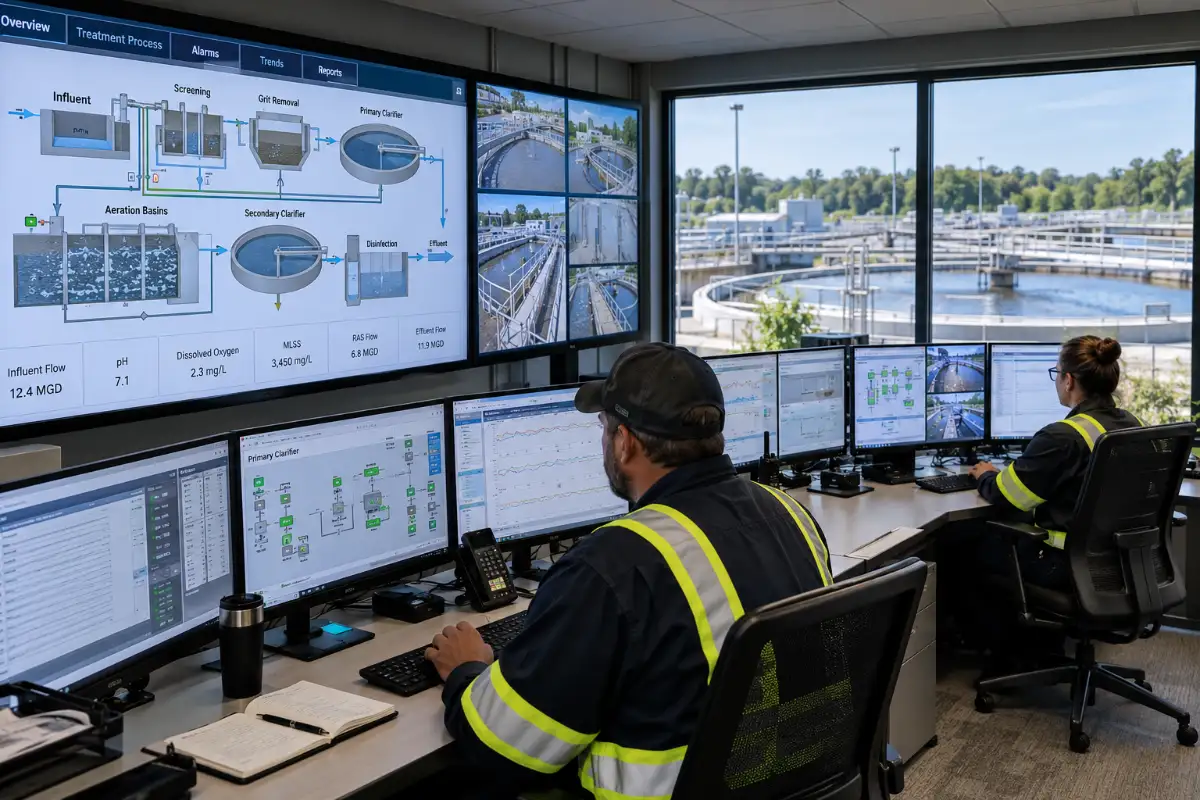
I prefer PLC control with a proper HMI and data logging. Trend data is how you diagnose problems six months later. Without it, you are guessing.
Maintenance Reality
Anyone who tells you a low-temperature evaporator is maintenance-free is selling something. Here is what you will actually be doing:
| Task | Frequency | Notes |
|---|---|---|
| Visual inspection | Daily | Look for leaks, foam, unusual noise |
| Conductivity/density check | Daily | Confirms concentration control |
| Vacuum system check | Weekly | Vacuum pump oil, seal condition |
| Heat exchanger cleaning | 1–6 months | Depends entirely on feed chemistry |
| Compressor service | 6–12 months | Per manufacturer schedule |
| Full inspection | Annually | Tubes, gaskets, instrumentation calibration |
The heat exchanger cleaning interval is the single best indicator of whether your pre-treatment is working. If you are cleaning monthly, something upstream is wrong.
Common Failure Modes and How to Avoid Them
Foaming
Certain organics and surfactants cause violent foaming, which carries liquid into the compressor or condenser. Antifoam dosing usually handles it, but if the feed is consistently foamy, you may need a mechanical foam breaker or a different evaporation approach. This is common with evaporation with oily wastewater.
Scaling on the Heat Exchanger
Almost always a pre-treatment or antiscalant problem. Sometimes it is a design problem — the heat exchanger surface temperature is too high. In low-temperature designs, that should never happen, but I have seen poorly designed units run hot spots.
Carryover of Volatile Organics
If your feed contains solvents, ammonia, or other volatiles, they will end up in the distillate. That may or may not be a problem depending on your discharge limits. If it is, you need either pre-stripping or a post-treatment step on the distillate.
Vacuum Loss
Usually a seal, a gasket, or a vacuum pump issue. It shows up as higher boiling temperature and higher energy consumption. Fix it fast — running with a degraded vacuum is expensive.
Compressor Fouling or Vibration
On MVR units, compressor problems are the most expensive failures. Regular vibration monitoring and oil analysis catch most issues before they become catastrophic.
How to Compare Quotes Without Getting Fooled
When you have three quotes on the table, they will look different. Here is how I level the playing field:
- Ask for the guaranteed specific energy consumption at your design feed composition, with a defined tolerance and a defined penalty if it is missed.
- Ask for the guaranteed distillate quality — TDS, COD, ammonia — with the same penalty structure.
- Ask for the heat exchanger surface area and material in writing. This is where corners get cut.
- Ask for the compressor make and model, not just “high-efficiency compressor.”
- Ask for a reference list of units running on similar feeds for at least two years.
- Ask for the maintenance schedule and expected cleaning frequency based on your specific feed.
If a vendor cannot answer these clearly, that tells you something.
“The cheapest evaporator is the one you only buy once. I have never regretted paying 20% more for a properly sized heat exchanger and a real compressor.” — a commissioning engineer I have worked with for years, on a leachate project that is now in its seventh year of operation.
Site Conditions and Installation
Low-temperature evaporators are not plug-and-play. Plan for:
- Foundation loading — vessels full of brine are heavy. Get structural input early.
- Headroom — multi-effect and MVR units can be tall.
- Power supply — MVR units draw serious current at startup. Verify your transformer capacity.
- Cooling water — condensers need it, or you need an air-cooled alternative.
- Ventilation — if any volatiles are present, the room needs proper air changes.
- Concentrate handling — where does the brine go? Tanker? Crystallizer? This has to be decided before commissioning, not after.
I have seen projects delayed three months because the concentrate disposal route was not locked down. Do that homework first.
When a Low-Temperature Evaporator Is the Wrong Choice
I will be direct: this technology is not for everyone.
- Very low TDS streams — if your TDS is under 5,000 mg/L, reverse osmosis will almost always be cheaper to run.
- Streams with high volatile content — the volatiles end up in the distillate, which may not solve your problem.
- Intermittent, unpredictable flow — evaporators like steady state. Batch operation is possible but expensive.
- Very tight capital budgets with no operating cost concern — rare, but if it applies, a simpler technology may serve you.
If you are not sure which direction to go, the right move is a proper feasibility study with a mass and energy balance. That costs money but saves multiples of it later.
Putting It Together: A Practical Selection Sequence
Here is the sequence I use on every project:
- Full feed characterization over at least two weeks, capturing variability.
- Define the product requirements: distillate quality, concentrate quality, disposal route.
- Screen technologies with a simple mass and energy balance.
- Shortlist two or three evaporator types.
- Request budgetary quotes with specific energy consumption and materials defined.
- Run a pilot if the feed is unusual or the stakes are high.
- Finalize the design with pre-treatment included, not bolted on.
- Plan commissioning carefully — first months set the tone for the unit’s life.
If you want to talk through a specific stream, our engineering team works through these steps with clients regularly. Reach out and describe your feed and flow — we will tell you honestly whether evaporation is the right answer or not.
Frequently Asked Questions
How much does a low-temperature wastewater evaporator cost?
Capital cost varies enormously with flow rate, materials, and technology. A small heat pump unit for 1 m³/h might land in the low six figures in US dollars. A 10 m³/h MVR system with titanium wetted parts and full pre-treatment can run several times that. Operating cost is the bigger variable — electricity or steam consumption dominates the lifetime cost. Always model five-year total cost of ownership, not just purchase price.
What is the difference between MVR and MVC?
They describe the same core process. MVR stands for mechanical vapor recompression; MVC stands for mechanical vapor compression. Both use a compressor to raise the pressure and temperature of the vapor so it can be reused as the heating medium. Some vendors use the terms interchangeably. The key specification is the compressor type, compression ratio, and specific energy consumption.
How often will I need to clean the heat exchanger?
On a well-designed system with proper pre-treatment, cleaning intervals of three to six months are realistic. On a poorly pre-treated feed, you may be cleaning monthly or more. The cleaning interval is the single best indicator of whether your upstream treatment is doing its job. If it is short, fix the pre-treatment rather than accepting the cleaning burden.
Can a low-temperature evaporator handle landfill leachate?
Yes, but leachate is one of the hardest feeds you will encounter. It typically contains high TDS, high ammonia, variable organics, and sometimes heavy metals. A successful leachate evaporator usually needs upstream pH adjustment, softening, and sometimes biological pre-treatment for ammonia. Volatile organics in the distillate are a common issue that requires attention in the design phase.
What happens if the vacuum system fails?
The boiling temperature rises, energy consumption climbs, and if the system is not interlocked properly, you can damage the product or the heat exchanger. Modern control systems should trip the unit on vacuum loss. If your unit does not have that interlock, add it. It is a cheap insurance policy.
Do I need a pilot test before buying?
For unusual or highly variable feeds, yes. A pilot test on your actual water for two to four weeks tells you more than any vendor’s reference list. For well-understood streams like standard brine concentration, a solid design basis with good analytical data is usually sufficient. The decision should hinge on how much uncertainty remains after the sampling program.
How do I choose between MVR and multi-effect evaporation?
Look at your energy prices. If electricity is cheap relative to steam, or if you have no steam available, MVR usually wins. If you already have a boiler and steam is essentially free or low cost, multi-effect can be more economical. Flow rate matters too — MVR scales well to large flows, while multi-effect becomes more attractive as the number of effects increases with size.
What pre-treatment is always required?
At minimum, equalization and filtration. Most industrial streams also need pH adjustment and some form of hardness removal. Antiscalant dosing is common but should not be a substitute for proper softening when hardness is high. Every additional contaminant you remove upstream saves you maintenance downstream.