

If you’re specifying equipment for chemical plant effluent, the short answer is this: there is no single “best” machine. The right wastewater treatment equipment for the chemical industry depends on your effluent’s salt load, COD, solvent content, pH swings, and what your discharge permit actually limits. In my experience, most chemical plants end up with a staged train — pretreatment, biological or advanced oxidation, then a concentration or evaporation step, and finally dewatering. What separates a plant that runs smoothly for a decade from one that becomes a maintenance nightmare is rarely the headline technology. It’s how well the equipment matches the specific waste stream, and how honestly the designer accounted for fouling, corrosion, and turndown.
I’ve commissioned systems on everything from dye intermediates to specialty polymers, and the pattern is consistent. Let me walk you through how I actually think about selection.
Start With the Effluent, Not the Equipment
Every failed project I’ve seen started with someone picking a technology before characterizing the water. Chemical wastewater is not municipal sewage with a different label. It’s usually some combination of:
- High salts — sodium chloride, sulfate, and sometimes ammonium salts from neutralization steps
- Refractory COD — solvents, phenols, amines, and surfactants that resist conventional biological treatment
- Wide pH excursions — batch processes dump acid and caustic at different times of day
- Trace toxics — heavy metals, cyanide, or chlorinated compounds depending on the chemistry
- Variable flow — a batch reactor might discharge 40 m³ in two hours, then nothing for six
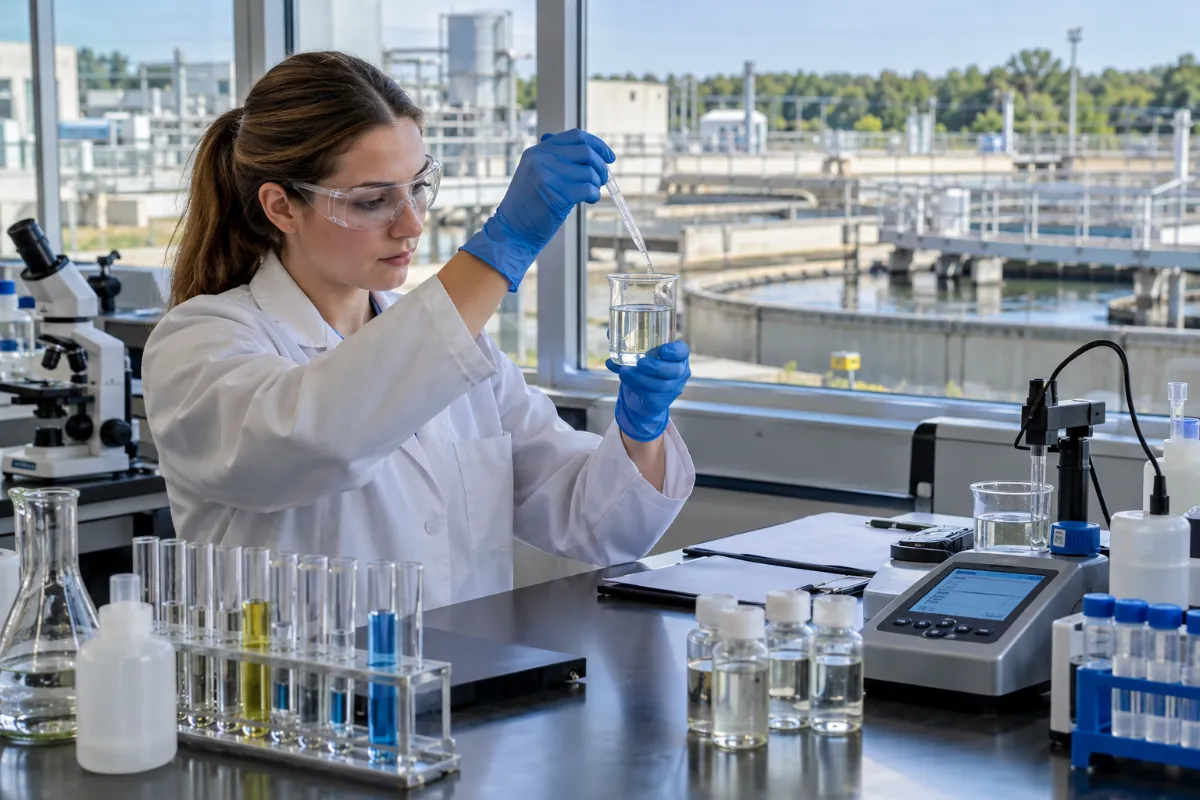
Before I specify anything, I want at least two weeks of composite sampling plus a few grab samples during the worst-case batch. If a client pushes back on the cost of that sampling, I tell them it’s the cheapest insurance they’ll buy on the whole project. You can read a broader primer on what wastewater actually contains if you need to align your team’s vocabulary first.
The Core Equipment Train for Chemical Effluent
Most chemical plants I work with need some version of the following stages. Not every plant needs all of them, but the logic of moving from bulk removal to fine separation to final concentration holds up again and again.
1. Equalization and pH Adjustment
This is unglamorous and it’s where half your operating stability comes from. A properly sized equalization tank — typically 8 to 24 hours of average flow — smooths out batch dumps and protects everything downstream. I size it on peak batch volume, not average daily flow. Add mixing, and pH control with redundant dosing pumps. If your neutralization is sloppy, every membrane and every biological stage downstream pays for it.
2. Primary Treatment: DAF or Chemical Precipitation
For oily or suspended-solids-heavy streams, dissolved air flotation removes fats, oils, and floating solids before they coat your membranes. For metal-bearing streams, hydroxide or sulfide precipitation followed by clarification is still the workhorse. I’ve written a separate walkthrough on DAF sludge thickening if your float layer is the bottleneck.
3. Biological or Advanced Oxidation for COD
If your BOD/COD ratio is above roughly 0.3 and salinity is manageable, an activated sludge or MBBR system can do a lot of the heavy lifting cheaply. Once salinity climbs past about 1.5–2% as chloride, biological activity degrades fast, and you’re better off with advanced oxidation (Fenton, ozone, or catalytic wet oxidation) or thermal treatment. This is a genuine fork in the road, and it’s driven by your chloride number, not by preference.
4. Membrane Concentration
For streams with moderate salinity and low fouling potential, reverse osmosis or DTRO can concentrate the brine and recover permeate for reuse. DTRO handles higher fouling and higher salinity than standard RO because of its open-channel design. If your feed is dirty or scaling-prone, DTRO membrane systems are usually the more forgiving choice. Standard high-pressure RO is fine when the feed is well pretreated and you need to push toward higher recovery.
5. Evaporation and Crystallization
When the brine is too concentrated or too toxic for membranes, or when you’re chasing zero liquid discharge, evaporation takes over. This is where the real engineering trade-offs live. The three families I specify most often are:
- MVC (mechanical vapor compression) — electrically driven, compact, best when power is available and steam is scarce. Very efficient at scale.
- MVR (mechanical vapor recompression) — similar principle, often used interchangeably in the field; the compressor is the heart of the system. Here’s a clean explanation of what an MVR evaporator is if your team is new to the terminology.
- Multi-effect evaporation — steam-driven, and often cheaper to run when you have waste steam available. More stages mean better steam economy but higher capital cost.
For a chemical plant with waste steam from a reactor jacket or boiler, a multi-effect train often wins on lifecycle cost. For a plant with cheap electricity and no steam, MVC usually wins. The heat exchanger design inside these units matters more than most people realize — MVC evaporator heat exchangers are where scaling and corrosion show up first.
6. Sludge Dewatering
Whatever solids you generate — biological sludge, chemical precipitate, or crystallized salt — need to leave the site in a form you can afford to handle. A screw press is my default for most chemical sludges because it handles oily and fibrous material without blinding the way a belt press does. For a detailed comparison, see this screw press dewatering guide. Centrifuges are an alternative when you need higher dryness and can tolerate the maintenance and power draw.
Equipment Comparison at a Glance
The table below reflects typical design ranges I’ve seen across projects. Actual numbers depend heavily on your specific effluent, so treat these as planning figures, not guarantees.
| Technology | Best Fit | Typical Capacity Range | Main Watch-Out | Relative Energy Demand |
|---|---|---|---|---|
| DAF | Oily/suspended solids removal | 5–500 m³/h | Chemical dosing tuning | Low |
| Chemical precipitation | Metals, phosphate, fluoride | 5–300 m³/h | Sludge volume | Low |
| MBBR / activated sludge | Biodegradable COD, low salinity | 10–2,000 m³/d | Salinity shock, toxics | Medium |
| DTRO / high-pressure RO | Brine concentration, reuse | 5–200 m³/h | Scaling, membrane life | Medium–High |
| MVC / MVR evaporator | High-salinity brine, ZLD | 1–100 m³/h | Compressor wear, scaling | High (electric) |
| Multi-effect evaporator | High-salinity brine with waste steam | 2–150 m³/h | Steam cost, tube fouling | High (thermal) |
| Screw press | Oily/fibrous sludges | 0.5–50 m³/h sludge | Polymer selection | Low |
How I Actually Choose Between MVC, MVR, and Multi-Effect
This is the question I get asked most, and the honest answer is that the decision usually comes down to your site’s energy balance, not the equipment spec sheet.
If you have a boiler and waste steam, multi-effect evaporation is often the lowest operating cost, especially at three effects or more. Steam economy roughly doubles from single to double effect, and again from double to triple, though with diminishing returns and rising capital cost. For a plant with a 5 t/h waste steam surplus, this is a no-brainer.
If you don’t have steam but you do have reliable electricity, MVC or MVR wins. The compressor does the work of the second and third effects without needing additional heat input. This is why MVC is the default for remote sites or plants that have moved away from steam boilers. If you want the deeper engineering, this overview of MVR technology covers the thermodynamics without overselling it.
For zero liquid discharge, you almost always need a hybrid: membranes to concentrate as far as they can go, then evaporation and crystallization to finish the job. A ZLD system that relies on evaporation alone is usually three to five times more expensive to run than one that lets the membranes do their share first.
“The most common mistake I see in chemical wastewater design is oversizing the evaporator and undersizing the pretreatment. The evaporator is the visible, expensive piece, so it gets all the attention. But every hour your evaporator spends fighting scale is an hour of lost capacity you paid for and can’t use.”
Real-World Selection Logic: Three Scenarios
Scenario A: Specialty Chemical Plant, High Salinity, Low COD
A plant producing inorganic salts discharges 80 m³/d of brine at 4% chloride with minimal organics. Membranes alone can’t reach the required concentration, so the train is: equalization → softening → high-pressure RO to about 8% → MVC evaporator to crystallize the remaining brine. The RO step cuts evaporator duty by roughly 60%, which pays for itself in under two years on energy alone. The crystallized salt goes to a licensed handler.
Scenario B: Pharmaceutical Intermediates, High COD, Moderate Salt
Here the problem is refractory organics, not salt. The train is: equalization → Fenton oxidation → MBBR → DAF for biomass → sludge dewatering. Evaporation isn’t needed unless the site is under ZLD pressure. The Fenton step is expensive on reagents, so I always ask whether upstream process changes can reduce the solvent load first. Sometimes they can.
Scenario C: Dye/Intermediate Plant with Mixed Waste
Mixed streams — some high salt, some high COD — get segregated. High-COD streams go to biological treatment after pretreatment. High-salt streams go directly to evaporation. Mixing them is the single most expensive mistake I see, because you end up treating everything at the cost of the worst stream. Segregation costs a bit of piping and a few extra tanks. It saves you a fortune in operating cost.
Energy, Cost, and Lifecycle Thinking
Capital cost is the easy number to compare. Operating cost is what actually decides whether the project succeeds, and it’s dominated by three things: electricity, steam, and chemicals.
As a rough planning range, thermal evaporation consumes 0.3–1.2 kWh of electrical equivalent per kilogram of water evaporated depending on the configuration, while MVC typically lands in the 15–40 kWh/m³ range for the compressor alone. Multi-effect with waste steam can be dramatically cheaper if the steam is genuinely surplus. I always ask the client to price their steam and electricity at the marginal cost, not the blended rate, because that’s the number that actually drives dispatch decisions.
Chemicals — antiscalant, polymer, pH adjusters, oxidants — often run 10–20% of total operating cost and are the easiest place to find savings through better dosing control. Membrane replacement is the other big recurring cost, typically every three to seven years depending on feed quality and cleaning discipline.
If you want a more detailed breakdown of the cost drivers on the evaporator side, this analysis of MVR evaporator capex and opex is worth reading before you budget.
Maintenance and the Failure Modes That Actually Bite
Every technology has a characteristic failure mode. Knowing them in advance is how you design for maintainability instead of reacting to shutdowns.
- Evaporators: scaling on heat transfer surfaces, compressor bearing wear, and corrosion at the vapor/liquid interface. Design for CIP and keep spare heat exchanger bundles.
- Membranes: biofouling, calcium sulfate scaling, and oxidation damage from over-aggressive cleaning. Track normalized flux weekly, not monthly.
- Biological systems: salinity shock from a batch dump, toxic inhibition, and sludge bulking. Equalization and a toxicity early-warning sensor pay for themselves.
- Screw presses: polymer over-dosing, screen wear, and inconsistent feed consistency. Automate the polymer make-down.
- Pumps: chemical attack on seals and impellers. Material selection matters more than brand. If you’re comparing options, this guide to wastewater pumps covers the material and seal decisions well.
One habit I’ve adopted on every project: build a “first 90 days” commissioning checklist that includes a fouling baseline, a cleaning trial, and a spare parts audit. Plants that skip this step spend their first year firefighting.
Regulatory Context Worth Knowing
Discharge limits for chemical effluent vary widely by jurisdiction, but the underlying logic is consistent. The U.S. EPA sets technology-based effluent guidelines for many chemical manufacturing categories, and the World Bank’s environmental, health, and safety guidelines for chemicals manufacturing give useful benchmark ranges for COD, ammonia, and metals. If you’re designing for a specific permit, work backward from the permit limits, not from a generic target. A general overview of wastewater discharge standards is a reasonable starting point, but the permit is the document that matters.
For ZLD projects, the driver is often a local zero-discharge mandate rather than a numeric limit. In those cases, the design must produce a solid residue and a reusable water stream, and the economics live or die on how much you can concentrate before the evaporator.
Designing a chemical wastewater system and want a second opinion?
Send us your water analysis and flow data. We’ll review the train logic, flag the likely fouling and corrosion risks, and tell you honestly where the design should be simplified.
Frequently Asked Questions
What’s the single most important piece of equipment in a chemical wastewater train?
Equalization. It’s not exciting and it doesn’t show up in a glossy brochure, but a properly sized and mixed equalization tank is what makes every downstream unit work as designed. Without it, your biological system sees shock loads, your membranes see pH swings, and your evaporator sees inconsistent feed. I’ve never regretted oversizing equalization; I’ve regretted undersizing it many times.
How do I decide between MVC and multi-effect evaporation?
Look at your site’s energy balance. If you have surplus waste steam, multi-effect is usually cheaper to operate, especially at three effects or more. If you don’t have steam but have reliable electricity, MVC or MVR wins. The crossover point depends on your marginal steam and power prices, so run the numbers with both. Don’t assume one is universally better.
Can I use standard RO instead of DTRO for chemical effluent?
Sometimes, but only if the feed is well pretreated and the fouling and scaling potential is low. DTRO tolerates higher suspended solids, higher salinity, and more aggressive chemistry because of its open-channel design. For dirty or high-salinity streams, DTRO almost always has a lower lifecycle cost despite the higher membrane price. For clean, well-controlled feeds, standard high-pressure RO is fine and cheaper upfront.
What causes the most unplanned downtime in these systems?
In my experience, it’s scaling and fouling on heat transfer surfaces and membranes, followed by compressor issues on MVC/MVR units. Both are largely preventable with proper pretreatment, antiscalant dosing, and a disciplined cleaning schedule. The plants that struggle are usually the ones that treat cleaning as a response to a problem rather than a scheduled activity.
How much does a chemical wastewater treatment system cost?
It varies enormously with capacity, effluent complexity, and discharge requirements. A small pretreatment and biological train might land in the low six figures, while a full ZLD system with evaporation and crystallization can run into the millions. The honest answer is that you need a water analysis and a defined discharge target before anyone can give you a meaningful number. Be wary of vendors who quote before seeing your data.
Is zero liquid discharge always the right answer?
No. ZLD is the right answer when regulations require it, when water reuse is genuinely valuable, or when discharge is physically impossible. But it’s energy-intensive and capital-heavy, and it’s often cheaper to treat to a tight discharge limit than to evaporate everything. I always ask clients to compare the lifecycle cost of ZLD against the lifecycle cost of compliance with a conventional train before committing.
What pretreatment do evaporators actually need?
At minimum, remove suspended solids, control pH, and soften or dose antiscalant to prevent scaling on heat transfer surfaces. Oil and grease must be essentially eliminated. If your feed has volatile organics, you may need to strip them first, because they’ll concentrate in the distillate and create a separate disposal problem. Pretreatment is where evaporator performance is won or lost.
If you’re still at the conceptual stage, the most useful thing you can do is get a thorough water analysis and a clear discharge target. Everything else — technology selection, sizing, cost — flows from those two inputs. Get them right, and the equipment choices become much clearer.