

Designing a battery recycling wastewater treatment system is not the same as specifying a conventional industrial treatment train. The feed is a moving target — lithium, nickel, cobalt, manganese, fluoride, sulfate, and residual organics from electrolyte and binder breakdown all show up in the same stream, and the ratios shift with every incoming battery chemistry. In my experience, the treatment train has to be built around three questions: what can be recovered, what has to be destroyed, and what has to be concentrated to a manageable volume. Get those three answers right and the rest of the design — membrane staging, evaporation duty, sludge handling — falls into place. This guide walks through how I approach that design logic, the process blocks that actually work, and where projects typically go wrong.
What Makes Battery Recycling Wastewater Different
Most industrial wastewater problems come down to one or two dominant contaminants. Battery recycling effluent is different because it is a mixed matrix by nature. A typical hydrometallurgical recycling line produces several distinct streams that often get combined before treatment, and that combination is usually the first mistake.
The main contributors I see:
- Leachate and raffinate from acid or alkaline leaching — high sulfate or chloride, dissolved nickel, cobalt, manganese, lithium, and sometimes copper and aluminum.
- Fluoride-bearing streams from electrolyte residue and separator processing, which behave very differently from the metal-bearing streams.
- Wash water and rinse water from cathode/anode material handling, usually lower concentration but high volume.
- Organic load from electrolyte solvents, binders, and plastic separator fragments — this is what fouls membranes and drives foaming in evaporators.
- Suspended solids — graphite fines, carbon black, and metal hydroxide particles that are slow to settle.
Because the composition is variable, a design based on a single “average” water analysis will fail. I always ask for a range: minimum, typical, and maximum concentrations for each key parameter, plus a realistic estimate of how the mix changes when the plant runs different feedstock batches. That range drives every downstream sizing decision.
Starting With Segregation, Not Treatment
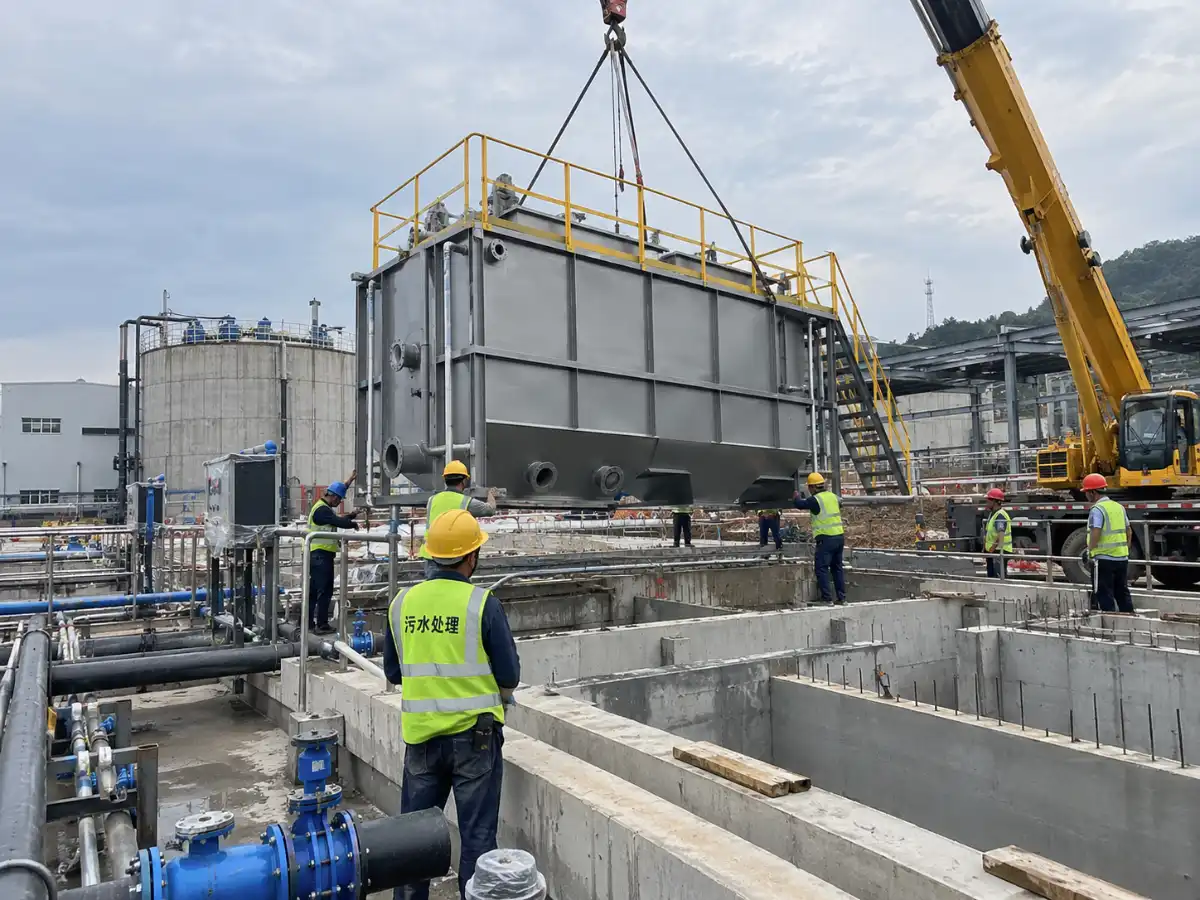
The cheapest treatment step is the one you don’t need. Before specifying any equipment, I look at whether the streams can be kept separate at the source. Segregating high-fluoride water from high-metal water, for example, lets you treat each with a simpler, more targeted process instead of a combined train that has to handle both.
Practical segregation rules I use:
- Keep fluoride-bearing streams separate — they need calcium precipitation or specialized media, and they interfere with metal hydroxide settling.
- Keep high-organic streams separate — they should go to oxidation or biological treatment before they reach membranes or evaporators.
- Keep high-salinity streams separate — they are candidates for evaporation or high-pressure membrane concentration, not for dilution into a large low-salinity flow.
- Combine only what genuinely shares a treatment chemistry.
This step alone often reduces the required evaporator capacity by 30–50% compared to a combined-stream design, because you are only concentrating the small high-salinity fraction instead of the whole plant flow.
Process Selection: Matching Technology to Stream Type
Once streams are segregated, each one gets its own treatment logic. The table below summarizes how I typically match process blocks to stream characteristics. These are indicative ranges and the actual selection depends on flow, concentration, discharge limits, and site constraints.
| Stream Type | Primary Treatment | Polishing / Concentration | Typical Design Range |
|---|---|---|---|
| Metal-bearing rinse water | Chemical precipitation + clarification | Filtration, ion exchange | pH 8.5–10.5 for hydroxide precipitation |
| High-fluoride stream | Calcium precipitation | Media adsorption | Target <10–15 mg/L F⁻ before discharge |
| High-salinity raffinate | Pre-treatment + softening | Membrane concentration, evaporation | Concentrate to 15–25% solids before crystallization |
| Organic-laden wash water | Advanced oxidation or biological | Membrane bioreactor, activated carbon | COD reduction of 70–90% typical |
| Mixed concentrated reject | Softening + deaeration | Evaporation to ZLD | Evaporator recovery 85–95% of feed as distillate |
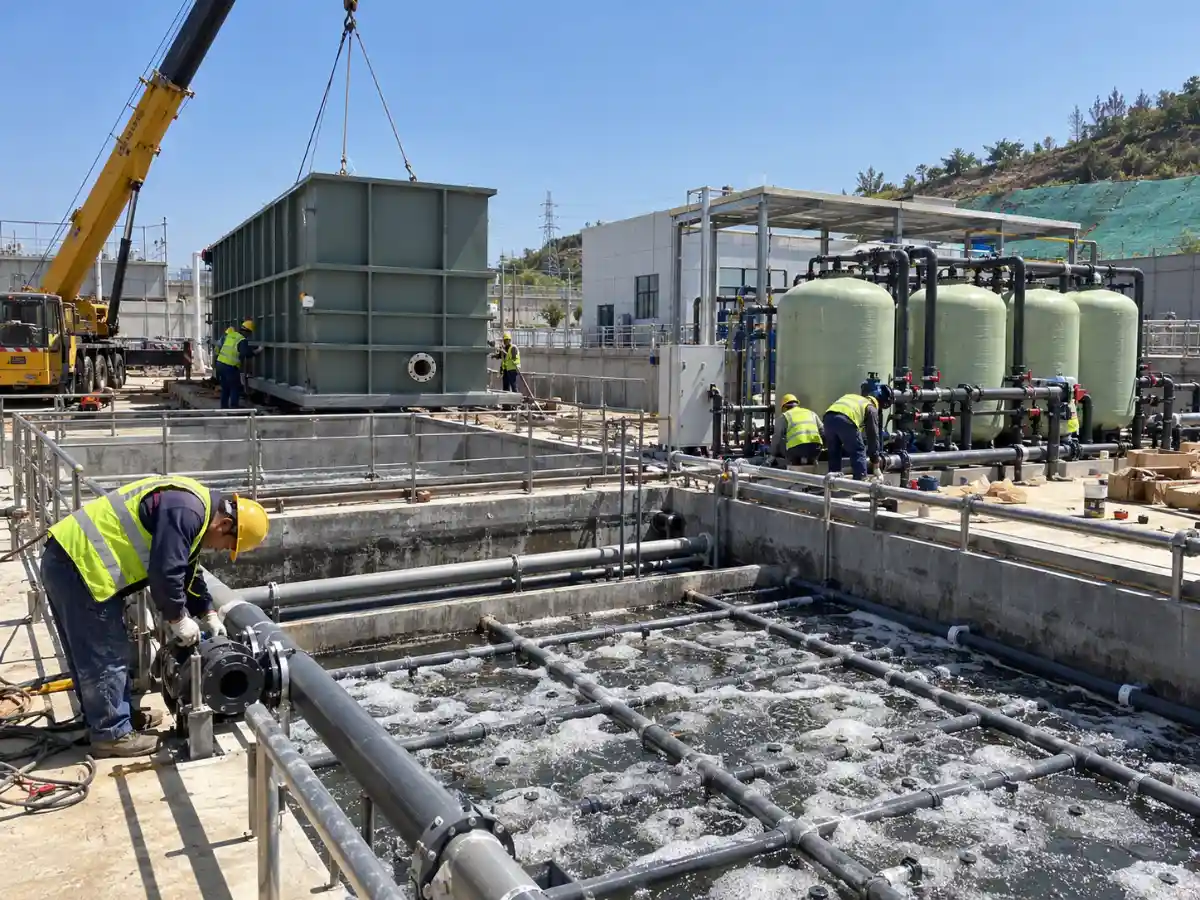
For the concentration and zero liquid discharge (ZLD) stages, the choice between membrane and thermal approaches is usually the biggest cost decision in the project. High-pressure membrane systems such as DTRO membrane systems can push concentration further than conventional RO and reduce evaporator load, but they need robust pre-treatment to survive the fouling potential of this water.
Membrane Concentration: Where It Helps and Where It Hurts
Membranes are attractive because they concentrate without phase change, so energy consumption is low compared to evaporation. In battery recycling water, though, membranes face three specific challenges:
- Scaling from calcium, magnesium, and silica — especially if softening is incomplete.
- Organic fouling from electrolyte residues and binder breakdown products.
- Oxidative damage if upstream oxidation leaves residual oxidant in the feed.
My rule of thumb: membranes are a concentration tool, not a treatment tool. They should sit after precipitation, filtration, and — where organics are present — after oxidation and carbon polishing. If you try to run raw leachate straight to a membrane skid, you will spend more on cleaning chemicals than you save on evaporator duty.
Where the salinity is very high and the organic load is low, high-pressure RO or high-pressure RO membrane configurations can recover a meaningful fraction of the water before the thermal stage. The exact recovery depends on osmotic pressure limits and the scaling tendency of the concentrate, so it has to be verified with bench or pilot testing rather than assumed.
Evaporation and Crystallization: The Backbone of ZLD
When discharge limits are tight or the site has no sewer option, evaporation becomes the core of the system. The two main approaches are mechanical vapor recompression (MVC/MVR) and multi-effect evaporation. Both work; the choice depends on energy cost, steam availability, and scale.
MVC vs. Multi-Effect: How I Decide
MVC uses a compressor to recompress the vapor and reuse its latent heat. It runs on electricity and needs no steam supply, which makes it a good fit for sites without a boiler. Multi-effect evaporators use steam in a cascade of effects and can be more economical when low-cost steam is available and the plant is large.
Key trade-offs I weigh:
- Energy source: MVC is electric; multi-effect is steam-driven.
- Scale: MVC tends to be favored for small to mid-size duties; multi-effect for larger duties where steam is cheap.
- Turn-down: MVC handles variable flow better in many cases.
- Maintenance: MVC has a compressor to maintain; multi-effect has more heat exchangers and pumps.
For a deeper comparison of the compressor-driven route, the mechanical vapor compression MVC evaporator overview is a useful reference. And if steam is available, a multi-effect evaporator arrangement is often the lower-operating-cost choice at higher capacities.
Pre-Treatment Before the Evaporator Is Non-Negotiable
I have seen more evaporator failures caused by poor pre-treatment than by any mechanical defect. Before feed enters the evaporator, it should be:
- Softened to remove hardness that would scale the heat exchanger surfaces.
- Deaerated to remove dissolved oxygen and carbon dioxide that drive corrosion.
- Filtered to remove suspended solids that would foul the distribution system.
- Adjusted for pH to keep the concentrate within the material’s corrosion envelope.
The heat exchanger design itself matters enormously. For high-chloride or high-fluoride concentrates, material selection (duplex stainless, titanium, or higher alloys) and the choice of falling-film versus forced-circulation configuration determine whether the unit runs for years or months between cleanings. The MVC evaporator heat exchanger design guide covers the material and configuration trade-offs in more detail.
Sludge and Solids Handling
Battery recycling wastewater produces two solid streams: the metal hydroxide sludge from precipitation, and the crystallized salt from the evaporator/crystallizer. Both need to be dewatered and handled.
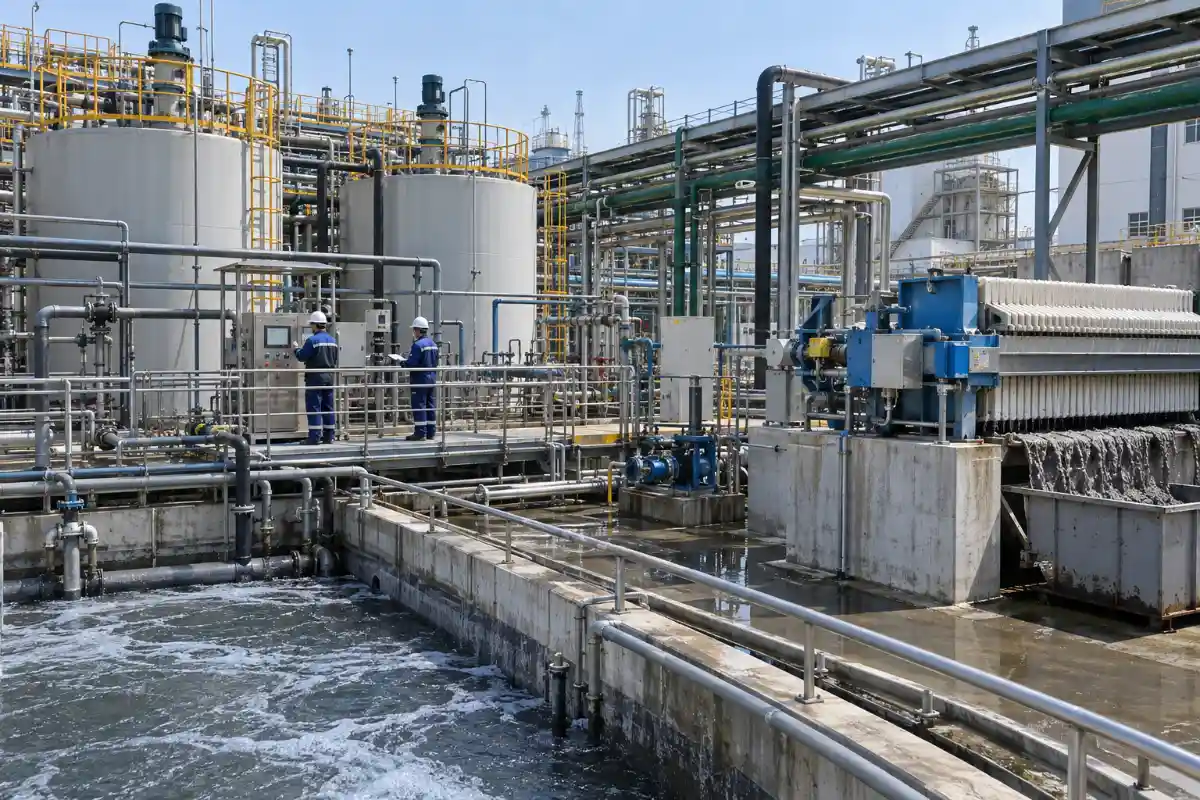
For the hydroxide sludge, a screw press sludge dewatering unit is often a good fit because it handles variable solids loading and produces a consistent cake without the operator attention that a filter press demands. The choice between screw press, belt press, and filter press usually comes down to cake dryness target, solids characteristics, and available operator time.
For the crystallized salt, the key design question is whether the salt can be sold, reused, or must be landfilled as hazardous waste. That decision affects the crystallizer design, the purity targets, and the overall project economics more than almost any other factor.
Energy, Cost, and Lifecycle Considerations
The operating cost of a battery recycling wastewater system is dominated by three items: evaporation energy, membrane cleaning and replacement, and sludge/salt disposal. Capital cost is significant, but over a 10-year horizon, the operating side usually wins.
Indicative cost drivers I track:
- Evaporation energy: MVC typically consumes 15–40 kWh per m³ of distillate, depending on feed concentration and compressor efficiency. Multi-effect steam consumption is often 0.3–0.5 kg steam per kg of water evaporated for a triple-effect arrangement, but this varies widely.
- Membrane replacement: Expect 2–5 year service life for RO elements in this service if pre-treatment is good; much shorter if it is not.
- Chemical consumption: Precipitation, softening, and cleaning chemicals are a recurring line item that is easy to underestimate.
- Disposal: Hazardous sludge and salt disposal costs vary enormously by jurisdiction and can dominate the operating budget.
I always build a simple lifecycle model before finalizing the process flow. If two process options have similar capital cost but different operating cost, the one with lower operating cost usually wins over a 10-year horizon — unless the site has a specific constraint (no steam, limited power, limited space) that rules one out.
Common Design Mistakes I See
After working on enough of these projects, the same mistakes show up again and again:
- Designing to a single water analysis. The feed varies; the design must handle the range.
- Combining incompatible streams. Mixing fluoride with metal-bearing water makes both harder to treat.
- Under-sizing pre-treatment. The evaporator and membranes are only as good as what feeds them.
- Ignoring turndown. Recycling plants rarely run at a constant rate; the system has to handle low-flow periods without scaling or fouling.
- Forgetting the salt disposal plan. If there is no home for the crystallized salt, the ZLD system is not actually closed.
- Skipping pilot testing. Bench or pilot work on the actual water is the cheapest insurance in the project.
“The most expensive mistake in battery recycling wastewater design is treating it like a conventional metal finishing effluent. The chemistry is different, the variability is different, and the recovery targets are different. Design for the range, not the average.”
Regulatory frameworks matter here too. Discharge limits for metals, fluoride, and salinity vary by jurisdiction, and the U.S. EPA’s effluent guidelines for battery manufacturing and metal finishing provide a useful reference point for what “treated” actually means. The World Bank’s environmental, health, and safety guidelines for water and wastewater also give practical benchmarks for discharge quality and treatment expectations. These are the documents I check first when a client asks what the treated water needs to meet.
Putting It Together: A Practical Design Sequence
When I start a new battery recycling wastewater project, I work through this sequence:
- Characterize the water. Get min/typical/max for every key parameter, and understand how the mix changes with feedstock.
- Segregate at the source. Separate fluoride, organic, and high-salinity streams before treatment.
- Define the discharge or reuse target. This drives everything downstream.
- Select the treatment blocks per stream. Precipitation, oxidation, membrane, evaporation — matched to stream chemistry.
- Size the concentration stage. MVC or multi-effect, with pre-treatment that actually protects the heat exchangers.
- Plan the solids. Sludge dewatering and salt crystallization/disposal.
- Model lifecycle cost. Compare options on a 10-year basis, not just capital cost.
- Pilot test. Verify the design on real water before committing to full scale.
If you are working through a design and want a second opinion on the process flow or the concentration stage, my team and I are happy to review the water analysis and talk through the options. You can reach out here with your project details.
FAQ
What is the biggest challenge in battery recycling wastewater treatment?
The variability of the feed. Unlike a conventional plating line or a municipal plant, battery recycling water changes composition with every feedstock batch. The design has to handle a range of concentrations and ratios, not a single average value. That is why segregation and flexible process control matter more here than in most industrial wastewater projects.
Should I use MVC or multi-effect evaporation for my system?
It depends on your energy source and scale. MVC runs on electricity and needs no steam, which suits sites without a boiler and small to mid-size duties. Multi-effect evaporators use steam and tend to be more economical at larger capacities when low-cost steam is available. I usually model both on a lifecycle basis before deciding.
How much pre-treatment does the evaporator need?
More than most people expect. Softening to remove hardness, deaeration to control corrosion, filtration for suspended solids, and pH adjustment are all standard. Skipping any of these shortens the time between cleanings and can damage the heat exchangers. The pre-treatment cost is small compared to the cost of an evaporator shutdown.
Can I discharge treated battery recycling wastewater to a municipal sewer?
Sometimes, but it depends on the local limits and the treatment level you achieve. Metals, fluoride, and salinity are the usual limiting parameters. In many cases, the salinity is too high for sewer discharge without further concentration, which is why ZLD or near-ZLD designs are common for this type of water. Check the local discharge limits before finalizing the process flow.
How often will membranes need to be replaced?
With good pre-treatment, RO elements in this service typically last 2–5 years. With poor pre-treatment — especially if organics or oxidants reach the membrane — that can drop to a year or less. Membrane replacement cost is a significant operating line item, so pre-treatment design has a direct financial return.
What happens to the salt produced by the crystallizer?
That depends on its purity and your local regulations. Some facilities can sell or reuse the mixed salt; others must landfill it as hazardous waste. The disposal path should be decided during design, because it affects the crystallizer specification and the project economics. A ZLD system without a salt disposal plan is not really closed.
Do I need to pilot test before building a full-scale system?
Yes, if the water is variable or the process is novel for your site. Pilot testing on real water is the cheapest way to confirm the process flow, verify membrane and evaporator performance, and catch fouling or scaling issues before they become capital problems. I consider it essential for any battery recycling project with a ZLD requirement.