

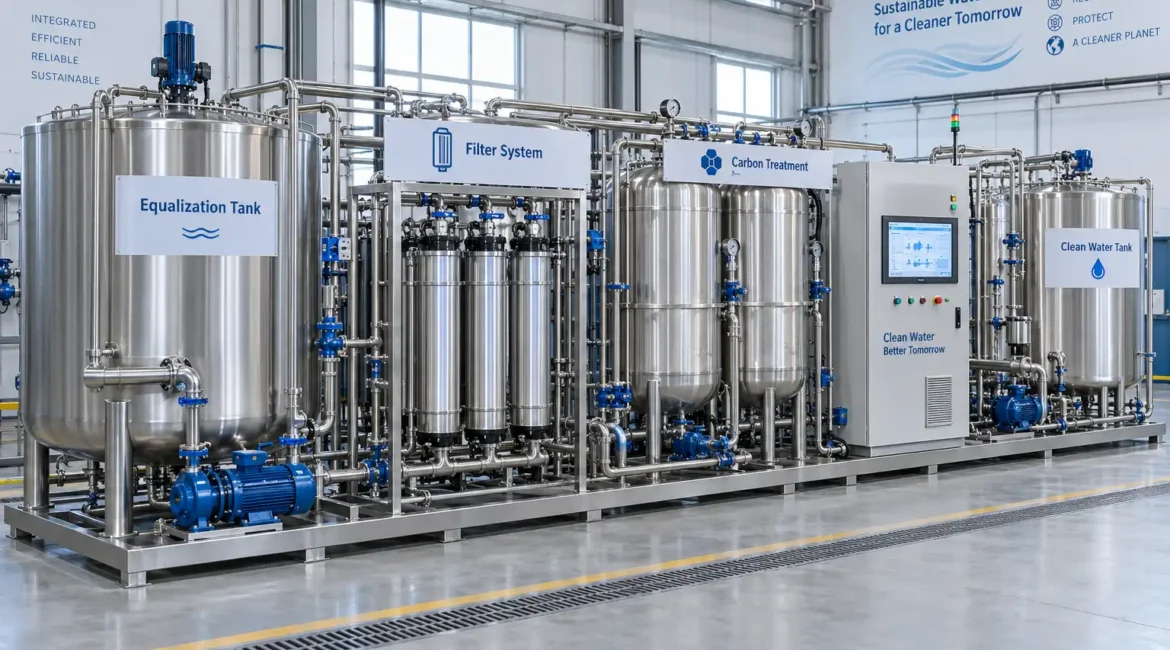
If you’re sourcing an MVR evaporator, the short answer is this: choose a manufacturer that can show you real thermodynamic calculations, actual compressor selection data, and a reference list you can call — not just a catalog with glossy photos. Mechanical vapor recompression is not a commodity product. Two vendors can quote the same evaporating capacity and deliver systems that behave completely differently after six months of operation. I’ve watched plants go from smooth operation to weekly shutdowns because the compressor was undersized for the boiling point elevation, or because the heat exchanger surface area was trimmed to win the bid. This article walks through what actually separates a competent MVR evaporator manufacturer from a fabricator, and how to evaluate them before you sign anything.
What an MVR Evaporator Manufacturer Actually Does
There’s a lot of confusion in the market about what “manufacturer” means. Some companies assemble skids from bought-in compressors and heat exchangers. Others design the entire thermal cycle, select or build the compressor, fabricate the heat exchangers, and write the control logic. The difference matters enormously when something goes wrong at 2 a.m.
A real MVR manufacturer owns four things:
- Thermal process design — the mass and energy balance, boiling point elevation calculation, and compression ratio selection.
- Compressor engineering — either in-house manufacturing or a deep, documented partnership with a compressor OEM, including impeller or screw mapping for your vapor conditions.
- Heat exchanger fabrication — material selection, fouling allowance, and surface area that isn’t cut to the bone.
- Control philosophy — the PLC and HMI logic that keeps the system stable across feed variations.
If a vendor outsources three of those four, you’re buying a system integrator, not a manufacturer. That’s not automatically bad, but you should price it accordingly and understand where the accountability sits.
Why the Compressor Decision Defines Everything
The compressor is the heart of an MVR system. It takes the vapor you just evaporated and recompresses it to a higher pressure and saturation temperature, so it can be reused as the heating medium. Get this wrong and the whole plant suffers.
There are two main families: centrifugal (turbo) compressors and positive displacement types, mostly screw or Roots blowers. The choice depends on your evaporating rate, compression ratio, and vapor quality.
| Parameter | Centrifugal Compressor | Screw / Roots Compressor |
|---|---|---|
| Typical evaporating capacity | Larger systems, roughly 5–100+ t/h | Smaller to mid-range, roughly 0.5–20 t/h |
| Compression ratio per stage | Modest, often 1.1–1.5 | Higher, can exceed 1.8–2.0 |
| Turndown flexibility | Good with variable speed drive | Good, but efficiency drops at low load |
| Sensitivity to entrained droplets | High — droplets erode impellers | Moderate — more tolerant |
| Maintenance profile | Lower routine maintenance, higher repair cost | More routine maintenance, simpler repairs |
| Best fit | Clean vapor, steady large loads | Variable loads, higher boiling point elevation |
Ask any candidate manufacturer to explain why they chose a specific compressor for your duty. If the answer is “that’s what we always use,” walk away. The right answer references your boiling point elevation, your required temperature lift, and your vapor cleanliness.
Heat Exchanger Design: Where Cheap Systems Hide Their Problems
The evaporator heat exchanger is where the actual heat transfer happens, and it’s the first place a low-cost manufacturer cuts corners. Surface area is expensive. Reducing it by 15% saves the vendor real money and costs you throughput and cleaning frequency for the next decade.
Two design points I always check:
Fouling allowance
Your wastewater will scale. It’s not a question of if. A serious manufacturer builds in a fouling factor and designs for a realistic cleaning interval — often measured in weeks, not days. Ask what fouling resistance they assumed and why.
Material and geometry
For aggressive streams — high chloride, high organic load, or abrasive solids — the tube material and flow configuration matter. Falling film designs handle some duties well; forced circulation handles others. The manufacturer should be able to justify the geometry against your specific stream, not just quote a standard model.
You can read more about how heat exchanger selection interacts with overall system performance in this guide to MVC evaporator heat exchangers.
Evaluating a Manufacturer: A Practical Checklist
When I screen vendors, I use a fixed set of questions. The answers tell me more than any brochure.
- Can you share a sample heat and mass balance for a similar duty? A real manufacturer will have these on file and can redact client details.
- What’s your compressor OEM, and can I speak with their application engineer? Hesitation here is a red flag.
- How many units of this size and type are in operation? Not total units shipped — this specific configuration.
- What’s the typical cleaning interval your customers report? Vague answers mean they don’t track field data.
- Who commissions the system, and who trains my operators? Factory commissioning by the design engineer is worth more than a local subcontractor.
- What spare parts do you recommend stocking, and what’s the lead time?
- Can I visit a running installation? The best vendors say yes without flinching.
That last one is non-negotiable for me on any system above a certain capacity. Watching a unit run, talking to the plant operator, and asking how often they clean the exchanger tells you more than a week of meetings.
Energy Consumption: The Number That Decides Your Operating Cost
MVR systems are sold on their low energy consumption compared to multi-effect evaporation or thermal evaporation. That’s true — but the specific power consumption varies widely between manufacturers for the same duty.
Typical design ranges I see in the field:
- MVR specific power consumption: roughly 15–40 kWh per ton of water evaporated, depending on boiling point elevation, compression ratio, and compressor efficiency.
- Multi-effect evaporators with a steam supply: often 0.3–0.5 tons of steam per ton of water evaporated, depending on the number of effects.
These are indicative ranges. Your actual number depends on the vapor pressure, the temperature lift required, and how well the manufacturer matched the compressor to the duty. A system with a poorly matched compressor can burn 30–40% more electricity than a well-designed one for identical throughput.
When you compare quotes, don’t just compare capital cost. Ask each vendor for their predicted specific power consumption at your design point, and ask what assumptions they used. Then compare that against the operating hours you expect. The gap between a good and a mediocre design often pays back the capital difference within two to three years.
Wastewater Characteristics That Change the Selection
MVR evaporators are not one-size-fits-all. The feed stream dictates the design in ways that a generic quote often ignores.
High salinity and scaling salts
Streams with high calcium, magnesium, or silica content will scale heat transfer surfaces. The manufacturer needs to design for this with appropriate circulation rates, surface temperatures, and cleaning provisions. Pretreatment — softening, pH adjustment — may be required upstream.
Organic content and foaming
High COD streams can foam, which carries liquid into the compressor and causes serious damage. A proper design includes mechanical or chemical defoaming provisions and adequate vapor-liquid separation. This is where a lot of field failures originate.
Volatile components
If your stream contains volatile organics or ammonia, they’ll partition into the vapor and can concentrate in the distillate or foul the compressor. The manufacturer must account for this in the vapor path and condensate handling.
For a broader look at how evaporation fits into a full treatment train, see this overview of evaporators for wastewater treatment.
Common Failure Modes and What They Tell You About the Manufacturer
After enough projects, you start recognizing patterns. Most MVR problems trace back to design decisions made during the bidding stage.
| Failure Mode | Root Cause | What It Reveals |
|---|---|---|
| Frequent heat exchanger fouling | Undersized surface area or wrong geometry | Manufacturer cut capital cost at your expense |
| Compressor surging or tripping | Poor turndown design or mismatched compressor | No real process engineering behind the quote |
| Carryover into compressor | Inadequate vapor-liquid separation | Design didn’t account for your foaming tendency |
| Unstable operation during feed changes | Weak control logic | Controls were an afterthought |
| Corrosion in heat exchanger | Wrong material for the stream | No proper stream analysis before design |
Every one of these is preventable with proper front-end engineering. When a manufacturer skips the detailed stream analysis and quotes from a template, these failures become inevitable.
Capital Cost vs. Lifecycle Cost: The Real Comparison
Capital cost is easy to compare. Lifecycle cost is where the real decision lives, and it’s where most buyers get it wrong.
The main lifecycle cost drivers for an MVR system are:
- Electricity — usually the largest single operating cost. A 20% efficiency difference compounds over years.
- Maintenance and cleaning — labor, chemicals, and downtime. Fouling frequency directly drives this.
- Compressor overhaul — a major expense every several years, and highly dependent on how well the compressor was matched to the duty.
- Downtime — often the hidden killer. Every unscheduled shutdown has a production cost.
A cheaper system that fouls twice as often and consumes 25% more power is not cheaper. It’s a liability. When I evaluate quotes, I build a simple ten-year lifecycle model with the vendor’s own predicted consumption figures. The results are often surprising, and they give you a factual basis for negotiation.
For a detailed breakdown of what drives MVR system pricing, this analysis of MVR evaporator cost drivers is worth reading before you request quotes.
Installation, Commissioning, and Operator Training
A well-designed system can still fail if it’s installed and commissioned poorly. This is where the manufacturer’s field support matters as much as their engineering.
What good commissioning looks like:
- The design engineer is on site, not a third-party contractor reading a manual.
- Performance is verified against the guaranteed specific power consumption and evaporating capacity.
- Operators are trained on normal operation, cleaning procedures, and troubleshooting — not just button-pushing.
- You receive a complete documentation package: P&IDs, control narratives, maintenance schedules, and spare parts lists.
Ask upfront who will commission the system and how long they’ll stay. A manufacturer who treats commissioning as a checkbox will leave you with a system nobody understands.
Reference Checks: The Step Most Buyers Skip
Every manufacturer will give you references. The trick is to ask the right questions when you call them.
Don’t ask “are you happy with the system?” Everyone says yes. Ask:
- How often do you clean the heat exchanger, and has that changed over time?
- What’s your actual power consumption per ton of water evaporated?
- How many unscheduled shutdowns have you had in the last year?
- How responsive is the manufacturer when you have a problem?
- Would you buy from them again?
That last question is the one that matters. The pause before the answer tells you everything.
Matching the Technology to Your Application
MVR isn’t always the right answer. Sometimes a multi-effect evaporator makes more sense, especially if you have cheap waste steam available. Sometimes a membrane system like DTRO handles the concentration duty more economically before evaporation. And sometimes the right answer is a hybrid approach.
A good manufacturer will tell you when MVR isn’t the best fit for your stream. If every vendor you talk to says their technology is perfect for every application, you’re not talking to engineers — you’re talking to salespeople.
The selection logic usually comes down to:
- Energy source economics — electricity price versus steam availability and cost.
- Stream characteristics — scaling tendency, foaming, volatility, corrosivity.
- Concentration target — how far you need to concentrate, and whether you’re heading toward zero liquid discharge.
- Scale and turndown — steady large loads favor different designs than variable smaller loads.
How to Run a Fair Vendor Comparison
If you want an apples-to-apples comparison, you have to control the inputs. Here’s the process I use:
- Issue a detailed specification with your stream analysis, required capacity, and operating assumptions. Don’t let vendors guess.
- Require a heat and mass balance with each quote, not just a price.
- Require predicted specific power consumption at the design point and at 70% turndown.
- Require a list of comparable references with contact information.
- Require a lifecycle cost estimate covering ten years, including maintenance assumptions.
- Score the quotes on a weighted matrix — technical merit, references, lifecycle cost, and capital cost.
This takes more work upfront, but it prevents the far more expensive mistake of buying the wrong system. I’ve seen buyers save 15% on capital cost and lose three times that in the first two years of operation.
Frequently Asked Questions
How do I know if a manufacturer is actually building the compressor or just reselling one?
Ask directly, and ask for the compressor OEM’s name and application engineer contact. A real manufacturer will have a documented relationship and can discuss impeller or rotor mapping for your specific vapor conditions. If they can’t, they’re integrating someone else’s compressor, which changes the accountability structure.
What’s a realistic specific power consumption for an MVR evaporator?
For most industrial wastewater duties, expect roughly 15–40 kWh per ton of water evaporated. The exact figure depends on boiling point elevation, required temperature lift, compressor efficiency, and system design. Always ask for the predicted figure at your specific design point, not a generic range.
How often will I need to clean the heat exchanger?
That depends entirely on your stream. A well-designed system on a moderately scaling stream might run several weeks between cleanings. A poorly designed one on the same stream might need weekly cleaning. Ask the manufacturer what cleaning interval they designed for and what fouling factor they assumed.
Can an MVR system handle high-salinity wastewater?
Yes, but the design must account for scaling salts. This usually means higher circulation rates, controlled surface temperatures, and possibly upstream softening. Manufacturers who don’t ask about your salinity profile before quoting are not designing for your actual stream.
What’s the biggest mistake buyers make when selecting a manufacturer?
Choosing on capital cost alone. The cheapest quote is often cheap because surface area was cut, the compressor was undersized, or the controls were simplified. Those savings show up as operating cost and downtime within the first year. Build a lifecycle model before you decide.
Should I visit a reference installation before buying?
For any significant system, yes. Watching the unit run and talking to the plant operator gives you information no brochure can. Ask about cleaning frequency, power consumption, and how the manufacturer responds to problems. The answers are usually candid.
How long does commissioning typically take?
For a mid-sized industrial system, plan on several weeks from mechanical completion to performance verification, depending on the complexity and the site’s readiness. The manufacturer’s design engineer should be on site for the critical phases. If they plan to hand it to a local contractor, ask why.
The Bottom Line on Choosing a Manufacturer
The MVR evaporator market has plenty of companies that can weld a skid and ship it. Far fewer can design a system that runs reliably for a decade on a real industrial wastewater stream. The difference comes down to whether the manufacturer does genuine process engineering or just assembles components.
My advice is simple: demand the engineering. Ask for the heat and mass balance, the compressor selection rationale, the fouling assumptions, and the lifecycle cost model. Talk to their references and ask hard questions. Visit a running installation if you can. A manufacturer who welcomes that scrutiny is the one you want. One who deflects it is telling you something important.
If you’re in the evaluation stage and want a second opinion on a design or a quote, our engineering team is happy to review the details with you. Get in touch and we’ll walk through your stream data and selection logic together.