

Choosing an industrial wastewater evaporator manufacturer for a custom project comes down to one question: can they prove they understand your water before they quote you a price? I’ve sat on both sides of this table — designing systems and reviewing vendor bids — and the manufacturers who deliver reliable plants are almost never the ones with the flashiest catalog. They’re the ones who ask for a full water analysis, push back on vague specifications, and walk you through the mass and energy balance line by line. This article covers how I screen evaporator suppliers, what to demand in a proposal, where custom projects usually go wrong, and how to compare lifecycle cost instead of just sticker price.
Start With Your Water, Not the Equipment
Every bad evaporator project I’ve seen started the same way: someone picked a technology before anyone characterized the feed stream. Evaporators are unforgiving that way. A mechanical vapor recompression (MVC) unit that runs beautifully on mildly brackish RO concentrate can foul solid in three weeks on high-hardness leachate.
Before you talk to any manufacturer, build a feed profile that covers:
- Total dissolved solids (TDS) and the full ion breakdown — not just a conductivity number
- Hardness (calcium, magnesium, barium, strontium) and silica, which drive scaling
- Organics — COD, TOC, oils and grease, solvents
- pH and alkalinity, plus any volatile compounds that will carry over into condensate
- Flow rate range, including turndown expectations and future expansion
- Boiling point elevation at your target concentration — this quietly dictates compressor or steam design
If a vendor quotes you without asking for this data, that’s your first red flag. Custom work is custom precisely because the water is unusual.
Match the Evaporator Type to the Duty
There’s no universally “best” evaporator. There’s the one that fits your energy costs, your scaling risk, and your operators. Here’s how I think about the main options.
| Technology | Typical fit | Energy profile | Watch out for |
|---|---|---|---|
| Single-effect | Small flows, high fouling, simple duty | Highest steam per kg evaporated | Operating cost at scale |
| Multi-effect (2–4 effects) | Medium–large flows with available steam | Steam economy improves with each effect | Capital cost, footprint, turndown |
| MVC / MVR | Where electricity is cheaper than steam | Very low specific energy once stable | Compressor reliability, scaling on hot surfaces |
| Membrane pre-concentration + evaporator | High-volume, moderate-salinity feeds | Shifts load off the thermal stage | Membrane fouling, brine disposal |
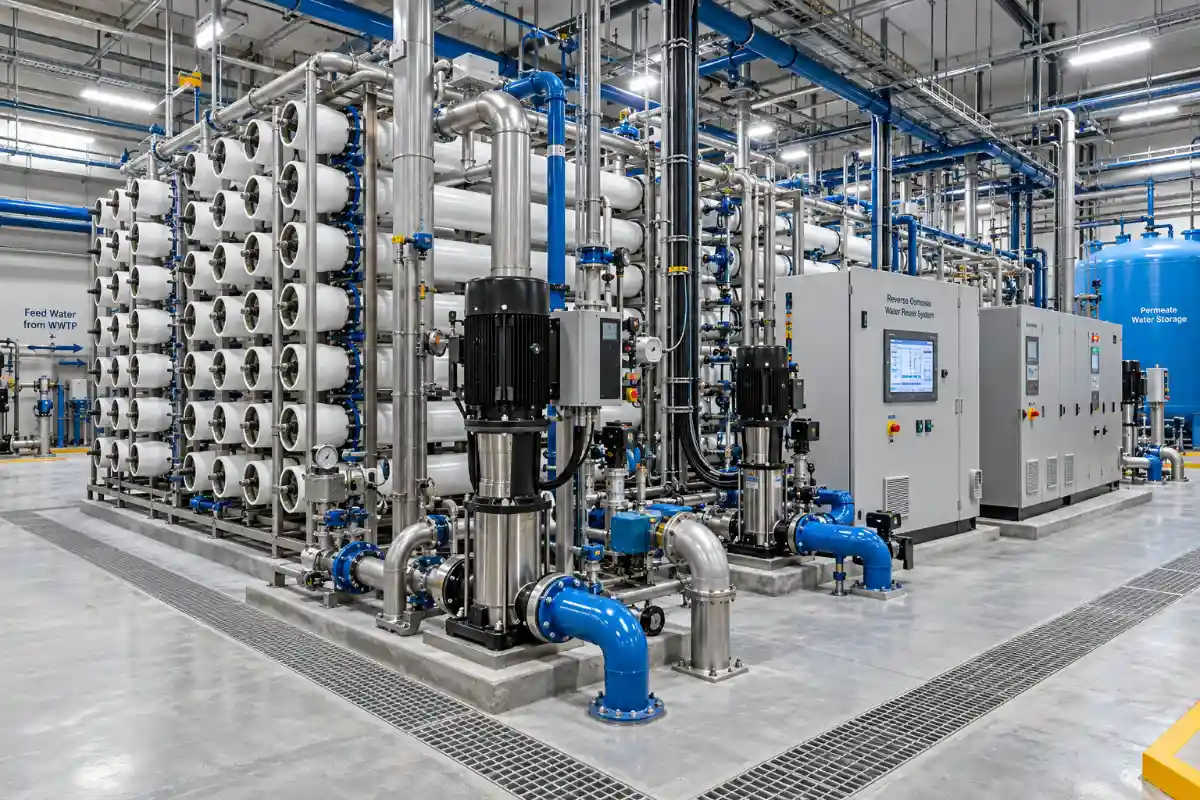
In practice, most custom industrial projects end up as a hybrid — for example, high-pressure RO or DTRO membrane systems to concentrate the stream, then a mechanical vapor compression MVC evaporator to finish the job. A manufacturer who only sells one technology will steer you toward it regardless of fit. That’s worth remembering during evaluation.
What a Credible Custom Manufacturer Actually Does
They run a real heat and mass balance
Ask for the balance. A serious supplier will show you evaporation rates, steam or power demand, condenser duty, and the concentration factor at each stage. If the proposal is a table of equipment with no thermal calculations, you’re buying a box, not a system.
They address scaling and fouling upfront
Scale is the number one killer of evaporator uptime. Good manufacturers propose specific countermeasures: seeded slurry operation, antiscalant dosing, forced circulation versus falling film, CIP sequences, and realistic cleaning intervals. Ask what cleaning frequency they’re assuming — and then ask what happens if it’s double that.
They talk about turndown and startup
Your plant won’t always run at design flow. A system that only works at 100% capacity is a liability. I want to see a turndown range, a startup sequence, and how the compressor or steam supply behaves at part load.
They give you a materials story
Duplex stainless, titanium, 316L, or exotic alloys — the choice should follow from chloride content, pH, and temperature, not from what’s on the shelf. Ask them to justify each wetted material against your specific chemistry.
Questions That Separate Real Suppliers From Resellers
I keep a short list of questions that reveal how much engineering depth sits behind the sales pitch:
- Who owns the process design — you, or a third party?
- Can I speak with a reference customer running a similar feed chemistry?
- What’s your guaranteed performance, and what are the penalty terms if you miss it?
- How do you handle the compressor, and what’s the expected overhaul interval?
- What spare parts do you recommend stocking, and what’s the lead time on each?
- Who commissions the plant, and do your engineers stay through performance testing?
- What happens to the concentrate or brine — do you help design that side too?
Vendors who dodge the reference question or can’t explain their own compressor sourcing usually can’t support you two years in, when it matters most.
Energy and Lifecycle Cost: Where the Real Money Is
Capital cost is the easy number to compare and the least useful one. Over a ten-year horizon, energy and maintenance typically dominate. When I evaluate bids, I build a simple model:
- Specific energy consumption — kWh or steam per cubic meter evaporated, at your actual operating concentration
- Antiscalant and chemical dosing — annualized, based on the vendor’s own dosing rates
- Cleaning downtime — lost throughput, not just labor and chemicals
- Compressor or boiler maintenance — including realistic overhaul intervals
- Consumables and spares — membranes, gaskets, heat exchanger tube replacements
A unit that costs 20% more upfront but runs at 60% of the energy demand often pays for itself in two to three years. This is where a manufacturer’s transparency about their own numbers tells you everything. If they can’t back up an efficiency claim with a calculation, treat it as marketing.
My rule of thumb: if a vendor’s energy claim can’t be reproduced from a heat and mass balance you can see, don’t put it in your budget.
For projects targeting discharge limits or reuse, the evaporator is usually one piece of a larger train. If you’re heading toward minimal or zero liquid discharge, it’s worth understanding how the evaporator integrates with upstream membrane concentration — see this overview of zero liquid discharge (ZLD) systems for how the stages typically stack.
Three Project Scenarios and What They Teach You
Electroplating rinse water
High chloride, high metal content, and aggressive corrosion. Material selection dominates here — titanium or duplex heat exchangers, careful attention to pH control, and often a membrane pre-concentration step to reduce thermal load. The custom part isn’t the evaporator; it’s the corrosion strategy.
Pharmaceutical wastewater
Variable composition, solvents, and sometimes stringent condensate quality requirements. Volatile organics can carry over into the distillate, so the manufacturer needs to think about stripping or post-treatment. This is a case where a generic evaporator design fails quietly.
Landfill leachate
Probably the hardest feed in the business — high hardness, high organics, high ammonia, and unpredictable chemistry as the landfill ages. Scaling is severe, and the design almost always needs seeded slurry or forced circulation plus robust pretreatment. A manufacturer without leachate experience will underestimate the fouling rate.
Red Flags in a Custom Proposal
After reviewing a lot of bids, these patterns almost always predict trouble:
- No water analysis requested before quoting
- Performance guarantees stated as ranges so wide they’re meaningless
- No cleaning frequency assumption
- Compressor or major component sourced from an unnamed third party
- No commissioning or performance test plan
- Spare parts list that looks copy-pasted from a different project
- No answer for what happens to the brine or concentrate
Any one of these can be worked through. Three or more, and I’d walk away.
How to Run a Fair Comparison
The cleanest way to compare custom manufacturers is to give every bidder the same feed data, the same target concentration, and the same utility assumptions. Then normalize their proposals into a single table:
| Comparison point | What to look for |
|---|---|
| Process design ownership | In-house, not subcontracted |
| Heat & mass balance | Provided and verifiable |
| Specific energy | Stated at your operating point |
| Turndown range | Realistic, with part-load behavior explained |
| Materials of construction | Justified against your chemistry |
| Cleaning & maintenance plan | Specific intervals and procedures |
| Commissioning support | On-site, with performance test criteria |
| References | Reachable, similar feed chemistry |
When the proposals are laid out this way, the choice usually becomes obvious — and it’s rarely the lowest bid.
If you want a second opinion on a feed profile or a proposal you’re reviewing, our engineers are happy to look at the numbers with you. Send us your water analysis and project parameters and we’ll tell you honestly whether an evaporator is the right answer.
Frequently Asked Questions
How do I know if my wastewater needs an evaporator at all?
Evaporation makes sense when you need high concentration factors, when membrane systems can’t handle the salinity or fouling potential, or when you’re targeting near-zero discharge. If your TDS is moderate and organics are low, membrane concentration may be cheaper. Run the comparison before committing.
What’s the difference between MVC and MVR, and does it matter for vendor selection?
They refer to the same core idea — using a compressor to recompress vapor and reuse its latent heat. Some vendors use the terms interchangeably. What matters is whether the manufacturer can explain compressor selection, surge control, and how the system behaves at part load.
How long should commissioning take on a custom evaporator?
It depends heavily on feed complexity and plant size. Simple systems may commission in days; leachate or high-fouling applications can take weeks of tuning. Be suspicious of any vendor who promises a fixed, very short commissioning window without knowing your water.
What causes most evaporator downtime?
Scaling and fouling, by a wide margin, followed by compressor issues and instrumentation problems. A good manufacturer designs for cleaning — easy access, proper CIP, and realistic cleaning intervals built into the operating plan.
How should I evaluate energy cost claims?
Ask for the heat and mass balance behind the number and check the assumptions: operating concentration, boiling point elevation, and part-load behavior. If the vendor can’t produce the calculation, treat the claim as unverified.
Do I need a single vendor for the whole train, or can I split membrane and thermal stages?
Both work. A single vendor simplifies interface responsibility, which matters when the membrane concentrate feeds directly into the evaporator. If you split, make sure someone owns the interface conditions — flow, temperature, and chemistry at the handoff point.
What spare parts should I stock from day one?
At minimum: compressor wear parts, heat exchanger gaskets, key instruments, pump seals, and dosing pump components. Ask the manufacturer for a criticality-ranked spares list, and check lead times — a six-month lead on a critical part is a risk you need to plan around.