

If you are comparing a double-effect evaporator against a triple-effect evaporator, the short answer is this: a triple-effect unit evaporates roughly 50% more water per unit of steam than a double-effect unit, but it costs more, takes up more space, and only pays off when your feed chemistry and steam supply justify the added stage. I have sized and commissioned both across chemical, pharmaceutical, and leachate duty, and the decision almost never comes down to efficiency alone. It comes down to steam cost, scaling behavior, turndown, and how much the plant can actually operate the extra stage without fouling it.
This article walks through how each configuration actually behaves in service, where the numbers come from, and how I decide between them on real projects.
How Multi-Effect Evaporation Actually Works
The core idea is simple and old: you reuse the vapor you already paid to make. In a single-effect evaporator, one kilogram of steam boils off roughly one kilogram of water, then that vapor goes to the condenser and its heat is thrown away. That is a steam economy of about 1.0.
In a multiple-effect arrangement, the vapor boiled off in the first effect becomes the heating medium for the second effect. Because the second effect runs at a lower pressure, its boiling point is lower, so the vapor from effect one is still hot enough to boil the liquid in effect two. Each additional effect adds another kilogram of evaporation from the same original kilogram of steam.
That gives the rule of thumb engineers carry in their heads:
- Single-effect: steam economy around 0.9 to 1.0 kg evaporated per kg steam
- Double-effect: roughly 1.7 to 1.9 kg per kg steam
- Triple-effect: roughly 2.5 to 2.8 kg per kg steam
These are typical design ranges, not guarantees. Actual performance depends on boiling point elevation, feed temperature, fouling, and whether you are running forward feed, backward feed, or mixed feed. If your feed is cold and you use forward feed, a chunk of the first effect’s heat goes into simply warming the liquid, which drags the real economy below the textbook figure.
In my experience, the gap between nameplate economy and measured economy is usually 8 to 15 percent, and it almost always traces back to feed temperature and venting losses rather than the number of effects.
Double-Effect Evaporators: Where They Fit
A double-effect system is the workhorse of mid-sized industrial wastewater concentration. It gives you a meaningful jump in steam economy over a single effect without the capital and footprint of a third stage. For plants that already have a boiler and pay real money for steam, the payback on going from one effect to two is usually the easiest justification in the whole project.
Typical applications I have seen work well:
- Moderate flow concentration where feed is 5 to 15 m³/h
- Streams with moderate scaling tendency where a third stage would foul faster than it saves
- Retrofit projects where the existing building or skid footprint is fixed
- Plants with intermittent operation, where a two-stage system is easier to start, stop, and clean
The double-effect design also tends to be more forgiving on turndown. When your flow drops to 40 or 50 percent of design, a two-stage system usually keeps both effects stable. A three-stage system at the same turndown can starve the last effect, and you end up venting or bypassing, which quietly erases the efficiency advantage you paid for.
For a closer look at how the two-stage configuration is built and controlled, the double-effect evaporator page covers the arrangement and heat balance in more detail.
Triple-Effect Evaporators: When the Extra Stage Pays
A triple-effect system adds a third boiling stage and a third heat exchanger, plus the interstage piping, pumps, and instrumentation that go with it. You get roughly another 0.8 kg of evaporation per kg of steam compared with a double-effect unit. Whether that is worth it depends entirely on how many hours a year you run and what steam costs you.
The triple-effect configuration earns its place when:
- Steam is expensive or internally metered against a production budget
- The plant runs continuously, 6,000 hours a year or more
- Feed chemistry is stable and scaling is manageable with antiscalant or periodic wash
- Flow is high enough — typically above 10 to 15 m³/h — that the third stage stays loaded
- Site has room for the taller or longer train and the added structural load
I have also used triple-effect designs as the front end of a zero liquid discharge train, where the evaporator concentrates brine before a crystallizer. In that duty, the steam savings compound because the crystallizer downstream is also steam-hungry, and shaving load off the evaporator reduces the whole plant’s thermal demand. If that is your configuration, the triple-effect evaporator overview is a reasonable starting point.
Direct Comparison: Double-Effect vs Triple-Effect
The table below reflects typical design ranges I use for early-stage sizing. Treat these as indicative, not as vendor guarantees. Real numbers move with boiling point elevation, feed temperature, and how aggressively you recover condensate heat.
| Parameter | Double-Effect | Triple-Effect |
|---|---|---|
| Steam economy (kg evaporated / kg steam) | 1.7 – 1.9 | 2.5 – 2.8 |
| Typical steam consumption vs single-effect | ~50–55% | ~35–40% |
| Capital cost (relative) | 1.0 (baseline) | 1.3 – 1.5 |
| Footprint / height | Moderate | Larger, often taller |
| Cooling water / condenser load | Higher | Lower |
| Turndown flexibility | Better | More limited |
| Cleaning frequency (scaling feeds) | Lower | Higher |
| Best fit | Mid flow, intermittent, moderate scaling | High flow, continuous, stable chemistry |
Notice the pattern: the triple-effect wins on operating cost and loses on capital, footprint, and operational complexity. The engineering question is whether the annual steam savings clear the added capital and the added maintenance burden within your payback threshold.
The Economics: When Does the Third Effect Pay Back?
I run this calculation early because it kills a lot of bad specifications. Here is the logic I use, with a simple worked example.
Assume a plant evaporating 8,000 kg/h of water, running 7,000 hours a year, with steam costing USD 25 per tonne.
- Double-effect at economy 1.8: steam demand ≈ 4,444 kg/h
- Triple-effect at economy 2.6: steam demand ≈ 3,077 kg/h
- Steam saved ≈ 1,367 kg/h, or about 9,570 tonnes per year
- Annual saving at USD 25/t ≈ USD 239,000
If the triple-effect train costs USD 400,000 to 600,000 more than the double-effect equivalent, simple payback lands somewhere between 1.7 and 2.5 years. That is usually an easy approval.
Now change one variable. Drop the operating hours to 3,000 per year because the plant only runs one shift. The annual saving falls to roughly USD 102,000, and payback stretches past five years. At that point, I stop recommending the third effect. The capital is better spent on heat recovery on the double-effect unit or on a mechanical vapor recompression design, depending on electricity versus steam pricing.
This is the part that gets lost in generic comparisons. Efficiency percentages are meaningless without hours of operation and utility pricing behind them. For a deeper look at how energy and capital trade off in evaporator selection, see the discussion on evaporator cost drivers.
Feed Chemistry and Fouling: The Hidden Deciding Factor
Steam economy is the headline number, but fouling is what actually determines whether a triple-effect system performs as designed six months after startup. Each additional effect adds a heat transfer surface that can scale, and the last effect runs at the lowest temperature, which is often where salt solubility is worst.
Things I check before committing to three stages:
- Solubility curve of the dominant salt across the full concentration range
- Whether the final effect will operate near saturation for any species
- Presence of calcium, silica, or organics that form hard deposits
- Whether the plant can commit to a regular clean-in-place schedule
- Boiling point elevation, which reduces the effective temperature difference and can make the last effect marginal
A triple-effect system on a scaling feed is not more efficient in practice. It is more expensive to clean. I have seen plants quietly run a triple-effect train as a two-stage system for most of the year because the third effect fouled too fast, which means they paid triple-effect capital for double-effect performance. That is a hard conversation to have with a finance team.
For high-scaling or high-organic feeds, a membrane preconcentration step before the evaporator often makes more sense than adding a thermal stage. DTRO membrane systems can pull a large fraction of the water out at far lower energy cost, letting the evaporator handle a much smaller, more concentrated stream. That combination frequently beats a bigger evaporator on both capital and operating cost.
Operational Stability and Control
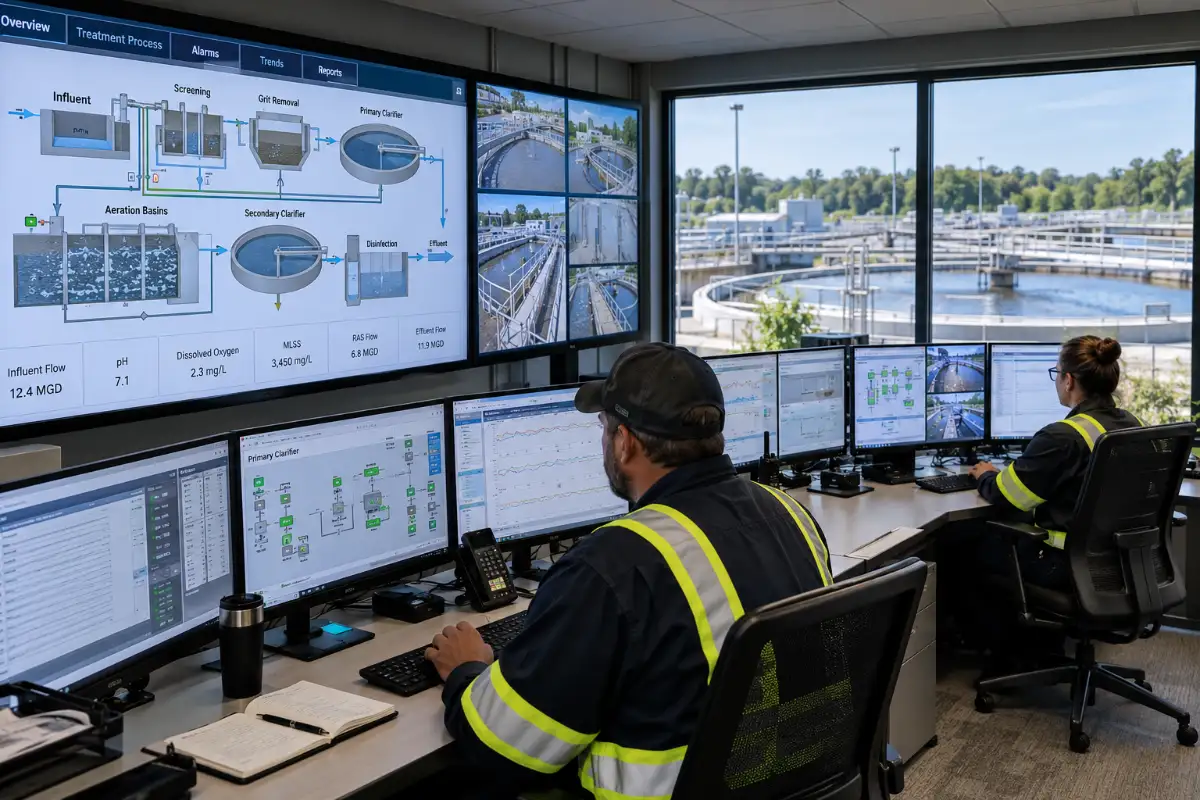
Multi-effect systems live or die on stable pressure and level control. Each effect sits at a different pressure, and the whole train is coupled. A disturbance in one effect propagates. This matters more as you add stages.
On a double-effect unit, the control scheme is relatively forgiving. Two pressure loops, two level loops, and a feed flow controller will usually hold the train steady through normal upsets.
On a triple-effect unit, I insist on tighter instrumentation and better feed conditioning. The third effect is sensitive to any drop in the temperature difference across its heat exchanger. If the first effect underperforms because of fouling, the third effect loses driving force and the whole train derates. Operators need to watch interstage temperatures, not just the final product concentration.
Practical points I build into the design:
- Independent condensate drainage per effect to avoid vapor locking
- Non-condensable venting at each stage, since accumulated air kills heat transfer
- Feed preheating using condensate and condensate flash to stabilize the first effect
- Redundant level instrumentation on the final effect, which is the easiest to upset
If you want to understand how the heat exchangers themselves are specified and how surface area is allocated across stages, the note on evaporator heat exchangers is useful background even though it is written around MVC systems.
Maintenance and Cleaning Reality
Maintenance load scales roughly with the number of effects. More stages mean more pumps, more valves, more instrumentation, and more heat transfer area to clean. On a clean feed, this is manageable. On a dirty feed, it is the dominant cost.
What I tell clients during selection:
- Budget for at least one full chemical clean per year on a double-effect unit for moderate feeds, and expect more frequent cleaning on a triple-effect unit with the same feed.
- Keep spare heat exchanger gaskets and pump seals on site. Multi-effect trains are hard to run partially.
- Train operators on interstage temperature trending. A slow drift is the earliest fouling signal, well before product quality changes.
- Design for isolation of individual effects so you can clean one stage without a full shutdown where possible.
The maintenance penalty is real, and it belongs in the lifecycle cost comparison alongside the steam savings. A triple-effect unit that saves USD 200,000 a year in steam but adds USD 60,000 a year in cleaning, downtime, and parts is still a good investment, but the margin is thinner than the efficiency table suggests.
How I Decide: A Practical Selection Framework
When a client asks me to pick between two and three effects, I work through this sequence:
- Establish the duty. Flow, feed concentration, target concentration, and hours per year. No selection without these.
- Check the chemistry. Scaling tendency, boiling point elevation, and the solubility of the final brine. If the last effect will run near saturation, the third stage is risky.
- Run the steam economics. Compare annual steam cost at 1.8 versus 2.6 economy using actual utility prices.
- Add lifecycle costs. Capital delta, cleaning frequency, spare parts, and the operational complexity of a third stage.
- Test the turndown. If the plant will run below 60 percent of design flow for long periods, favor the double-effect.
- Consider alternatives. If the payback on the third effect is weak, check whether mechanical vapor recompression or membrane preconcentration gives a better result.
In practice, I end up specifying double-effect systems for the majority of mid-sized industrial wastewater projects, and triple-effect systems for large, continuous, thermally stable duties where steam is a real line item. The split is not close. Most plants do not run enough hours at high enough flow to justify the third stage, and the ones that do usually know it already because their steam bill is visible on the monthly report.
Where Evaporation Fits in the Broader Treatment Train
It is worth stepping back. Evaporation is a concentration and volume-reduction tool, not a standalone treatment process. In most industrial wastewater projects, the evaporator sits at the back end, after pretreatment has removed the components that would foul or corrode it.
A typical train for a challenging industrial stream looks like this:
- Equalization and pH adjustment
- Chemical pretreatment or precipitation for heavy metals and hardness
- Membrane concentration, often high-pressure RO or DTRO, to reduce the volume reaching the evaporator
- Evaporation to concentrate the residual brine
- Crystallization or solidification for zero liquid discharge where required
Getting the front end right is what makes the evaporator selection straightforward. If you push a clean, preconcentrated feed to the evaporator, a double-effect unit often performs better than a triple-effect unit on a poorly pretreated feed, at lower total cost. The number of effects is the last decision, not the first.
For projects targeting zero liquid discharge, the evaporator is one module in a larger system. The ZLD system design overview explains how the thermal and membrane stages are balanced against each other.
Regulatory and Discharge Context
Selection also depends on what you are allowed to discharge. Where liquid discharge is restricted, evaporation becomes a compliance tool rather than just a cost-reduction measure, and the economics change because you are comparing against the cost of non-compliance or trucking, not just steam.
Regulators in most jurisdictions publish effluent limits and pretreatment standards that drive the required concentration and the acceptable quality of condensate. In the United States, the EPA effluent guidelines are the reference point for industrial categories, and the World Bank water resources program publishes broader guidance used on international projects. I always check the applicable limits before finalizing concentration targets, because the required brine concentration directly affects which effect count is viable.
One practical note: condensate quality from a multi-effect evaporator is usually good enough for reuse as cooling tower makeup or wash water, but not always. Volatile organics and ammonia can carry over. If condensate reuse is part of the value case, verify carryover behavior during piloting rather than assuming it.
Common Mistakes I See in Selection
After enough projects, the same errors show up:
- Choosing effects by efficiency alone. The third effect is only worth it if the hours and utility cost support it.
- Ignoring boiling point elevation. High BPE eats the temperature difference and can make the last effect useless.
- Underestimating fouling. A scaling feed turns a triple-effect system into an expensive two-stage system.
- Forgetting turndown. Plants rarely run at design flow all year, and multi-effect trains dislike low load.
- Skipping the front end. Pretreatment and preconcentration usually matter more to total cost than the effect count.
Each of these has cost real money on real projects. The fix is almost always the same: do the chemistry and the operating profile first, then let the effect count fall out of the analysis.
Frequently Asked Questions
How much steam does a triple-effect evaporator save compared with a double-effect unit?
On a typical design, a triple-effect unit evaporates about 2.5 to 2.8 kg of water per kg of steam, against roughly 1.7 to 1.9 for a double-effect unit. That is a steam reduction in the range of 30 to 35 percent. The actual figure depends on feed temperature, boiling point elevation, and how well the train is vented and controlled. Cold feed and poor venting both pull the real number below the design value.
Is a triple-effect evaporator always more economical than a double-effect one?
No. The steam savings only justify the extra capital when the plant runs enough hours at high enough flow. Below roughly 4,000 to 5,000 operating hours a year, or at low flow, the payback on the third effect often stretches past five years. At that point, a double-effect unit with heat recovery, or a mechanical vapor recompression design, usually gives a better return.
What causes a triple-effect evaporator to underperform in service?
The most common causes are fouling on the later effects, non-condensable gas accumulation, and low turndown. The final effect runs at the lowest temperature and often near salt saturation, so it scales fastest. Air leaking into any stage reduces heat transfer and forces the train to run hotter to hit target concentration. When flow drops well below design, the last effect loses driving force and the efficiency advantage disappears.
How often do multi-effect evaporators need cleaning?
On a clean, well-pretreated feed, one chemical clean per year is often enough for a double-effect unit. On scaling or organic-rich feeds, expect cleaning every two to four months, and more frequently on the later effects of a triple-effect train. The right answer comes from tracking interstage temperature difference — a steady decline is the signal, and it usually appears before product quality changes.
Can a double-effect evaporator be upgraded to triple-effect later?
Sometimes, but it is rarely clean. Adding a third effect means a new heat exchanger, vessel, pump, piping, and revised control logic, plus structural and footprint checks. If there is a realistic chance the plant will need the third stage within a few years, it is usually cheaper to design the original train with space and connections for the future stage than to retrofit it later. I have seen both, and the pre-planned version is always less painful.
When should I choose membrane concentration instead of more evaporation stages?
When the stream is high in scaling species or organics and the evaporator would foul quickly, or when electricity is cheap relative to steam. Membrane preconcentration, including high-pressure RO and DTRO, removes a large share of the water at lower energy cost and shrinks the stream the evaporator has to handle. In many industrial projects, the best configuration is a membrane stage followed by a smaller double-effect evaporator, not a larger thermal train.
Not sure whether two effects or three is right for your stream?
Send us your flow rate, feed analysis, and operating hours. We will run the steam and lifecycle comparison and tell you which configuration actually pays back for your plant.
Final Thoughts
Double-effect and triple-effect evaporators are not competing products so much as two points on a continuum. The double-effect unit is the reliable, flexible, lower-capital choice that fits most mid-sized industrial wastewater duties. The triple-effect unit is the higher-efficiency, higher-commitment choice that rewards continuous operation, stable chemistry, and expensive steam.
Pick based on your operating hours, your steam price, and your feed chemistry — in that order. If the numbers say the third effect pays back inside your threshold and the feed will not foul it into early retirement, take the efficiency. If either of those conditions fails, the double-effect system will serve you better, and you can spend the difference on pretreatment that makes the whole train work harder.