

Heavy metal wastewater treatment equipment is not a single machine you buy off a shelf. It is a treatment train — usually a combination of chemical precipitation, membrane separation, evaporation, and sludge handling — that you size around one specific waste stream. The right configuration depends on metal species, concentration, pH, competing ions, flow variability, and where your discharge limits sit. Get that train right and you get stable effluent, manageable sludge, and predictable operating cost. Get it wrong and you inherit a system that passes commissioning and fails six months later. In this article I’ll walk through how these systems are actually designed, selected, and operated, based on the lessons that tend to repeat across industrial projects.
What Makes Heavy Metal Wastewater Different
Heavy metal wastewater is not biodegradable. You cannot aerate it, digest it, or wait for bacteria to consume the problem. Copper, nickel, chromium, zinc, lead, cadmium, and mercury have to be physically removed or chemically converted into a separable solid. That single fact drives every design decision downstream.
The second defining trait is variability. A plating line that switches from nickel to chrome to zinc within a single shift produces a waste stream that changes character several times a day. A battery manufacturing plant may discharge a fairly steady stream but with high fluoride and sulfate competing for the same treatment chemicals. A mine drainage stream can swing from pH 3 to pH 8 after a rain event.
Three parameters matter more than anything else during the initial survey:
- Metal speciation — free ionic metal behaves very differently from metal bound in a complex with EDTA, citrate, ammonia, or cyanide. Complexed metals often resist simple hydroxide precipitation entirely.
- Concentration range — 20 mg/L and 20,000 mg/L are different treatment problems with different equipment.
- Co-existing contaminants — oil, suspended solids, chelating agents, high TDS, and organics all interfere with removal efficiency.
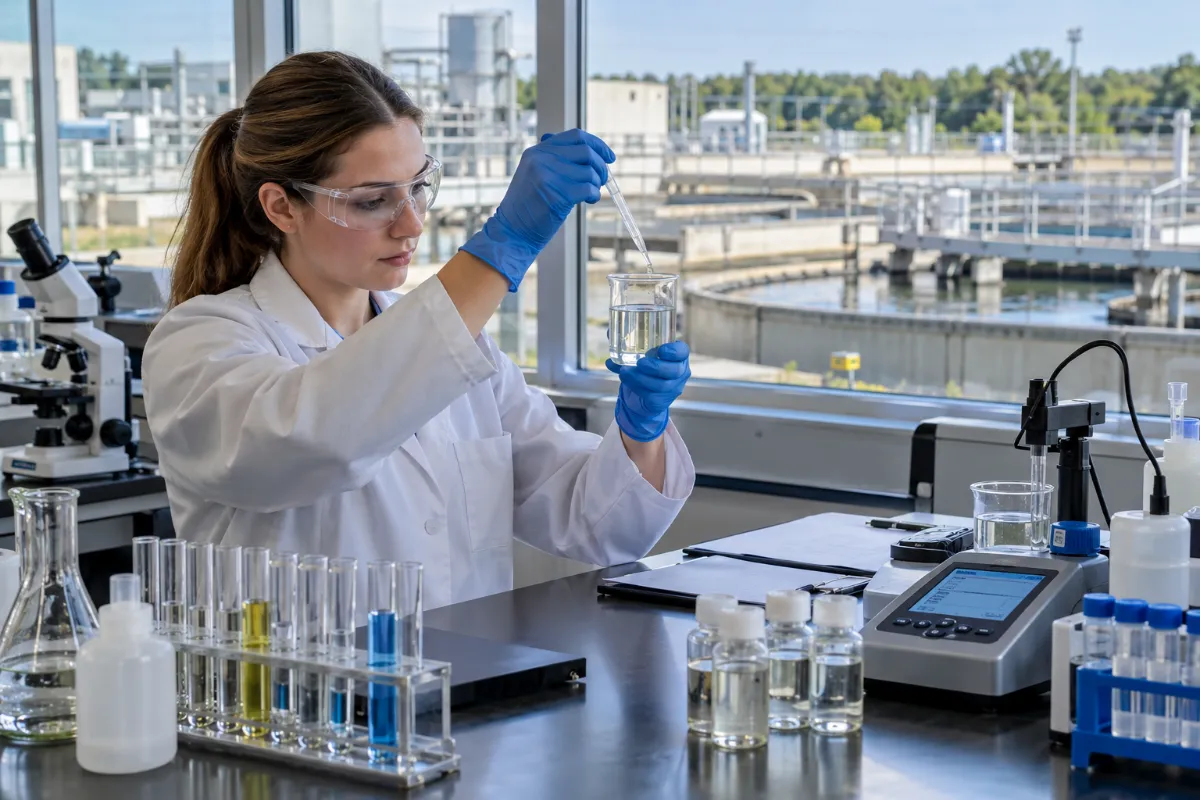
If you skip a proper waste characterization and design from a datasheet instead of from your actual water, you will spend the next two years chasing it. I have seen this happen more times than I care to count.
The Core Treatment Building Blocks
Almost every heavy metal treatment train uses two or three of the following stages. The order and combination depend on the waste.
Chemical Precipitation and Coagulation
Hydroxide precipitation is the workhorse. You raise pH with lime, caustic, or magnesium hydroxide, the metals drop out as hydroxides, and you flocculate and settle or float the solids. It is cheap, well understood, and effective for most free metal ions. Its limits are real, though: some metals (nickel, cadmium) need high pH to precipitate well, other metals (zinc, lead) start re-dissolving at very high pH, and complexed metals may not precipitate at all.
Sulfide precipitation handles what hydroxide cannot. Metal sulfides are extremely insoluble, so you can push residual concentrations down to very low levels and you can operate at lower pH. The trade-off is reagent cost, odor control, and the risk of residual sulfide in the effluent.
Membrane Separation
Once you are past precipitation, membranes handle the polishing and volume reduction. Reverse osmosis concentrates dissolved metals into a small reject stream and produces permeate clean enough for reuse in many plants. For high-salinity or high-fouling streams, DTRO membrane systems tolerate much higher suspended solids and scaling potential than conventional spiral-wound RO, which matters when upstream clarification is imperfect.
Where you need to push recovery further, high-pressure RO membranes can concentrate brine beyond what standard RO can handle, extending the range where membrane treatment remains economical before you have to evaporate.
Evaporation and Crystallization
When the reject stream is small but highly concentrated, evaporation closes the loop. A mechanical vapor compression MVC evaporator recompresses the vapor it produces and reuses that heat in the same heat exchanger, which cuts energy consumption dramatically compared to a simple boiling system. For larger flows where steam is available, a multi-effect evaporator uses the vapor from one effect to heat the next, multiplying the water removed per unit of steam.
For projects targeting zero liquid discharge, evaporation is usually the final concentration step, followed by a crystallizer or a spray dryer that turns the residual brine into a solid you can landfill or, in some cases, recover.
Selecting the Right Configuration
Selection is not about picking the most advanced technology. It is about matching the treatment train to your actual constraints: discharge limits, flow rate, metal mix, available utilities, plot space, and operator skill.
The table below reflects how I usually frame the decision when I’m sitting with a client in the early design phase. The numbers are typical design ranges, not guarantees — your project will land somewhere specific based on your water.
| Stream Type | Typical Metal Load | Recommended Train | Key Constraint |
|---|---|---|---|
| Electroplating rinse water | 10–200 mg/L | Precipitation + clarification + polishing RO | Complexing agents (cyanide, EDTA) |
| Battery / new energy manufacturing | 50–500 mg/L (Ni, Co, Mn) | Precipitation + UF + RO + evaporation | High sulfate, fluoride, and TDS |
| Metal finishing with mixed metals | 20–300 mg/L | Sulfide precipitation + membrane polishing | Chromium reduction step required first |
| Acid mine drainage | 100–2,000 mg/L | Lime neutralization + settling + sludge dewatering | Sludge volume and disposal cost |
| Concentrated spent bath / reject brine | 1,000–50,000 mg/L | Evaporation (MVC or multi-effect) + crystallization | Energy cost, scaling, materials of construction |
Notice that the concentrated streams almost always end up at evaporation. That is not because evaporation is elegant — it is because at some point the dissolved solids load makes membrane treatment impractical, and you need a thermal step to finish the job.
Sludge Handling: The Part Everyone Underestimates
Precipitation produces sludge, and sludge is where operating cost quietly accumulates. A plant that treats 500 m³/day of metal-bearing wastewater might generate a few hundred kilograms of dry solids per day, but that sludge leaves the clarifier at 1–3% solids. You are paying to move water, not metal.
Thickening and dewatering are not optional. A screw press sludge dewatering system is a common choice for metal hydroxide sludge because it handles the abrasive, fine, gelatinous solids better than a belt press and requires less operator attention. Cake dryness in the 20–35% range is typical for hydroxide sludge, though it varies with the metal mix and the conditioning chemicals used.
Two practical rules I follow:
- Dewater as soon as the sludge is stable. Holding dilute sludge in a tank for weeks changes its dewatering behavior for the worse.
- Characterize the sludge for hazardous waste classification before you design the disposal route. Metal hydroxide sludge is often regulated, and the disposal cost can exceed the treatment cost.
Energy, Chemicals, and Lifecycle Cost
Capital cost is a one-time number. Operating cost is what determines whether the system survives budget reviews year after year. For heavy metal treatment, the main operating cost drivers are:
- Reagent consumption — lime, caustic, sulfide, polymer, and acid for pH adjustment. Complexed metals drive reagent use up sharply.
- Sludge disposal — often the single largest recurring cost after the first year.
- Membrane replacement — RO and DTRO elements have finite life; fouling and chemical cleaning shorten it.
- Evaporation energy — for thermal stages, energy per cubic meter of distillate is the number that matters.
Evaporation is where the energy conversation gets serious. An MVC evaporator typically consumes on the order of 15–40 kWh per cubic meter of distillate, depending on boiling point elevation and compressor efficiency. A multi-effect system with available waste steam can be competitive on a per-cubic-meter basis, but only if the steam is genuinely cheap or already available. If you are generating steam just for the evaporator, the economics usually favor MVC or MVR.
I generally recommend running the lifecycle comparison over at least ten years, with realistic assumptions about membrane life, chemical price volatility, and disposal cost escalation. The cheapest capital option is rarely the cheapest total cost.
Operating Pitfalls I See Repeatedly
Most failures in heavy metal treatment are not exotic. They are the same few mistakes, repeated.
Insufficient pH control
Metal hydroxide precipitation is pH-sensitive in both directions. If your pH drifts low, metals stay dissolved. If it drifts high, amphoteric metals like zinc and lead re-dissolve. Automated pH control with redundant probes and a proper mixing regime is not a luxury.
Ignoring complexed metals
If your waste contains cyanide, ammonia, or chelating agents, standard hydroxide precipitation will underperform and you will blame the equipment. The fix is upstream: cyanide destruction, complex breaking, or a switch to sulfide precipitation.
Undersized equalization
Batch discharges from plating lines create shock loads that overwhelm a treatment system sized for average flow. Equalization tanks smooth this out. Size them for peak load, not average.
Membrane fouling from poor pretreatment
RO membranes are not filters. If suspended solids or organics reach them, they foul, and cleaning cycles become a full-time job. Invest in the pretreatment and the membranes will last their expected life.
Scaling in evaporators
Metal brines scale aggressively. Heat exchanger surfaces need to be designed for cleaning, and antiscalant or seed crystallization may be necessary. A properly designed heat exchanger for MVC service is the difference between a system that runs for months between cleanings and one that runs for days.
In my experience, more than half of the operating problems in heavy metal treatment trace back to the waste characterization stage, not the equipment itself. If you get the water right, the equipment usually behaves.
Where Evaporation Fits in the Modern Treatment Train
Ten years ago, evaporation was seen as a last resort — expensive, energy-hungry, and only for the toughest streams. That has changed. Tighter discharge limits, rising disposal costs, and the push for water reuse have moved evaporation into the mainstream, especially for concentrated reject streams.
Two configurations dominate:
- MVC / MVR — mechanical vapor recompression. Best for medium flows with moderate scaling potential. Lower energy consumption than thermal-only systems and no steam supply required.
- Multi-effect evaporation — best where steam is available and flows are large. Higher capital, but efficient when the energy source is already on site.
For oily or high-organic streams, an evaporation system designed for oily wastewater handles the fouling and foaming issues that a standard evaporator cannot. For most heavy metal projects, though, the stream reaching the evaporator is relatively clean brine, and the design challenge is scaling rather than organics.
If you want to go deeper into how these systems compare at the equipment level, the MVR technology overview is a reasonable starting point for understanding where each configuration fits.
Design Data You Should Collect Before You Talk to Anyone
When I get a project brief that is missing the following information, I know the design will be iterative and slow. Collect it up front and you will save months.
- Full metal analysis, including speciation where possible
- pH, alkalinity, hardness, TDS, and conductivity ranges
- Flow rate — average, peak, and variability pattern
- Presence of cyanide, ammonia, chelating agents, oil, and organics
- Discharge limits or reuse targets, including any specific metal limits
- Available utilities — power, steam, cooling water, compressed air
- Plot space and elevation constraints
- Sludge disposal route and cost
- Operator availability and skill level
- Any future expansion plans
That list is not glamorous, but it is the difference between a system that works and a system that gets rebuilt.
Working on a heavy metal project and need a second opinion on the treatment train? I’m happy to review your water analysis and talk through the options — no obligation.
Maintenance: What Actually Keeps These Systems Running
Heavy metal treatment systems are not maintenance-free. They are, however, predictable. The plants that run well are the ones that follow a disciplined routine.
Daily: pH probe verification, chemical dosing rates, clarifier sludge blanket level, membrane pressure differentials.
Weekly: Jar testing to confirm coagulant and polymer doses are still optimal, visual inspection of sludge dewatering performance, review of effluent quality trends.
Monthly: Membrane cleaning where required, calibration of all instrumentation, inspection of pumps and valves for wear.
Annually: Heat exchanger inspection and cleaning, compressor service on MVC systems, membrane element evaluation and replacement planning.
The single most valuable habit is trend monitoring. If you track effluent metal concentrations and membrane differential pressures over time, you will see problems developing weeks before they become failures. If you only look at the numbers when something breaks, you will always be reacting.
Frequently Asked Questions
What is the most common heavy metal wastewater treatment method?
Hydroxide precipitation followed by clarification or filtration is the most widely used method, mainly because it is simple, well understood, and cost-effective for free metal ions. It is often combined with membrane polishing or evaporation when discharge limits are tight or when the waste contains complexed metals.
Can heavy metals be removed without generating sludge?
Not entirely. Any precipitation-based process produces sludge. Membrane and evaporation processes concentrate metals into a smaller reject stream, but that reject still needs final disposal or recovery. The goal is to minimize sludge volume, not eliminate it.
When should I choose evaporation over membrane treatment?
Evaporation becomes the better choice when dissolved solids are too high for membranes, when the reject stream is small in volume but highly concentrated, or when you need to achieve zero liquid discharge. For dilute streams, membranes are almost always more economical.
How much does a heavy metal wastewater treatment system cost?
Capital cost varies widely with flow rate, metal load, discharge requirements, and whether evaporation is included. A simple precipitation and clarification system for a few cubic meters per hour costs far less than a full zero liquid discharge train. Operating cost is usually dominated by chemicals, sludge disposal, and — where applicable — evaporation energy.
Why does my system pass commissioning but fail later?
The most common reasons are underestimated waste variability, complexed metals that were not present during commissioning, membrane fouling from inadequate pretreatment, and pH control drift. A thorough waste characterization before design prevents most of these.
How do I handle sludge from heavy metal treatment?
Thicken and dewater the sludge as soon as it is stable, then characterize it for hazardous waste classification. Dewatered cake is typically 20–35% solids for hydroxide sludge. Disposal route and cost depend on local regulations and the specific metals present.
Is zero liquid discharge realistic for a mid-sized plant?
Yes, but it requires a clear-eyed look at energy cost and complexity. ZLD is most practical when the concentrated stream is small, when water reuse has real value, or when discharge is not permitted at all. For large dilute streams, the energy demand can be prohibitive.
What maintenance tasks are most often neglected?
pH probe calibration and membrane cleaning frequency are the two most commonly skipped tasks. Both lead to gradual performance loss that is easy to miss until effluent quality fails. Trend monitoring catches both early.
Heavy metal wastewater treatment equipment works when it is designed around the actual water, not around a generic specification. The engineering is not exotic — precipitation, membranes, evaporation, and sludge handling are all mature technologies. What separates a system that runs for fifteen years from one that gets rebuilt in three is the quality of the waste characterization, the honesty of the design assumptions, and the discipline of the operating routine. Get those three right and the equipment will do its job.